Soku AI
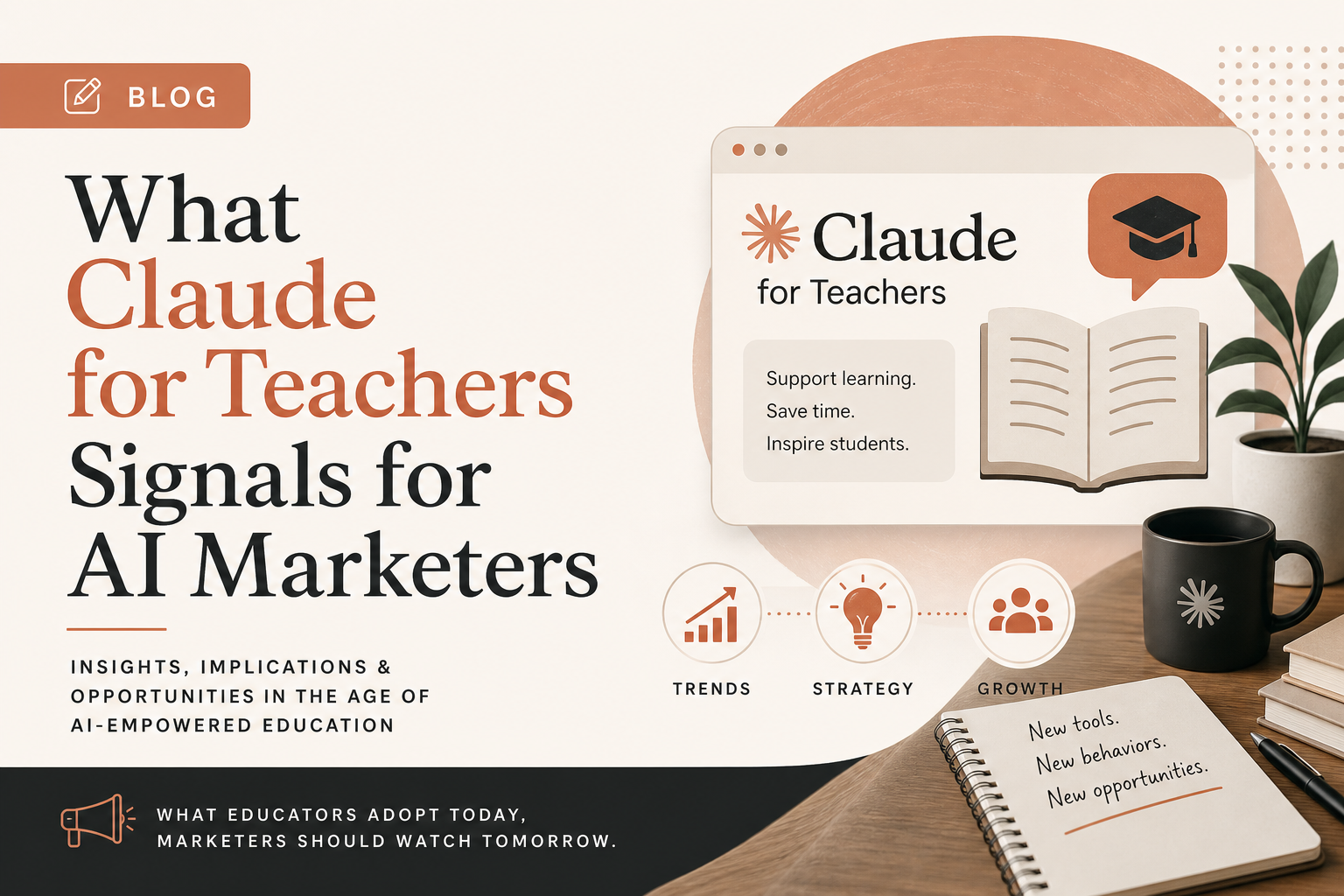
On July 14, 2026, Anthropic launched Claude for Teachers, free premium access for verified US K-12 educators through June 30, 2027. It ships with a teaching skills library, curricula mapped to academic standards in all 50 states, FERPA-aligned data terms, and agentic tasks that carry work forward on their own — like reviewing daily exit tickets at 4pm and adapting the next day's lesson.
If you run ads, none of that is for you. But the shape of it is. This is the clearest public example yet of Anthropic packaging Claude not as one open-ended chatbot, but as a role-scoped product: a bounded job, domain guardrails, hard data boundaries, and autonomy that's gated to what the role is allowed to touch. That packaging decision — not the classroom use case — is the signal AI marketers should read. It's the same operating model agentic AI is converging on for ad operations, and it tells you how to prepare.
The real news isn't education. It's the packaging.
Notice what Anthropic did not ship. It didn't tell teachers "here's Claude, prompt it." It built a version where the skills were co-developed with Learning Commons and evaluated for "rigor, pedagogical alignment, and classroom usability," where student data sits behind a K-12 Data Processing Addendum and is never used for training, and where the American Federation of Teachers signed off on the privacy standards — its president calling the tool "designed by and for educators."
Strip the education vocabulary and you're left with a template: take a general model, scope it to a role, wire in the domain's real workflows, fence off the sensitive data, and let it act only inside those fences. That template is provider-agnostic and industry-agnostic. Education got it first because the stakes (children, FERPA, public trust) forced the discipline early. Ad operations has the same three ingredients — real money, sensitive customer data, and brand risk — so it gets the same template next.
Why marketers should read a K-12 launch as a roadmap
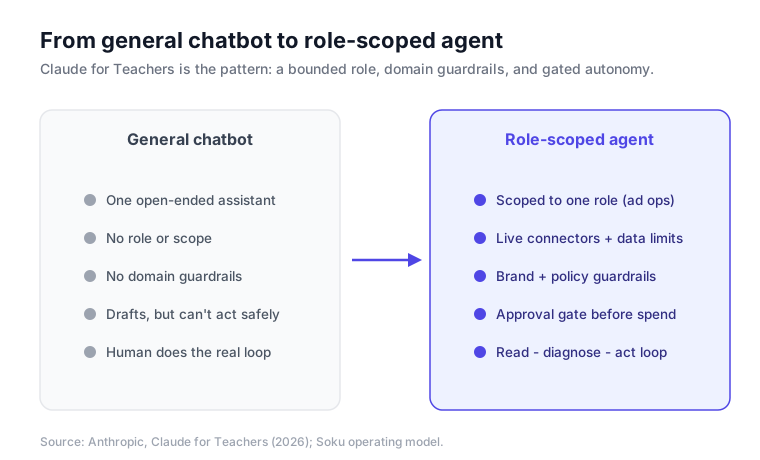
The instinct across ad teams for two years has been to treat AI as a smarter chatbot: paste in a brief, get copy back, paste in a screenshot, get a "diagnosis." That's the left side of the diagram — an assistant that drafts but can't safely act, so a human still does the real loop of pulling numbers, deciding, executing in Ads Manager, and remembering what changed.
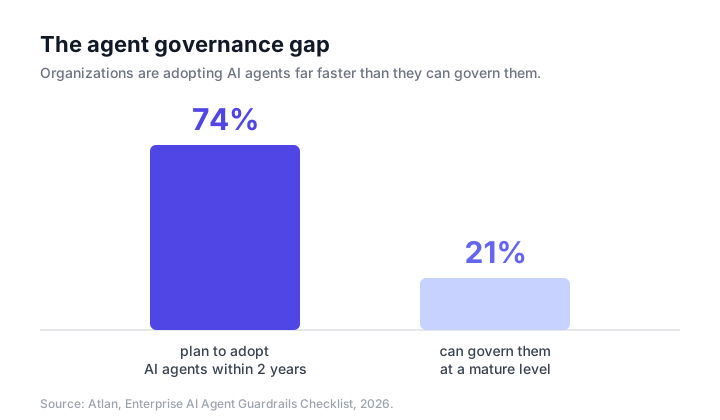
The direction Anthropic just demonstrated is the right side. And the market is already being pushed there by governance, not just capability. In enterprise surveys, 74% of organizations plan to adopt AI agents within two years, but only 21% can govern them at a mature level — many can't even stop a rogue agent mid-task. With EU AI Act obligations for high-risk systems landing in August 2026, "let the model act" without scoping, approval gates, and an audit trail stops being a product choice and becomes a liability.
For a fuller picture of what actually separates an agent from automation — and the adoption data behind it — see our pillar on AI marketing agents in 2026. The short version: a real agent reasons toward a goal inside constraints. A chatbot answers a prompt. Claude for Teachers is a productized agent. Your ad stack should be too.
Translating the four signals into ad operations
Every design choice in the teacher product has a direct analog for a paid-media team. This is where we can speak first-hand: Soku is an ad-automation agent, and we already build to exactly these four patterns.
Role-scoped agents. The teacher version isn't "all of Claude" — it's Claude bounded to a teaching role with teaching skills. The ad analog is an agent scoped to ad operations, not a general assistant you hope stays on task. Soku's agent is scoped to the marketer's job: it knows Meta, Google, TikTok, GA4, and Shopify as first-class objects and reasons about campaigns, not arbitrary requests. Role scope is what makes the rest of the guardrails enforceable.
Domain guardrails. Anthropic's teaching skills were vetted for pedagogical alignment before a teacher ever touched them. The ad analog is brand and policy rules checked before a creative or budget change goes live — banned claims, tone, spend ceilings, geo and audience rules. In Soku, that constraint check runs on every proposed action, so the agent's output is fenced by your rules, not by whatever the base model felt like generating.
Data boundaries. FERPA is why student rosters and diagnostics stay walled off and out of training. The ad analog is customer-match lists, first-party audience data, and ad-account credentials that must stay scoped to the task and never leak. Treating ad and customer data with the same seriousness a teacher product treats a class roster is the baseline, not a nice-to-have.
Gated autonomy. The teacher agent will review exit tickets and prep tomorrow's lesson on its own — but inside a defined, low-blast-radius task. It doesn't get to email parents unprompted. The ad analog is the hard line every serious team should hold: an agent can read everything and diagnose freely, but a human approval gate sits in front of anything that moves spend. Human-in-the-loop approval for high-impact actions — payments, spend, customer-facing content — is the single control that separates "AI drafted it" from "AI shipped it." Soku's loop is deliberately built this way: read → diagnose → propose → human approves → act → log.
The operating loop this points toward
Put those four together and you get the loop that Claude for Teachers models in a classroom and that ad teams need on a campaign: connect to the live systems, read the real data, diagnose against goals and constraints, propose a change, gate it behind a human when spend is involved, execute, and log every recommendation with its outcome for the audit trail. The model is the engine. The loop is the product.
This is also why "which model" is the wrong first question. Whether you run Claude, GPT-5.6 Sol, or a mix, the differentiator is the operating loop wrapped around it. If you want the model-specific view, we cover Claude Sonnet 5 for AI marketers and, if you'd rather connect Claude to your platforms yourself, how to connect Claude to Meta Ads via the official MCP. For the broader Meta and TikTok agent surface, see the official Meta MCP for AI ad teams and the TikTok Ads MCP guide.
How to prepare before role-scoped ad agents are the default
You don't need to wait for a "Claude for Marketers" to adopt the pattern. Three moves, in order:
- Write your guardrails down as rules, not vibes. Brand claims, tone, spend ceilings, audience and geo constraints — the things a domain-scoped agent needs to check against. If they only live in a human's head, no agent can enforce them.
- Define the approval gate explicitly. Decide which actions an agent may take read-only (audits, diagnosis, reporting) and which require a human click (anything touching live budget or customer-facing creative). Blast radius, not model confidence, sets the gate.
- Demand an audit trail. Every agent recommendation and its outcome should be logged. It's what makes the loop defensible under governance pressure — and what turns "the AI changed something" into an accountable decision.
For the wider stack of tools that plug into this operating model, our roundup of AI marketing tools is a good map.
The take
Claude for Teachers is a small product for a specific audience. But it's a loud signal about where agentic AI is going for everyone who lets a model touch something that matters: away from one general chatbot, toward role-scoped agents with domain guardrails, hard data boundaries, and gated autonomy. Education got the discipline first because the stakes demanded it. Ad operations — real money, real customer data, real brand risk — is next in line for the same template.
The teams that win won't be the ones who adopt the smartest model fastest. They'll be the ones who already built the loop this launch is quietly describing: scoped role, enforced guardrails, walled data, and a human gate before spend. That's not a prediction. At Soku, it's already how the agent runs.
FAQ
What is Claude for Teachers?
It's a role-scoped version of Claude that Anthropic launched on July 14, 2026, giving verified US K-12 educators free premium access through June 30, 2027 — with a teaching skills library, curricula mapped to standards in all 50 states, FERPA-aligned data handling, and agentic tasks that run inside a bounded teaching role.
Why should AI marketers care about an education launch?
Because the packaging is the point. Anthropic scoped a general model to one role, wired in the domain's real workflows, fenced off sensitive data, and gated its autonomy. That template — role-scoped agents, guardrails, data boundaries, approval gates — is exactly where agentic AI for ad operations is heading.
What does "role-scoped agent" mean for ad teams?
An agent bounded to the ad-operations job — one that knows your ad platforms and campaigns as first-class objects, checks brand and policy rules before acting, keeps ad and customer data scoped, and requires human approval before changing spend. That's the model Soku already runs, versus a general chatbot you paste briefs into.
Is there a Claude for Marketers?
Not as a named product yet. But you don't need to wait: connect an ad-automation agent to your platforms, write your guardrails down as enforceable rules, define an explicit approval gate for spend, and require an audit trail. That reproduces the Claude for Teachers pattern for paid media today.