 Soku AI
At TikTok World '26 on May 12–13, 2026, TikTok announced an official TikTok Ads MCP (Model Context Protocol) server, a companion developer toolkit it calls TikTok Ads Skills, and a broader Agentic Hub for publishing and discovering agent-ready skills (TikTok Newsroom, TikTok API for Business Blog, Digiday). With that announcement, TikTok became the last of the big-four ad platforms to commit to an MCP layer, following Google, Meta, and Amazon.
Here is the part most write-ups skip: as of late June 2026, this is an announcement, not a generally available product. There is no public self-serve install guide, no official tool spec, and no confirmed GA date. So this TikTok Ads MCP guide does two things honestly - it maps exactly what TikTok confirmed and what it didn't, and it shows you what you can _actually_ run today (third-party servers on the live TikTok Marketing API) while the official server finishes baking. Each section gives you the map; where you want the full treatment, we link to the deep dive. If your immediate problem is creative rather than connector setup, pair this with our TikTok Creative Center benchmarks and AI creative guide; if you want the Meta-side control surface that is already live, read the Meta Ads AI Connectors breakdown. For the cross-platform decision, use the TikTok vs Meta vs Google Ads MCP comparison before you build around a connector that is not public yet. If the new marketplace layer is what caught your attention, read the focused TikTok Agentic Hub guide. If your broader question is how frontier models change the ad-agent layer above these connectors, our GPT-5.6 Sol guide for ad workflows covers model routing and approval gates.
What the TikTok Ads MCP is, in 30 seconds
- What was announced: an official TikTok Ads MCP server, a TikTok Ads Skills toolkit, and an Agentic Hub surface for agent-ready skills, unveiled around TikTok World on May 12–13, 2026 (TikTok Newsroom, TikTok API for Business Blog).
- What it's meant to do: let your own AI agent "plan, launch and optimize campaigns without manual intervention" — campaign setup, bid adjustments, budget reallocation, targeting changes, and ad-asset creation (Digiday).
- Which agents: Claude and ChatGPT are named explicitly as example clients (Social Media Today).
- The honest caveat: no public self-serve install path, no tool list, and no confirmed general-availability date yet. The "launched" language reads as an announcement, not a shipped, self-serve product.
That last bullet is the whole story. TikTok told the market where it's going; it has not yet handed advertisers the keys. The useful move right now is not to wait for the press release to become a product — it's to prepare the operating model so that the day OAuth opens, your team connects in an afternoon instead of starting from zero. The rest of this guide is that preparation.
The big-four MCP timeline: TikTok is the laggard, and that's the opportunity
MCP went from a niche protocol to table stakes for ad platforms in roughly eight months. The order of arrival matters, because the later entrants are learning from the earlier ones:
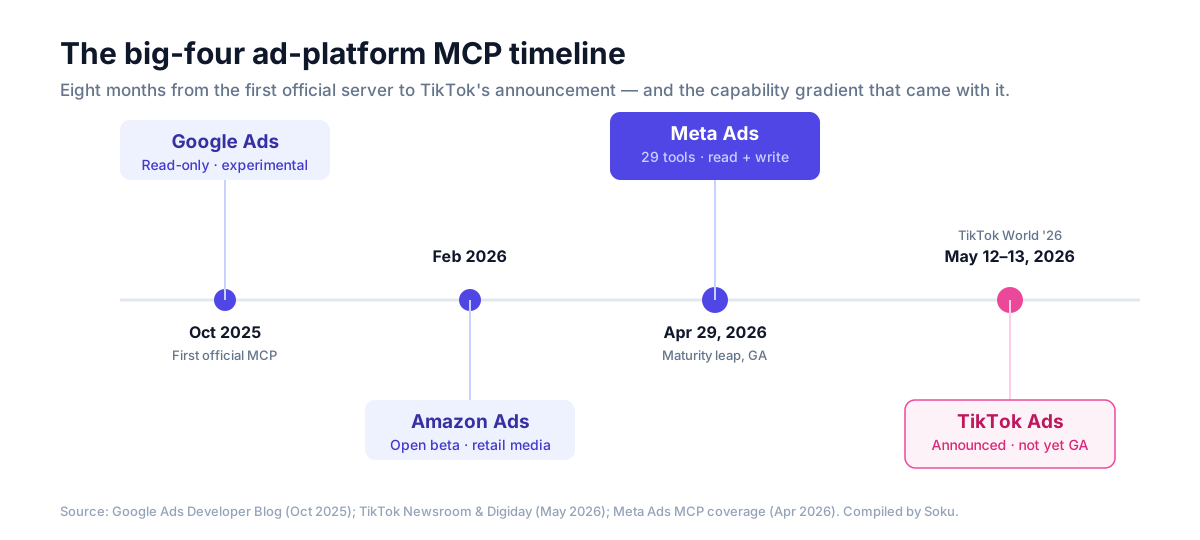
- Google Ads (Oct 2025): the first official ad-platform MCP — open-source, read-only, and explicitly experimental (Google Ads Developer Blog); our Google Ads MCP guide covers its two-tool GAQL surface and setup wall; the third-party servers that add write access are ranked in Best MCP Servers for Google Ads.
- Amazon Ads (Feb 2026): reached open beta, extending the pattern to retail media.
- Meta Ads (Apr 29, 2026): the maturity leap — an official, remote, OAuth-gated server with 29 tools spanning read _and_ write from day one, no Developer App required.
- TikTok Ads (May 12–13, 2026): announced, supports Claude/ChatGPT, scope described journalistically — not yet GA.
The strategic read: TikTok arriving last is not a weakness for advertisers, it's a head start for the few who prepare early. The keyword tiktok ads mcp has effectively zero search volume today because the term barely exists — which is exactly the window in which early, genuinely useful coverage and early operating experience compound. For the platform-by-platform comparison — what each MCP can and can't do, and which is furthest ahead — see TikTok vs Meta vs Google Ads MCP, Compared.
What the official server is expected to cover
TikTok framed the Ads Skills toolkit as a set of building blocks an agent composes: campaign creation, performance insights, creative analysis, audience discovery, and budget optimization (TikTok Newsroom). Mapped to the jobs an ad agent actually does:
| Ads Skill area | What an agent would do with it | Confirmed? |
|---|---|---|
| Campaign creation | Stand up campaigns, ad groups, and ads from a brief | Announced |
| Performance insights | Pull spend, CTR, CVR, ROAS; flag anomalies | Announced |
| Creative analysis | Read and assess ad creative performance | Announced |
| Audience discovery | Find and size targeting segments | Announced |
| Budget optimization | Reallocate budget and adjust bids | Announced |
Treat this table as direction, not spec. The exact tool names, endpoint, auth scopes, and whether writes land paused or active are all still unpublished. Meta's server, by contrast, ships a documented 29-tool surface where every _create_ lands paused — a guardrail TikTok has not confirmed it will match. Until TikTok publishes a spec, the safe assumption is that an early TikTok agent should run read-first, exactly as the Meta and Google rollouts taught.
Where Agentic Hub fits
The MCP server is the connection layer: it lets an AI client call TikTok Ads tools. Agentic Hub is the distribution and governance layer around those tools. In TikTok's developer-facing framing, the Hub gives developers a place to package and publish ad-related skills so brands and partners can discover approved agent workflows instead of wiring raw API calls from scratch (TikTok API for Business Blog).
For marketers, that distinction matters:
- MCP answers "how does the agent reach TikTok Ads?" It standardizes the tool call interface.
- Ads Skills answer "what jobs can the agent do?" Campaign creation, reporting, creative analysis, audience discovery, and optimization are the announced job areas.
- Agentic Hub answers "where do vetted agent workflows live?" It is closer to a marketplace or operating surface than a single connector.
That makes Agentic Hub strategically different from a one-off MCP endpoint. If TikTok executes it well, agencies will not only connect Claude or ChatGPT to TikTok; they will browse, approve, and reuse packaged campaign skills. The practical preparation is covered in the dedicated spoke: TikTok Agentic Hub for AI Ads: What Marketers Should Know.
What you can actually run today: third-party TikTok Ads MCP servers
While the official server is still an announcement, the community already shipped. Independent TikTok Ads MCP servers have existed on GitHub since mid-2025 — they wrap the live TikTok Marketing API, so they work right now:
- AdsMCP/tiktok-ads-mcp-server — auth/login and account switching, campaigns, ad groups, and campaign/ad-group performance, with a hosted remote-MCP option. Part of a multi-platform (Google/Meta/TikTok) automation product. Tools are namespaced
tiktok_ads_*. - ysntony/tiktok-ads-mcp — six read-only tools: Business Centers, authorized ad accounts, campaigns, ad groups, ads, and reports. The conservative choice for an analysis-only agent.
These are early and low-star, and they run on _your_ access token rather than an OAuth handshake — which means the same caution that applied to third-party Meta connectors applies here: an unverified server firing unthrottled calls on your token is an account-safety question, not just a convenience one. But for a team that wants to learn the agent loop on TikTok _today_, a read-only third-party server is a legitimate on-ramp. The full rundown — what each wraps, install method, and the safety trade-offs — is in Open-Source TikTok Ads MCP Servers (2026).
The foundation under all of it: the TikTok Marketing API v1.3
Every TikTok Ads MCP — official or third-party — is a natural-language wrapper over the TikTok Marketing API v1.3. Understanding that surface is what separates an agent you can trust on spend from one you can't:
- Auth: OAuth 2.0 advertiser authorization. You register an app in the TikTok for Developers portal, complete the advertiser consent flow, and exchange for an
access_tokenplus the list ofadvertiser_ids it can act on (TikTok Marketing API docs). - Hierarchy: Business Center → Advertiser → Campaign → Ad Group → Ad. The Business Center is the hub for multi-account and agency setups.
- Capability areas: Campaign/Ad Group/Ad CRUD, synchronous and async Reporting, creative/video upload, custom and lookalike Audiences, and the server-side Events API for conversion tracking.
The reason this matters for an _agent_: the MCP doesn't invent capabilities — it exposes the v1.3 verbs in natural language. So the API's limits become the agent's limits, and the API's rate ceilings become your autopilot's speed limit. The full developer-grade walkthrough — versions, auth flow, the endpoints an agent calls most, and the rate-limit math — is in TikTok Marketing API v1.3 Explained.
How to connect TikTok Ads to an AI agent right now
You don't have to wait for the official server to point an agent at TikTok. Today's path uses a third-party MCP server and an OAuth'd TikTok app: register a Marketing API app, authorize your advertiser account, drop the server's endpoint and your token into your client's connector settings, and test with a read-only prompt like _"List my authorized TikTok ad accounts."_ When the official server opens, the connection model will simplify to a single OAuth click — but the agent prompts and the read-first discipline you build now carry straight over. The step-by-step for Claude specifically — Desktop, Claude.ai, and Claude Code, with the prompt patterns that get decisions instead of guesses — is in How to Connect TikTok Ads to Claude (MCP).
The honest limitations (read before you trust it)
This is where most early coverage goes thin, because admitting what _doesn't_ work yet is less exciting than the launch. The honest list:
- It isn't GA. The official server is announced, not shipped — no docs, no endpoint, no confirmed date. Any "set it up today" guide pointing at an official TikTok MCP is describing a product that isn't public.
- No published tool spec. Tool names, scopes, and the paused-vs-active default are unknown. You can't yet audit what an agent is allowed to do.
- Third-party servers run on your token. The available-today options trade OAuth safety for immediate access. Unthrottled calls on a personal token carry account-restriction risk.
- The agent can't see creative the way a human does. Reading creative _metadata_ is not judging a hook, a thumbnail, or how an ad renders on a phone — the format where TikTok lives or dies.
- Rate limits are real. An agent looping over reports can hit the v1.3 ceilings fast; check the official limits before you let it run unattended.
- "Autonomous" is vendor framing. "Plan, launch and optimize without manual intervention" is the pitch, not a verified outcome. Treat full autonomy on live spend as a goal to earn, not a default to switch on.
The recommended posture mirrors what Google and Meta's rollouts taught: read-only first, a human approval gate on every write, and no edit to budgets or audiences more than once a day to avoid resetting the learning phase.
Forecast: why prepare now (our opinion, clearly labeled)
The following is our read of where this goes — a forecast, not a reported fact. We think the direction is close to inevitable, and the cost of waiting is higher than it looks.
Every major ad platform will have a first-party MCP within the year, and the control surface will shift from the dashboard to the agent. Google opened the door, Meta proved the read-and-write model is safe enough to ship, Amazon followed, and TikTok has now committed publicly. The protocol layer is becoming as standard as a REST API. Once it's standard, _having access_ stops being a differentiator — every team can ask Claude to pull TikTok performance. The advantage moves entirely to the _operating model_: which team has the playbooks, the approval gates, the cross-account discipline, and the months of agent-supervised reps that turn a connector into reliable output.
That's the FOMO that's actually rational. Not "connect a TikTok MCP before your competitor" — the connection is a single OAuth click everyone gets. The real gap is the preparation: the team that spends the pre-GA window building the read-first loop, the prompt library, and the human-in-the-loop guardrails will operate TikTok agents safely on day one, while the team that waits for the docs to drop will still be learning what not to let the agent touch. Autonomous ad agents are coming whether you prepare or not. Preparing is cheap; catching up under live spend is expensive. The window to prepare is open now precisely _because_ the official product isn't.
The agent operating model the rollout implies
With no published guardrails yet and the lesson of two prior rollouts, the safe TikTok agent is read-heavy and write-gated from the start:
- Connect at read-only first. Use a read-only third-party server (or read-only scope when the official one opens), one advertiser account, no write access. Let the agent _observe_ before it can touch anything.
- Plan through the agent. Pull anomalies — CTR/CVR/ROAS drift, delivery dips, frequency creep — and pin every date range and breakdown so the model can't backfill a hallucinated number.
- Review, then act. A human approves; the agent issues a deterministic edit; nothing changes a budget or audience more than once a day; high-risk creates stay paused until a person flips them on.
Tool access is about to become table stakes for everyone. Disciplined use is the moat. The same MCP gives every team the same TikTok verbs — the judgment around them is what separates a safe operator from an expensive accident.
How Soku fits
Soku is itself an ad-automation agent built on the human-in-the-loop, read-first model this whole guide argues for. TikTok already sits under the top-level Integrations entry in the sidebar under _Bring Your Own_, alongside Meta Ads, Google Ads, and GA4 — so a TikTok advertiser connects once and operates inside an agent that already enforces the approval gate and the cross-account discipline, rather than wiring a raw connector and inventing the guardrails alone.
The part that matters for agencies is what happens _after_ the connection: Soku assigns each ad account to one or more brands, so a single agent can operate a whole client roster without ever pointing the wrong account at the wrong brand — the cross-account-confusion risk a bare MCP leaves entirely on you. When TikTok's official server opens, the connection simplifies to an OAuth click; the operating model you've been running doesn't change. That's the point of preparing now: the agent layer that decides _which account belongs to which brand_, keeps a human gate on spend, and enforces read→diagnose→act is the durable advantage, not access to the protocol.
Where to go next
This page is the map. For the full treatment of each sub-topic, follow the deep dive that matches your intent:
- Compare the platforms → TikTok vs Meta vs Google Ads MCP, Compared — the maturity gradient, what each MCP can and can't do, and which is furthest ahead.
- Understand Agentic Hub → TikTok Agentic Hub for AI Ads — how the Hub relates to MCP, Ads Skills, governance, and agency workflows.
- Connect through Claude → How to Connect TikTok Ads to Claude (MCP) — the available-today path, Claude Desktop / Claude.ai / Claude Code, and read-first prompt patterns.
- Understand the foundation → TikTok Marketing API v1.3 Explained — auth flow, the endpoints an agent calls most, and the rate-limit math that becomes your autopilot's speed limit.
- Use one today → Open-Source TikTok Ads MCP Servers (2026) — the third-party servers that work now, what each wraps, and the account-safety trade-offs.
FAQ
What is the TikTok Ads MCP?
An official MCP (Model Context Protocol) server TikTok announced at TikTok World on May 12–13, 2026, plus a companion TikTok Ads Skills toolkit and Agentic Hub. It's designed to let AI agents like Claude and ChatGPT connect to TikTok's ad platform to plan, launch, and optimize campaigns. As of late June 2026 it's an announcement — there's no public self-serve install guide or confirmed general-availability date yet (TikTok Newsroom).
Can I use the TikTok Ads MCP right now?
Not the official one — it isn't generally available. You _can_ use third-party TikTok Ads MCP servers that have existed since mid-2025 (e.g. AdsMCP and ysntony's read-only server), which wrap the live TikTok Marketing API v1.3. See the open-source rundown.
How does it compare to the Meta and Google Ads MCPs?
TikTok is last of the big four. Google shipped a read-only official MCP in October 2025; Meta shipped a 29-tool read-and-write server in April 2026; TikTok only announced in May 2026 and hasn't shipped a public spec. Full comparison here.
Which AI agents will it support?
TikTok named Claude and ChatGPT as example clients. MCP is an open protocol, so any MCP-compatible client should be able to connect once the server is public (Social Media Today).
Should I wait for the official server or start now?
Start preparing now. The connection itself will be a single OAuth click everyone gets, so it's not a differentiator. The durable advantage is the operating model — read-first loop, approval gates, cross-account discipline — which you can build today on a read-only third-party server and carry straight over when the official MCP opens.