 Soku AI

Claude Sonnet 5 matters to marketers because it moves the affordable middle tier of AI models closer to real agent work. Anthropic describes it as its "most agentic Sonnet model yet" and says it can plan, use tools like browsers and terminals, and run autonomously at a level that recently required larger, more expensive models (Anthropic). That is not just a developer story. The same capabilities map directly to paid media work: inspect account data, diagnose a campaign, draft a budget move, generate creative variants, check its own evidence, and hand a human a decision.
For the complete Claude Sonnet 5 cluster, use this pillar as the map. If you need implementation steps, the full Meta and Google Ads setup walkthrough is in this guide. If you want an evaluation harness, use the Claude Sonnet 5 ad automation test. If you are choosing between models, read Claude Sonnet 5 vs Opus 4.8 for marketing agents.
The useful question is not "is Claude Sonnet 5 smarter?" The useful question is "which marketing tasks become cheap enough, reliable enough, and safe enough to run every day?"
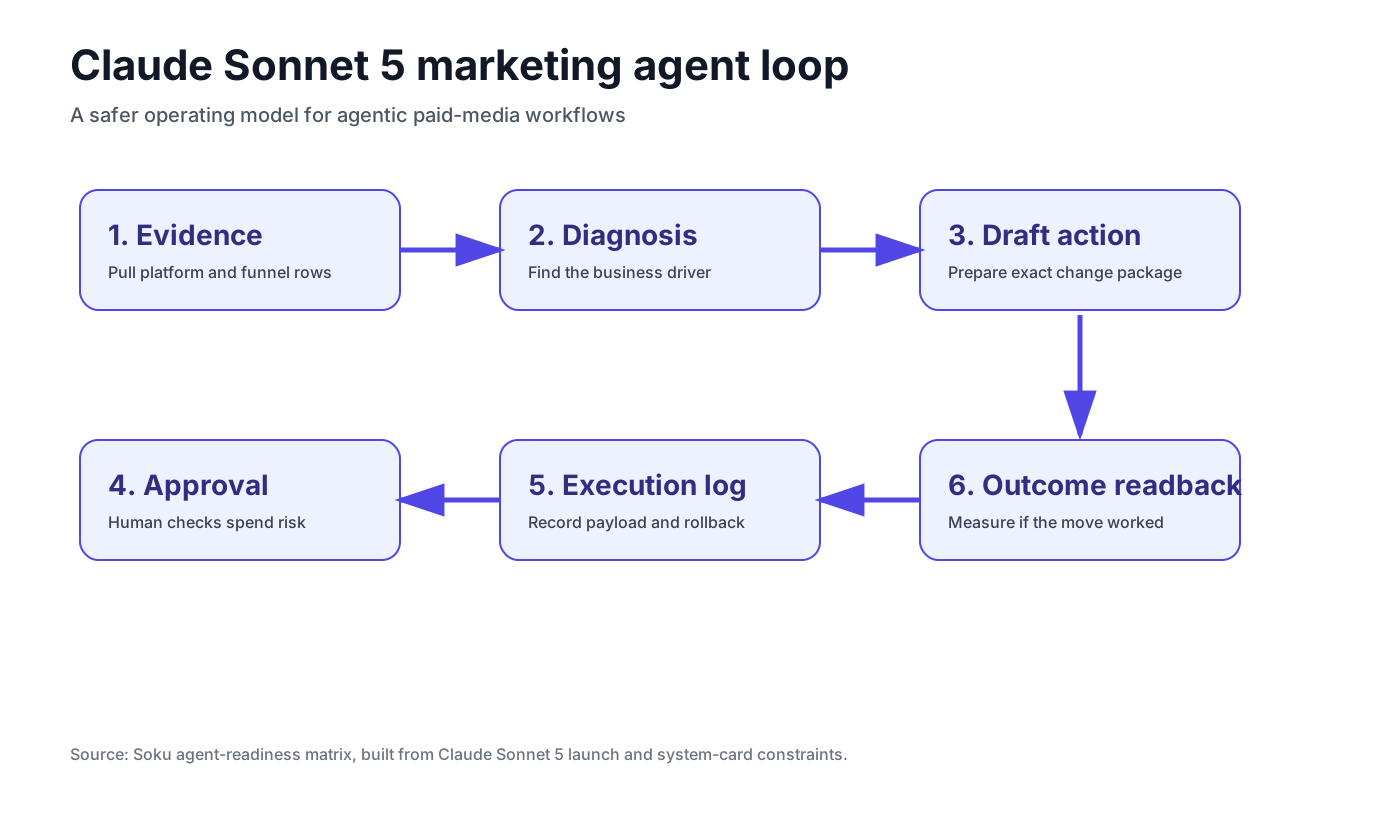
The short version for ad teams
Claude Sonnet 5 is a better default execution model for marketing agents than previous Sonnet models. It is not the highest-capability model Anthropic offers, but it changes the cost-performance line for work that repeats every day.
| Marketing job | Sonnet 5 fit | Why it matters |
|---|---|---|
| Daily account diagnosis | Strong | Better agentic search and tool use make it more likely to gather evidence before making a recommendation. |
| Creative refresh planning | Strong | It can connect performance symptoms to next creative hypotheses instead of only writing variants. |
| Landing-page and feed audits | Strong | Browser and terminal use matter when the agent must verify a URL, sitemap, feed, or tracking issue. |
| Budget and bid recommendations | Strong with approval | It can prepare a decision package, but spend changes still need guardrails and human sign-off. |
| One-shot strategic planning | Good | Use it for structured plans, but escalate ambiguous high-stakes choices to a stronger model or human review. |
| Security-sensitive automation | Limited | Anthropic says Sonnet 5 is not optimized for cyber tasks and recommends Opus 4.8 for cybersecurity work that needs reduced guardrails. |
Anthropic's launch post gives three facts marketers should care about.
First, Sonnet 5 narrows the gap with Opus 4.8 while keeping lower Sonnet-tier pricing. Anthropic says Sonnet 5 performance is close to Opus 4.8 on important agentic dimensions such as reasoning, tool use, coding, and knowledge work, while staying cheaper (Anthropic).
Second, it ships everywhere immediately. Anthropic says Sonnet 5 is the default model for Free and Pro plans, available to Max, Team, and Enterprise users, available in Claude Code, and available through the Claude Platform under the API ID claude-sonnet-5 (Anthropic).
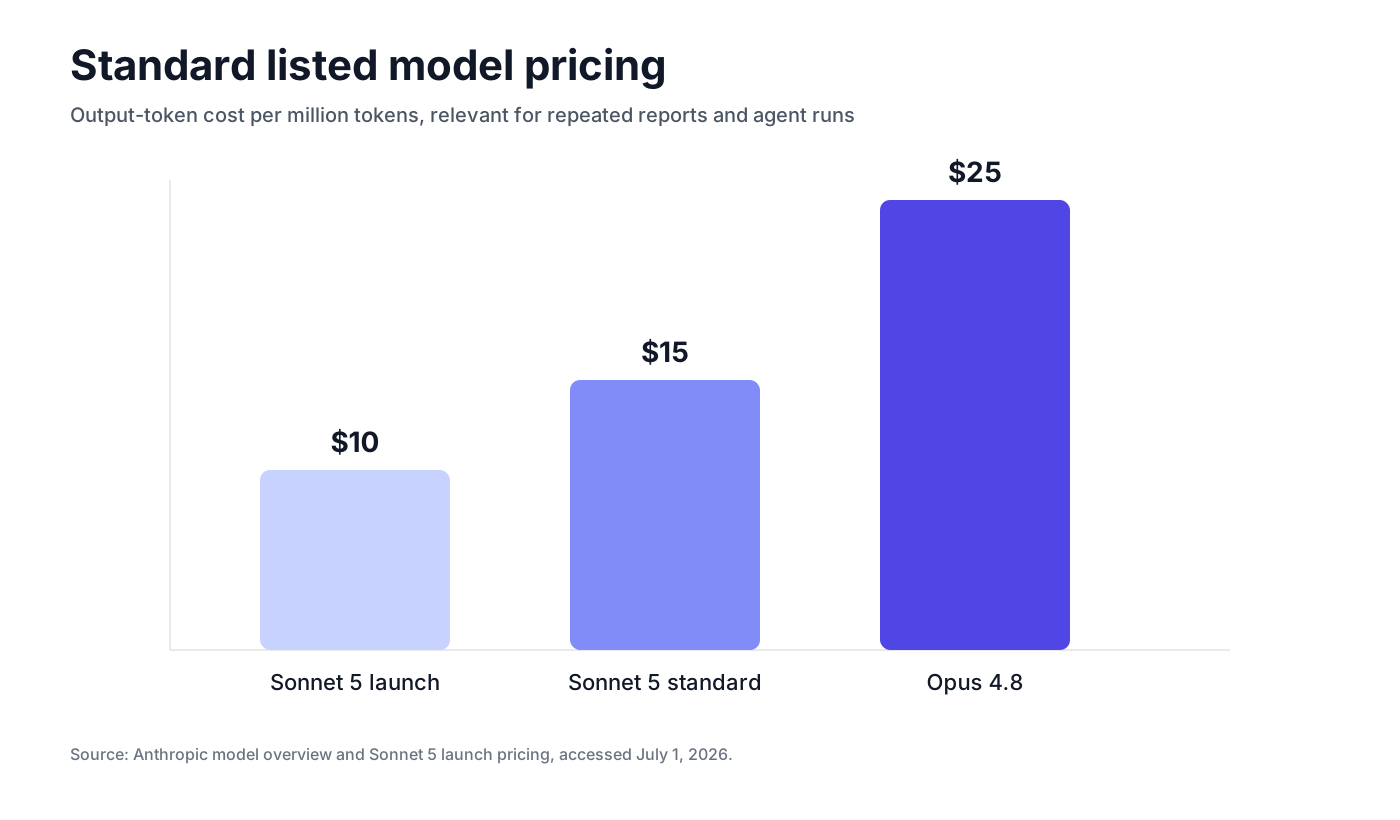
Third, the economics are unusually relevant. Anthropic's introductory price is $2 per million input tokens and $10 per million output tokens through August 31, 2026, then $3 per million input tokens and $15 per million output tokens after that. Anthropic's model overview lists Opus 4.8 at $5 input and $25 output per million tokens (Claude docs).
Why the picker caught it but did not make it the default pick
Today's launch radar did catch claude sonnet 5 from Anthropic with score 10 and source URL https://www.anthropic.com/news/claude-sonnet-5. It did not appear as the single default blog pick because the picker prints only the top launch item after sorting. In this run, the printed top item was the YouTube MRC accreditation launch; Claude Sonnet 5 was still in the launch alternatives pool.
That is a product issue in the picker presentation, not a discovery miss. For launch events, the daily report should show every score-10 launch candidate with source, freshness, and recommended cluster commands. The library entry for Claude Sonnet 5 exists with lane: launch, score: 10, firstSeen: 2026-07-01, and sourceUrl pointing to Anthropic.
The SEO data also supports moving it up manually. DataForSEO returned estimated US search volume of 2,900 for claude sonnet 5, while early long-tail terms such as claude sonnet 5 api and claude sonnet 5 pricing are still low volume. That is exactly the moment when a low-authority site should build the cluster: own the useful operator angles before the long-tail demand becomes obvious.
What changed from Sonnet 4.6
Anthropic positions Sonnet 5 as a direct upgrade from Sonnet 4.6. The public launch post names gains in reasoning, tool use, coding, knowledge work, agentic search, and computer use. The system card says Sonnet 5 shows clear gains over Sonnet 4.6 in coding, agentic search, multimodal reasoning, and professional-task performance (system card).
For marketing teams, the practical difference is follow-through. The bottleneck in ad automation is rarely "can the model write a headline?" It is "can the model keep the whole job in memory, inspect enough evidence, notice when a platform result contradicts its plan, and produce a recommendation a media buyer can safely approve?"
That shows up in tasks like:
- Pull yesterday's Meta and Google performance.
- Detect whether CAC moved because of volume, conversion rate, CPM, CTR, or mix shift.
- Check whether tracking, landing pages, or feed health changed.
- Draft the specific campaign, audience, creative, or budget move.
- Explain the evidence and confidence level.
- Stop before making a spend change unless the approval rule allows it.
Older Sonnet-class models could do parts of that. The issue was often stopping short: a partial analysis, a missing source, a recommendation without the account object IDs, or a creative plan that did not match the actual failing segment. Sonnet 5's value is that more of the workflow can be kept inside one execution loop.
The Soku agent-readiness matrix
Here is the original framework we use to decide whether a model is ready to run a marketing workflow. The point is not a generic benchmark score. The point is whether the model can operate across the real surfaces a marketer cares about.
| Criterion | What we check | Sonnet 5 implication |
|---|---|---|
| Evidence gathering | Does it inspect account, landing-page, and tracking evidence before advising? | Stronger browser, terminal, and tool use should improve diagnosis quality. |
| Object discipline | Does it preserve campaign IDs, ad set IDs, account IDs, date ranges, and platform names? | Better agentic follow-through helps, but platform adapters still need schema validation. |
| Approval behavior | Does it stop at the right point before spend, targeting, or creative publishing changes? | Anthropic reports better agentic safety and prompt-injection robustness than Sonnet 4.6. |
| Creative reasoning | Does it map performance symptoms to fresh creative hypotheses? | Strong fit for ad variant planning when paired with performance data. |
| Cost control | Can it run every day without turning routine audits into premium-model spend? | Stronger fit than Opus 4.8 for repeated account scans. |
| Escalation | Does it know when ambiguity is high enough to hand off? | Still requires product guardrails and confidence thresholds. |
This is where Sonnet 5 is interesting: it does not replace the workflow guardrails. It lowers the cost of putting a capable model inside those guardrails every day.
The four workflows we would move first
1. Daily paid media diagnosis
The best first use case is a daily account diagnosis that does not mutate anything. Sonnet 5 should pull the last 7 and 28 days of performance, compare deltas, identify the most likely driver, and produce a recommendation with evidence.
The output should be specific:
| Bad output | Useful Sonnet 5 output |
|---|---|
| "CTR is down, refresh creative." | "Meta prospecting CTR fell from 1.4% to 0.9% on two UGC-style ads after frequency crossed 3.2. CPA rose mainly from CTR loss, not CPM. Refresh the hook and first frame for ad IDs X and Y." |
| "Google spend is inefficient." | "Search CPA rose because non-brand broad-match traffic expanded into three low-converting terms. Add negatives, keep exact-match brand untouched, and review AI Max final URL expansion." |
| "TikTok needs new videos." | "TikTok CTR is stable but conversion rate fell after landing-page latency rose. Fix page speed before producing new creative." |
The model is not the full system. It still needs clean data connectors, platform object mapping, and an approval layer. But a more agentic mid-tier model makes daily diagnosis cheaper enough to run continuously.
2. Creative fatigue and variant planning
Creative teams do not need more generic headlines. They need a machine that can say what to make next.
For example, if Meta spend is flat, CPA is up, CTR is down, and frequency is high, the agent should not simply generate 50 variants. It should separate the hypothesis set:
- Hook problem: test first-frame contrast and benefit-first copy.
- Audience fatigue: rotate proof points by segment.
- Offer mismatch: test a sharper discount or risk reversal.
- Format mismatch: move a winning static angle into short-form video.
- Landing-page mismatch: keep creative stable and fix the page if click quality is intact.
Sonnet 5's better tool use matters because the model can inspect the actual ad objects and performance rows instead of writing from a prompt summary. The new value is not "more copy." It is "performance-aware creative planning."
3. Cross-platform MCP and API workflows
The ad platform stack is moving toward agent-readable control surfaces: Google Ads MCP, Meta Ads AI Connectors, TikTok's announced Ads MCP direction, Amazon retail-media agent layers, and third-party MCP servers. Sonnet 5 is well positioned as the execution model that sits above those connectors.
That does not mean giving it write access on day one. The safer ladder is:
| Stage | Agent can do | Human role |
|---|---|---|
| Read-only | Pull reports, inspect settings, identify anomalies | Review diagnosis |
| Draft changes | Prepare negatives, budget moves, creative briefs, and campaign edits | Approve or reject |
| Constrained writes | Execute changes inside pre-approved spend and policy limits | Monitor exceptions |
| Autonomous loops | Run recurring optimizations with rollback and audit logs | Audit outcomes |
Sonnet 5 is most compelling in stages 1 and 2. Stage 3 requires strong product controls. Stage 4 should wait until you have enough historical evidence that the loop improves outcomes without creating hidden risk.
4. Reporting and narrative analysis
Most marketing reports fail for the same reason: they describe numbers without explaining the mechanism. Sonnet 5's professional-work improvements should help with narrative reporting when the model can inspect the source data.
A good report should answer:
- What changed?
- Where did it change?
- Why did it probably change?
- What evidence supports that?
- What should the team do next?
- What should not be changed yet?
This is especially useful for agencies. Instead of a human analyst turning platform exports into prose every week, the agent can assemble a first draft, cite the rows behind the claim, and flag uncertain reads for human review.
How to set up Sonnet 5 for Meta and Google Ads
Sonnet 5 is useful for ad teams only if it can see the right data and stop at the right boundary. That is exactly why the setup matters. A stronger model connected to vague exports is still guessing. A stronger model connected directly to spend-changing tools without approval is risky.
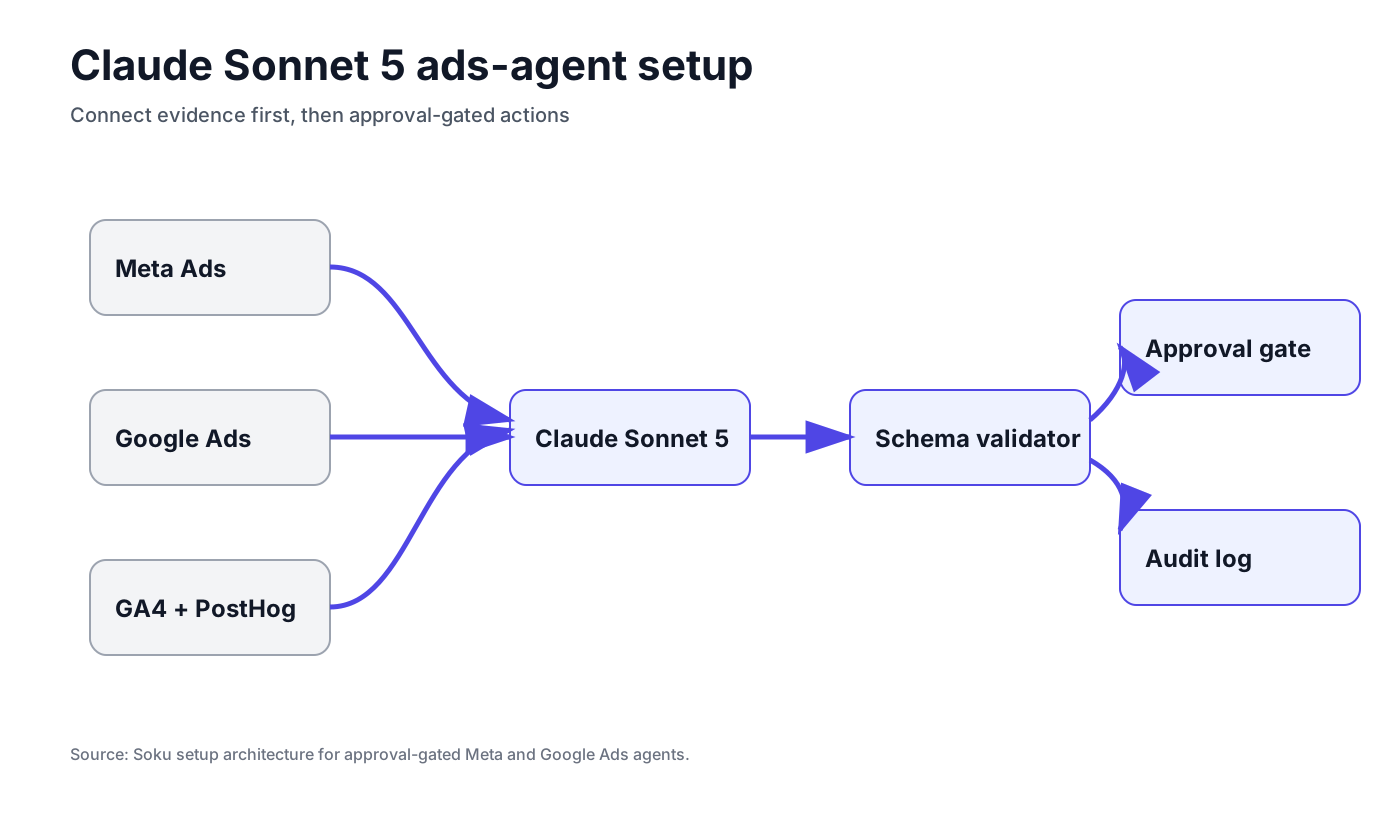
The safest setup has five layers.
| Layer | Purpose | Example |
|---|---|---|
| Data connectors | Read performance, settings, creative, and conversion data | Meta Ads, Google Ads, GA4, PostHog, CRM |
| Model runtime | Reason over the evidence and draft next actions | claude-sonnet-5 |
| Tool schemas | Keep platform actions structured and validated | Campaign ID, ad set ID, date range, platform |
| Approval gates | Stop before spend, targeting, publishing, or customer-data changes | Human approval, spend caps, allowlists |
| Audit log | Record what was proposed, approved, changed, and measured | Change log, report links, rollback note |
The model is only one layer. If you skip the other four, Sonnet 5 becomes a confident analyst with incomplete evidence.
Step 1: Define the model role
Do not tell Sonnet 5 to "optimize my ads." That instruction is too broad.
Use a role like this:
You are a paid media analyst. You may read account, campaign, creative, landing-page, and analytics data. You may draft recommendations and prepare platform changes. You must not execute spend, targeting, creative publishing, or customer-data changes unless an explicit approval tool returns approved=true for the exact change.The key is the boundary. Sonnet 5 can plan and reason. Your product should decide what it can touch.
Step 2: Start read-only
The first production use case should be diagnosis. Give Sonnet 5 enough evidence to answer a narrow question:
- Which campaign changed most?
- Was the change driven by CPM, CTR, CVR, AOV, or mix?
- Which ad or keyword object explains it?
- What should we check before changing anything?
- What is the smallest safe next action?
For Meta, read:
- Account, campaign, ad set, and ad IDs.
- Spend, impressions, CPM, clicks, CTR, CPC, conversions, CPA, ROAS.
- Frequency, placement, audience, creative ID, and landing URL.
- Creative fatigue signals by ad.
For Google Ads, read:
- Campaign, ad group, asset group, keyword, search term, and final URL.
- Spend, clicks, impressions, CTR, CPC, conversions, CPA, ROAS.
- Match type, search-term expansion, negatives, and landing-page status.
- AI Max, Performance Max, and Demand Gen settings where relevant.
For analytics, read:
- GA4 landing-page sessions and conversion rate.
- PostHog funnel drop-off and event changes.
- CRM or ecommerce revenue when available.
- Tracking anomalies and missing events.
Step 3: Normalize platform object names
Most failed ad-agent runs are not reasoning failures. They are object failures. The model refers to "the Meta campaign" but the tool needs an account ID, campaign ID, ad set ID, ad ID, platform, and date range.
Force every recommendation into a schema:
| Field | Required? | Why |
|---|---|---|
platform | Yes | Prevents a Meta action from being sent to a Google tool. |
account_id | Yes | Avoids ambiguous brand or client routing. |
object_type | Yes | Campaign, ad set, ad, keyword, asset group, landing page. |
object_id | Yes when available | Makes the recommendation executable and auditable. |
date_start and date_end | Yes | Prevents cherry-picked comparisons. |
metric_delta | Yes | Forces evidence rather than opinion. |
recommended_action | Yes | The proposed change in plain English. |
tool_payload | Only after validation | The exact structured action, not prose. |
This is where Sonnet 5's agentic gains help: it is better at carrying structured context across steps. But the schema still belongs in your product.
Step 4: Give Sonnet 5 a platform-specific checklist
Meta Ads checklist. Ask Sonnet 5 to check these before recommending creative changes:
- Did frequency rise on the affected ad set?
- Did CTR fall while CPM stayed stable?
- Did conversion rate fall after the click?
- Did a placement or audience mix shift?
- Did a winning ad exit learning or hit fatigue?
- Did a tracking or pixel event change?
- Is the issue isolated to creative, audience, landing page, or budget?
Only after that should it draft an action. For example:
| Symptom | Better recommendation |
|---|---|
| Frequency up, CTR down, CVR stable | Refresh hook and first frame. |
| CTR stable, CVR down | Check landing page, offer, and tracking. |
| CPM up, CTR stable | Audience auction pressure, not necessarily creative. |
| CPA up on one placement | Split placement analysis before changing creative. |
Google Ads checklist. Ask Sonnet 5 to check these before recommending Google changes:
- Did the search-term mix change?
- Did broad match or AI Max expansion enter weak terms?
- Did final URL expansion route traffic to a weaker page?
- Did negatives, brand exclusions, or assets change?
- Is CPA movement volume-driven or quality-driven?
- Did conversion lag explain the apparent drop?
The model should not add negatives blindly. It should propose candidate negatives with evidence:
| Candidate negative | Evidence required |
|---|---|
| Off-intent query | Spend and clicks with low or zero conversion. |
| Competitor query | Strategic decision, not automatic block. |
| Research query | Low conversion rate across enough clicks. |
| Brand-adjacent query | Human approval because brand defense may matter. |
Step 5: Add approval gates
The staged ladder from the cross-platform workflow section becomes concrete as three approval levels. No approval is needed to read data, summarize, and diagnose — a daily report or an anomaly explanation. Soft approval covers drafting a change package: a negative list, a creative brief, a budget recommendation. Hard approval is required before executing anything that pauses an ad, changes a budget, or publishes creative.
The approval record should include the platform, object ID, proposed change, estimated impact, rollback plan, and reviewer.
Step 6: Use effort levels deliberately
Anthropic says Sonnet 5 supports effort levels and that higher effort expands cost-performance options on agentic search and computer-use work (Anthropic). Marketing teams should not run every task at the highest setting.
Use this routing:
| Task | Suggested effort |
|---|---|
| Daily metric summary | Low or medium |
| Account anomaly diagnosis | Medium |
| Cross-platform root-cause analysis | Medium or high |
| Preparing executable change payloads | High |
| Investigating tracking or landing-page failures | High |
| Ambiguous strategy call | Escalate to Opus 4.8 or human |
Starter prompts for Sonnet 5 ad workflows
Use a prompt like this for read-only diagnosis, after the tool layer has loaded structured data:
Analyze the attached Meta, Google Ads, GA4, and PostHog data for the last 7 days versus the previous 7 days. Identify the largest performance change by business impact. Separate volume, cost, click-through, conversion-rate, and mix effects. Cite the exact campaign, ad set, keyword, creative, or landing page objects behind the claim. Do not recommend a spend or targeting change unless the evidence points to one object-level action. End with a change package that requires human approval.Use this one when the diagnosis points to creative fatigue:
Given the fatigued ads and their historical winners, propose 12 new creative hypotheses. Group them by hook, offer, proof, format, and audience angle. For each hypothesis, name the performance symptom it addresses, the platform placement it fits, and the first metric we should watch after launch. Do not write final ad copy until the hypotheses are approved.Common setup mistakes
Mistake 1: Giving the model screenshots instead of data
Screenshots are useful for interface context. They are not enough for diagnosis. Sonnet 5 needs structured rows with date ranges, metric definitions, and object IDs.
Mistake 2: Letting prose become the tool payload
The model can write "reduce budget by 20%." Your tool should require a structured payload with object ID, current budget, new budget, reason, approval ID, and rollback note.
Mistake 3: Mixing brands or accounts
Marketing agents often fail when one user manages several brands. Always bind the data namespace: organization, brand, platform account, and connected credential.
Mistake 4: Treating recommendations as truth
Sonnet 5 should produce evidence-weighted hypotheses, not unquestioned commands. Force confidence labels: high, medium, low, and "needs data."
What not to automate yet
Sonnet 5 is more agentic, but the unsafe pattern is obvious: a stronger model connected to weak tools can make bad changes faster.
Do not start with:
- Unbounded budget reallocation.
- Blind creative publishing.
- New campaign creation without naming, spend, targeting, and compliance checks.
- Multi-platform changes without a rollback plan.
- Black-box "optimize everything" loops.
Anthropic's system card says Sonnet 5 improved over Sonnet 4.6 on agentic safety, especially prompt-injection robustness, but that does not remove the need for product-level controls. In marketing, prompt injection can come from a landing page, a competitor page, a Google Sheet, an email brief, or a website the agent browses. The model needs instruction hierarchy; the product needs tool boundaries.
How Soku should use Sonnet 5
Soku should treat Sonnet 5 as the default execution layer for repeated marketing operations, not as the final authority on spend.
The clean architecture is:
- Soku pulls platform evidence from Meta, Google, TikTok, GA4, PostHog, CRM, and landing-page checks.
- Sonnet 5 drafts a diagnosis and action plan.
- Soku validates object IDs, date ranges, spend limits, and platform schemas.
- The human approves changes that affect money, targeting, publishing, or customer data.
- Soku records the action, monitors the result, and feeds the next run.
That gives marketers the benefit of stronger model execution without pretending the model is the control plane.
Where to go next
Use the cluster based on intent:
| If you want to... | Read this |
|---|---|
| Understand the broad model launch and marketing implications | This pillar |
| Wire Sonnet 5 into Meta and Google workflows | The setup walkthrough in this guide |
| Test whether it can run ad automation safely | Claude Sonnet 5 ad automation test |
| Choose between Sonnet 5 and Opus 4.8 | Claude Sonnet 5 vs Opus 4.8 for marketing agents |
FAQ
What is Claude Sonnet 5?
Claude Sonnet 5 is Anthropic's latest Sonnet-class model, released June 30, 2026. Anthropic describes it as its most agentic Sonnet model yet, with stronger planning, tool use, coding, and professional-work performance than Sonnet 4.6.
What is the API model ID?
The Claude API ID is claude-sonnet-5, according to Anthropic's model overview.
How much does Claude Sonnet 5 cost?
Anthropic lists introductory pricing of $2 per million input tokens and $10 per million output tokens through August 31, 2026. Standard pricing after that is $3 input and $15 output per million tokens.
Is Claude Sonnet 5 better than Opus 4.8?
Not generally. Anthropic positions Opus 4.8 as the more capable Opus-tier model for complex reasoning and high-autonomy work. Sonnet 5 is interesting because it gets closer on some agentic tasks at lower cost.
Should marketers use Claude Sonnet 5 for live ad changes?
Use it first for read-only diagnosis and draft recommendations. Let it prepare budget moves, negatives, creative briefs, and reporting narratives, but keep approvals on anything that changes spend, targeting, publishing, or customer data.