 Soku AI
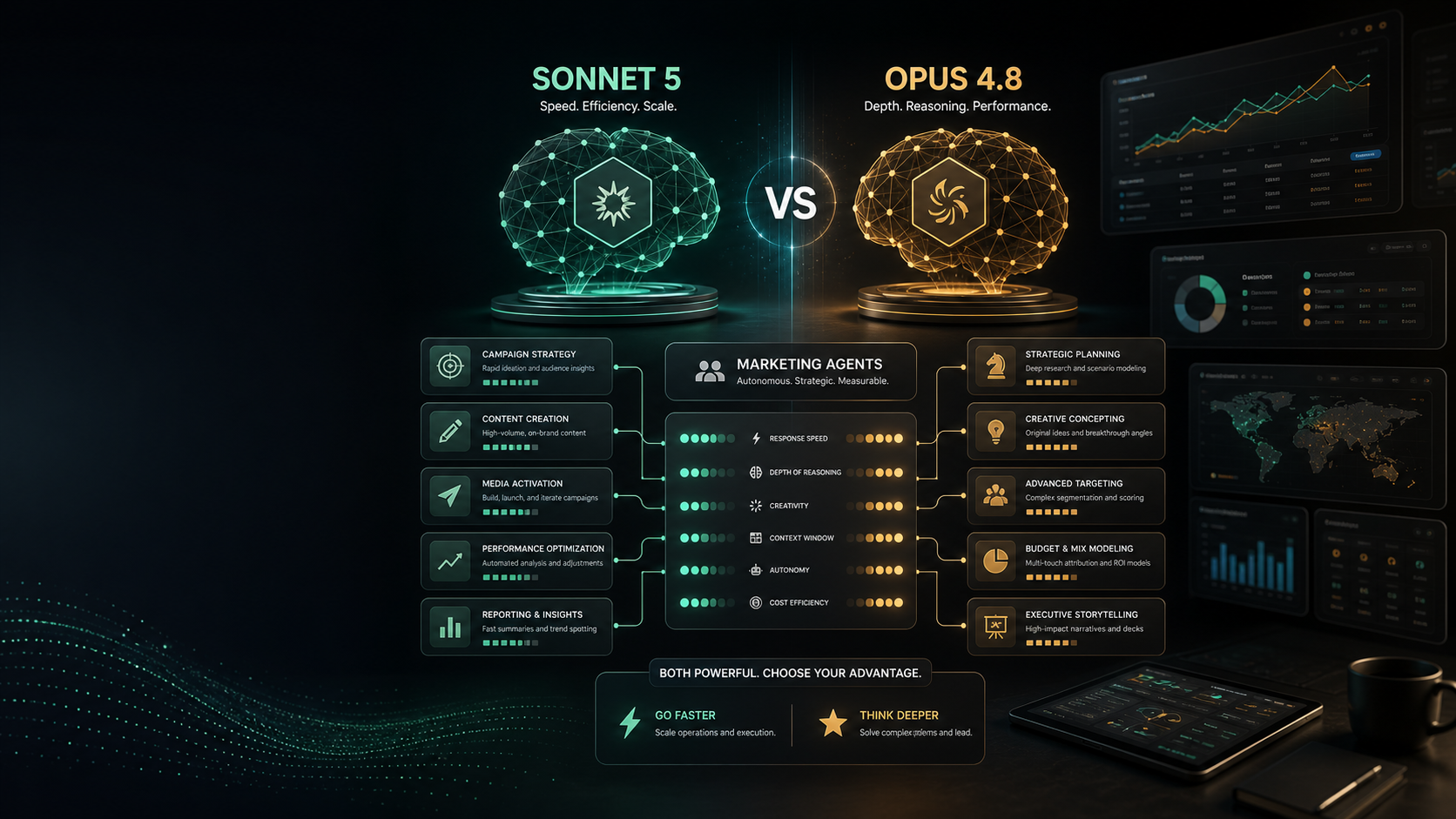
Claude Sonnet 5 is not a simple replacement for Opus 4.8. It is a routing decision. Anthropic says Sonnet 5 narrows the gap with Opus 4.8 on agentic performance at lower prices, while the Claude model overview still positions Opus 4.8 as the more capable Opus-tier model for complex reasoning and high-autonomy work (Anthropic, Claude docs).
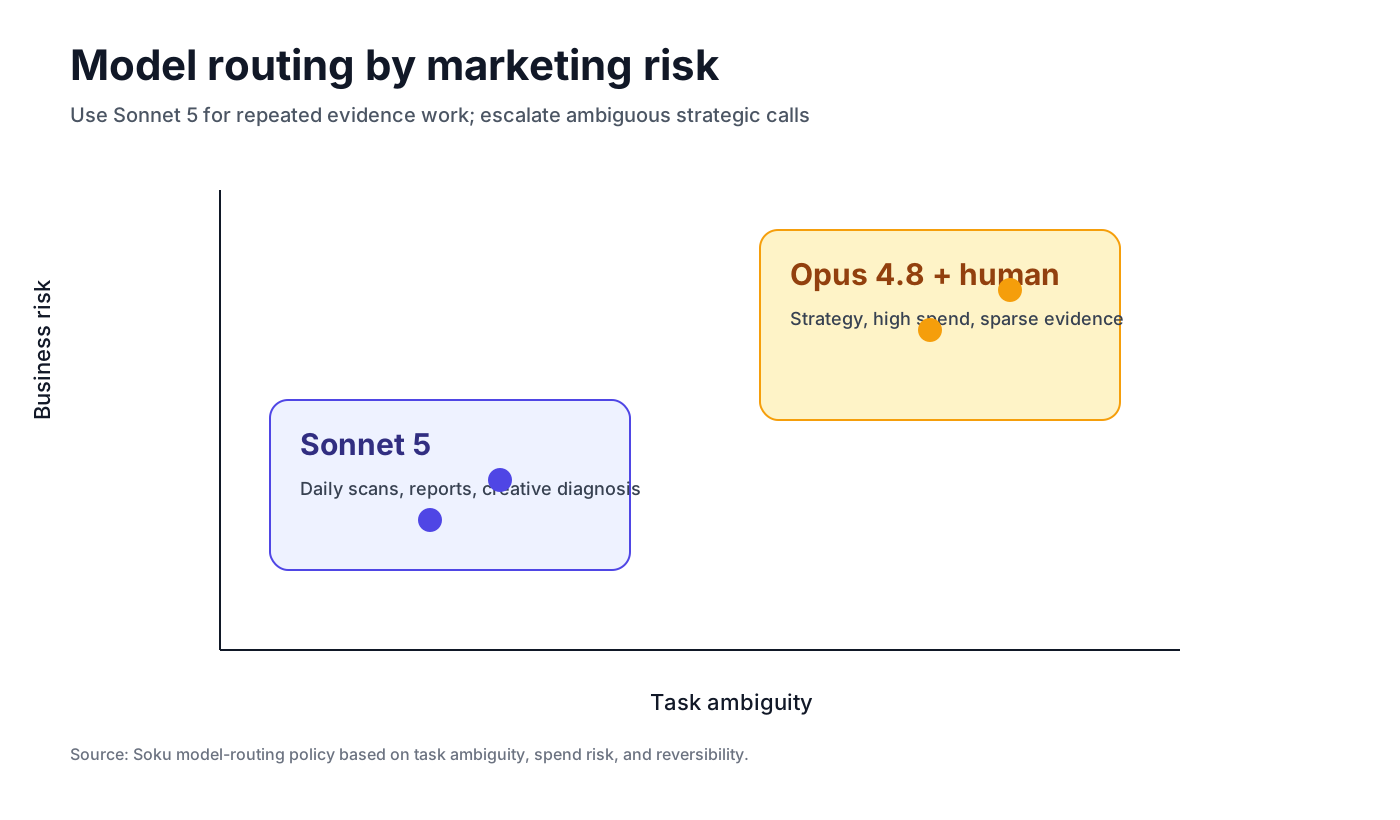
For marketing teams, that creates a clean split: use Sonnet 5 for repeated execution and evidence gathering; use Opus 4.8 for ambiguous, high-stakes judgment.
For the full cluster and the Meta and Google Ads implementation steps, start with Claude Sonnet 5 for AI marketers. For evaluation, use the ad automation test suite.
Pricing changes the default
Anthropic lists Sonnet 5 at $3 per million input tokens and $15 per million output tokens after launch pricing, with introductory pricing of $2 and $10 through August 31, 2026. Anthropic lists Opus 4.8 at $5 input and $25 output per million tokens (Claude docs).
That means Opus 4.8 costs about 1.67x Sonnet 5 at standard listed prices.
| Model | Input MTok | Output MTok | Relative standard output cost |
|---|---|---|---|
| Claude Sonnet 5 | $3 | $15 | 1.00x |
| Claude Opus 4.8 | $5 | $25 | 1.67x |
| Sonnet 5 launch pricing | $2 | $10 | 0.67x versus standard Sonnet 5 |
For one strategic analysis, that difference may not matter. For daily account scans across dozens of brands, it matters quickly.
The routing rule
Use Sonnet 5 when the task is:
- Repeated.
- Evidence-heavy.
- Tool-heavy.
- Narrowly scoped.
- Approval-gated.
- Easy to audit after the fact.
Use Opus 4.8 when the task is:
- Ambiguous.
- High-stakes.
- Strategy-heavy.
- Sparse on data.
- Cross-functional.
- Expensive to reverse.
Task-by-task recommendation
| Marketing task | Recommended model | Why |
|---|---|---|
| Daily Meta and Google account scan | Sonnet 5 | Repeated, structured, evidence-heavy. |
| Creative fatigue diagnosis | Sonnet 5 | Needs data inspection and hypotheses, not frontier reasoning. |
| Landing-page and tracking audit | Sonnet 5 high effort | Browser/tool work with clear evidence. |
| Weekly client report draft | Sonnet 5 | Narrative synthesis with source rows. |
| Budget reallocation proposal | Sonnet 5 draft, human approval | Useful for preparing options, not final authority. |
| Multi-channel launch strategy | Opus 4.8 or human | Ambiguous and high impact. |
| Agency pricing or positioning decision | Opus 4.8 or human | Sparse data and strategic judgment. |
| Security-sensitive connector design | Opus 4.8 or specialist | Anthropic recommends Opus 4.8 for cybersecurity work needing reduced guardrails. |
Why Sonnet 5 is enough for most daily ad-agent work
Most ad-agent work is not a genius task. It is a discipline task.
The model must:
- Pull the right rows.
- Preserve object IDs.
- Compare the right windows.
- Avoid mixing brands.
- Diagnose before recommending.
- Stop at approval boundaries.
- Produce a concise explanation.
Anthropic's launch post says Sonnet 5 is a strict improvement over Sonnet 4.6 across agentic search and computer-use cost-performance curves, and can match Opus 4.8 on some tasks at higher effort. That is exactly the shape marketers need: lower-cost repeated work, with the ability to raise effort when the task becomes messier.
Where Opus 4.8 still belongs
Opus 4.8 still belongs in the escalation lane.
Use it for:
- A major budget shift across brands.
- A new market entry plan.
- A messy attribution dispute.
- A customer-facing board narrative.
- A model-policy or connector-safety review.
- A complex root-cause analysis where the evidence conflicts.
The rule is simple: if being wrong creates expensive organizational consequences, use a stronger model and a human decision.
A practical Soku routing policy
Here is the routing policy we would use in Soku:
| Signal | Route |
|---|---|
| Routine daily scan | Sonnet 5 medium effort |
| Account anomaly with clean data | Sonnet 5 high effort |
| Missing data or conflicting evidence | Sonnet 5 asks for data, then optionally escalates |
| Spend change over approved threshold | Human approval required |
| Strategic ambiguity | Opus 4.8 summary plus human call |
| Security or permission design | Opus 4.8 plus engineering review |
The important design choice is that routing should be based on task risk, not model hype.
How to prevent model-routing waste
Do not send everything to Opus 4.8 "just in case." That turns every daily audit into premium reasoning spend and makes the agent harder to scale.
Also do not send everything to Sonnet 5 because it is cheaper. Cheap mistakes are still mistakes.
Instead, define escalation triggers:
- Recommendation affects spend above a threshold.
- Confidence below 70%.
- Required data missing.
- More than one plausible root cause.
- Customer-facing claim needs executive confidence.
- Platform write action would be hard to roll back.
When a trigger fires, Sonnet 5 should summarize the evidence and hand off the decision.
A concrete agency routing example
Imagine an agency managing 24 ecommerce brands. Each brand has Meta, Google, GA4, and Shopify connected. The agency wants an agent to run every morning before the media buyers start work.
The naive routing policy is simple: send every account to the strongest model. That feels safe, but it burns premium model budget on work that is mostly structured comparison.
The better routing policy is staged:
| Run stage | Model | What it does |
|---|---|---|
| Account scan | Sonnet 5 medium effort | Pulls yesterday, 7-day, and 28-day deltas across spend, CPA, ROAS, CTR, CVR, and revenue. |
| Driver diagnosis | Sonnet 5 high effort when anomaly found | Explains whether the change is cost, click, conversion, volume, mix, tracking, or landing-page driven. |
| Draft package | Sonnet 5 high effort | Prepares candidate negatives, creative briefs, budget suggestions, or landing-page checks. |
| Strategic escalation | Opus 4.8 | Reviews cases where evidence conflicts or spend impact crosses the agency threshold. |
| Human approval | Media buyer | Approves or rejects the proposed change package. |
This keeps Opus 4.8 focused on the accounts where judgment is actually scarce. If only 4 of 24 accounts need escalation on a given day, the agency avoids sending 20 routine scans through a more expensive model.
Cost intuition for repeated reports
Suppose a daily account scan consumes 150,000 input tokens and 12,000 output tokens after retrieving platform rows, landing-page context, prior notes, and report templates. At standard listed prices, Sonnet 5 would cost about:
Input: 0.15 MTok × $3 = $0.45
Output: 0.012 MTok × $15 = $0.18
Total: $0.63 per account scan
The same shape on Opus 4.8 would cost about:
Input: 0.15 MTok × $5 = $0.75
Output: 0.012 MTok × $25 = $0.30
Total: $1.05 per account scan
That difference is not decisive for one account. Across 24 accounts every weekday, the rough monthly difference becomes meaningful:
| Routing | Approx daily cost | Approx 22-workday month |
|---|---|---|
| All Sonnet 5 | $15.12 | $332.64 |
| All Opus 4.8 | $25.20 | $554.40 |
| Sonnet 5 scans plus 4 Opus escalations | About $16.80 | About $369.60 |
The exact numbers will vary by context size, caching, batching, and prompt design. The point is the shape: daily marketing operations reward efficient models, while strategic ambiguity rewards stronger models.
The human approval boundary stays the same
Model routing should never weaken approval policy. Sonnet 5 and Opus 4.8 should both stop before irreversible or expensive changes unless the approval layer explicitly allows them.
For paid media, the hard boundaries are:
- Budget changes above the approved threshold.
- New campaign creation.
- Pausing proven evergreen campaigns.
- Publishing customer-facing creative.
- Uploading customer lists or changing audience exclusions.
- Adding broad negatives that could block brand or competitor-defense strategy.
- Changing conversion goals or attribution settings.
Sonnet 5 can draft the payload. Opus 4.8 can review the reasoning. Neither should bypass the operating system.
What to measure after routing
Do not judge the routing policy only by model cost. Measure quality and downstream outcomes:
| Metric | Why it matters |
|---|---|
| Diagnosis acceptance rate | Shows whether media buyers trust the model's root-cause analysis. |
| Revision rate | Shows how much human rewriting is still required. |
| Approval rejection reason | Reveals missing data, bad assumptions, or overreach. |
| Time to first useful recommendation | Measures operational speed, not just model latency. |
| Post-action lift | Connects recommendations to CPA, ROAS, CTR, CVR, or revenue movement. |
| Escalation precision | Checks whether Opus is used on genuinely harder cases. |
If Sonnet 5 produces cheap but noisy recommendations, route more work upward. If Opus 4.8 mostly rubber-stamps Sonnet 5 on routine cases, route more work downward.
The decision
For marketing agents, Claude Sonnet 5 should become the default execution model. Opus 4.8 should become the escalation model.
That gives you the right economic shape: Sonnet 5 handles the daily evidence loop, while Opus 4.8 is reserved for the moments where judgment matters more than throughput.