 Soku AI
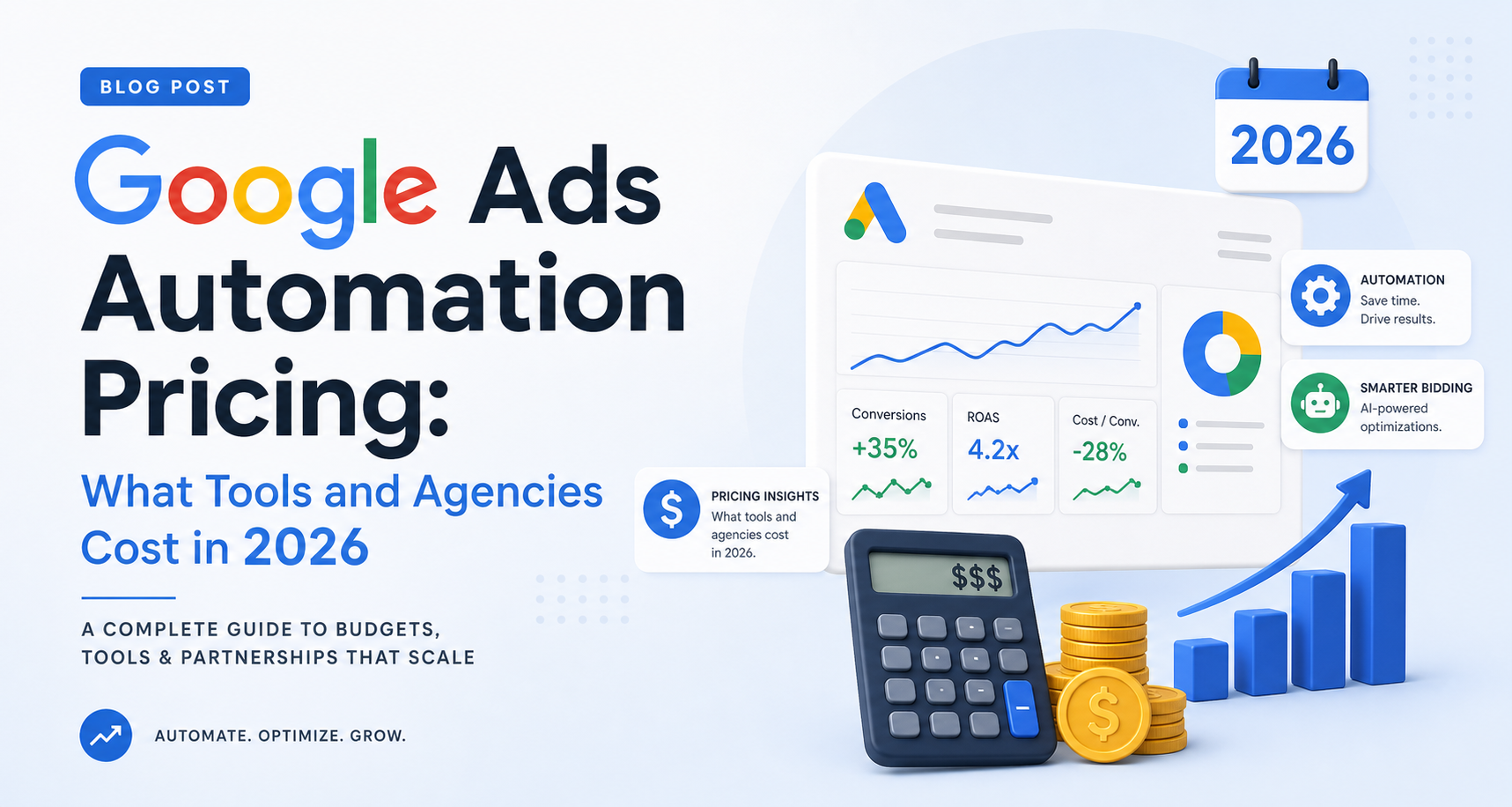
Comparing Google Ads automation tools on list price is nearly useless, and the reason is structural: the vendors do not all bill on the same meter. One charges by your ad spend, one by seat, one by connected account, one a flat subscription. Two products with an identical $249 sticker can differ by 10x in what they cost you a year from now, and which one is cheaper depends entirely on the shape of your operation — not on anything in the feature comparison.
So this guide does two things. First, the real 2026 numbers: what agencies charge, what the major PPC tools charge, and where the tier boundaries actually fall. Second, the part nobody publishes — a cost-per-managed-account model across three buyer profiles, so you can see how the same list prices invert depending on whether you are one in-house team, a freelancer with five clients, or an agency with twenty.
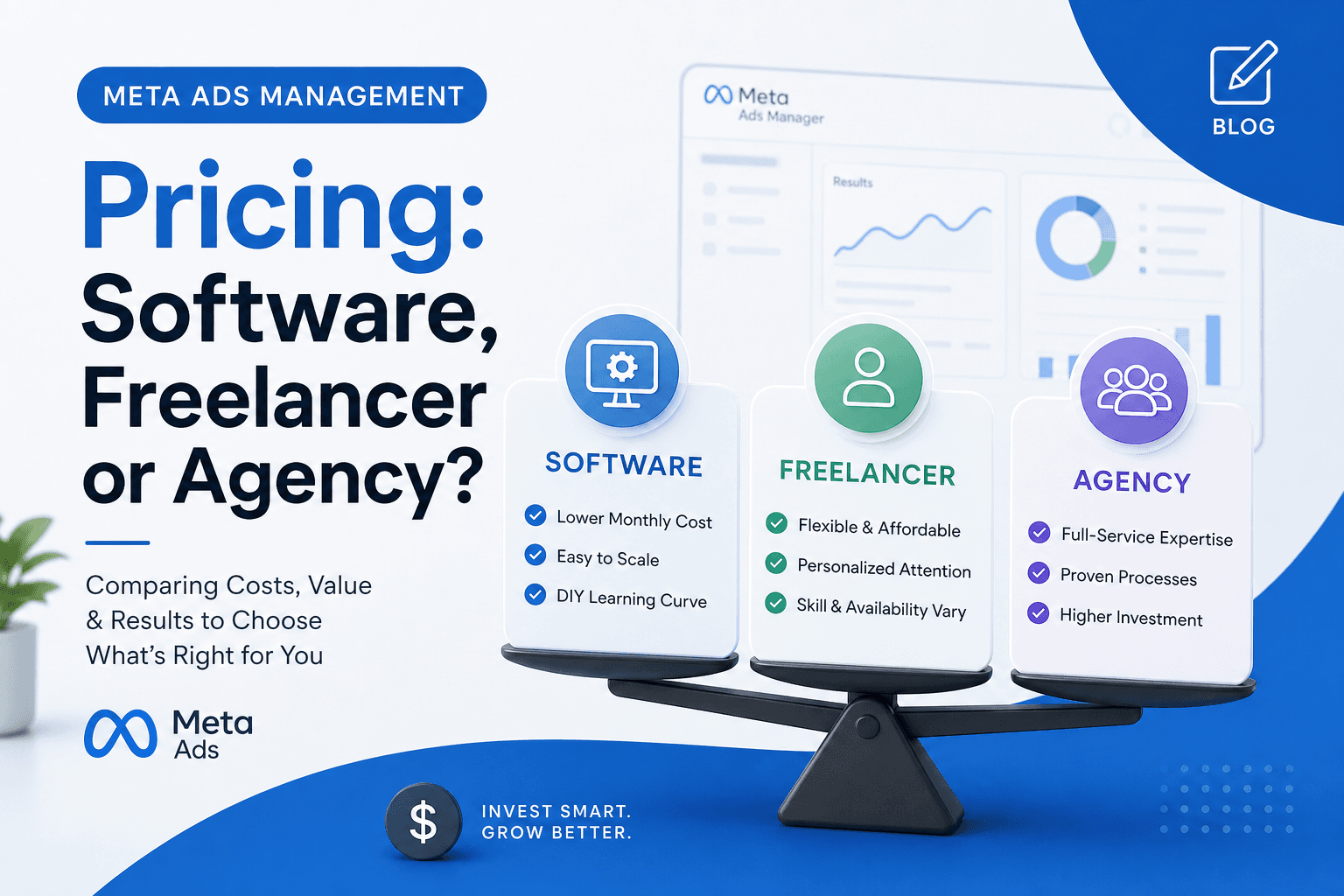
The Meta-side companion to this analysis is Meta ads management pricing, which covers the software-versus-freelancer-versus-agency decision. This one goes deeper on the tooling layer specifically.
The four meters
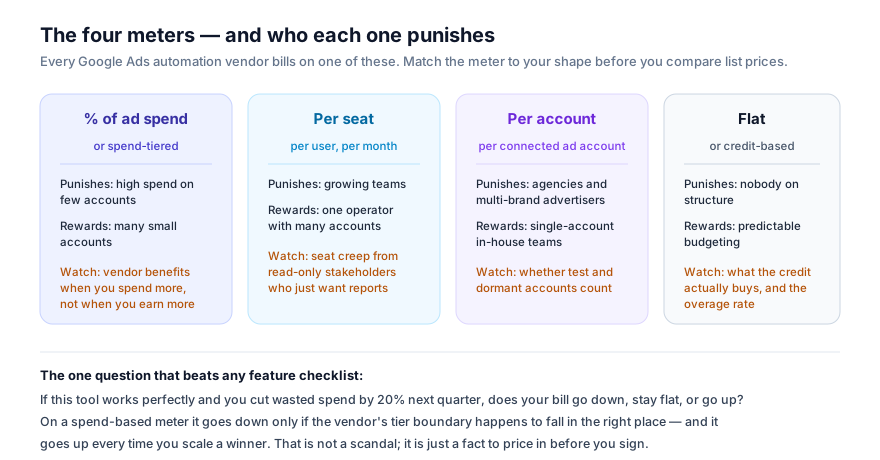
Before any price comparison, identify which meter you are being billed on.
Percentage of ad spend, or spend-tiered. The dominant model for both agencies and the established PPC tool vendors. Agencies charge 10–20% of monthly spend. Tools use spend tiers rather than a straight percentage — you pay one price up to $10,000 of managed spend, more above it, and custom pricing above $50,000. Punishes high spend concentrated in few accounts. Rewards many small accounts.
Per seat. A flat price per user per month. Punishes teams as they grow, and particularly punishes seat creep — the account manager, the client-services person and the analyst who all just want to read reports. Rewards a single operator running many accounts.
Per connected ad account. Punishes agencies and multi-brand advertisers. Rewards single-account in-house teams. The detail to check in the contract: whether dormant, test, and MCC-child accounts count against the limit.
Flat subscription or credits. Punishes nobody on structure, which is why it is increasingly common among newer entrants. The thing to interrogate is what a credit actually buys and what the overage rate is.
There is one question that cuts through all of it, and it is worth asking every vendor in the room:
If your tool works perfectly and I cut wasted spend by 20% next quarter, does my bill go down, stay flat, or go up?
On a spend-based meter the answer is that it goes down only if a tier boundary happens to fall in the right place — and it goes up every time you successfully scale a winner. That is not a scandal. It is a structural fact about the model, and it belongs in your evaluation rather than being discovered in month seven.
What things actually cost in 2026
Automation and optimization tools
Optmyzr is the category incumbent and prices on spend tiers. Published 2026 pricing starts around $249/month for accounts up to $10,000 in managed spend, rises to roughly $499/month above $10,000, and moves to custom pricing above $50,000 in managed spend — where it typically lands above $800/month. The important word in all of that is managed: the tier is based on total ad spend under management across every account in your instance, so an agency's tier is the sum of its clients.
Opteo sits below Optmyzr with an entry tier in the ballpark of $250/month, competing on simplicity rather than feature breadth.
Adalysis is the per-seat option at roughly $126 per user per month, focused on ad testing and analysis rather than broad automation.
Soku AI is a flat subscription: free to start, $49/month Starter (20,000 credits, up to 10 ad accounts per channel) and $249/month Pro (200,000 credits, unlimited ad accounts), with custom Enterprise pricing. Full detail on the pricing page.
Google Ads Scripts cost nothing and are worth naming explicitly, because a surprising number of the automations people shop for are forty lines of JavaScript. Budget pacing, n-gram search term reports, anomaly alerts, and quality score tracking are all solved problems in the free scripts ecosystem. The cost is engineering maintenance, which is real but is not a subscription.
Agencies and managed service
Agencies price the same three ways they do on Meta, with slightly higher percentages because Search accounts carry more structural work:
- Percentage of ad spend: 10–20%, most commonly quoted at 15–20% for mid-market accounts.
- Flat retainer: $1,000 to $10,000/month depending on complexity and positioning, with $1,500–$5,000 the common band.
- Tiered by spend: small businesses at $1,000–$5,000 of monthly spend typically pay $500–$1,500/month or 15–25% of spend; mid-market at $5,000–$25,000 pay $1,500–$5,000/month or 10–20%.
- Hybrid: a base retainer plus a smaller percentage above a threshold.
Note the small-business band: 15–25% of spend. At $2,000 of monthly spend, a $500 minimum is 25% of your budget going to management before a single click is bought. That is the same retainer-floor problem we quantified on the Meta side, and it has the same conclusion — under roughly $5,000/month, paid human management is very hard to justify arithmetically.
Cost per managed account: the model nobody publishes
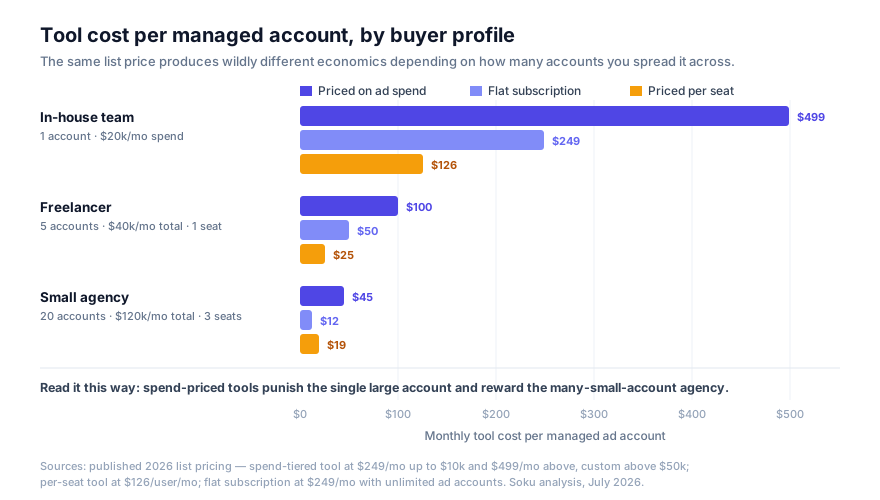
Here is where the list prices stop being comparable. Three realistic profiles, the same three tools, divided by the number of accounts each one manages.
| Profile | Accounts | Total monthly spend | Spend-priced tool | Per-seat tool | Flat subscription |
|---|---|---|---|---|---|
| In-house team | 1 | $20,000 | $499 → $499/account | $126 (1 seat) → $126/account | $249 → $249/account |
| Freelancer | 5 | $40,000 | $499 → $100/account | $126 (1 seat) → $25/account | $249 → $50/account |
| Small agency | 20 | $120,000 | ~$900 custom → $45/account | $378 (3 seats) → $19/account | $249 → $12/account |
Three conclusions worth taking to a vendor call.
The single-account in-house team is the worst-served buyer in this market. Almost every pricing model in the category was designed for agencies amortising a subscription across a client roster. If you run one account at $20,000/month, a spend-tiered tool costs you $499 for one account's worth of value — the most expensive cell in the entire table. Per-seat and flat pricing are structurally better for you, and it is worth filtering vendors on the meter before you look at features.
Agencies should model their tier at next year's spend, not this year's. A spend-tiered tool that costs $499 today becomes a custom-priced conversation the month you cross $50,000 of managed spend — and you will cross it by winning clients, which is exactly when you least want a pricing renegotiation. Ask for the tier schedule in writing, including what happens at each boundary.
Per-seat looks cheapest until it isn't. The freelancer column makes per-seat pricing look unbeatable at $25/account, and for one operator it genuinely is. But seats are the fastest-growing line item in any agency: add an account manager, a junior buyer and a client-facing analyst and a $126 tool is $504/month before you have added a single new client.
What you are actually buying at each price point
Price bands in this category map fairly cleanly onto capability tiers. Roughly:
| Monthly cost | What it typically buys |
|---|---|
| $0 | Google Ads Scripts, the native Recommendations tab, automated rules inside Ads. Real capability, real maintenance burden. |
| $50–$150 | Single-purpose tools: ad copy testing, script libraries, reporting connectors, alerting. |
| $150–$300 | Broad optimization suites with rule engines, bid management, budget pacing and n-gram analysis. Also where flat-priced AI agents land. |
| $300–$800 | The same suites at higher spend tiers, plus multi-account management, white-label reporting and API access. |
| $800+ | Enterprise tiers, custom integrations, dedicated support, and the start of managed-service bundles. |
| $1,500–$10,000 | Human management — agency retainers, where you are buying strategy and labour rather than software. |
The band that has changed most since 2024 is $150–$300. It used to buy a rule engine and a set of dashboards. It now increasingly buys something that reads the account and proposes actions with reasoning attached, which is a different product wearing the same price tag. When you evaluate anything in this band, the question that separates the two is: does it tell me what changed, or does it tell me why?
The hidden costs nobody quotes
The subscription is not the total. Four line items reliably show up later:
Onboarding and implementation fees. Common at the enterprise end, typically $500–$2,500 one-off. Negotiable, especially against an annual commitment.
Annual lock-in. Most tools in this category discount 15–20% for annual billing. That discount is real, and so is the risk of paying twelve months for a tool your team stops opening in month three. For a first purchase, pay monthly and take the discount at renewal once you know it stuck.
Data and API costs. Some tools charge separately for API access, historical data retention beyond a window, or connectors to third-party attribution. Ask what is included in the tier you are quoted, not the tier on the pricing page.
The operator hours the tool does not eliminate. The largest hidden cost by a wide margin. A $249 tool that requires eight hours a month of a $60/hour operator has a true cost of $729. This is the number to compare against an agency retainer — not the sticker.
A buying framework by profile
In-house, one or two accounts, under $10,000/month spend. Start with free Google Ads Scripts and native automated rules. If you outgrow them, buy on a flat or per-seat meter, not a spend meter — you have the worst possible shape for spend-tiered pricing. Budget $0–$250/month.
In-house, one account, $10,000–$100,000/month. You can justify a real tool, and the operator-hours saving is where the return comes from. Compare the all-in cost — subscription plus operator hours — against the 10–15% an agency would charge. At $50,000 of spend, an agency is $5,000–$7,500/month and a tool plus a good in-house operator is under $1,500. That gap is why in-housing keeps happening.
Freelancer, three to ten accounts. Per-seat pricing is your friend and you should be aggressive about staying single-seat. Watch the spend-tier boundary if you use a spend-priced tool — winning one large client can move your whole instance into the next tier.
Agency, ten or more accounts. Model total managed spend at 12-month projected growth, get the tier schedule in writing, and price seats for the team you will have, not the team you have. Also worth asking: does the vendor charge for client read-only access, or is that free? Over twenty clients that single term can be worth more than the base subscription.
Anyone spending under $3,000/month on ads. Do not buy management of any kind, human or software, beyond a free tier. The arithmetic does not work — you would be spending 20–30% of a budget that is already too small to generate the conversion volume Google's bidding needs to learn anything. Put the money in the auction and use the free tooling.
Where Soku sits, stated plainly
Soku is a flat subscription in the $150–$300 band: free to start, $49 Starter, $249 Pro with unlimited ad accounts. That meter is deliberate — it is the model that does not penalise you for scaling spend and does not penalise an agency for adding accounts.
What that buys is the diagnosis layer rather than a rule builder: Soku connects to Google Ads, reads what actually changed, proposes specific actions with the reasoning attached, and executes behind an approval gate. It also generates ad creative, which most tools in this band do not. If your existing setup is a mature rule library that works, the honest advice is that you may not need to replace it — the Revealbot (Bïrch) comparison lays out where a rules engine is genuinely the better answer.
What it does not buy is a strategist. If you have nobody in-house to operate it, you are shopping for an agency, and no subscription price will change that.
FAQ
How much does Google Ads automation software cost?
Between $0 and $800+ per month depending on the meter and your scale. Free Google Ads Scripts cover a lot of common automations. Mid-tier optimization suites run $150–$300/month at entry spend tiers, rising to $499 and beyond above $10,000 of managed spend. Enterprise tiers exceed $800.
Is Optmyzr worth the price?
It depends on your shape more than on the features. At $249–$499/month it is expensive for a single in-house account and reasonable for an agency amortising it across a client roster. Its spend-tiered meter means your bill grows as you grow, which is fine if you have modelled it and unpleasant if you have not.
What is the cheapest way to automate Google Ads?
Google Ads Scripts, at $0. Budget pacing, n-gram search term analysis, anomaly alerting and quality-score tracking all have well-maintained free scripts. The cost is engineering time to install and maintain them, which for a technical team is often lower than a subscription.
Should I pay a percentage of ad spend for automation software?
Be careful with it. A spend-based meter means the vendor's revenue rises when your spend rises, including when the correct decision would be to spend less. It is not disqualifying — most of the mature tools use it — but ask for the tier schedule in writing and model it at your projected spend, not today's.
How much do Google Ads agencies charge in 2026?
10–20% of ad spend, or flat retainers from $1,000 to $10,000/month with $1,500–$5,000 being most common. Small accounts under $5,000 of spend typically face 15–25% or a $500–$1,500 minimum, which is why paid management rarely makes arithmetic sense below that level.
Tool or agency — which is cheaper?
The tool, at every spend level, on cash cost. The question is whether you have someone to operate it. At $50,000 of monthly spend an agency runs $5,000–$7,500 while a tool plus an in-house operator runs under $1,500 — but that $1,500 assumes the operator exists and knows what a healthy Search account looks like.
Do automation tools charge per ad account?
Some do, and it is the meter that hurts agencies most. Read the contract for whether dormant, test and MCC-child accounts count against the limit — this is where surprise invoices come from.