 Soku AI
Almost every article about Meta ads management pricing answers the wrong question. They tell you an agency charges 10–20% of ad spend, a freelancer charges $50–$150 an hour, and software costs $100–$300 a month — and then they stop, right at the moment the numbers become interesting.
The interesting part is that those three prices are not comparable. They buy different amounts of work. An agency fee buys strategy, creative, execution and analysis. A software subscription buys execution and analysis, and quietly hands strategy and creative direction back to you. A freelancer sits somewhere in between and the exact position is different for every freelancer you will ever hire.
So a price comparison that puts $2,000/month next to $249/month is comparing a taxi fare to the cost of a car. This guide does the comparison properly: what each option really costs at each ad spend band, what work you are still on the hook for afterwards, and the one test that actually decides which column you belong in.
If you want the Google-side equivalent of this analysis, we cover it separately in Google Ads automation pricing. If your question is broader than Meta — what an AI-first media operation costs in total — start with how much an AI marketing agency costs.
The three pricing models, stated precisely
Agencies: percentage of spend, retainer, or a hybrid of both
The dominant agency model is a percentage of ad spend, typically 10% to 20%, and it is almost always tiered downward as budgets grow. ClicksGeek's 2026 pricing guide puts the standard band at 10–20%, with enterprise accounts negotiating into the 8–12% range. The practical schedule most mid-market shops quote looks like this: 20% under $5k/month, 15% from $5k to $25k, 12% from $25k to $100k, and 10% above that.
The second model is a flat monthly retainer, generally $500 to $5,000 for local and SMB accounts, with $1,500 to $3,000 being the most common landing zone for a business running its first serious Meta program.
The third is a hybrid — a base retainer plus a percentage of spend above a threshold. A typical shape is $1,500 base plus 10% of anything over $5,000.
There is a fourth number nobody puts in the headline, and it matters more than the percentage: the minimum. Most reputable agencies require $1,000 to $3,000/month in ad spend before they will take the account, and they attach a retainer floor — usually around $1,500 — below which the percentage stops applying. That floor is the single most consequential number in this entire article, and we will come back to it.
Freelancers: hourly, retainer, or performance
Freelance Meta buyers price three ways. Hourly rates span an enormous range — entry-level offshore work starts around $15–$40/hour, while experienced US and EU specialists charge $50–$150/hour. Monthly retainers typically run $1,500 to $5,000 depending on seniority and account complexity. A minority work on performance deals, usually a smaller retainer plus a percentage of incremental revenue, which sounds aligned and in practice is very hard to attribute cleanly on Meta after iOS-era signal loss.
The freelancer's real economics are worth understanding: a good one is billing 20–30 hours a week across three to six clients. That caps how much attention any single account gets, and it means their retainer is broadly flat with respect to your ad spend. A freelancer charging $2,500 to manage $5,000/month will usually charge something close to $2,500 to manage $30,000/month, because the work — building campaigns, briefing creative, checking in weekly — did not get six times harder.
Software: subscription, plus the hours it does not remove
Meta ads software sits in three tiers. Point tools and lightweight dashboards run $50–$150/month. Mid-tier platforms with real automation run $100–$300/month. Enterprise creative-automation and media-management suites run from $500 to several thousand per month, usually with an annual commitment and an onboarding fee.
For reference, Soku AI prices at $0 for Free, $49/month for Starter (20,000 credits, up to 10 ad accounts per channel), and $249/month for Pro (200,000 credits, unlimited ad accounts), with custom Enterprise pricing. That puts it in the mid-tier band.
But the subscription is not the cost. The cost is the subscription plus the internal hours the tool does not eliminate. This is where almost every software-vs-agency comparison on the internet cheats: it prints $249 next to $3,000 and declares a winner, without noting that the $249 option requires a human on your side who knows what a good Meta account looks like.
What it actually costs, by spend band
Here is the comparison done honestly. Three columns, six ad spend bands, and the software column carries its real operator cost.
The assumptions, stated so you can disagree with them:
- Agency — tiered at 20% / 15% / 12% / 10% with a $1,500 monthly floor.
- Freelancer — $2,500/month flat, the midpoint of the observed $1,500–$5,000 range.
- Software — $249/month (mid-tier plan) plus in-house operator time, scaling from 5 hours a month at small budgets to 24 hours a month at $100k, costed at $60/hour fully loaded.
| Monthly ad spend | Agency | Freelancer | Software + operator |
|---|---|---|---|
| $2,000 | $1,500 (75%) | $2,500 (125%) | $549 (27.5%) |
| $5,000 | $1,500 (30%) | $2,500 (50%) | $609 (12.2%) |
| $10,000 | $1,500 (15%) | $2,500 (25%) | $729 (7.3%) |
| $25,000 | $3,750 (15%) | $2,500 (10%) | $969 (3.9%) |
| $50,000 | $6,000 (12%) | $2,500 (5%) | $1,209 (2.4%) |
| $100,000 | $10,000 (10%) | $2,500 (2.5%) | $1,689 (1.7%) |
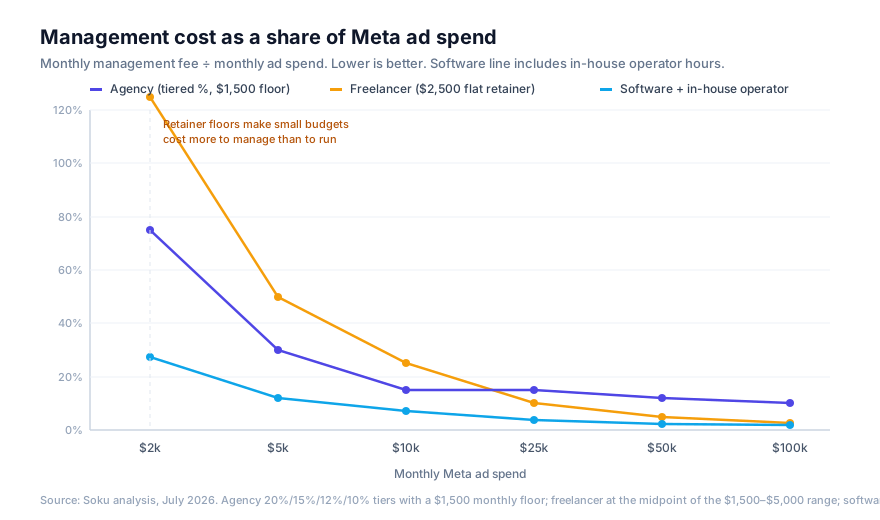
Three things fall out of that table, and they are not the things the pricing pages tell you.
First: below roughly $10,000/month, the retainer floor is the whole story. At $2,000 of spend, an agency's $1,500 floor means you are paying 75 cents in management for every dollar that reaches Meta's auction. A freelancer at $2,500 costs you more than your entire ad budget. This is not agencies being greedy — it genuinely takes a similar number of hours to run a $2,000 account and a $10,000 account, so the floor reflects real cost. But it means the honest advice for a business under $5k/month is that paid management of any kind is difficult to justify, and the money is better spent on the ads themselves plus a tool that compresses the operator time.
Second: the freelancer line crosses the agency line around $20,000–$25,000/month. Below that crossover, the agency's floor makes it the cheaper of the two human options. Above it, the freelancer's flat retainer wins on price and keeps winning by a widening margin — at $100k of spend a freelancer costs a quarter of what an agency costs. Whether that is a good trade depends entirely on whether one person can carry a six-figure monthly account, which for most businesses is where a single freelancer starts to break.
Third: software is the cheapest line at every band, and that fact is less useful than it looks. Because the operator hours are the constraint, not the dollars. Which brings us to the actual decision.
The test that decides it
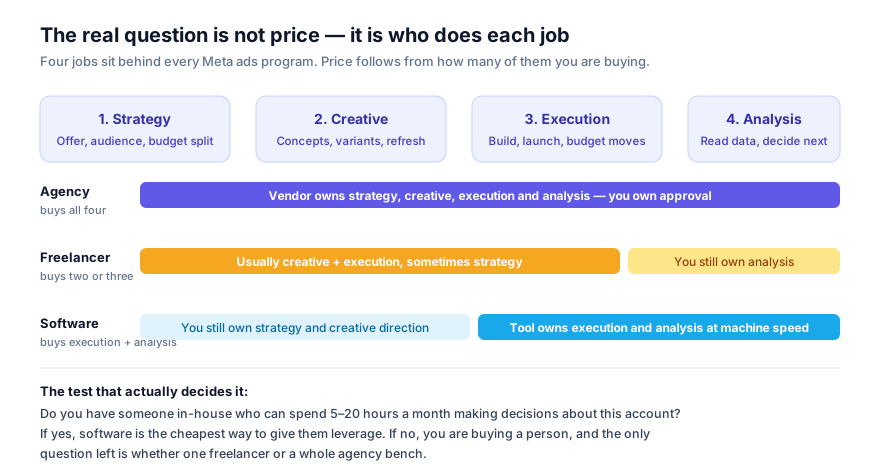
Every Meta ads program contains four distinct jobs:
- Strategy — what the offer is, who it is aimed at, how budget splits across prospecting and retargeting, what a win looks like.
- Creative — concepts, the variants that test them, and the refresh cadence that keeps them from fatiguing.
- Execution — building campaigns, launching them, moving budget, pausing losers, fixing tracking.
- Analysis — reading what happened and deciding what to do next.
An agency sells you all four. A freelancer typically sells creative and execution, sometimes strategy, and almost never a rigorous analysis layer. Software sells execution and analysis — increasingly well, and at machine speed — and hands strategy and creative direction back to you.
So the test is not "what is my budget." It is:
Do you have someone in-house who can spend 5–20 hours a month making decisions about this account?
If the answer is yes, software is by far the cheapest way to give that person leverage, and the table above understates the gap because a good tool also makes their hours more productive. If the answer is no, then you are not shopping for software at all — you are hiring a person, and the only remaining question is whether you need one freelancer or a whole agency bench.
Businesses get this wrong in both directions. They buy a $249/month platform with nobody to operate it, and then conclude that "the software didn't work." Or they pay an agency $3,000 a month to run a $6,000 account while a perfectly capable marketing manager sits two desks away with no tooling.
Where each option is genuinely the right answer
Choose an agency when
- You have no in-house paid-media capability at all and no plan to build one.
- Your spend is above $10,000/month, so the floor stops distorting the price.
- You need more than Meta — the same team is running Google, TikTok, and email, and the coordination is worth paying for.
- You want creative production included. This is the most underrated part of agency value. Concepting, shooting, editing and versioning ads is a real cost centre, and an agency retainer that includes it is often cheaper than assembling that capability yourself.
- Your account has a compliance, regulatory, or brand-safety dimension that needs a human who is accountable.
The failure mode to watch for: a percentage-of-spend agency has a structural incentive to increase your spend, not your profit. Ask, before signing, what happens to their fee if the correct recommendation is to spend less. A good agency will have a clean answer.
Choose a freelancer when
- Your spend is $10,000–$50,000/month and the account is Meta-only or Meta-dominant.
- You need one specific skill deeply — a media buyer who lives inside Advantage+ all day beats a generalist agency team.
- You have someone internally who can own strategy, and you are buying execution.
- You can tolerate key-person risk. This is the real cost of the freelancer model and it is not on any pricing page. One person gets sick, takes a holiday, or takes a full-time job, and your account stops.
Mitigate it the boring way: insist that all work happens inside your Business Manager, under your ad account, with your pixel and your creative assets. If a freelancer runs your ads through their own account, you are renting your own advertising history.
Choose software when
- You have an in-house operator, even a part-time one.
- Your spend is under $10,000/month, where every human option is dominated by its own floor.
- Your bottleneck is volume of creative variants and speed of iteration, not strategic direction. This is the case for most ecommerce accounts, and it is precisely what the tooling layer is now good at — our video ad variant generation workflow walks through what that looks like in practice.
- You want the analysis layer to be continuous rather than a monthly deck. A tool watching an account daily will catch a fatiguing creative or a runaway ad set faster than a human reviewing on a weekly cadence.
The combination almost nobody prices out
The configuration that most often wins for a business spending $15,000–$60,000/month is not on any of these vendors' pricing pages: a part-time senior freelancer for strategy and creative direction, plus software for execution and analysis.
Run the numbers. A senior freelancer at 10 hours a month at $120/hour is $1,200. Add a $249 platform. Total: $1,449/month — less than half the $3,750 an agency would charge at $25,000 of spend, and you keep the senior human judgment that is genuinely hard to automate while handing the repetitive execution to something that does not get bored at 11pm.
The reason nobody sells you this is obvious: no single vendor books the whole revenue.
What is actually different in 2026
Two things have moved since the last time most of these pricing guides were written, and both compress the middle of the market.
Meta's own automation absorbed a lot of what mid-tier management used to be. Advantage+ campaigns, automated placements, and broad targeting have removed much of the manual structural work that agencies used to bill for. If a prospective agency's pitch deck is mostly about audience layering and manual bid management, they are selling you 2021. The work that still has real leverage is creative volume, offer testing, measurement hygiene, and knowing when to override the platform — which is a smaller and more senior job than it used to be.
The connector layer became real. Meta shipped an official MCP surface — we broke down what it does in Meta Ads AI Connectors for AI ad teams — which means an AI agent can now read and act on a Meta account through a supported interface rather than a scraped one. Practically, that moves the "execution and analysis" column of software from dashboards you look at toward work that gets done. That is why the software line in the table above can carry fewer operator hours in 2026 than the same line would have carried in 2024.
Neither of these makes strategy or creative direction cheaper. Both make execution cheaper. The pricing follows.
Questions to ask before you sign anything
Take these to any agency or freelancer conversation. The answers separate the good ones fast.
- What is your fee if I spend less next month? Tests whether their incentive is aligned with your profit or your budget.
- Whose Business Manager and ad account will the work live in? Yours is the only correct answer.
- Is creative production included, and how many new concepts per month? "Creative included" can mean 20 fresh concepts or two resized banners.
- What is the minimum term and the exit notice? Six-month lock-ins with 60-day notice are common and rarely necessary.
- Who actually touches my account day to day, and what else are they running? The person in the pitch is frequently not the person in the account.
- What reporting cadence do I get, and can I see the raw account? If you cannot open Ads Manager yourself, walk away.
- What happens to the pixel, the audiences, and the creative library if we part ways? These are your assets. Get it in writing.
How Soku fits
Soku AI is the software column in that table, so treat the following as interested but specific.
Soku connects to your Meta ad account and covers the execution and analysis jobs: pulling the account's real performance data, generating and versioning ad creative, and surfacing what changed and what to do about it — with actions gated behind your approval rather than fired automatically. It is not a replacement for a strategist, and we would rather say that plainly than sell you a $249 subscription you have nobody to operate.
Concretely, the fit is good if you have an operator and your bottleneck is throughput — creative variants, reporting, catching problems early. The fit is bad if you were hoping to outsource the thinking; buy a human for that, and then give them a tool.
Plans are Free, $49 Starter and $249 Pro, and you can connect a Meta account on the free tier to see your own numbers before deciding anything.
FAQ
How much does Meta ads management cost per month?
Between $500 and $10,000+ per month depending on the model and your ad spend. Agencies charge 10–20% of spend with a typical $1,500 retainer floor, freelancers charge $1,500–$5,000 flat, and software runs $50–$500/month plus your own operator hours. Below $10,000 of monthly ad spend, the floor dominates and management can exceed 30% of spend.
Is 20% of ad spend a fair management fee?
It is fair at small budgets and expensive at large ones. At $3,000 of spend, 20% is $600, which is below most agencies' real cost to serve. At $50,000, 20% is $10,000 a month and you should be negotiating toward 10–12%.
What is the minimum ad spend to justify hiring help?
Roughly $5,000/month for a freelancer and $10,000/month for an agency, on the basis that management should not exceed about 20–25% of spend once you are past the experimental stage. Below that, software plus your own hours is usually the only configuration that leaves enough money in the auction to learn anything.
Is a freelancer cheaper than an agency?
Above about $20,000–$25,000 of monthly spend, yes, and by a lot — the freelancer retainer is flat while the agency percentage keeps climbing. Below that crossover the agency's floor usually makes it the cheaper of the two, and the agency also brings redundancy the freelancer cannot.
Can software actually replace a Meta ads agency?
It replaces the execution and analysis parts, not the strategy and creative-direction parts. If your agency's value is mostly campaign building, budget shuffling and monthly reporting, software replaces it. If their value is a senior strategist and a creative team, it does not.
Do agencies charge a setup fee?
Frequently — typically $500 to $2,500 as a one-off for account audit, tracking setup, and initial campaign build. It is negotiable, especially against a longer term, and it is usually worth paying for if your pixel and conversions API setup is a mess.
How do I know if I am overpaying?
Divide your total management cost by your monthly ad spend. Under 10% is efficient, 10–20% is normal, over 25% means you are either too small for paid management or being overcharged. Then ask the harder question: how many new creative concepts and how many structural decisions did you actually receive last month for that fee?