 Soku AI
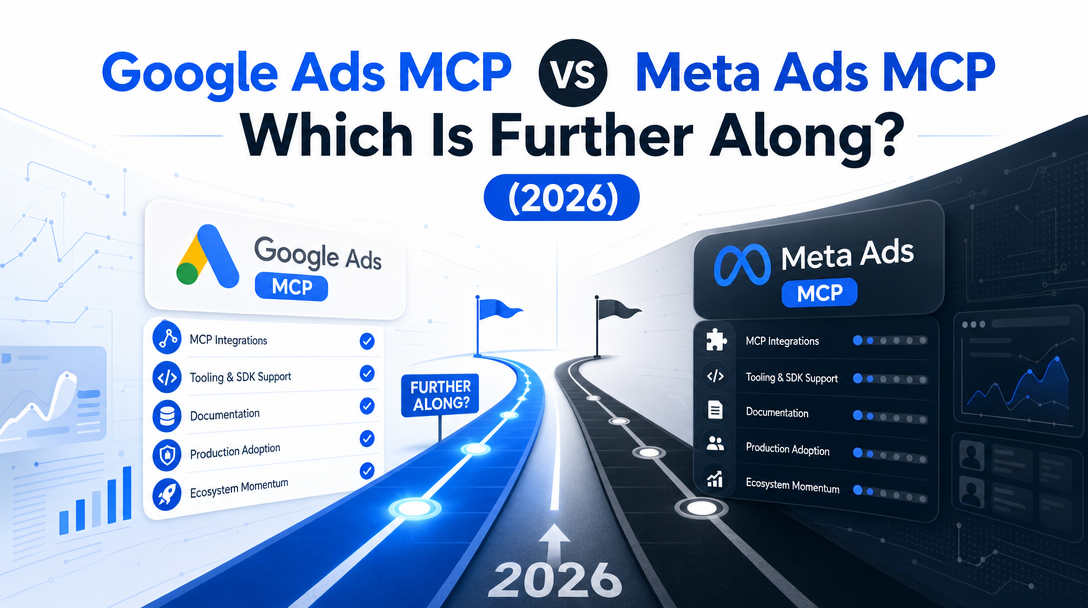
Two of the largest ad platforms on earth now ship an official Model Context Protocol (MCP) server, the standard that lets an AI agent like Claude call a platform's tools directly. On paper that sounds like parity: connect your agent, manage your ads. In practice the two servers were built by teams with very different risk appetites, and the gap between them tells you a lot about where agentic advertising actually is in 2026.
This is the bridge post between two clusters. If you want the full setup-and-capability treatment for each, start with the complete Google Ads MCP guide and the complete Meta Ads MCP guide. Here we put them side by side, score them on the dimensions an AI ad team actually cares about, and end with a verdict — including why the "weaker"-looking server may be the safer design.
The one-line difference
If you remember nothing else: Meta's MCP can change your account; Google's MCP can only read it. Meta ships a hosted server with roughly two-dozen tools that create and edit campaigns (in a paused state). Google ships a self-hosted, strictly read-only server whose entire job is to run GAQL queries and hand back data. Everything else in this comparison is a consequence of that single design choice.
That choice isn't an accident of maturity — it's a philosophy. Meta optimized for "let the agent do the work, then a human approves." Google optimized for "let the agent see everything, but never let it touch the live account." Both are defensible. Neither is finished.
The scorecard
Here is the head-to-head across the six dimensions that decide whether you can put an MCP into a real workflow.
| Dimension | Meta Ads MCP | Google Ads MCP |
|---|---|---|
| Hosting | Hosted by Meta (remote endpoint) | Self-hosted (local or your own Cloud Run) |
| Tool count | ~29 tools | 3 tools |
| Read access | Full (accounts, campaigns, insights, audiences) | Full, via GAQL |
| Write access | Create + edit (campaigns/ad sets/ads created paused) | None — strictly read-only |
| Auth | Meta Business OAuth, effectively one-click | OAuth 2.0 (or service account) plus a developer token |
| Query model | Natural per-entity tools (create_campaign, get_insights) | One search tool that takes raw GAQL |
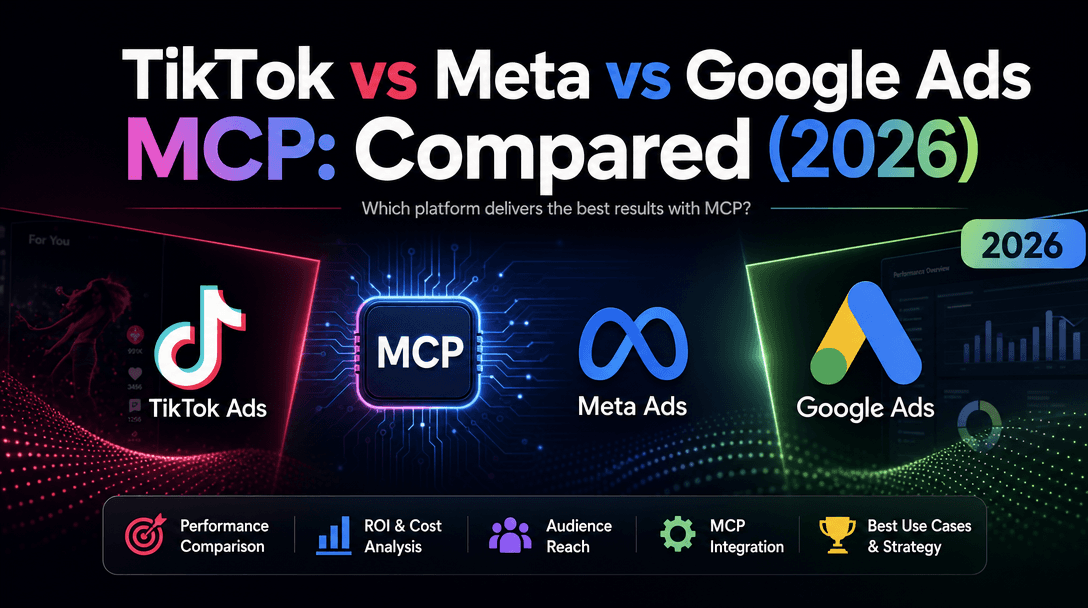
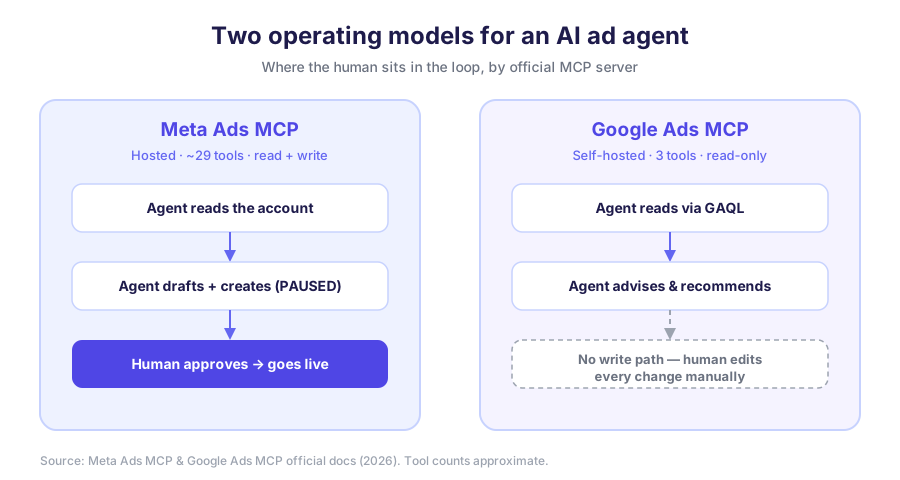
The visual below sums up the same contrast as an operating-model split — what each server lets the agent do, and where the human sits in the loop.
Hosting: hosted convenience vs self-hosted control
Meta runs the server for you. You point your MCP client at Meta's remote endpoint, authenticate, and you're live — there is nothing to deploy, patch, or keep running. For a marketer who just wants Claude talking to their ad account in ten minutes, that is a real advantage.
Google does the opposite. The official server is something you host yourself — locally for testing, or on Google Cloud Run (or any cloud) for a team. That means you own the deployment, the credentials, and the uptime. It's more work, but it also means your ad data never passes through a vendor's hosted layer, and you can lock the server inside your own network. For security-conscious or agency environments, self-hosting is a feature, not a tax.
The trade is classic: Meta gives you speed, Google gives you control. If you're a solo operator, hosted wins. If you're an agency with compliance reviewers, self-hosting may be the only version your security team signs off on.
Tool count: 29 vs 3 (and why the number lies a little)
The tool counts look lopsided — Meta exposes around 29 discrete tools, Google exposes three. But the raw number oversells the gap.
Meta's surface is broad because it is granular: separate tools to create a campaign, create an ad set, create an ad, fetch insights, manage custom audiences, pull pages, and so on. Each verb-on-noun is its own tool, which is exactly what makes Meta's server feel like a real management API to an agent.
Google's three tools are deliberately minimal:
list_accessible_customers— returns the Google Ads customer IDs and account names the credentials can reach.search— executes a GAQL query and returns metrics, budgets, and status.get_resource_metadata— describes the API's resource types so the agent can construct valid queries.
In practice, search is the product. Because GAQL can express almost any read against the Google Ads API — campaigns, ad groups, keywords, budgets, conversions, change history — that single tool covers an enormous read surface. Three tools that wrap an entire query language is not the same as three buttons. So the honest reading is: Meta has far more write capability and more hand-holding; Google has comparable read breadth compressed into one expressive tool.
Read vs write: the line that decides everything
This is where the two diverge most sharply, and it's the dimension that should drive your decision.
Meta's server can both read and write. An agent can draft a full campaign — campaign, ad set, creative — and Meta's design backstops the risk by creating new entities in a paused state so nothing spends before a human flips it live. That's a genuine "agent builds, human approves" loop, and it's the most advanced write story any official ad MCP ships today.
Google's server writes nothing. The documentation is blunt: it "cannot modify bids, pause campaigns, or create new assets." The agent can analyze your entire account in depth and tell you exactly what to change — but a person still has to make every edit in the Google Ads UI or via a separate script.
So the practical split is:
- *Want the agent to do the work?* Only Meta's MCP can. It drafts and edits; you approve.
- *Want the agent to understand and advise?* Both do this well; Google's GAQL surface is arguably the stronger analyst.
We dig into what each capability tier means strategically in the Google Ads MCP analysis for AI ad teams and the Meta MCP analysis for AI ad teams.
Auth: one-click OAuth vs OAuth plus a developer token
Onboarding friction is where Google's enterprise heritage shows.
Meta uses Business OAuth. You authorize the connection against your Meta Business account, grant ad permissions, and you're done — effectively one click for someone who already manages the account.
Google requires more. You need OAuth 2.0 credentials (or a service account) and a Google Ads developer token — a 22-character string issued through an API access application that can sit in a "test account only" tier until Google approves production access. You also supply a Cloud project ID. None of this is hard for a developer, but it is several steps and at least one approval gate more than Meta. For a non-technical marketer, the Meta path is dramatically smoother; the Google path usually means involving whoever owns your API access.
GAQL vs natural tools: power vs ergonomics
The query models reflect the same philosophy split.
Google hands the agent raw GAQL through one search tool. GAQL is SQL-like and extremely expressive — SELECT campaign.name, metrics.cost_micros FROM campaign WHERE ... — which means a capable model can ask for almost anything in one round trip. The catch: the agent has to write correct GAQL, know the resource schema (hence get_resource_metadata), and remember Google quirks like cost_micros (spend is in millionths of a currency unit). It's powerful, and it leans on the model's competence.
Meta hands the agent named, typed tools — get_insights, create_campaign, get_ad_accounts. Each tool has a clear schema, so the agent doesn't have to author a query language; it fills in parameters. That's more ergonomic and less error-prone for the model, at the cost of being bounded by whatever tools Meta chose to expose.
Neither is strictly better. GAQL gives you a ceiling-less read surface if your model is sharp; named tools give you reliability and write actions if you stay inside the lines.
What each is ready for today
Map the two servers onto the jobs an AI ad team actually runs:
| Job to be done | Best server today |
|---|---|
| Pull deep cross-account performance analysis | Google (GAQL read surface) |
| Let an agent draft new campaigns for human approval | Meta (write + paused creation) |
| Stand up in ten minutes, no deploy | Meta (hosted) |
| Keep ad data inside your own network | Google (self-hosted) |
| Hand to a non-technical marketer | Meta (one-click OAuth) |
| Edit live entities autonomously | Neither — by design |
The honest takeaway: neither server lets an agent run your account unattended, and that's correct for 2026. Meta is further along on action; Google is further along on containment.
The verdict — and why read-only-first may be the smarter design
If "further along" means "can the agent change my ads," Meta wins outright — it's the only official ad MCP that writes, and its paused-creation safety net is a genuinely thoughtful design. For a team that wants an agent to build, Meta is the obvious starting point today.
But there's a contrarian case for Google's restraint, and it's worth taking seriously. The single biggest risk in agentic advertising isn't a bad analysis — it's an agent confidently making a wrong change that spends real money. A read-only server makes that class of incident structurally impossible. You get the full value of an AI analyst (and GAQL gives a sharp model a huge surface to reason over) with zero blast radius. As models get better at advising and worse mistakes get more expensive, "read everything, write nothing" looks less like immaturity and more like a deliberate safety posture you'd actually choose.
Our verdict for most AI ad teams in 2026:
- Start read-only on both platforms. Let the agent analyze, surface opportunities, and draft recommendations before it ever touches a live entity.
- Add Meta's write path deliberately, with the human-approval gate as a hard requirement, not an afterthought.
- Treat write access as a privilege you grant per workflow, not a default you turn on everywhere.
That's also how Soku approaches it. Rather than betting on one platform's MCP design, Soku sits above both — reading from each account's data surface, drafting the changes an analyst would recommend, and keeping a human in the loop before anything spends. The platforms will keep shifting their read/write lines; the operating model that survives those shifts is the one where the agent advises by default and acts only with approval.
The bottom line
Meta's MCP is the more capable manager; Google's MCP is the more disciplined analyst. Meta is hosted, broad, and can write inside a safety net. Google is self-hosted, minimal, read-only, and quietly safer for it. "Which is further along" depends on whether you want an agent that does the work or one that can't possibly break it — and the right answer for most teams, today, is to use both for reading and grant writing slowly and on purpose.
For the full deep dives, see the Google Ads MCP complete guide and the Meta Ads MCP complete guide, plus the strategic reads on what each means for Google-side AI ad teams and Meta-side AI ad teams.