 Soku AI
Google quietly published something that reframes how AI agents will touch paid search: an official Google Ads MCP server, documented inside the Google Ads API developer toolkit. It is small, it is deliberately constrained, and it is more interesting for what it refuses to do than for what it does. If you run paid media — or you're building the agent that will — this is the launch to read carefully.
This post is the strategic read. For the full hands-on walkthrough, see our complete Google Ads MCP guide; for how the official server stacks up against the community connectors, see our ranked comparison of Google Ads MCP servers. Here we're after one question: what changes — and what deliberately does not — when an agent can interrogate your Google Ads account in plain language but cannot touch a single bid?
What Google actually shipped
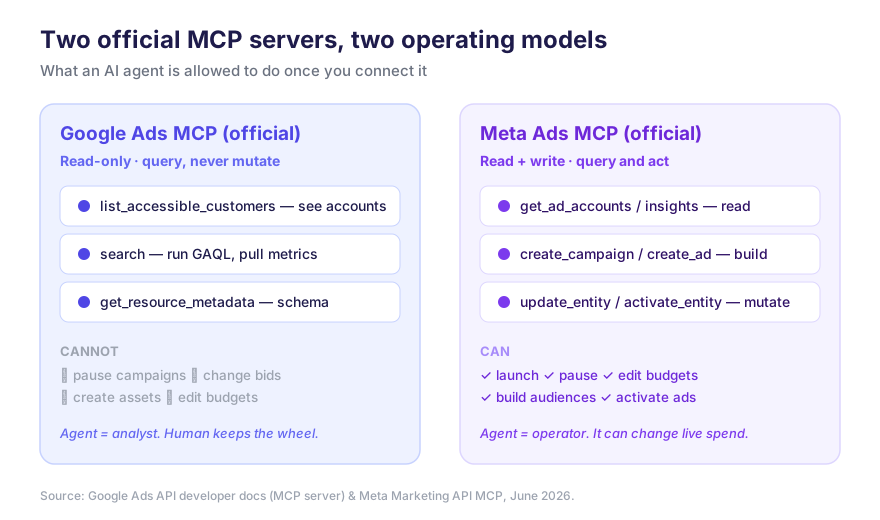
The official Google Ads MCP server exposes the Google Ads API to any MCP-speaking client — Claude, ChatGPT's agent mode, Cursor, or your own harness — through a tiny, well-defined tool surface. There are three tools, and the whole design philosophy is visible in the list:
| Tool | What it does |
|---|---|
list_accessible_customers | Returns the Google Ads customer IDs and account names the authenticated user can reach. |
search | Executes a Google Ads Query Language (GAQL) request to fetch metrics, budgets, and status. |
get_resource_metadata | Returns metadata about a resource type (e.g. campaign), so the agent knows the schema before it queries. |
That's it. One tool to discover accounts, one to query them, and one to teach the model the shape of the data. The center of gravity is search: it's the GAQL pipe, and it's the reason this is genuinely useful rather than a toy. Authentication runs through standard OAuth 2.0 or a service account, and you can run it locally or deploy it to Cloud Run, which keeps it usable for both a solo marketer on a laptop and a platform team standing up a shared internal endpoint.
The headline, though, is the sentence the docs go out of their way to state plainly: this implementation is strictly read-only. It cannot modify bids, pause campaigns, or create new assets. No mutate, no create, no update. The agent can see everything and change nothing.
"Read-only first" is a posture, not a missing feature
It's tempting to read the read-only constraint as v1 incompleteness — write operations coming in v2, presumably. That misreads the move. Read-only is the product decision, and it's the right one for where agents are today.
Think about the failure modes. A GAQL search that goes wrong returns bad numbers — annoying, but inert; you notice and re-run it. A mutate that goes wrong pauses a top-performing campaign at 2 a.m., zeroes a budget, or rewrites a bidding strategy on a six-figure account. The Google Ads API's write path is unforgiving precisely because it sits on real money. Handing an LLM — still prone to confidently malformed calls — a direct line to that path, on day one, with no mediation, is how you manufacture an incident. Google chose to ship the half of the surface where the blast radius of a hallucination is a wrong answer, not wrong spend.
There's a second, quieter reason. Read-only is trustless to adopt. A marketer can connect the server to their account in minutes without a security review, because the worst an agent can do is read data the marketer can already see. That dramatically widens the top of the funnel for agentic Google Ads. Write access would have forced every cautious advertiser and every brand-safety team to gate the integration behind approvals — and most never would. By shipping read-only, Google made the connector adoptable by default and bought itself time to design the mutation surface (approvals, dry-runs, scoped permissions) without holding the read use case hostage to it.
The operating model a read-only connector implies
Here's the part worth internalizing, because it dictates how you should actually build with this. A read-only connector doesn't make the agent a junior media buyer. It makes the agent a tireless analyst that hands recommendations to a human operator who keeps both hands on the wheel.
Concretely, the loop looks like this:
- The agent queries — "pull every campaign below a 2x ROAS over the last 14 days, with their budgets and impression share." That's a single GAQL call it can compose from natural language.
- The agent reasons — it spots the underperformers, the budget-capped winners, the wasted impression share, and writes the diagnosis in plain English.
- The agent recommends — "pause these three, shift $400/day from this campaign to that one, raise this tCPA by 15%."
- The human acts — the actual mutation happens in the Google Ads UI, in the API directly, or through a separate tool that has write scope and the guardrails to match.
This is a fundamentally different posture from "the agent runs your account." It's analysis-as-conversation, with the decision and the keystroke still human. For most teams that's not a limitation — it's the correct division of labor for 2026. The expensive, error-prone, soul-draining part of paid search isn't clicking "pause." It's the nightly slog of pulling reports, normalizing them across accounts, and finding the three things that actually matter. A read-only agent eats exactly that work and leaves the consequential decisions where they belong.
The catch: read-only means the loop never closes on its own. Insight and action live in two different places, and the handoff is manual. That's a feature for safety and a friction tax for velocity — and which one it is depends entirely on what you're optimizing for.
The contrast that defines the moment: Google read-only vs. Meta read+write
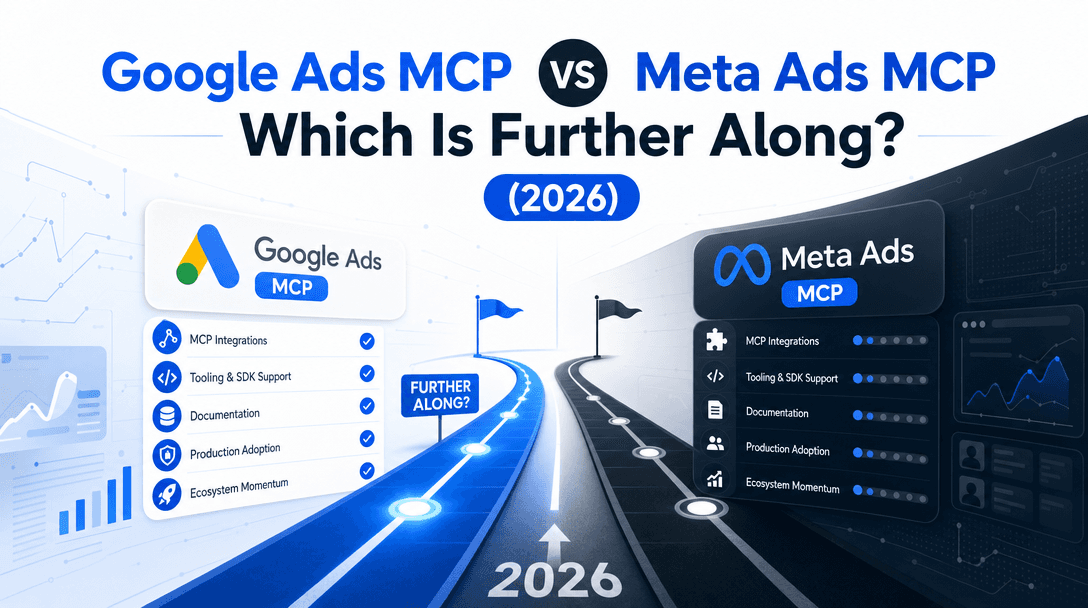
This is where it gets strategically interesting, because the other platform made the opposite call. Meta's official MCP server is a full read and write surface — an agent connected to it can create_campaign, create_ad, update_entity, build custom audiences, and activate ads. It can change live spend. We unpacked that connector in detail in our analysis of what Meta's official MCP means for AI ad teams, and the head-to-head — tool by tool, scope by scope — lives in our Google Ads MCP vs. Meta Ads MCP comparison.
Two platforms, two philosophies, shipped within months of each other:
| Google Ads MCP | Meta Ads MCP | |
|---|---|---|
| Surface | Read-only | Read + write |
| Agent role | Analyst / recommender | Operator / executor |
| Worst-case error | Wrong answer | Wrong spend |
| Adoption friction | Near-zero — read your own data | Requires trust + guardrails |
| Loop closure | Manual handoff to human | Agent can close the loop |
Neither is "ahead." They're different bets on how much autonomy advertisers will tolerate from an LLM touching their money. Google bet on safety and broad adoption: get every advertiser comfortable with agentic querying first, earn trust, add mutation later behind the right controls. Meta bet on capability and velocity: give the agent the full toolset now and let advertisers decide how much rope to use. Google's posture says the bottleneck is trust; Meta's says the bottleneck is capability.
Both can be right at once, because they're describing different stages of the same adoption curve. The teams that win the next year are the ones that read each platform's posture correctly and don't try to force Google's connector to be Meta's — or vice versa.
What this changes for your stack today
So you've connected the official Google Ads MCP to your agent. What's genuinely different on Monday?
- Reporting collapses into conversation. "How did Brand vs. Non-Brand split last week by device?" becomes one GAQL call instead of a saved report, an export, and a pivot table. This is the single biggest day-one win, and it's available to anyone.
- Cross-account triage gets fast.
list_accessible_customersplus a loop ofsearchcalls lets an agent sweep an entire MCC for anomalies — the kind of audit that eats an analyst's morning — in the time it takes to read the summary. - The agent learns your schema before it guesses.
get_resource_metadatameans the model can ground its queries in the real resource shape instead of hallucinating field names — a small tool that quietly makes thesearchtool far more reliable.
What it deliberately does not change
And this is the part to be honest with your stakeholders about:
- No autonomous optimization. The agent cannot pause a loser or scale a winner. Every action still routes through a human or a separate write-capable system. If someone sold you "the AI runs your Google Ads," the official server is not that — not yet, and on purpose.
- No closed-loop automation on this connector alone. Because insight and action are split, end-to-end automation requires bridging the read surface to a write path you trust. That bridge is yours to build (or buy).
- It doesn't make GAQL go away. The agent writes the query language for you, but the quality of the question is still on you. Garbage prompt, garbage GAQL, garbage answer. The constraint moved from "can you write GAQL" to "do you know what to ask" — which is the better problem to have, but it's still a problem.
Where Soku fits
Soku is an ad-automation agent that lives across both worlds — the read-only Google posture and the read-write Meta one — and the read-only/read-write split is exactly the seam it's designed to manage. The analysis layer (pull, normalize, diagnose across Google and Meta in one conversation) maps cleanly onto Google's connector. And when you do want to close the loop, Soku puts the mutation behind explicit confirmation and an audit trail — so the agent can recommend a budget shift the way Google's read-only model intends, and you decide whether it ever becomes a write. The point isn't to override either platform's posture. It's to give you one conversation that respects both.
The bottom line
Google's official Ads MCP is small, sharp, and strategically loud. Three tools, strictly read-only, and a clear message: we'll let agents see everything and change nothing — until the trust is there for more. For AI ad teams, the move is to lean all the way into the analyst role this enables, get fluent at conversational reporting and cross-account triage, and build the write path separately and carefully — instead of waiting for Google to hand you a mutate tool it isn't going to ship until it's safe. Read-only isn't the limitation. It's the on-ramp.
For the full setup walkthrough and a deeper map of the ecosystem, start with our Google Ads MCP guide.