Soku AI
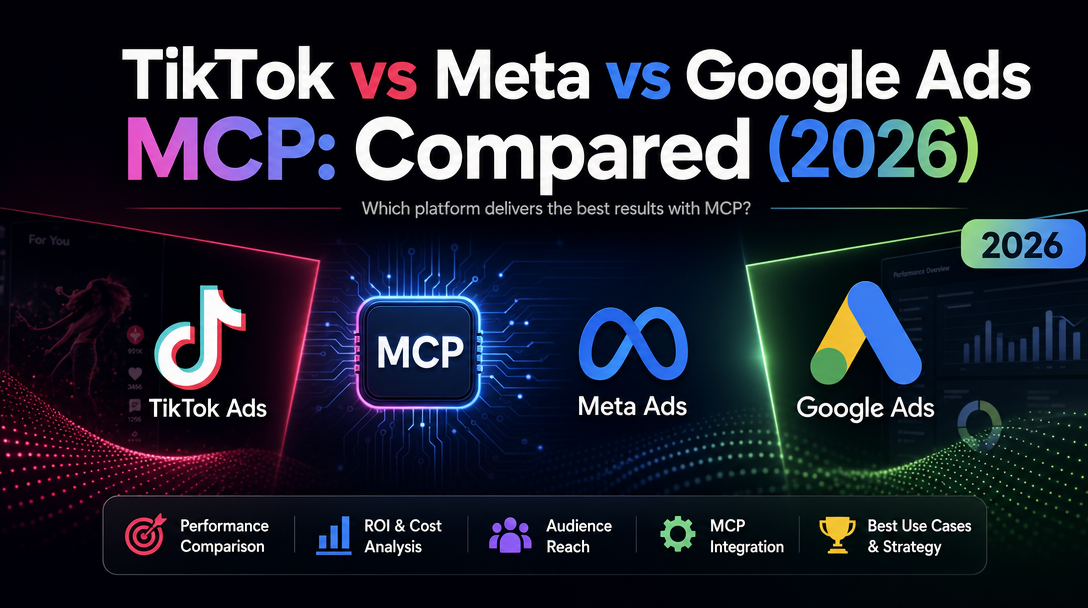
Three of the biggest ad platforms on earth now have a Model Context Protocol (MCP) story — the standard that lets an AI agent like Claude or ChatGPT call a platform's tools directly instead of you clicking through a dashboard. On paper that reads like a three-way tie: connect your agent to TikTok, Meta, or Google Ads and let it run your campaigns. In practice the three are not even close to the same stage. One of them you cannot use at all yet.
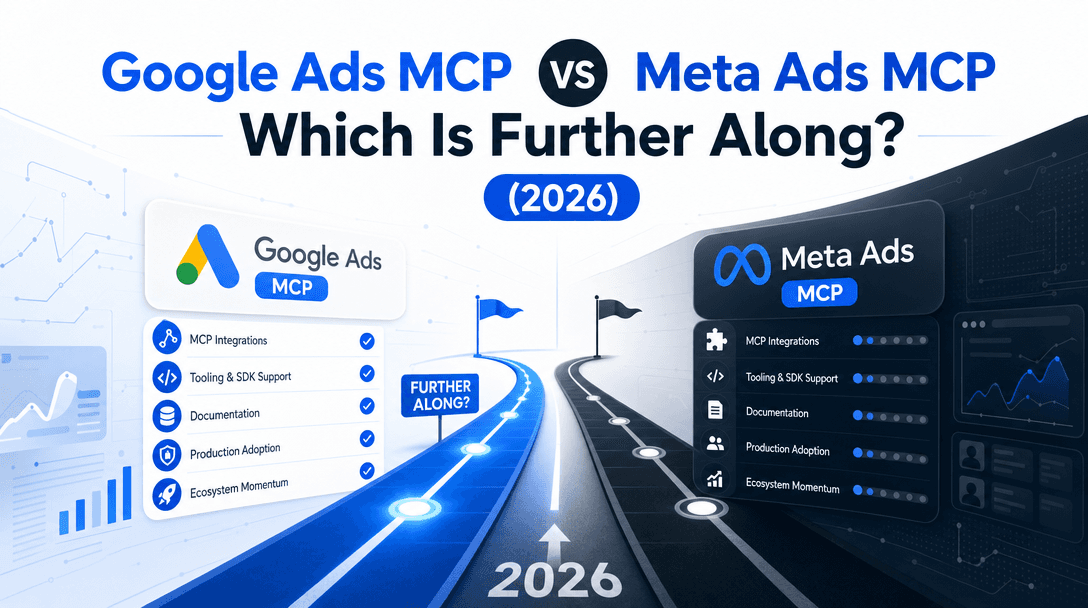
This post puts the google ads mcp, the meta ads mcp, and the tiktok ads mcp side by side along a maturity gradient, then gives an honest verdict on which is furthest ahead. If you want the full single-platform treatment for TikTok specifically, start with the pillar: TikTok Ads MCP and Agentic Hub. If the new marketplace layer is your question, read TikTok Agentic Hub for AI Ads. For the two-platform deep dive on the official servers, see Google Ads MCP vs Meta Ads MCP.
The maturity gradient in one sentence
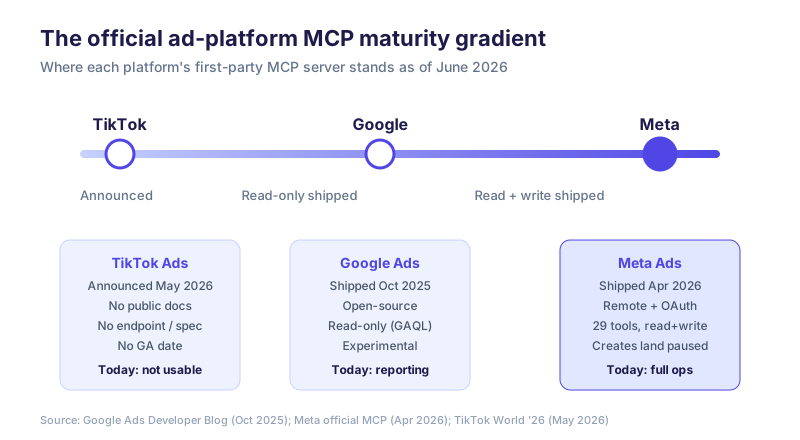
If you remember nothing else from this comparison: Google opened the door with a read-only server, Meta proved that read-and-write is safe to ship, and TikTok arrived last with an announcement and not much else. Every other difference below is a downstream consequence of where each platform sits on that timeline.
That ordering is counterintuitive if you rank platforms by ad spend or cultural relevance, where TikTok punches well above its weight. But MCP maturity is about engineering risk appetite and shipping discipline, not audience size — and on that axis the order is Google first, Meta most capable, TikTok last.
It also helps to be precise about what "an MCP server" buys you, because the term gets thrown around loosely. An MCP server is not a chatbot and not a dashboard. It is a typed contract: a published list of tools, each with defined inputs and outputs, that any MCP-aware agent can discover and call. The value isn't that Claude can "talk to" Google Ads — it's that the agent can enumerate exactly which operations exist, call them with structured arguments, and get structured data back, without anyone writing glue code per platform. That is why an announced server is worth so much less than a shipped one: until the tool list, the schemas, and the endpoint are public, there is no contract for an agent to bind to, and "AI agents can run TikTok campaigns" is a slide, not a capability.
Google Ads: first through the door, read-only
Google was the first major ad platform to ship an official MCP server. It open-sourced the Google Ads API MCP server in October 2025, and the framing was deliberately conservative. The server is self-hosted, open-source, and explicitly experimental — Google labeled it as such rather than dressing it up as a finished product.
The defining constraint is that it is read-only. The Google Ads MCP server exists to run GAQL (Google Ads Query Language) queries and hand structured data back to your agent. It can pull campaign performance, surface which keywords are bleeding budget, and assemble a report from your account — but it cannot create a campaign, change a bid, or pause an ad. Nothing the agent does through this server can alter your account.
That sounds like a limitation, and it is, but it is also a sane first step. A read-only surface means the worst case of a hallucinating agent is a wrong number in a report, not a blown budget. Google effectively shipped the half of agentic advertising that carries almost no downside and held back the half that carries real money risk. For the full setup-and-capability treatment, see the complete Google Ads MCP guide.
For context, Google was not alone in the read-leaning camp for long: Amazon Ads entered open beta with its own MCP in February 2026, broadening the set of platforms an agent can at least read from. But Amazon's beta does not change the headline — the first official ad-platform MCP, and the first to set the read-only precedent, was Google's.
Meta Ads: the one that proved write is safe
Meta shipped its official MCP server on April 29, 2026, and it is the most capable of the three by a wide margin. Where Google held back from writes, Meta went the other way: the server does read and write from day one, exposing roughly 29 tools that cover both pulling insights and actually building campaigns.
Three design decisions make Meta's server the maturity benchmark. First, it is remote and OAuth-gated — you authenticate through Meta's own consent flow rather than pasting long-lived tokens into a config file, and there is no Developer App to register as a prerequisite. That removes the single most common piece of friction in connecting an agent to an ad account. Second, the toolset is genuinely operational: an agent can create campaigns, ad sets, ads, and creatives, not just report on them.
Third — and this is the detail that makes write safe — every create operation lands in a paused state. The agent can assemble an entire campaign structure, but nothing starts spending until a human reviews it and flips it live. That single guardrail is what lets Meta ship write capability without it being reckless. It is the same insight Google encoded by staying read-only, just expressed as a safety default instead of a hard wall. For the full treatment, see the complete Meta Ads MCP guide.
The takeaway: Meta didn't just ship more tools than Google. It demonstrated that read-and-write agentic advertising can be shipped responsibly, by pairing OAuth-gated access with a created-paused default. That is why, on capability, Meta sits at the far end of the gradient.
TikTok Ads: announced, not shipped
Here is where honesty matters most. TikTok's official MCP server was announced at TikTok World '26 on May 12–13, 2026 — and as of early June 2026, that is all it is: an announcement.
What TikTok showed is real and worth taking seriously. The announcement covers support for Claude and ChatGPT, and an "Ads Skills" toolkit that, per TikTok, spans campaign creation, performance insights, creative analysis, audience discovery, and budget optimization. Coverage from TikTok's own newsroom, Digiday, and Social Media Today all describe an ambitious, write-capable vision on paper.
But the gap between announcement and availability is the whole story. As of early June 2026 there is no public documentation, no endpoint to connect to, no published tool specification, and no general-availability date for TikTok's official MCP server. You cannot wire your agent to it today, because there is nothing to wire it to. Anyone telling you the official TikTok Ads MCP is usable right now is wrong.
There is a real workaround, though, and it is important not to overcorrect into "TikTok has nothing." TikTok is usable from an AI agent today — just not through a first-party server. Community-built MCP servers have existed since mid-2025, including open-source projects like AdsMCP's tiktok-ads-mcp-server and ysntony's tiktok-ads-mcp. These wrap the TikTok Marketing API and give an agent a real, working connection right now. They are not official, they are not OAuth-gated by TikTok, and they carry the usual third-party maintenance risk — but they are the only way to run TikTok ads through an agent in June 2026. We rank them in Open-Source TikTok Ads MCP Servers, walk the wiring in How to Connect TikTok Ads to Claude, and break down the underlying surface in TikTok Marketing API v1.3 Explained.
The head-to-head table
Here is the comparison condensed. Treat the "today" columns as fact and the trajectory column as informed opinion.
| Dimension | Google Ads MCP | Meta Ads MCP | TikTok Ads MCP (official) |
|---|---|---|---|
| Status | Shipped (Oct 2025) | Shipped (Apr 29, 2026) | Announced (May 2026), not GA |
| Hosting | Self-hosted, open-source | Remote, hosted by Meta | Unknown (no endpoint) |
| Auth | Local API credentials | OAuth, no Developer App | Unknown |
| Read | Yes (GAQL queries) | Yes | Announced |
| Write | No (read-only) | Yes (29 tools) | Announced, no spec |
| Safety default | Read-only by design | Creates land paused | Unknown |
| Maturity label | Experimental | Production-ready | Announcement only |
| Usable today? | Yes, for reporting | Yes, full ops | No (use community servers) |
The one nuance the table flattens: "usable today" for TikTok is a hard no for the official server but a qualified yes through community servers. If your only options are first-party, TikTok is off the table entirely.
What each stage means for your workflow
The maturity gradient isn't an abstraction — it changes what your agent can be told to do on each platform.
On Google, the natural prompt shape is investigative: "find the campaigns whose cost-per-conversion rose more than 20% week over week," or "list every search term that spent over $50 with zero conversions last month." The agent gathers, joins, and summarizes; you act on the findings yourself in the Google Ads UI. It is a powerful analyst and a powerless operator, which for many teams is exactly the trust level they want before handing an agent the keys.
On Meta, the prompt shape becomes operational: "build three ad sets targeting these audiences with this creative and a $30 daily budget, paused." The agent assembles the whole structure and stops at the line. Your review is now an approval step on a finished draft rather than a hand-built campaign, which is a different kind of leverage — the agent does the construction work, you do the judgment work. The created-paused default is what makes that delegation comfortable.
On TikTok, the official answer is "you can't, yet." The community-server answer is "you can, with caveats" — the same operational prompt shape as Meta, but routed through a third-party wrapper you have to install, trust, and maintain yourself, without TikTok's OAuth flow or any first-party paused-by-default guarantee. That is a meaningfully higher operational burden, and it is the price of being early on a platform whose official server hasn't shipped.
So which is furthest ahead?
It depends on what "ahead" means, and the honest answer splits two ways.
On shipping discipline and time-in-market, Google is furthest ahead — it was first, it has been stable since October 2025, and read-only is a defensible product, not a placeholder. If your bar is "an official server that has proven itself in production," Google clears it most convincingly.
On capability, Meta is furthest ahead, and by a lot. It is the only official server that can actually operate an account — create campaigns, edit them, pull insights — while keeping the spend-risk contained behind a created-paused default and OAuth. For an AI ad team that wants an agent to do real work and not just read reports, Meta's MCP is the most complete option shipping today. That is our pick for the overall maturity leader.
TikTok is last, full stop. Not because the announcement is unimpressive — the Ads Skills vision is arguably the most ambitious of the three — but because a vision you cannot connect to is not a product. The opinion part: TikTok has a clear path to catch up fast, because it announced write capability from the start rather than easing in read-only like Google did. If TikTok ships the Ads Skills toolkit roughly as announced, with proper OAuth and a paused-by-default safety net, it could leapfrog straight to Meta's tier. But "could" is doing real work in that sentence, and there is no GA date to anchor it to. Until then, treat any TikTok MCP roadmap claim as forecast, not fact.
How Soku fits
If you don't want to wait for every platform's official server to mature — or stitch together a first-party Meta server, a read-only Google server, and a community TikTok server by hand — Soku gives you all three behind one agent today. Under Integrations → Bring Your Own, you connect TikTok, Meta, and Google Ads, and a single agent operates across all three. Every change runs through a human-in-the-loop approval gate before it goes live, and accounts are assigned per brand, so the agent only ever touches the account you've scoped it to. That gives you the created-paused safety model Meta pioneered, applied uniformly across platforms whose official MCPs are at three completely different stages of maturity.