 Soku AI
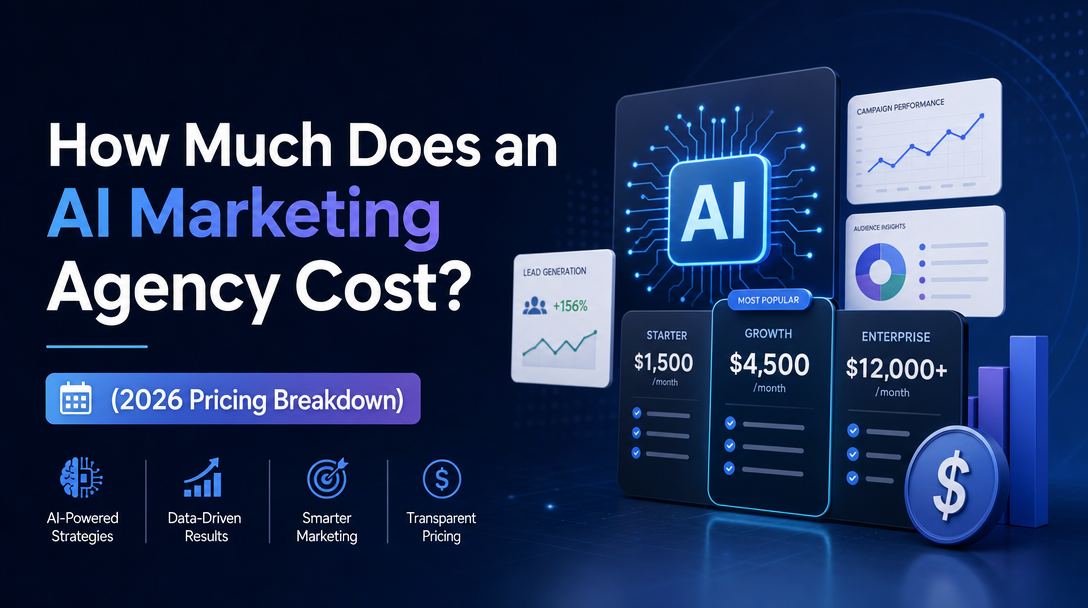
"How much does an AI marketing agency cost?" has a frustrating honest answer — anywhere from $500 to $200,000+ a month — because the label covers everything from a self-serve automation tool to a fully custom enterprise deployment. This post makes that range useful: the real numbers by business size, the three ways agencies bill, the fees that hide outside the headline price, and how to read a quote so you're comparing like for like.
This is the pricing spoke of our AI Marketing Agency buyer's guide — start there for the full overview. It targets "how much does an ai marketing agency cost" (the buyer-side money question). If you also want to compare the model itself, see AI Marketing Agency vs Traditional Agency; if you've set a budget and need to pick a vendor, see How to Choose an AI Marketing Agency.
Note: this is written for the buyer. If you run an agency and want to set your own rates, that's a different post — How to Price an AI Ads Agency. One disclosure: Soku is an AI ad-automation agent, so we explain the cost structure from the inside — including why the floor is as low as it is.

What an AI marketing agency costs, by business size
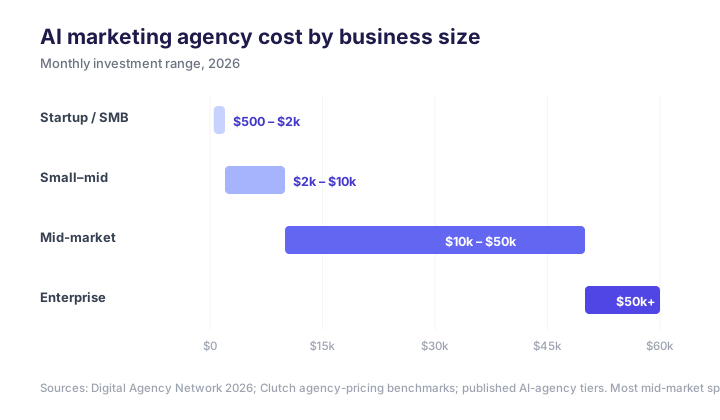
Price tracks scope, content volume, number of channels, and company size. The honest 2026 ranges:
| Business size | Monthly cost | Typically includes |
|---|---|---|
| Startup / small business | $500 – $2,000 | Basic automation, AI SEO, templated chat/creative agents |
| Small–mid | $2,000 – $10,000 | Dedicated manager, custom content, multi-channel campaigns |
| Mid-market | $10,000 – $50,000 | Custom model tuning, advanced data pipelines, deeper reporting |
| Enterprise | $50,000+ | Fully custom deployments, dedicated support |
The most common landing spot for mid-market brands is $5,000–$25,000 per month. For reference, digital marketing agency retainers commonly fall between $5,000 and $50,000 per month regardless of the AI label — so an AI agency quoting $3,000/mo for production-heavy scope is real, not a gimmick. It's the operating model (below) that makes that price sustainable.
The three billing models
Every AI marketing agency uses some version of three models. Which one you want depends on how much risk you're willing to carry versus hand off.
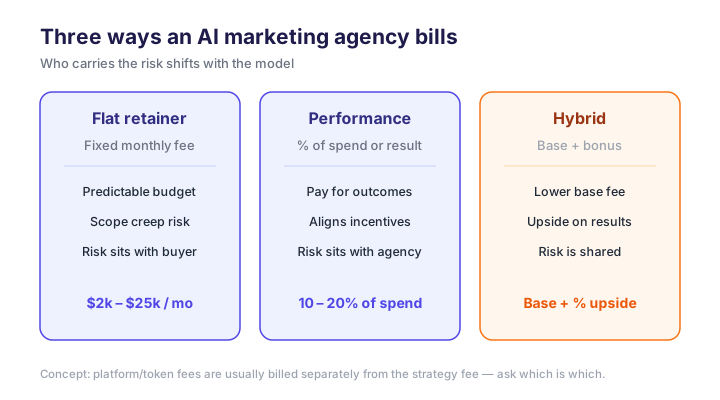
- Flat retainer — a fixed monthly fee, typically $2,000–$25,000 depending on scope. Predictable and easy to budget, but the risk sits with you: if results are flat, you still pay, and unscoped work can creep.
- Performance — a percentage of ad spend (commonly 10–20% of managed spend) or a share of a defined result. Incentives align and the risk shifts to the agency, but a percentage of spend can get expensive fast as you scale, and "performance" needs a tightly defined metric or it's meaningless.
- Hybrid — a lower base fee plus a bonus tied to results. Risk is shared, which is why it's increasingly the default for mid-market engagements: you cap your downside and the agency keeps upside for delivering.
There's no universally correct model. Small, execution-heavy accounts usually prefer a flat retainer for predictability; spend-heavy accounts often prefer performance or hybrid so the fee tracks value.
Why the floor is so low (the operating-model math)
The reason an AI agency can quote $2,000–$5,000/mo for work a traditional shop can't touch below $15,000 isn't a discount — it's a different cost structure. This is the part worth understanding as a buyer, because it tells you which "cheap" quotes are sustainable and which are a loss-leader that will change at renewal.
A traditional agency's cost is mostly labor, and labor scales linearly: every new client needs more human hours, so growth means more hires, more management, more overhead. An AI marketing agency's cost is mostly software, which is largely fixed. Once the agent and its integrations exist, adding a client costs the marginal compute plus a few hours of human review. That's why the same platform can profitably serve accounts at $2,000–$5,000/month — the tools are paid for, and more clients means the same tools plus marginal review time.
Concretely, a rough monthly cost stack for an AI-run engagement looks like: platform/tooling (fixed), agent compute and API/token usage (variable, scales with volume), and a slice of human oversight time. Compare that to a traditional retainer, which is mostly loaded salary for the humans doing the work. The gap between those two structures is the price difference — and unlike a promo, it doesn't evaporate at renewal.
The fees that hide outside the headline price
The number one way AI-agency quotes mislead is by quoting the strategy fee and leaving the platform costs off the page. Watch for:
- Platform and token fees. API usage, model/token costs, and third-party tool subscriptions may be billed separately from the agency's fee. A "$1,500/mo" quote can become $2,500 once token usage is added. Ask for platform fees to be itemized.
- Setup and onboarding. One-time integration and onboarding can run into the thousands, especially if your data is messy — an agent is only as good as the accounts and feeds it's wired into.
- Ad spend itself. The retainer is the management fee; your media budget is separate and larger. Make sure a quote is clearly one or the other.
- Contract length. A low monthly rate locked into 12 months before any proof is a worse deal than a slightly higher month-to-month.
A legitimate agency separates its strategy fee from platform costs and shows you both. If a vendor resists itemizing, treat that as a pricing red flag (more of these in the how to choose guide).
How to read a quote
Put every quote into the same shape before comparing: strategy/management fee + itemized platform and token fees + one-time setup + contract term. Two agencies quoting "$4,000/mo" can differ by thousands once platform fees and a setup charge are added on one side and bundled on the other. Comparing headline numbers alone is how buyers overpay.
Also ask what the fee actually buys in cadence and volume: how many campaigns, how many creative variants, how often the optimization loop runs, and how much of that is automated versus a human. A cheaper quote that runs a twice-daily human review is a different product from one running a continuous agent loop — see the vs traditional comparison for why iteration cadence matters more than the sticker price.
Is it worth it? A quick payback frame
For most execution-heavy accounts, the cost question answers itself on management fee alone: an AI agency at $3,000–$8,000/mo replaces scope that a traditional agency prices at $15,000–$50,000, so the fee gap is the immediate saving. On top of that, faster iteration can improve media efficiency — vendors claim double-digit CPA reductions, which you should treat as a claim to verify, not a guarantee. At meaningful spend, even a modest efficiency gain dwarfs the fee difference, which is why cost-per-month should never be your only lens. For the full worked model against an in-house buyer, see AI Media Buyer Cost vs an Agency.
Where Soku fits
Soku is priced as software that does agency work, not as an agency retainer — which is the whole point of the low-floor economics above. It connects to your Google, Meta, and TikTok accounts and GA4, runs the campaign and optimization loop continuously, and produces creative variants at volume, with a human owning strategy and approvals. For the complete decision — model, cost, and vetting — start at the AI Marketing Agency buyer's guide.
Frequently asked questions
What's the cheapest an AI marketing agency costs?
Around $500/mo for small-business automation, AI SEO, and templated agents. Below that you're usually buying a self-serve tool, not a managed service.
What do most companies actually pay?
Mid-market brands typically pay $5,000–$25,000/mo. Small and mid businesses commonly land at $2,000–$10,000/mo depending on channels and content volume.
Retainer, performance, or hybrid — which is cheapest?
It depends on spend. A flat retainer is cheapest and most predictable for smaller, execution-heavy accounts; performance or hybrid can be better value at high spend because the fee tracks results. Model both against your expected spend before signing.
Why are some quotes so much lower than a traditional agency?
Because the cost structure is software (largely fixed) rather than labor (scales with headcount). That gap is structural and sustainable — as long as the quote includes platform and token fees rather than hiding them.
Are there hidden costs?
Commonly: platform/token fees billed separately, one-time setup and onboarding, and long contract lock-ins. Always ask for the strategy fee and platform costs to be itemized separately.