 Soku AI
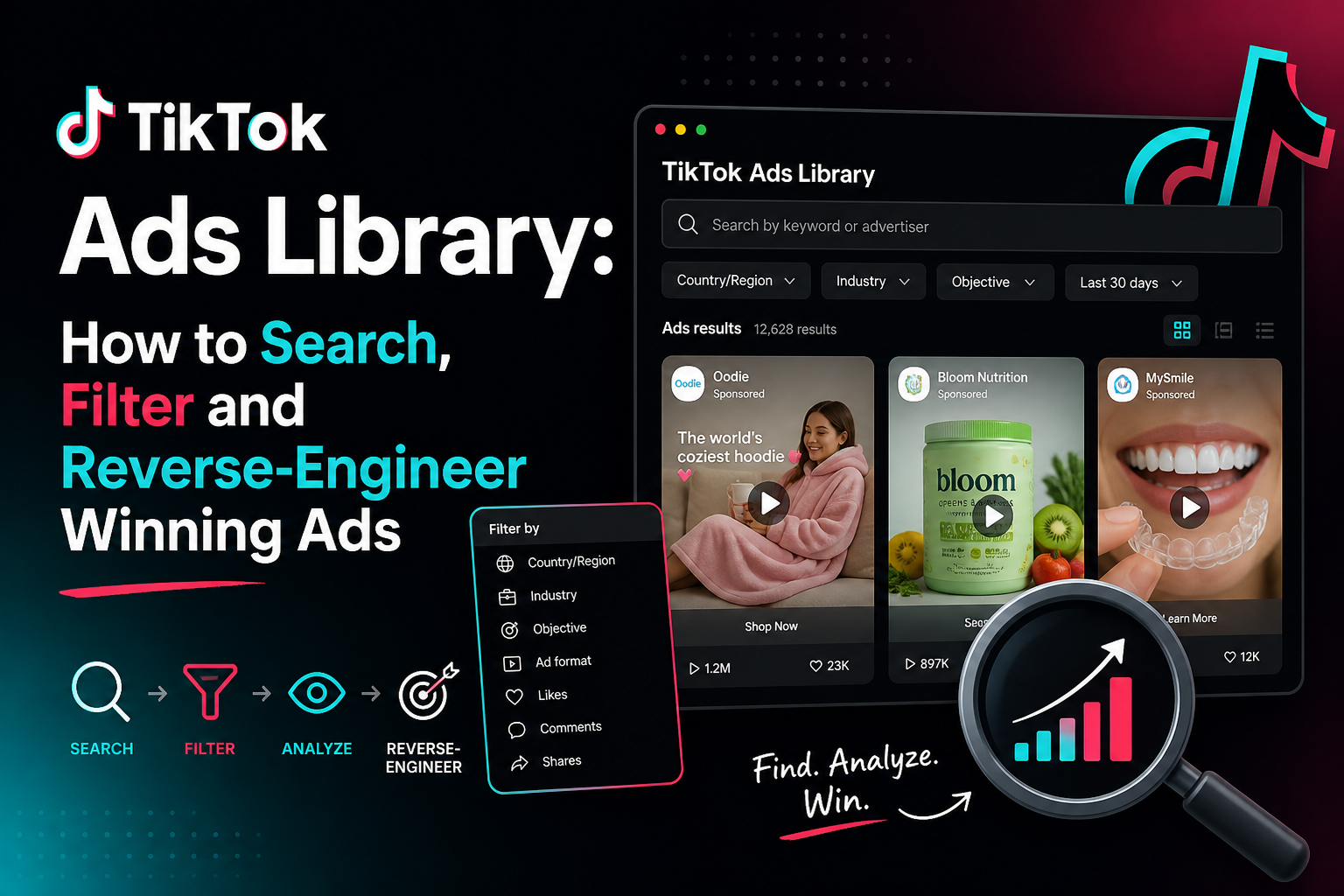
Most guides to the "TikTok Ads Library" have a problem: they describe a tool the reader probably can't use for the thing they want to do.
There are three separate TikTok products that people call the ads library, they expose completely different data, and only one of them is an actual advertising archive. That one — the Commercial Content Library — covers the European Economic Area, the UK, and Switzerland, and nothing else. If you are a US advertiser researching US competitors, the tool at the centre of most "TikTok Ads Library" articles will return nothing useful about them.
This guide separates the three, states exactly what each one gives you, and then gets to the part nobody writes: the archive has a structural bias baked into its retention rule, and once you understand that bias it becomes far more useful for reverse-engineering than it first appears.
The three tools, and which one you actually want
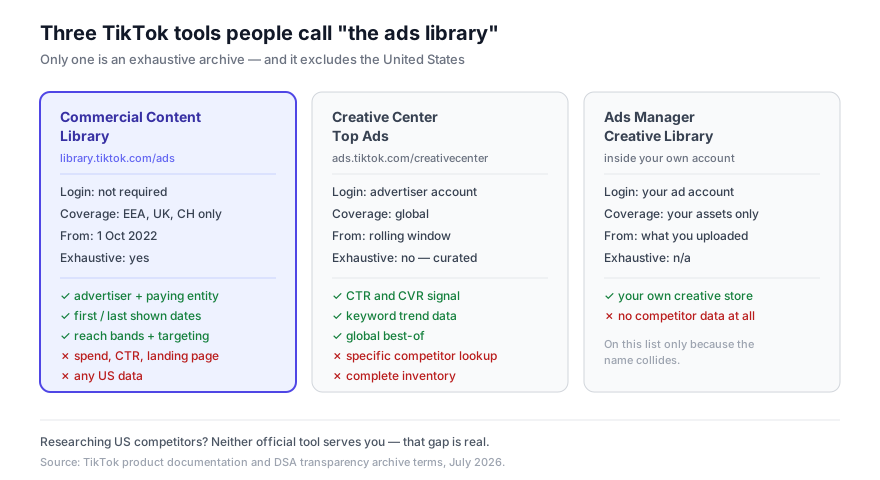
1. Commercial Content Library — the real archive
URL: library.tiktok.com/ads · Login: none required · Coverage: EEA, UK, Switzerland only, from 1 October 2022
This is TikTok's regulatory transparency archive, published to satisfy the EU's Digital Services Act. It is the only one of the three that attempts to be exhaustive rather than curated, and it is the only one that shows you ads from advertisers who never opted into being seen.
What it exposes per ad:
| Field | Detail |
|---|---|
| Advertiser identity | Handle, verified business name, and the paying entity when different |
| Business registration | Where the advertiser is legally registered |
| Ad ID | Unique, stable identifier |
| Dates | First shown and last shown |
| Reach | Bracketed bands, e.g. 100,000–1,000,000 users |
| Geography | Country-level reach breakdown across EU member states |
| Targeting summary | Age bracket, gender, location, interest clusters |
| Creative | Playable inline video |
What it does not expose, and this matters: no spend figures, no click-through or conversion rates, no custom audience definitions, no landing page URLs, no specific interest keywords inside a cluster, and no way to tell which creatives were A/B variants of each other.
2. Creative Center Top Ads — the curated showcase
URL: ads.tiktok.com/business/creativecenter · Login: preview without one, full access requires an advertiser account · Coverage: global, but opt-in
This is the one most "TikTok Ads Library" articles are actually describing, and it is a fundamentally different object: a best-of showcase, not an archive. In exchange you get a performance signal the transparency archive withholds — but it arrives as a percentile band ("Top 8% CTR") and a Low/High budget flag, not as an absolute click-through or conversion rate.
Two corrections worth carrying, both re-verified anonymously on 2026-07-30. First, appearance is advertiser-authorised: TikTok's own footnote states the ads shown are limited to those advertisers approved and may not reflect all top-performing auction ads — so it is an opt-in sample and a competitor's absence proves nothing. Second, the Keyword Insights surface is no longer reachable at either URL commonly cited in guides, and the Trends surfaces have migrated out into the newer TikTok One Creative Suite app.
We audited every Creative Center route and its full data schema in TikTok Creative Center: how to use it for ad research.
Use it for: what good looks like in your vertical right now, and directional creative patterns.
Do not use it for: "what is this specific competitor running," because a competitor's ads only appear if the advertiser authorised them.
3. Ads Manager Creative Library — your own assets
This is simply the asset store inside your own account. It contains creative you uploaded. It is on this list only because the name collides and it sends people looking in the wrong place.
The practical decision: if you need competitor-specific evidence and your competitors run in Europe, use the Commercial Content Library. If you need to know what is working on TikTok generally, use Creative Center. If you need competitor-specific evidence for US campaigns, neither official tool serves you — that gap is real, and worth stating plainly rather than papering over.
The retention rule is the most useful thing in the archive
Here is the detail buried in the documentation that changes how you should read the whole archive: ads are retained for one year from the last impression, not from the pause date.
Think about what that filter actually does to the population of ads you can see.
An ad that ran for three weeks as a test and got switched off in March 2025 is gone. An ad that has been running continuously since 2023 is still there, and its "last shown" date keeps rolling forward. The retention window does not sample TikTok advertising evenly — it systematically preserves long-running ads and deletes short-lived ones.
For a compliance archive that is a flaw. For a creative researcher it is close to a gift, because "has been running for eighteen months" is the single most reliable proxy for "this ad works" that exists in public data. Nobody keeps paying to serve a loser.
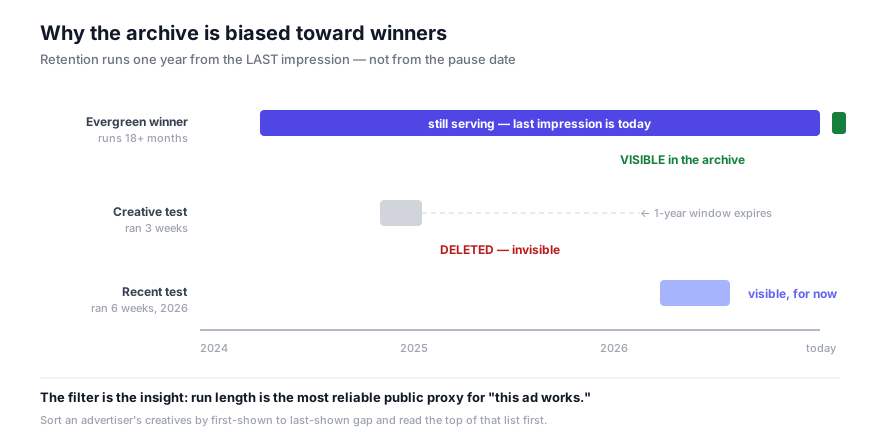
So the highest-value query in the Commercial Content Library is not "show me everything this advertiser runs." It is:
Sort by the gap between first-shown and last-shown, and read the top of that list. Those are the ads that survived. A creative with a 14-month spread has been through more audience saturation than any test you will run this quarter, and it is still live.
This single reframe is worth more than any filter combination, and it is the reason to use the archive even though it withholds spend and CTR. You do not need TikTok to tell you an ad performed. Longevity tells you.
A workflow that actually produces tests
Research that ends in a folder of screenshots is a waste of an afternoon. Here is the sequence that ends in a test queue instead.
Step 1 — Build the advertiser list before you open the tool. Five to fifteen names: direct competitors, the category leader, and two or three adjacent brands selling to the same person for a different reason. Searching by keyword first is how you end up with 400 irrelevant ads.
Step 2 — Pull each advertiser and sort by run length. For each, note the three longest-running creatives. Ignore everything else on the first pass. You are looking for survivors, not inventory.
Step 3 — Decompose the survivors on four axes, not vibes. For each long-runner, record: the hook in the first two seconds, the format (UGC talking-head, product demo, founder piece, text-on-screen listicle), the specific claim or offer, and the call to action. Four columns in a sheet. Patterns show up in about fifteen rows.
Step 4 — Read the targeting summary against the creative. This is the step people skip, and it is where the archive beats a scraping tool. When you can see that a survivor is targeted at 45–54 women in Germany, the creative choices stop looking arbitrary. Ads that look strange usually look strange because you are not the target.
Step 5 — Use the reach bands as a floor, not a ranking. A band of 100,000–1,000,000 is a wide bracket, so it will not rank two ads against each other. What it does tell you is which creatives got real distribution rather than a token flight. Discard anything in the lowest band before you draw conclusions.
Step 6 — Convert patterns into hypotheses, one per test. "Three of five survivors open on a problem stated by a customer, not the product" is a hypothesis. Write it as a test with a named metric before you brief anything. If you skip this, the research quietly becomes justification for whatever you were going to make anyway.
The API: mostly closed, and honest about it
If you were planning to automate the above, read this first.
The Commercial Content API is gated to approved researchers and qualified organizations — the application asks for a research justification, and commercial entities, agencies, and marketers are explicitly excluded. Approval cycles run weeks to months and access stays revocable.
For those who do get in, the ceiling is 1,000 requests per day, with no bulk export, no streaming or webhooks, and pagination caps that limit total reachable results. Roughly 12.5% of responses return empty metadata payloads. The API also returns fewer fields than the web interface — no downloadable creative, no destination URLs, no engagement signals.
That is not a bug in TikTok's design, it is the design: the API exists to satisfy a regulator, not to power competitive research. Plan for manual work, or for a third-party intelligence tool, and do not build a roadmap around API access you probably will not receive.
This is worth contrasting with the direction TikTok's advertising APIs are moving — the Marketing API v1.3 is a genuinely capable surface for managing your own campaigns, and the announced TikTok Ads MCP server points at agent-driven campaign operation. Transparency data and campaign operation are on completely different trajectories.
Where the official tools stop
Being straight about the limits, because most guides are not:
- No US coverage in the archive. The largest TikTok ad market is absent from the only exhaustive tool.
- No spend, ever. You can infer relative investment from run length and reach band. You cannot get a number.
- No creative lineage. You cannot see that six ads were variants of one concept, which is exactly what you would most like to know about a competitor's testing process.
- Short-lived tests are invisible. The retention rule that helpfully surfaces winners also hides everything a competitor tried and killed — so you learn what worked, never what failed.
- Interest clusters, not keywords. Targeting is summarized at a level too coarse to replicate.
For the US gap and for creative-lineage questions, third-party ad intelligence tools are the practical answer, with the usual caveat that their coverage is a crawl and therefore incomplete in ways they do not publish.
How this fits a creative testing loop
Competitor research has a failure mode: it generates a lot of input and very little change. The fix is to treat the library as one source feeding a standing test queue rather than as a project you do quarterly.
That is the loop Soku is built around — reading competitor creative alongside your own account's performance data, so that a pattern found in the archive arrives as a ranked, testable hypothesis next to the evidence of what your account already responds to. The library tells you what survived in someone else's account; your own data tells you whether the same mechanism works in yours. Neither is sufficient alone.
If creative is your current bottleneck, pair this with our TikTok Creative Center benchmarks and AI creative guide for the performance-signal half, and the best AI tools for Meta ad creatives if you are running both platforms.
Frequently asked questions
Is there a TikTok ad library for the US?
Not an official one. TikTok's Commercial Content Library covers only the European Economic Area, the UK, and Switzerland, from 1 October 2022 onward, because it exists to satisfy EU transparency regulation. US campaigns do not appear. The Creative Center shows global top ads but is curated by TikTok rather than exhaustive, so it will not reliably show a specific US competitor's ads.
Do I need a TikTok account to use the ads library?
No for the Commercial Content Library at library.tiktok.com/ads — it is fully public. Yes for Creative Center's Top Ads dashboard, which requires an advertiser login.
Can I see how much a competitor spent on a TikTok ad?
No. The archive publishes reach in wide bracketed bands (such as 100,000–1,000,000 users) and never publishes spend, CTR, or conversion data. The best available proxy for investment is how long an ad has been running combined with its reach band.
How far back does the TikTok ad library go?
Data starts 1 October 2022, but individual ads are retained for one year from their last impression rather than from when they were paused. An ad running continuously since 2023 is still visible; a three-week test from early 2025 is gone. This makes the visible archive systematically biased toward long-running ads.
How do I find a competitor's best-performing TikTok ads?
Search the advertiser in the Commercial Content Library, then sort their creatives by the gap between first-shown and last-shown dates. Longevity is the most reliable public proxy for performance — advertisers do not keep paying to serve ads that lose. Read the top three long-runners in detail rather than skimming the whole inventory.
Can I access the TikTok Ad Library API as an agency?
Almost certainly not. Access is restricted to approved researchers and qualified organizations with a stated research purpose, and commercial entities, agencies, and marketers are explicitly excluded. Approved users face a 1,000-request-per-day ceiling, no bulk export, and roughly 12.5% empty metadata responses. Plan for manual research or a third-party tool.