 Soku AI
Databox Review and Pricing (2026)
Databox pricing read from databox.com on 2026-10-19: Free, Analyst $71, Team $199 or $319, Agency from $79 plus $20 account packs (annual billing). The math for a 10-client agency, AI credit limits, and who shouldn't buy.
Prices and limits last verified against the vendor on 2026-10-19.
Databox's pricing changed shape in 2026. The old per-data-source tiers are gone. In their place are four self-serve plans built around three meters: data sources, users and AI credits, plus a separate Agency plan sold in account packs. This page is the price sheet and the evaluation in one. Every figure below was read from databox.com/pricing on 2026-10-19, logged out, in USD. If you've already decided Databox isn't for you, the shortlist of replacements is on Databox alternatives.
Databox Pricing at a Glance
| Plan | Billed annually | Billed monthly | Users | Data sources | AI credits / mo | Max sync |
|---|---|---|---|---|---|---|
| Free | $0 | $0 | 1 | 3 | 50 | Daily |
| Analyst | $71/mo ($852/yr) | $89/mo | 1 | 5 | 150 | Hourly |
| Team Core | $199/mo ($2,388/yr) | $249/mo | 3 | 10 | 500 | Hourly |
| Team Scale | $319/mo ($3,828/yr) | $399/mo | 10 | 30 | 1,000 | Hourly |
| Agency | from $79/mo + $20 per pack | from $99/mo + $25 per pack | Unlimited | 20 + 5 per pack | 300 + 50 per pack | Hourly |
| Custom | Contact sales | Contact sales | Unlimited | Custom | Custom | Hourly |
Source: databox.com/pricing, plan cards, plan comparison table and pricing FAQ, read 2026-10-19. Annual prices are the monthly equivalent; the annual discount is 20%. The yearly totals are our multiplication.
Three things in the table matter more than the headline prices:
- The Agency base includes 4 accounts. That figure isn't on the plan card. It's in the pricing page's calculator, which starts at "4 accounts, 20 data sources, 300 AI credits" with zero packs. Each account pack adds 1 account, 5 data sources and 50 AI credits. Above 50 extra packs, the calculator sends you to sales.
- A data source is an account, not a platform. Databox's comparison table says "each account or property counts as one, so 3 GA4 properties equal 3 data sources." Connecting Meta Ads for ten clients is ten data sources, not one.
- Agents are listed as "Soon" on Team, Agency and Custom. Today you're buying Genie (the AI analyst), routines, skills and the MCP server, not autonomous agents.
What each plan gates
The prices go up in steps, and some important features only arrive at specific steps:
| Feature | Free | Analyst | Team | Agency | Custom |
|---|---|---|---|---|---|
| Dashboards and reports | 1 | Unlimited | Unlimited | Unlimited | Unlimited |
| Custom metrics | 10 | Unlimited | Unlimited | Unlimited | Unlimited |
| Sharing and notifications (links, TV, embeds, scheduled snapshots, alerts) | No | No | Yes | Yes | Yes |
| CSV export of datasets | No | No | Yes | Yes | Yes |
| Custom data integrations (Sheets, Excel, SQL, APIs) | No | Yes | Yes | Yes | Yes |
| API access and MCP server | No | Yes | Yes | Yes | Yes |
| Custom skills, Genie in Slack, routines | No | No | Yes | Yes | Yes |
| Separate accounts (per client, brand or location) | No | No | Team Scale only | Yes | Yes |
| Chat and email support | No | Yes | Yes | Yes | Yes |
| Setup, AI implementation and enablement services | No | No | No | No | Yes |
The row people miss is sharing and notifications. On Analyst, the $71 plan, you can build unlimited dashboards but can't share them through links, TV mode or embeds, or send scheduled snapshots and alerts. For anyone reporting to someone else, Team Core at $199 is the realistic entry price.
Add-ons
| Add-on | Billed annually | Billed monthly | What it does |
|---|---|---|---|
| AI credit top-up | $200/mo | $250/mo | Extra monthly AI credits (the pricing page doesn't say how many) |
| Branding and white-labeling | $80/mo | $100/mo | Your logo, colors and domain in place of Databox's |
| Advanced security management | $40/mo | $50/mo | Enforced SSO and 2FA, login records, session control |
| Fiscal calendar | $160/mo | $200/mo | Date ranges aligned to your financial year |
| OKRs | $14/mo | $18/mo | Objectives and key results tied to Databox metrics |
| 15-minute sync per source | Not shown | Not shown | Faster refresh for selected sources; no price on the page |
White-labeling is an add-on on every plan, including Agency. Databox's agency section says so in plain words: white-label "available as an add-on."
Worked Example: An Agency With 10 Clients
This is the number agencies ask about most, so here's the full calculation using only the published prices above.
Assumptions: 10 clients. Each client has one Meta Ads account, one Google Ads account and one GA4 property, which is 3 data sources per client and 30 in total. Your whole team and every client contact need logins.
Step 1: pick the plan. Team Core (10 data sources, 3 users) is too small. Team Scale fits exactly on data sources (30) but caps you at 10 users. Agency has unlimited users, so it's the plan to price.
Step 2: count packs. Agency's base covers 4 accounts and 20 data sources. You need packs for whichever runs out first:
- Accounts: 10 clients − 4 included = 6 packs
- Data sources: 30 needed − 20 included = 10 more, at 5 per pack = 2 packs
- You need the larger number: 6 packs, which gives you 10 accounts, 50 data sources and 600 AI credits.
Step 3: price it.
| Billed annually | Billed monthly | |
|---|---|---|
| Agency base | $79 | $99 |
| 6 account packs | 6 × $20 = $120 | 6 × $25 = $150 |
| Total per month | $199 | $249 |
| Per year | $2,388 | $2,988 |
| Per client | $19.90 | $24.90 |
| Per data source in use (30) | $6.63 | $8.30 |
| Per data source of capacity (50) | $3.98 | $4.98 |
| With white-label (+$80 / +$100) | $279 ($27.90 per client) | $349 ($34.90 per client) |
For comparison inside Databox, Team Scale would cost $319 a month billed annually for the same 30 data sources, with a 10-user ceiling. For this agency, Agency is $120 a month cheaper than Team Scale and has no user cap.
What changes if clients use more sources. Say each client also connects Search Console, LinkedIn Ads, TikTok Ads and a Google Business Profile: 7 data sources each, 70 in total. Now data sources run out before accounts do: (70 − 20) ÷ 5 = 10 packs. The bill is $79 + 10 × $20 = $279 a month billed annually ($27.90 per client, $3.99 per data source), or $359 with white-labeling.
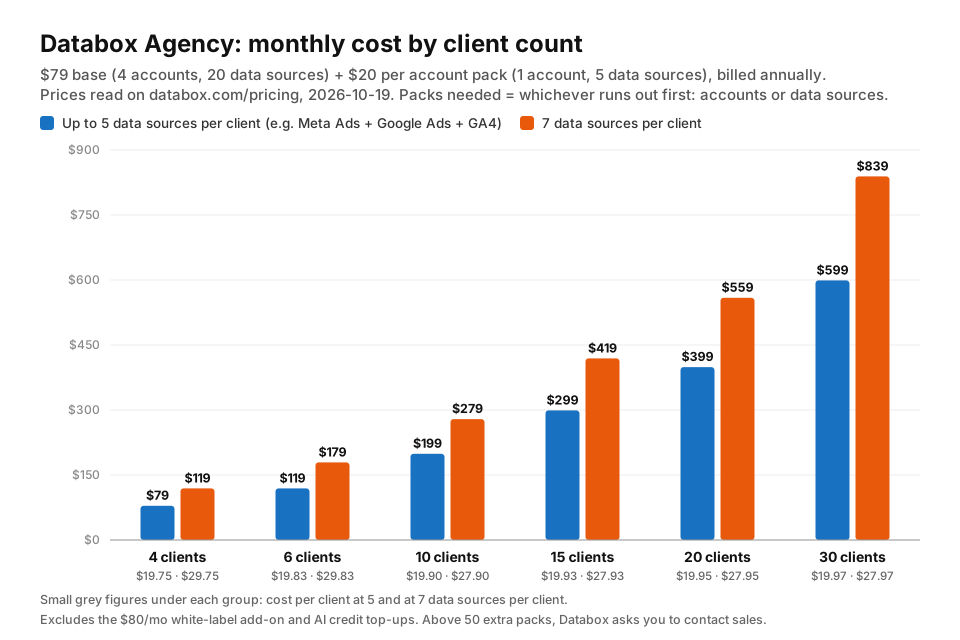
The chart shows a pattern that's easy to miss on the pricing page. At 5 or fewer data sources per client, Databox Agency costs a flat $20 per client after the fourth, because accounts run out first. Above 5 data sources per client, data sources set the price and the per-client cost rises to about $28.
AI credits in the same example. Six packs bring the pool to 600 credits a month, shared across all 10 clients and every user. Using the medians in Databox's AI credits help article, that's about 21 artifacts (28 credits each), about 52 deep analyses (11.4 each) or about 56 AI-built dashboards (10.6 each) per month across the whole agency. That's roughly two artifacts per client per month. AI Summary visualizations don't use credits. Light Genie questions do, at about 3 credits each. If your team plans to ask Genie questions all day, budget for the $200 top-up.
What the same 30-source book costs elsewhere, from each vendor's pricing page on 2026-10-19: AgencyAnalytics charges $20 per client per month billed annually ($200), with unlimited data sources and white-labeling included. Swydo charges $69 a month for the first 10 data sources plus $4.50 for each additional one ($159). DashThis Professional is $139 a month paid yearly for 10 dashboards and 40 sources. Each prices a different unit, which is why the ranking changes with your client mix. The Databox alternatives page covers when each one wins. For more on billing units, see the best PPC reporting tools for agencies.
How We Evaluated Databox
We'll say this up front because it affects how much weight the verdict deserves. We didn't buy a Databox seat or build dashboards in it. We can't grade the drag-and-drop editor, how good Genie's answers are, or support response times. This review is based on what Databox publishes about itself, read on 2026-10-19:
- the pricing page, including the plan comparison table, the agency calculator's settings and the pricing FAQ;
- the help center articles on AI credits and credit top-ups;
- the connector documentation in Databox's metric library for Facebook Ads and Google Ads, including the "known issues" Databox lists for each.
That's enough to judge fit and limits, because most of the things that make Databox a good or bad buy are written down. It isn't enough to judge the user experience, and we don't try to.
What Databox Does Well
It covers more than marketing. The integrations page lists 130+ native integrations. Next to the ad platforms (Google Ads, Facebook Ads, LinkedIn Ads, Microsoft Advertising, TikTok Ads, Pinterest Ads, Snapchat Ads, Reddit Ads, X Ads, StackAdapt) are HubSpot, Salesforce, Stripe, QuickBooks, Xero, Shopify, Jira, Zendesk, and SQL databases and warehouses such as BigQuery, Snowflake, Redshift and PostgreSQL. If your CEO wants pipeline, revenue and ad spend on one screen, few agency reporting tools connect to the finance side.
The connector docs are unusually honest. Each metric-library page lists the API version, required permissions, data scope and a list of known discrepancies. The Google Ads connector is on API v24 and is scoped per customer account. The Facebook Ads connector requires an Ad Account Admin or Advertiser role. Few vendors publish this much.
Goals and anomaly detection are on every plan, even Free. So is the governed semantic layer, which defines what each metric means so Genie and your team read it the same way.
Users don't drive the price. Agency has unlimited users, and the pricing FAQ is explicit that Databox "doesn't charge per seat." Growing your client-facing team doesn't raise the bill.
The free plan is real. It has 3 data sources, 1 dashboard and 50 AI credits, with no time limit. Paid plans have a 14-day trial with no card. You can test the actual connectors before paying.
Where It Bites
Sharing starts at $199
As covered above, Analyst doesn't include sharing and notifications. A solo consultant who wants to send a client a live dashboard link needs Team Core, almost triple the price of Analyst.
White-labeling is extra on the agency plan
An agency plan whose client-facing output carries the vendor's branding by default will surprise some buyers. The $80 a month (billed annually) is a fixed cost, so it hurts small agencies most. At 6 clients it adds $13.33 per client per month. At 30 clients it adds $2.67.
AI is metered, and the meter is shared
Every Genie question, AI-built dashboard and MCP call draws from one monthly pool that doesn't roll over. In the 10-client example, 600 credits is plenty for occasional analysis and tight for a team that relies on Genie every day. The pricing page lists the top-up at $200 a month (billed annually) but doesn't say how many credits that buys.
Synced history behaves like a warehouse, with the same problems
Databox stores data as it syncs, and its own Facebook Ads documentation lists the side effects:
- Renaming a campaign creates duplicates. Databox treats the new name as a new campaign. Metrics grouped by campaign can show both the old and new names, and its suggested fix, purging the data source, "can result in loss of important historical data."
- Pixel metrics start with 28 days of history. Custom metrics built on Facebook Pixel data have 28 days of history from when they're created, then build up over time.
- The basic Purchase ROAS metric won't match Ads Manager. It reflects website purchase ROAS only. Databox's advice is to build a custom ROAS from purchase conversion value ÷ amount spent.
The Google Ads page lists similar caveats. Dimensions whose value is 0 aren't fetched. Local Services campaigns that share a customer ID can cause mismatches. Google's own interface and API update at different times of day.
None of these issues is unusual for a tool that copies ad data into its own store. They're worth knowing before you promise a client that the dashboard will match Ads Manager to the cent.
The meter changes with your client mix
As the chart shows, the cost per client is flat up to 5 data sources per client, then jumps by about 40%. An agency whose clients run five or more ad and analytics accounts each should price Databox at roughly $28 per client, not $20.
Who Should Buy Databox
- A single company that wants one KPI hub across marketing, sales, finance and support, with goals and alerts for people who don't work in a BI tool.
- Agencies that report on more than ads, for example CRM pipeline, call tracking (CallRail), and ecommerce revenue alongside ad spend, at 5 or fewer data sources per client.
- Teams that want to put an AI assistant on top of governed metrics, using Genie, routines, the MCP server and Genie in Slack, and are comfortable budgeting credits.
Who Shouldn't Buy It
- Paid-media-only agencies that need white-labeled reports. The real price is $27.90 per client at 10 clients, and per-client tools that include branding usually beat it. See AgencyAnalytics alternatives for how the per-client tools compare.
- Solo consultants who need to share dashboards on a budget. Analyst can't share, and Team Core is $199.
- Teams that need warehouse-grade, editable history. If renaming a campaign shouldn't change past reports, send the raw data to a warehouse with a connector tool and build reports on that. Our guide to marketing analytics for agencies explains how that stack is layered.
- Anyone who expects the tool to change the campaigns. Databox reports, alerts and answers questions. Its agents, which would act on what they find, are still marked "Soon." If the work you're missing is changing budgets, creative or bids, you need a different kind of tool.
The Verdict
Databox is a well-documented, broad KPI platform with a pricing model that's fair to companies and slightly awkward for agencies. Its best feature is how much it connects to beyond ad platforms. Its weakest points for paid-media agencies are the $80 white-label add-on, a shared AI credit pool, and a per-client cost that rises once clients connect more than 5 data sources. If you're an agency, run the pack calculation above with your real source count per client before signing up.
Frequently Asked Questions
How much does Databox cost per month in 2026?
Databox's pricing page listed five plans on 2026-10-19. Free is $0 with 1 user and 3 data sources. Analyst is $71 a month billed annually or $89 billed monthly (1 user, 5 data sources). Team Core is $199 billed annually or $249 monthly (3 users, 10 data sources). Team Scale is $319 billed annually or $399 monthly (10 users, 30 data sources). Agency starts at $79 billed annually or $99 monthly (unlimited users, 4 accounts, 20 data sources) plus account packs at $20 or $25 a month each. Custom is priced by sales. Annual billing saves 20%. All prices are in USD.
Does Databox have a free plan?
Yes. The Free plan is $0 with no time limit: 1 user, 3 data sources, 1 dashboard, 10 custom metrics, 50 AI credits a month and daily sync. It doesn't include sharing and notifications, CSV export, API access, custom data integrations or chat and email support. Separately, every paid plan has a 14-day trial with no credit card.
How much does Databox cost for an agency with 10 clients?
On the Agency plan, $199 a month billed annually, or $249 billed monthly, if each client uses 5 data sources or fewer. The base plan includes 4 accounts and 20 data sources, so 10 clients need 6 account packs: $79 + 6 x $20 = $199. That works out to $19.90 per client, or $6.63 per data source if each client connects Meta Ads, Google Ads and GA4 (30 sources). Add the $80 white-label add-on and it's $279, or $27.90 per client. At 7 data sources per client, data sources run out before accounts do and the price rises to $279 before white-labeling.
What counts as a data source in Databox?
Each account, property or view you connect is one data source. Databox's own example: 3 GA4 properties are 3 data sources. A connection is the login that brings the data in, and one connection can hold several data sources. So a client with one Meta ad account, one Google Ads account and one GA4 property uses 3 data sources.
Does Databox charge per user?
No. Users are bundled into plans rather than sold per seat. Free and Analyst include 1 user, Team Core 3, Team Scale 10, and Agency and Custom have unlimited users. If you outgrow Team Scale's 10 users, you move plans; there's no per-seat add-on on the pricing page.
What are Databox AI credits and how far do they go?
AI credits meter Databox's AI features: Genie questions, dashboards and artifacts it builds, routines, skills and the MCP server. Plans include 50 (Free), 150 (Analyst), 500 (Team Core), 1,000 (Team Scale), or 300 plus 50 per account pack (Agency) a month. Credits are shared across the organization, don't roll over, and reset monthly. Databox's help center lists typical costs: about 1.2 credits for a help question, 3.1 for a light analysis, 10.6 to create a dashboard, 11.4 for a deep analysis and 28 for an artifact (medians). AI Summary visualizations don't use credits.
Did you test Databox hands-on for this review?
No. We didn't buy a Databox seat or build dashboards in it, so we can't grade the editor, Genie's answer quality or support. This review is built from Databox's public pricing page, its plan comparison table, its help center and its connector documentation, all read on 2026-10-19. Where we describe a limit, it's one Databox documents itself.
Is Databox worth it?
For a company that wants one place for marketing, sales, finance and product KPIs, with goals, alerts and an AI analyst, it's good value: 130+ integrations including CRMs, databases and spreadsheets, and a usable free plan. It's less compelling if you only report on paid media for clients, because white-labeling costs $80 a month extra, AI usage is capped by credits, and per-client reporting tools such as AgencyAnalytics bundle white-labeling into a similar per-client price.
See also the best Databox alternatives.