 Soku AI
Most agency analytics advice is a shopping list. This is not that — we have a separate, price-verified breakdown of PPC reporting tools for when you are ready to buy, and deliberately do not repeat those numbers here.
This article is about the layer underneath: why agency measurement breaks in ways no tool purchase fixes, and what to decide before you buy anything.
The distinction matters because the two problems look identical from the outside and have nothing in common:
- A reporting problem is "the client report went out three days late." You solve it with software.
- An analytics problem is "Meta says 400 conversions, Google says 250, GA4 says 380, and Shopify shows 310 orders." No software solves that, because nothing is broken.
Agencies buy reporting tools to fix analytics problems constantly, then discover the numbers still disagree — now on a schedule and in the client's brand colours.
Why the Numbers Disagree (and Why That Is Correct)
Start here, because everything downstream depends on getting this right.
When Google Ads, Meta and GA4 report different conversion counts for the same period, all of them are usually right. They are answering different questions:
| Source | What it actually reports | Credited to which date |
|---|---|---|
| Ad platform (Google, Meta, TikTok) | Conversions it believes it caused, under its own attribution window and view-through rules | The date of the ad interaction |
| GA4 | Conversions it observed, under its own model, from interactions it could see | The date of the conversion |
| Commerce backend (Shopify, CRM, billing) | Transactions that actually happened | The date of the transaction |
Three consequences follow, and they explain nearly every reconciliation argument:
1. Platform-reported conversions overlap. If a user sees a Meta ad and later clicks a Google ad before buying, both platforms may claim that sale under their own rules. Neither is lying. Adding them together produces a number larger than reality — which is why the sum of platform conversions routinely exceeds the order count in the backend.
2. Date attribution differs. An ad platform credits a conversion back to the click, so a sale today can appear in last week's numbers and change a report you already sent. GA4 credits it to the conversion. Two correct systems, two different dates, one confused client.
3. Each platform's number is the one its algorithm optimises against. This is the part most reconciliation advice misses. Google's bidding acts on Google's conversion data. Meta's acts on Meta's. Replacing those with a "unified" number does not change what the algorithms see — it only changes what you see.
The practical rule that follows: use each platform's own number to make decisions inside that platform, and use one backend source as the scoreboard for whether the spend worked. Never present a sum of platform figures as a total.
The Four Layers
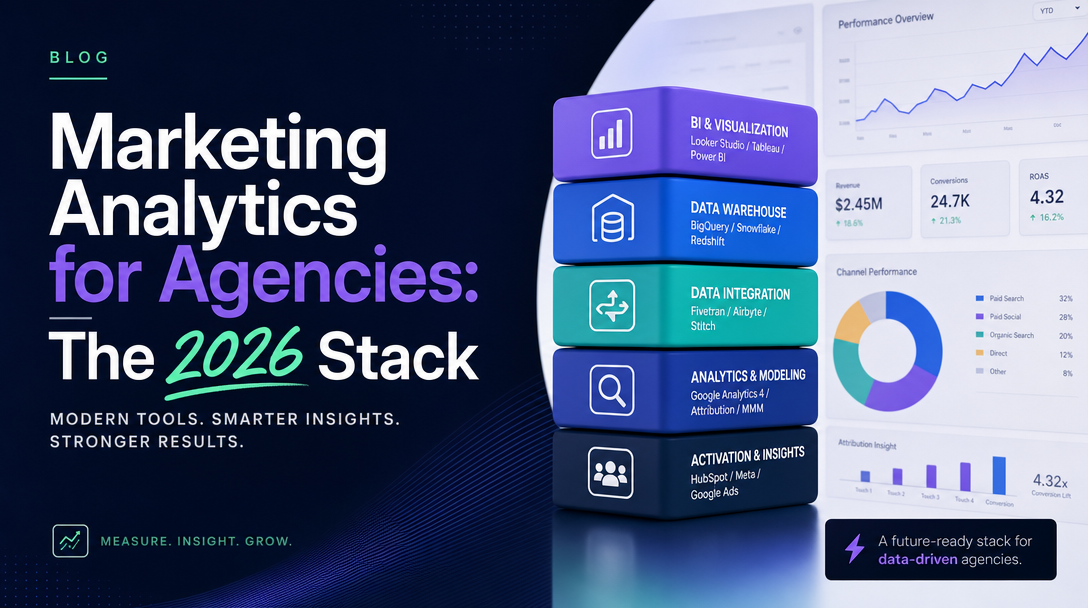
A measurement stack that survives twenty client accounts has four layers. Most agencies build layer 4 first, which is why it keeps collapsing.
Layer 1 — Collection: what is observed, and how reliably
This is where the quality of everything above it is determined, and it is the layer agencies inherit rather than design — every new client arrives with whatever their last agency left behind.
The decisions that matter:
- Server-side versus browser-side. Browser-side tags are cheap to deploy and lossy — blocked by ad blockers, truncated by browser privacy features, unreliable on mobile in-app browsers. Server-side collection is more work and materially more complete. The honest position: server-side is worth it when the loss is changing decisions, not automatically.
- Platform conversion APIs. Meta's Conversions API, Google's enhanced conversions, TikTok's Events API, and OpenAI's Conversions API for ChatGPT Ads all exist to recover signal the browser no longer supplies. If you are running a channel and not sending its server-side signal, you are optimising that channel on a partial sample.
- Consent. Where consent mode is in play, some fraction of behaviour is modelled rather than observed. You need to know which of your numbers are modelled before you defend them to a client.
The agency-specific problem: you do not control this layer. You inherit it, twenty times over, in twenty different states. Which leads directly to the thing that actually differentiates a scalable agency:
Layer 2 — Standardisation: the layer that decides whether you scale
This is the highest-leverage and most-skipped layer. It is unglamorous, involves no software, and determines whether your twentieth client costs what your fifth did.
Five things to standardise:
1. A conversion taxonomy. One canonical set of event names and definitions, applied in every account. If Lead means a form submission in one client and a qualified sales conversation in another, no cross-client analysis is possible, and every analyst has to relearn the account before they can read it.
2. One documented attribution reference model. Not the "right" model — the stated one. Write down which number is the scoreboard, which numbers are for in-platform optimisation, and what window applies. The goal is consistency and disclosure, not accuracy in some absolute sense.
3. Machine-parseable naming. Campaign, ad group and UTM conventions that a script can decompose into channel, market, funnel stage and creative theme. The test is simple: can you answer "how did prospecting perform across all clients in Germany last month" without a human opening each account? If not, your naming is the constraint, not your tooling.
4. One source of truth per metric. Spend from the ad platform. Revenue from the backend. Sessions from analytics. Written down. Every "which number do we use?" conversation you have had is this decision not being made.
5. Retention and access. Platforms do not keep granular history forever, and a client offboarding can take their data access with it. Decide what you retain, where, and who can reach it — before the offboarding, not during it.
None of this requires buying anything. All of it has to be true before any tool produces trustworthy output, because a reporting tool faithfully reproduces whatever inconsistency you feed it.
Layer 3 — Storage: only when a question forces it
The warehouse question gets answered by vendors as "yes, always" and by cost-conscious agencies as "never". Both are wrong.
You do not need a warehouse when you are under roughly ten clients, on one or two channels, answering questions the platforms already answer. A reporting tool reading APIs directly is cheaper and faster, and the maintenance you avoid is real.
You do need one when any of these becomes true:
- You need history the platforms will not keep — granular data ages out, and a two-year trend request cannot be answered retroactively.
- You need to join ad data to backend revenue rather than platform-reported conversions. This is the big one. The moment the question is "what did this campaign contribute to closed revenue", no platform can answer it, because no platform can see your CRM.
- Clients ask questions requiring blended sources — ad spend against organic, or paid performance against inventory.
- You are recomputing the same joins by hand every month.
The honest trigger is a question you cannot answer, not a client count. If nobody has asked a question the platforms cannot handle, a warehouse is infrastructure you are maintaining for its own sake.
Layer 4 — Delivery: the layer everyone starts with
Dashboards, scheduled reports, client portals. Necessary, and the least differentiating part of the stack — the tools are mature and largely interchangeable within a price band.
The one structural point worth making: reporting vendors do not charge in the same unit. Some bill per connected data source, some per client, some per source credit. That means the cheapest vendor depends on the shape of your client book rather than on features — an agency with many clients on few channels and an agency with few clients on many channels should rationally buy different products. We work that break-even out with verified 2026 pricing in Best PPC Reporting Tools for Agencies, and there is a Facebook-specific version in Facebook Ads reporting tools.
The Reconciliation Conversation, Scripted
Every agency has this conversation. Having it before it becomes an accusation is the difference between a routine explanation and a credibility problem.
Set the convention at kickoff, in writing:
"Each ad platform reports the conversions it believes it drove, using its own attribution rules, and those figures overlap — so we never add them together. We use each platform's own number to make decisions inside that platform, because that is what its bidding algorithm acts on. For the question of whether the spend worked, we use [named backend source] as the single scoreboard. That number will usually be lower than the platform totals. That is expected, and it is the number we hold ourselves to."
Three details that prevent most of the remaining trouble:
- Restate history when you change models. Changing attribution mid-engagement makes every previous report retroactively wrong. If you change it, reissue the comparison.
- Warn about backfill. Platform numbers for a closed period can still move as delayed conversions are credited back to the click date. A client who does not know this will assume the first report was wrong.
- Label modelled data as modelled. Where consent mode or modelled conversions are contributing, say so at the point of the number.
What This Stack Still Does Not Do
Worth being straight about, because it is the actual ceiling of the category.
A correctly built measurement stack tells you what happened with high confidence. It does not tell you what to do next, and it does not do anything on its own. The end state of layers 1–4 is an accurate dashboard — and an accurate dashboard is still a thing a human has to open, read, interpret, and act on, once per client, every week.
For an agency, that is precisely where the cost sits. The reporting was never the expensive part; the expensive part is the analyst hour spent per account working out what the report means and what to change. Twenty clients is twenty of those hours, every week, and it scales linearly with headcount no matter how good the dashboard is.
Closing that gap is a different category of tool — one that reads the accounts, reconciles what each platform claims, and proposes the next change rather than rendering the last one. That is what Soku does, and it sits on top of the four layers above rather than replacing them: it still needs your collection to be sound and your taxonomy to be consistent. Analytics infrastructure is the prerequisite, not the competitor.
The Order To Build In
- Fix collection on the accounts where signal loss is changing decisions — not everywhere at once.
- Standardise taxonomy, naming and the attribution convention. Free, unglamorous, and the thing that decides whether you scale.
- Set the reconciliation convention with every client in writing, at kickoff.
- Buy delivery — pick the vendor whose billing unit matches your client book.
- Add storage only when a real question demands it.
- Then look at what is consuming analyst hours, because by this point it will not be the reporting.
Most agencies do this list backwards, starting at step 4 and never reaching step 2. That is why the tool keeps getting blamed.
Related Reading
- Best PPC Reporting Tools for Agencies — verified 2026 pricing and the per-client vs per-source break-even
- Facebook Ads Reporting Tools
- AgencyAnalytics Alternatives — the delivery-layer shortlist when the per-client model stops fitting
- The AI Ads Agency Tech Stack — the wider stack this measurement layer sits inside
- ChatGPT Ads attribution tracking