Soku AI
What Are ChatGPT Ads?
On February 9, 2026, OpenAI officially began rolling out advertising inside ChatGPT — the AI chatbot used by over 800 million people every week. This marks the first time ads have been integrated into a conversational AI product at this scale.
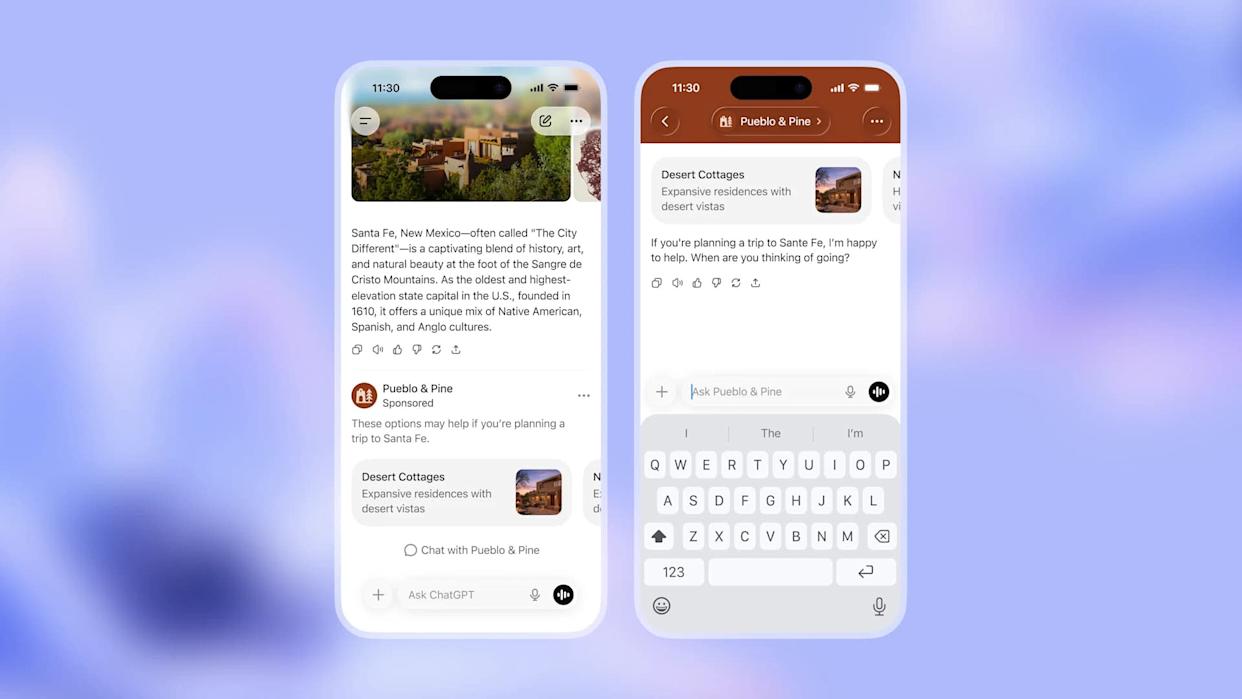
ChatGPT Ads appear at the bottom of the AI's responses when there is a contextually relevant product or service. They are clearly labeled as "Sponsored" and visually separated from the organic content. Unlike traditional search ads, these are not triggered by keyword bidding — they are matched based on the context of the entire conversation.
OpenAI has been clear about one important boundary: advertisers cannot influence, shape, or alter ChatGPT's responses. The ad system runs on a completely separate infrastructure from the chat model itself.
How Do ChatGPT Ads Work?
Ad Formats
OpenAI has introduced three ad formats at launch:
- Sponsored Recommendations: Product or service suggestions that appear contextually after a relevant conversation
- Companion Display Ads: Visual ad units shown alongside ChatGPT's responses
- Native Content Cards: Seamlessly integrated cards that appear after the model's response without disrupting the conversation flow
Who Sees Ads?
Ads are currently shown to Free tier and Go tier ($8/month) users in the United States who are logged in and over 18 years old. Users on Plus ($20/month), Pro ($200/month), Business, Enterprise, and Education plans will not see ads.
Targeting and Privacy
This is where ChatGPT Ads fundamentally differ from Google or Meta. There is no keyword bidding. Instead, targeting is contextual — ads are matched to the topic of the user's conversation. Users can manage their ad preferences through Settings > Ad Controls, and ads will not appear near sensitive topics like health, mental health, or politics.
Pricing
The current pricing model is impression-based at approximately $60 CPM (cost per thousand impressions), with a minimum campaign spend of $200,000 during the launch phase. There are no self-serve buying tools yet — everything is managed through direct partnerships with OpenAI.
ChatGPT Ads vs. Google Ads vs. Meta Ads
To understand the significance of ChatGPT Ads, it helps to compare them with the established players:
- User Intent: Google captures high-intent users actively searching for answers. Meta targets passive browsers in social feeds. ChatGPT sits in the middle — users are exploring, researching, and making decisions in real time.
- Targeting: Google uses keyword matching. Meta uses demographic and behavioral data. ChatGPT uses the live conversation context.
- Creative Approach: Google favors direct-response copy. Meta thrives on visual creative. ChatGPT rewards conversational, educational content that feels like a natural recommendation.
- Measurement: Google and Meta offer mature attribution and conversion tracking. ChatGPT currently provides only basic aggregate impression metrics — a significant limitation for performance marketers. Our AI ad creative ROI measurement guide covers how to build a cross-platform measurement stack that accounts for emerging channels like this.
- Conversion Quality: Early data suggests AI search traffic converts at 14.2% compared to Google's 2.8%, making each AI-driven visitor worth roughly 4.4x more than a traditional search visitor. For a deeper dive on the AI search visibility shift, see our guide on GEO vs SEO.
The Deeper Implications for Advertising
A Fundamental Shift in How Consumers Discover Products

ChatGPT Ads represent something bigger than just another ad platform. They signal a fundamental shift in the discovery layer of the internet. Younger consumers are increasingly bypassing traditional search engines entirely, turning to AI assistants for product research, comparisons, and recommendations.
When someone asks ChatGPT "What's the best project management tool for a small team?", they are in a deeply considered decision-making moment. The context and intent behind this question is far richer than a Google search query like "project management software." This creates an opportunity for advertisers to reach users at a uniquely influential moment.
The Trust Paradox
This also creates a significant tension. People interact with ChatGPT differently than they interact with Google — they treat it more like a trusted advisor than a search engine. They share personal details, ask for nuanced advice, and rely on its recommendations. Placing ads in this environment raises legitimate questions about whether commercial interests could erode the trust that makes the platform valuable in the first place.
OpenAI researcher Zoe Hitzig resigned on February 11, 2026 over exactly this concern, warning that ChatGPT holds "the most detailed record of private human thought ever assembled" and that advertising built on that archive creates potential for manipulation that we do not yet have tools to understand.
The Revenue Imperative
Despite these concerns, the financial reality makes advertising almost inevitable for OpenAI. Only about 5% of ChatGPT's 800 million weekly users pay for a subscription. With infrastructure costs exceeding $1 trillion over five years and the company not expected to reach cash-flow positivity until 2029, advertising provides a critical revenue stream. Internal projections estimate $1 billion from free-user monetization in 2026, scaling to $25 billion in ad revenue by 2030.
Market Projections
The broader AI-driven search advertising market is projected to grow from approximately $1.1 billion in 2025 to $26 billion by 2029 — a 24x increase. This is not just about ChatGPT. It is about an entirely new category of advertising that will reshape how brands allocate their marketing budgets.
Early Movers and What We Can Learn
Several major brands have already signed on as launch partners, including Adobe, Ford, Marriott, Target, Expedia, and Williams-Sonoma. Early signals suggest that campaigns with conversational, education-first creative outperform traditional hard-sell approaches.
The industries showing the most promise in early testing include SaaS, e-commerce, online education, healthcare, and financial services — all categories where users naturally turn to ChatGPT for research and comparison.
How Soku Can Help You Run ChatGPT Ads

As the advertising landscape fragments across more platforms — Google, Meta, TikTok, and now ChatGPT — managing campaigns becomes exponentially more complex. This is exactly the problem Soku was built to solve.
Cross-Platform Campaign Management
Soku connects to your ad accounts across every major platform. As ChatGPT Ads become available through self-serve tools, Soku will integrate them alongside your existing campaigns, giving you a unified view of performance across all channels.
Conversational Ad Creation
ChatGPT Ads reward a different kind of creative — conversational, educational, and contextually relevant. Soku's AI-powered creative generation is uniquely suited for this. Describe your product and target audience, and Soku will generate ad copy optimized for the conversational format that ChatGPT Ads demand.
Intelligent Budget Allocation
With yet another platform competing for your ad budget, deciding where to allocate spend becomes harder. Soku analyzes performance across all your channels and recommends optimal budget distribution — including when and how much to invest in emerging platforms like ChatGPT Ads.
Stay Ahead of the Curve
The advertising landscape is shifting faster than ever. New platforms, new formats, new rules. Soku keeps you ahead by continuously monitoring the ecosystem and adapting your strategy in real time. You focus on your business goals — Soku handles the complexity.
Go Deeper: The ChatGPT Ads Series
A lot has happened since OpenAI's first pilot — the platform now has a self-serve Ads Manager, CPC bidding, and real conversion measurement. We've covered each piece hands-on:
- ChatGPT Ads Manager: A Hands-On First Look at OpenAI's Self-Serve Beta — inside the beta: signup, campaign structure, context-hint targeting, and early performance data.
- How to Run ChatGPT Ads with Soku: Pixel + CAPI Setup Guide — the step-by-step tracking setup, from pixel install to server-side conversions.
- ChatGPT Ads vs Google Ads vs Meta Ads: Where Each Fits in 2026 — benchmarks and budget strategy across the three channels.
- ChatGPT Ads Attribution: How Tracking Works Without Third-Party Cookies — the measurement model and why the 28-day window matters.
The Bottom Line
ChatGPT Ads are not just another advertising channel. They represent the beginning of a new era in digital advertising — one where AI mediates the relationship between brands and consumers. The brands that experiment early, develop conversational creative strategies, and invest in cross-platform tools like Soku will be best positioned to win in this new landscape.
The question is not whether AI-powered advertising will reshape the industry. It is whether you will be ready when it does.