 Soku AI
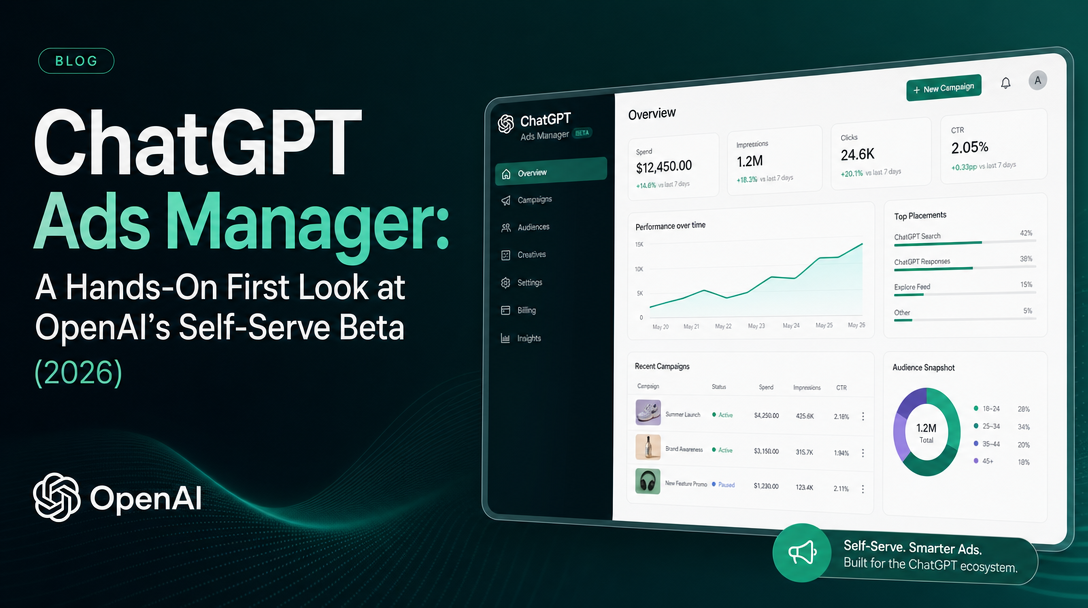
On May 5, 2026, OpenAI opened a beta self-serve Ads Manager for ChatGPT — the first time any advertiser, not just enterprises with $200,000 pilot budgets, could buy ads inside the world's most-used AI assistant. Four weeks later, the platform is already iterating fast: on June 9, OpenAI began testing multi-advertiser placements sold through a second-price auction, alongside bulk editing and budget tools that make the Ads Manager look a lot more like the platforms media buyers already live in.
We run an AI ads agent for a living, so we registered for the beta and walked through every screen of the new Ads Manager. This post is the hands-on tour: what the signup actually involves, how campaigns are structured, how the strange new "context hints" targeting works, what the early performance data says, and where the platform is still clearly a beta.
This is the first post in our ChatGPT Ads series. For the background on how OpenAI got here — the February pilot, the ads principles, the privacy architecture — start with our ChatGPT Ads explainer. For the step-by-step tracking setup, see how to run ChatGPT Ads with Soku.
The four-month sprint from $200k pilot to open beta
The speed of this rollout is the story. In February 2026, ChatGPT ads launched as a managed pilot: a flat $60 CPM with a $200,000–250,000 minimum, bought through agency partners Dentsu, Omnicom, Publicis, and WPP. By March, the pilot had crossed $100 million in annualized ad revenue with over 600 advertisers participating. In April, OpenAI introduced CPC bidding-ads-to-chatgpt-475148) at recommended bids of $3–5 per click, observed CPMs fell to $25–45, and the minimum dropped to $50,000. On May 5, the minimum disappeared entirely and the self-serve Ads Manager opened at ads.openai.com.

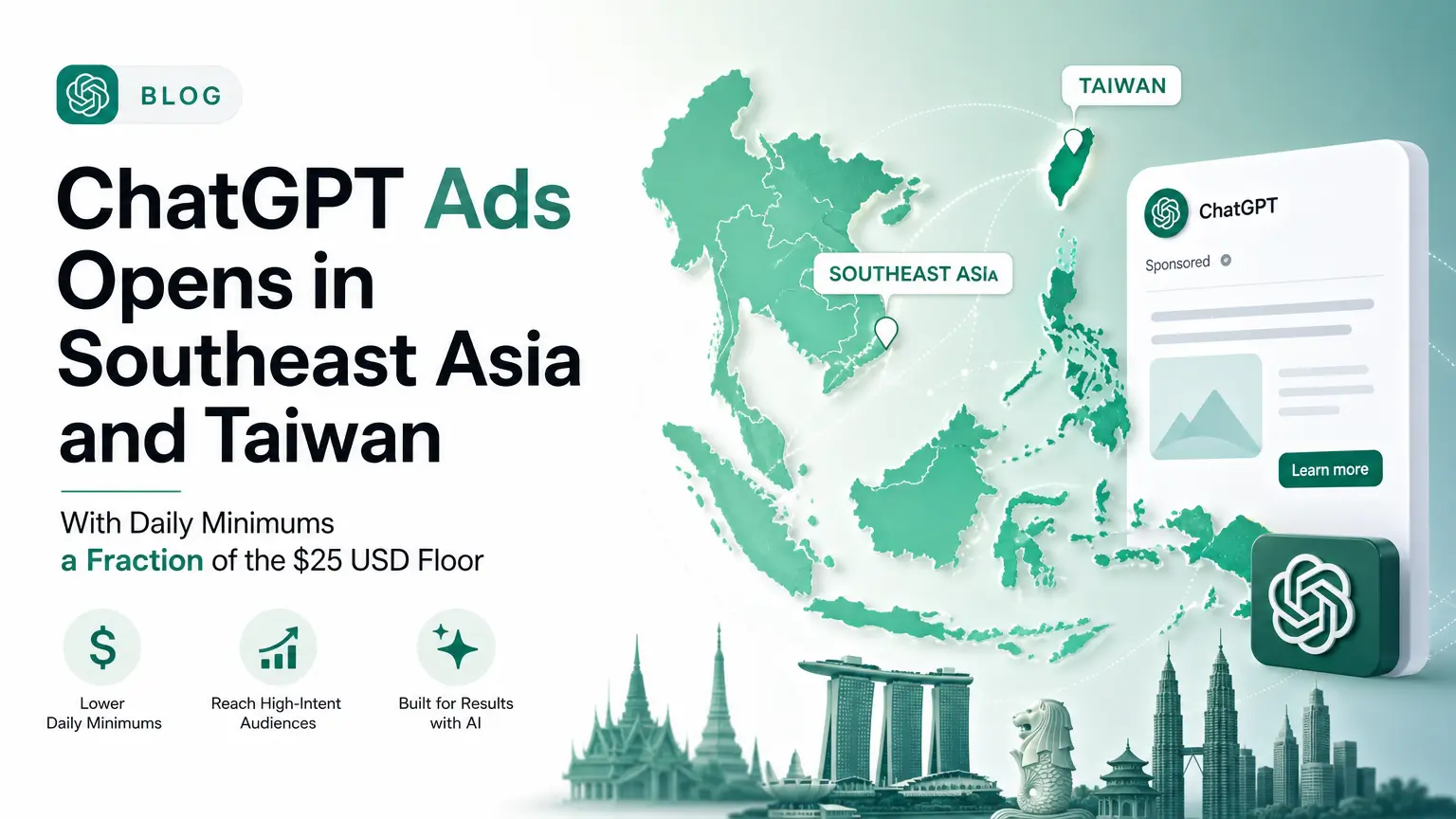
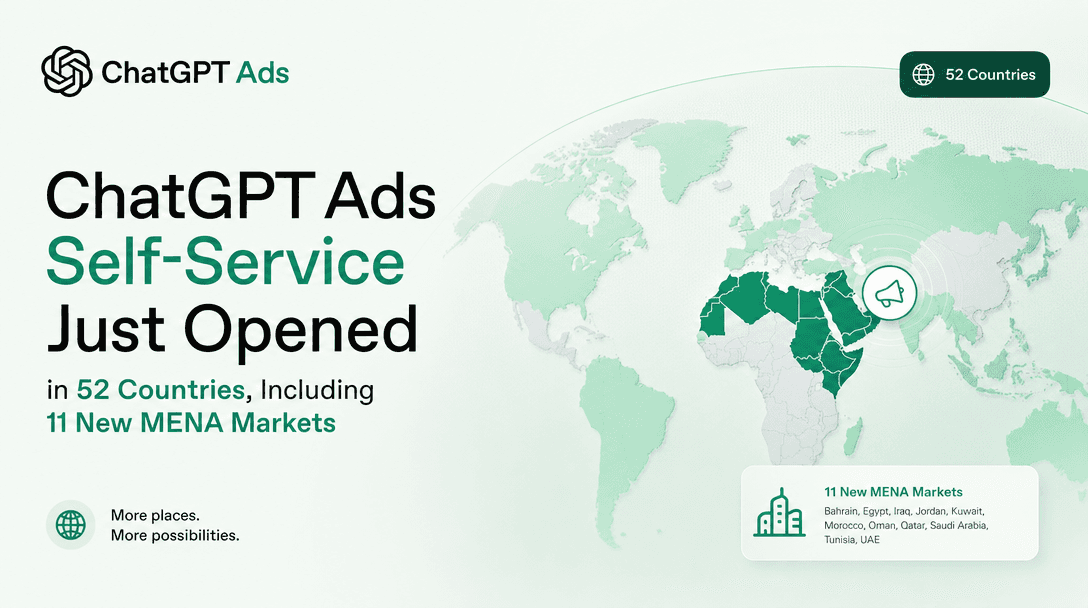
Geographic availability expanded just as fast. The pilot started US-only; OpenAI's public availability table currently lists the US, Canada, Australia, New Zealand, the UK, Japan, South Korea, Brazil, and Mexico. Paid tiers (Plus, Pro, Business, Enterprise, Edu) remain ad-free — ads show only to free-tier and Go ($8/month) users, which is still hundreds of millions of weekly actives out of ChatGPT's 900M+ weekly accounts.
Getting into the beta: what signup actually involves
The signup flow at ads.openai.com is straightforward but gated by manual review. Here's what to expect, based on our own registration and what early advertisers consistently report:
- You register with a business email tied to an OpenAI account, then enter legal name, address, business category, tax identifier, and a credit card.
- Account verification is manual. Early advertisers reported 5–15 business days; wait times have shortened since the May opening, but this is not Meta's instant account creation.
- One person owns the advertiser account and invites teammates afterward. Agencies need a separate account per client — there's no business-manager-style multi-account structure yet.
- Your landing page gets reviewed too. Generic homepages often fail review; pages with clear conversion intent pass.
The friction is deliberate. OpenAI is rate-limiting the beta while it tunes delivery, and a manual review queue is the throttle.
Inside the Ads Manager: campaign → ad group → ad
The object hierarchy is familiar on purpose: campaigns hold budget and objective, ad groups hold targeting, ads hold creative. If you've run Google or Meta ads, you'll orient in minutes. The differences are in the details.
Campaigns offer exactly two objectives today: Reach (CPM bidding, default max $60) and Clicks (CPC bidding, recommended $3–5). Budgets can be daily or lifetime — and as of the June 9 update, you can convert a lifetime-budget campaign to daily budgets, clone a CPM campaign into a CPC campaign in one click, and set custom CPM max bids on impression campaigns. Daily budgets are also moving to an average-daily model for weekly pacing flexibility, the same model Google Ads uses.
Ad groups are where ChatGPT ads stop resembling anything else: targeting runs on context hints, not keywords or audiences. You write 5–10 short phrases describing the conversations where your product belongs — not search terms, but situations: "comparing CRM options for a small team," "asking how to automate ad reporting." OpenAI's system matches those hints against the live conversation topic, your ad copy, and your landing page. There are no audience segments, no lookalikes, no retargeting lists. If a conversation doesn't touch a commercial topic, no ad shows at all — the system serves at most one ad per response.
Ads are brutally compact: a headline of 16–24 characters, description of 32–48 characters, a square image of at least 256×256, your advertiser name and favicon, and a URL. Adthena's tracking of 300,000+ daily prompts found the "Brand: Benefit" pattern wins — "Betterment: 5.25% APY Cash Account" beats any clever tagline, because the user has already read a full answer before they see your card. Creative review typically clears within 24 hours.

The three ad formats live today
The recommendation card is the workhorse: a tinted, clearly-labeled "Sponsored" card below the answer. This is what the Ads Manager beta buys.
Product carousels show scrollable product cards with images and prices on shopping-intent queries, fed through partners including Etsy and Shopify — more relevant to ecommerce feeds than to the self-serve manager today.
"Chat with Brand" is the format to watch, still in preview: users can pull an ad into the thread and ask follow-up questions about the product. For anything that needs explaining — B2B software, financial products, considered purchases — this turns the ad into a qualified conversation rather than a click to a landing page.
And as of June 9, OpenAI is testing multi-advertiser placements: several relevant advertisers inside a single sponsored unit, sold by second-price auction. That's how OpenAI grows inventory without showing users more ads — and it means your ad can now lose an auction inside a placement it used to own outright.
What the early performance data actually says
Be skeptical of anyone selling certainty here — the measurement layer is only weeks old. But the directional data is consistent across sources:
| Metric | Early data | Source |
|---|---|---|
| Overall CTR | 0.68% | Similarweb, May 2026 |
| Top-quartile advertiser CTR | ~1.0% | Similarweb |
| Best-brand CTR | 1.57% (peak 5.4%) | Similarweb |
| Google/Microsoft search ads CTR | 6.66% avg | LocaliQ benchmark, 16,000+ campaigns |
| Conversion rate vs other referrals | ~1.5× higher | Criteo, 500 US retailers |
| CPC | $3–5 recommended | OpenAI Ads Manager |
| CPM | ~$25–45 observed | advertiser reporting, April–May 2026 |
Two honest readings of that table:
The CTR looks terrible against search — and the comparison is structurally unfair. A search ad sits above the answer; a ChatGPT ad sits below it. The user already got what they came for. A 0.68% CTR on a post-answer suggestion is a different animal from a 6.6% CTR on a gateway link, and judging the channel on CTR alone will lead you to a wrong conclusion in both directions.
The conversion quality signal is the real story. Criteo's finding that AI-referred users convert at roughly 1.5× other referral channels matches the mechanism: by the time someone clicks, the conversation has already qualified them — they've spent five or six messages narrowing exactly what they need. Fewer clicks, warmer clicks.
The cautionary tales are real too. During the managed pilot, one enterprise advertiser reportedly spent just 3% of a $250,000 budget after several weeks — delivery was that constrained — and pilot advertisers initially had no way to see whether their ads worked at all. Conversion tracking (a JavaScript pixel plus a server-side Conversions API) only arrived in May. Reporting still refreshes with a lag; there is no real-time dashboard. And roughly 60% of attributable conversions land outside the immediate click window, so short attribution windows will undercount the channel — use the longest window available (28 days) before judging CPA. We dig into the measurement mechanics in our ChatGPT ads attribution deep-dive.
Our take after walking through it: who should test now

After going hands-on with the Ads Manager, our honest read is that this platform is worth a structured test for three kinds of advertisers:
- Brands whose category gets researched conversationally — software, travel, education, consumer products with comparison-heavy purchase paths. ChatGPT's ad system only fires on commercial conversations; if your category isn't one people discuss with an AI assistant, there's no inventory for you yet.
- Teams that can write disciplined creative. 16–24 character headlines punish vague brand copy and reward specific, numeric value props.
- Advertisers who will instrument measurement properly on day one. Without the pixel and Conversions API installed, you're buying impressions and clicks with no way to see downstream value — exactly the position pilot advertisers complained about.
A sensible pilot, based on what early advertisers report working: one high-intent topic, one ad group with 5–10 tight context hints, 4–6 creative variants in the Brand: Benefit format, CPC bids at $3–5, $100–300/day for two to three weeks, judged on a 28-day window against a pre-committed threshold (scale if blended CPA lands within ~1.5× your Google Search benchmark).
And register before you're ready to spend — account review takes days, and the pixel should be collecting baseline data before your first campaign goes live.
Where an AI ads agent fits
The practical problem with every new ad channel is operational: it's another dashboard, another reporting export, another set of creative specs, another thing to check every morning. That cost lands hardest on exactly the small teams the no-minimum beta just let in.
That's the gap Soku is built for. Soku is an AI ads agent that already manages Meta, Google, and TikTok campaigns through plain conversation — and ChatGPT Ads is joining that roster. Soku ships its own tracking layer (the Soku Pixel plus server-side conversions) so attribution is in place from the first click. Inside Soku, the ChatGPT Ads integration lives under the top-level Integrations entry in the sidebar, with a guided pixel and CAPI setup. The agent monitors spend and performance across every connected channel, drafts the compressed creative variants the format demands, and flags when a new channel's CPA earns more budget — the full walkthrough is in how to run ChatGPT Ads with Soku, and the head-to-head channel comparison is in ChatGPT Ads vs Google Ads vs Meta Ads.
FAQ
Is the ChatGPT Ads Manager available to everyone?
It's rolling out gradually as a beta. Any US business can sign up at ads.openai.com with no minimum spend. OpenAI's public availability table currently lists nine markets — US, CA, AU, NZ, UK, JP, KR, BR, and MX. Account verification is manual and can take days.
How much do ChatGPT ads cost in 2026?
CPC bids run a recommended $3–5 per click; bids under $3 often fail to win impressions. CPM campaigns observe roughly $25–45. There is no minimum spend since May 5, 2026, but daily budgets under $50 rarely generate enough volume to learn from.
Can advertisers see ChatGPT conversations?
No. Advertisers get aggregated reporting on impressions, clicks, and conversions. OpenAI states that conversations are never shared and answers can't be bought — ads are generated by a separate system from the model's responses.
Do ChatGPT ads work for B2B?
The audience skews to free-tier users — individual contributors, founders, students — since paid plans are ad-free. B2B software is an eligible category and conversational research suits considered purchases, but your most senior buyers may literally never see the ads.
What's the minimum setup before launching?
A reviewed advertiser account, a conversion-focused landing page, 3–5 creative variants within the character limits, and the conversion pixel plus Conversions API installed. Skipping measurement is the most common early-advertiser mistake.