 Soku AI
Most advice about Google Ads campaign structure is answering a question that stopped mattering around 2021. It tells you how to group keywords tightly so that each ad matches its query, because match types were literal and Quality Score rewarded relevance you could engineer by hand.
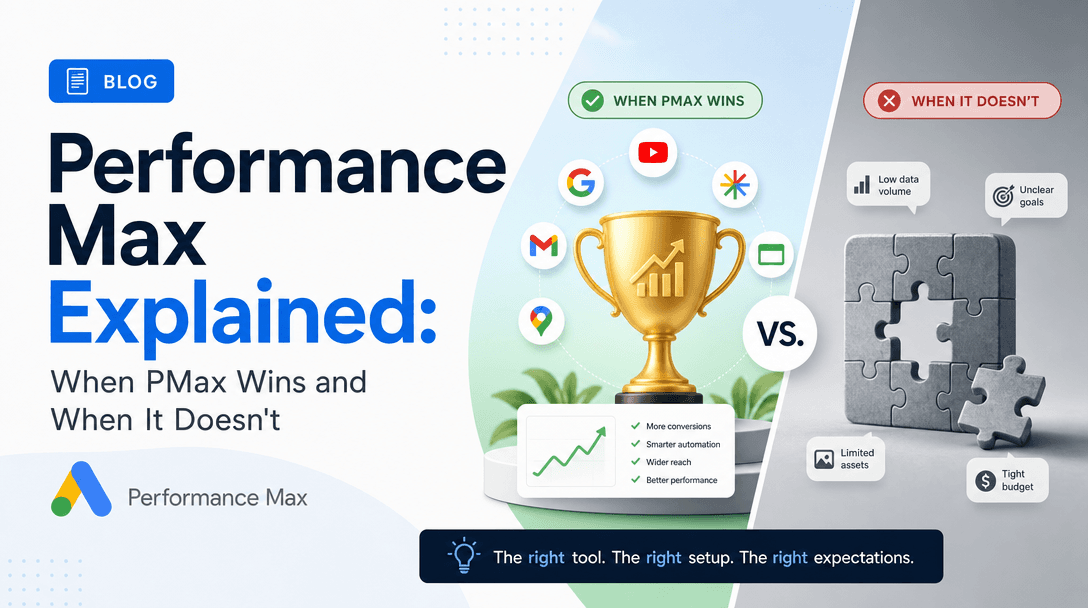
Close variants ended that. Broad match plus Smart Bidding ended what was left. Performance Max removed the ad group as a meaningful unit entirely and replaced it with the asset group, which is not the same thing and is not controlled the same way.
So the useful question in 2026 is not "how do I organise my keywords". It is: what decisions does the platform still let me make, and what is the smallest structure that lets me make them? Structure is now a control surface, and every campaign you create is a claim that you want to control something separately. If you cannot name what that something is, you have built overhead rather than architecture.
This page is the blueprint that follows from that.
What campaign structure still controls
There are exactly four things a campaign boundary buys you in 2026. Everything else you may have separated campaigns for is now decided by the same automation regardless of how you arrange it.
1. Budget. A campaign is the unit of daily budget. If two things need to be funded independently — brand and non-brand, prospecting and retargeting, a product line you must not starve — they must be separate campaigns. This is the single most common legitimate reason to split.
2. Bidding strategy and target. A campaign carries one bid strategy and one target. If part of your traffic should be bought at a 600% ROAS target and part at 250%, that is two campaigns, because there is no way to express two targets inside one.
3. Negative keywords and brand controls. Negatives apply at campaign and ad-group level. Separating brand from non-brand exists primarily so you can exclude brand terms from the non-brand campaign and stop paying prospecting prices for people who already typed your name.
4. Reporting boundaries. Anything you want to see as a clean line in a report without building a segment for it every time needs its own campaign. This is a weaker reason than the other three, and it is the one most often used to justify structures that then cost real performance in fragmentation.
If a proposed split does not serve one of those four, it is decoration.
The counter-pressure: fragmentation costs data
Every split divides your conversion data. Smart Bidding learns per campaign, and a campaign that gets fifteen conversions a month is being asked to make statistical decisions from noise.
The practical floor most practitioners work to is roughly 30 conversions per campaign per month before automated bidding has anything to work with, and comfortably more before it works well. Below that, consolidation almost always beats precision — a single campaign with 90 conversions makes better decisions than three campaigns with 30 each, even though the three-campaign version gives you nicer reports.
This is the real tension in modern account structure, and it resolves in one direction more often than practitioners like: when in doubt, consolidate. The 2015 instinct to separate everything was correct when bidding was manual and structure was the optimisation. It is actively harmful when the algorithm needs volume.
The account blueprint
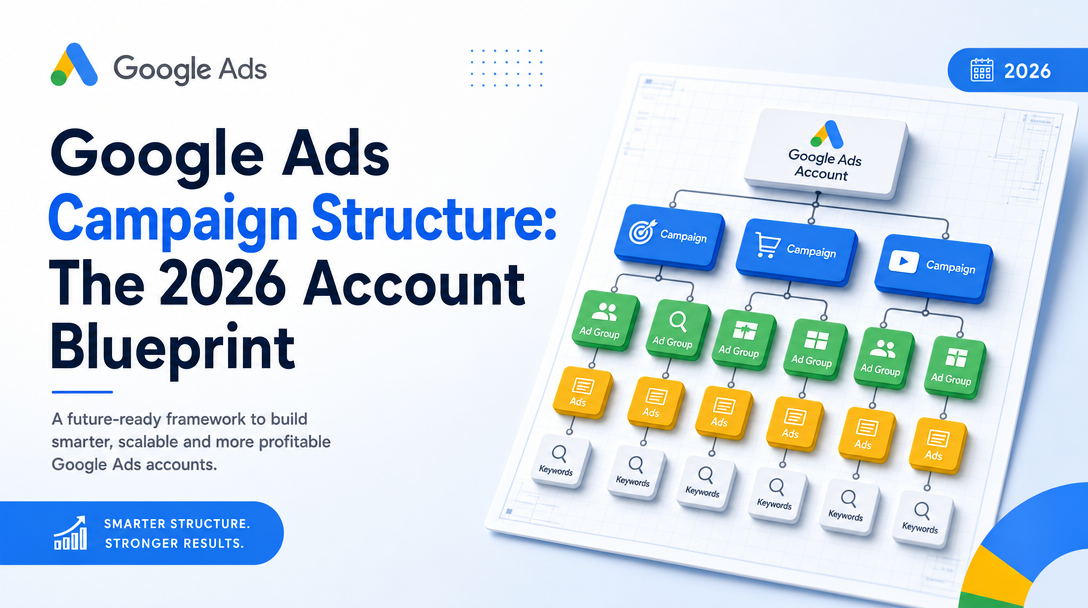
Here is a structure that works for most non-trivial advertisers. Treat it as a starting shape to subtract from, not a checklist to fully implement.
Layer 1 — Brand
One Search campaign, brand terms, exact and phrase match.
Separate always, for three reasons: the CPCs and conversion rates are so different from non-brand that mixing them corrupts every average you look at; you need the brand terms as negatives elsewhere; and brand is the one place where a low target and manual-ish control is usually correct.
Do not let this campaign use broad match. Brand broad match reliably drifts into competitor and generic territory, which is exactly the spend you separated it to avoid.
On whether to bid on your own brand at all: if you have competitors bidding on your name, yes, and the cost is a defensive tax. If you genuinely have the SERP to yourself, the incremental value is small and worth testing by pausing rather than assuming. Very few advertisers actually run that test.
Layer 2 — Non-brand Search
One campaign per genuinely distinct economic unit, where "economic unit" means a different profitable CPA or ROAS, not a different topic.
The failure mode here is splitting by theme — "Shoes", "Boots", "Sandals" — when all three convert at similar rates and margins. That is three campaigns making one decision, with a third of the data each. Split instead when the economics diverge: high-margin versus low-margin, a product line with a much longer consideration cycle, a geography with a materially different conversion rate.
Within the campaign, ad groups should still be thematically coherent — not because Quality Score demands it any more, but because the ad group is where your responsive search ad lives, and an RSA can only be relevant to queries that are actually related to each other. Ad group coherence is now a creative constraint rather than a bidding one, which is a genuinely different rationale for the same behaviour.
Three to seven ad groups per campaign is a reasonable working range. If you have thirty, you are running the SKAG playbook without its benefits.
Match types in 2026. The pattern that holds up: exact match for the queries you must win and know the economics of, phrase for the reliable middle, broad match only inside a campaign with Smart Bidding and a disciplined negative list. Broad match without either is how accounts quietly fund irrelevant traffic — and the search terms report is where you find out, which is why a recurring search terms audit matters more now than it did when match types were literal.
Layer 3 — Shopping and Performance Max
For ecommerce, Performance Max is the primary shopping engine in 2026 and Standard Shopping has become a supporting instrument rather than the default.
A structure that works:
- PMax, full catalogue, segmented into asset groups by category or price tier. Asset groups are not ad groups — they do not have their own budgets or bids, and they exist to give the system distinct creative and audience signals for distinct parts of your catalogue.
- Standard Shopping as a controlled catch-all, at lower priority, to capture what PMax misses and to give you a place where you can still set a manual bid on a specific product.
- Separate campaigns where the economics genuinely differ: brand terms, high-margin lines, clearance with a defined date window.
The feed is more important than the structure. This is the part most structure guides underweight. In Shopping and PMax, your product feed determines which auctions you enter at all and how you are represented in them. A meticulously segmented campaign structure sitting on top of a feed with missing GTINs, weak titles and one image per product will underperform a crude structure on an excellent feed, every time. If you have limited hours, spend them on the feed.
One honest limit on PMax: it is deliberately opaque. You get less visibility into placement and query-level performance than any other campaign type, and the reporting that does exist arrives with a delay and at a level of aggregation that makes some questions unanswerable. Structure is one of the few remaining levers, which is an argument for using asset groups deliberately — but not an argument for believing you have regained control you have not.
Layer 4 — Retargeting and audience campaigns
Separate from prospecting, always. The conversion rates differ by an order of magnitude, and mixing them makes both unreadable and lets the algorithm harvest cheap conversions from people who were going to convert anyway.
What not to build
- A campaign per keyword. SKAGs solved a Quality Score problem that close variants dissolved. What remains is data fragmentation and an unmaintainable account.
- A campaign per ad copy test. Test inside the ad group, where the traffic already is.
- A campaign per month or per promotion, unless the budget genuinely must be ring-fenced. Otherwise you restart the learning phase every time.
- Mirrored campaign sets per device. Device is a bid modifier and a reporting segment, not a structural axis.
Naming conventions
Naming is not cosmetic once an account has more than about twenty campaigns, because it is the only thing standing between you and a filter box that cannot find anything.
A convention that survives scale:
[Brand/NonBrand] | [Channel] | [Geo] | [Segment] | [Match/Type]

NonBrand | Search | US | HighMargin | Exact
Brand    | Search | US | Core       | Exact
NonBrand | PMax   | US | FullCatalog
Retarget | Demand | US | CartAbandon30d
Three rules that matter more than the specific scheme:
- Fixed field order, always — so that alphabetical sort produces a usable grouping and prefix search works.
- A consistent delimiter that does not appear inside field values — pipes and double underscores are safer than hyphens, because hyphens show up inside real names.
- Never encode anything that changes — putting the bid target or the budget in the name guarantees the name will be a lie within a quarter.
If you are standardising naming across more than one platform, it is worth doing once, properly, with a shared taxonomy rather than per-channel improvisation.
Budget architecture
Budget is set at the campaign level, and Google may spend up to twice a campaign's daily budget on a given day while keeping the monthly total to roughly 30.4 times the daily figure. Two consequences that catch people out:
- A daily budget is a monthly commitment, not a daily cap. Planning a flight around "we will only spend X today" does not work.
- Pausing mid-month does not recover the overspend you have already absorbed on high-traffic days.
Shared budgets are useful when you have several campaigns whose combined spend matters more than their individual split — and harmful when you have a campaign that must not be starved, because a shared budget lets the greedy campaign eat it.
How to allocate. Fund by marginal return, not by fairness. The question is never "does this campaign deserve more" but "if I add 100 USD here, do I get more back than adding it there". Campaigns that are budget-limited and profitable should be funded before campaigns that are merely profitable — a campaign hitting its cap every day is telling you there is demand you are declining to buy.
The real Google Ads limits
Structure discussions rarely mention the ceilings, and it is worth knowing where they are — mostly to confirm that you will never approach them, and that "we cannot do that, it is against the limits" is almost always wrong.
Read from Google's own account-limits documentation on 2026-08-14:
| Limit | Value |
|---|---|
| Campaigns per account (active + paused) | 10,000 |
| Performance Max campaigns per account | 100 |
| Ad groups per campaign | 20,000 |
| Ad group targeting items per ad group | 20,000 |
| Ad group targeting items per account (keywords, placements, audiences) | 5,000,000 |
| Negative keywords per campaign | 10,000 |
| Active text ads per ad group | 50 |
| Image or gallery ads per ad group | 300 |
| Ads per account (active + paused) | 4,000,000 |
| Campaign-level assets per account | 50,000 |
| Ad group-level assets per account | 250,000 |
| Shared budgets per account | 11,000 |
| Product groups | 20,000 |
| Campaign drafts | 25 |
The one worth committing to memory is 100 Performance Max campaigns per account — dramatically lower than the general campaign ceiling, and the only one on this list a large ecommerce account can realistically hit.
Google also notes that rapid, large-scale structural changes can trigger system stability measures. If you are rebuilding an account via the API or bulk uploads, stage it rather than rewriting everything in one pass.
Migrating an over-segmented account
Most accounts that need structural work are over-segmented, not under-segmented. The migration is a consolidation, and it should be done carefully because it resets learning.
- Measure before you touch anything. Record 90 days of conversions, CPA and ROAS per campaign. You need this to tell whether the consolidation helped, and after the fact is too late.
- Find the starved campaigns. Anything under roughly 30 conversions a month is a merge candidate.
- Merge along economics, not topic. Group the starved campaigns by similar target CPA or ROAS. If two starved campaigns have genuinely different economics, they cannot merge, and the honest answer may be to pause one.
- Move ad groups rather than rebuilding them, so historical performance is preserved where the platform allows it.
- Rebuild the negative lists deliberately. This is where consolidations go wrong: negatives that were implicit in the old separation must become explicit, or the merged campaign will start buying the traffic the old structure excluded by accident.
- Expect two to four weeks of noise. Do not judge the result inside the learning period, and do not make a second structural change while the first is still settling.
- Change one thing. A consolidation and a bid-strategy change at the same time produces a result you cannot attribute to either.
An honest note on how much structure matters now
Structure was once a large fraction of PPC skill. It is now a smaller one, and pretending otherwise sells a lot of audits.
In 2026, the ranked levers for most accounts are roughly: the offer and landing page, the feed (for ecommerce), the creative, the measurement setup, the budget allocation, and then the structure. An account with excellent structure and broken conversion tracking is worse off than the reverse, because the second one is at least optimising toward something real.
Structure earns its attention when it is wrong — when a campaign cannot be funded independently, when brand and non-brand are mixed, when Smart Bidding is starved across fifteen fragments. Fixing those is high value. Refining a structure that is already adequate is one of the most reliable ways to feel productive without moving a number.
The related trap is optimising structure while nobody is reading the search terms report. A structural review that does not include an audit of what queries you are actually buying is a review of the container rather than the contents.
Frequently asked questions
How many campaigns should a Google Ads account have?
As few as let you control budget, bidding, negatives and reporting separately. For most advertisers that is somewhere between three and fifteen. If a campaign gets fewer than about 30 conversions a month, it is probably a merge candidate.
Should I still use single keyword ad groups (SKAGs)?
No. Close variants mean an exact-match keyword already matches a range of queries, so the SKAG's core premise no longer holds. What remains is fragmented data and an account nobody can maintain.
How many ad groups per campaign?
Three to seven for most Search campaigns. The constraint now is that each ad group's responsive search ad has to be genuinely relevant to every query in it — a creative constraint, not a Quality Score one.
Should brand and non-brand be separate campaigns?
Yes, essentially always. Different economics, and you need brand terms as negatives in the non-brand campaign.
Does Performance Max replace my Search campaigns?
No. The prevailing practice is to run them alongside each other — exact-match Search for the high-intent queries whose economics you know, PMax for incremental reach across the surfaces Search cannot reach. Note the 100-PMax-campaign account ceiling if you are planning a heavily segmented catalogue.
How do asset groups differ from ad groups?
Asset groups are PMax's creative-and-signal containers. They have no independent budget or bid, so they are not a control surface in the way ad groups are — they shape what the system shows and to whom, not what you pay.
Will restructuring reset my learning?
Yes, largely. Budget two to four weeks of unstable performance, change one thing at a time, and record your baseline before you start.
Where to go next
- Google Ads audit checklist — what to inspect before deciding structure is the problem.
- Google Ads search terms audit — the report that tells you whether broad match is working or leaking.
- Google Ads management software — the tooling category, and the honest limits of what it fixes.
- Google Ads match types — how literal each match type actually is in 2026.
Sources
Account limits — campaigns, ad groups, targeting items, negative keywords, ads, assets, shared budgets, product groups, drafts and the 100-campaign Performance Max ceiling — read from Google Ads Help — account limits on 2026-08-14. Campaign-type guidance reflects prevailing 2026 practice across published PMax and Shopping structure analyses. The four-controls framework, the consolidation thresholds, the naming convention, the budget-allocation rule and the migration sequence are Soku's own analysis. Conversion-volume floors are working heuristics, not platform-published thresholds — validate against your own account before restructuring.