 Soku AI
Almost everything written about Google Ads match types describes a system that no longer exists. The old model — exact means the exact string, phrase means the string in order, broad means anything vaguely related — was retired in stages over several years, and the mental model that replaced it is genuinely different in kind, not just in degree.
The single change that matters: *all three match types now match on meaning, not on characters.* Once you internalise that, most of the classic advice about match types stops making sense, and several widely-taught account structures turn from best practice into liability.
This is the current model as Google documents it, verified 2026-08-12, with each claim sourced and each opinion labelled.
The three definitions, as Google writes them
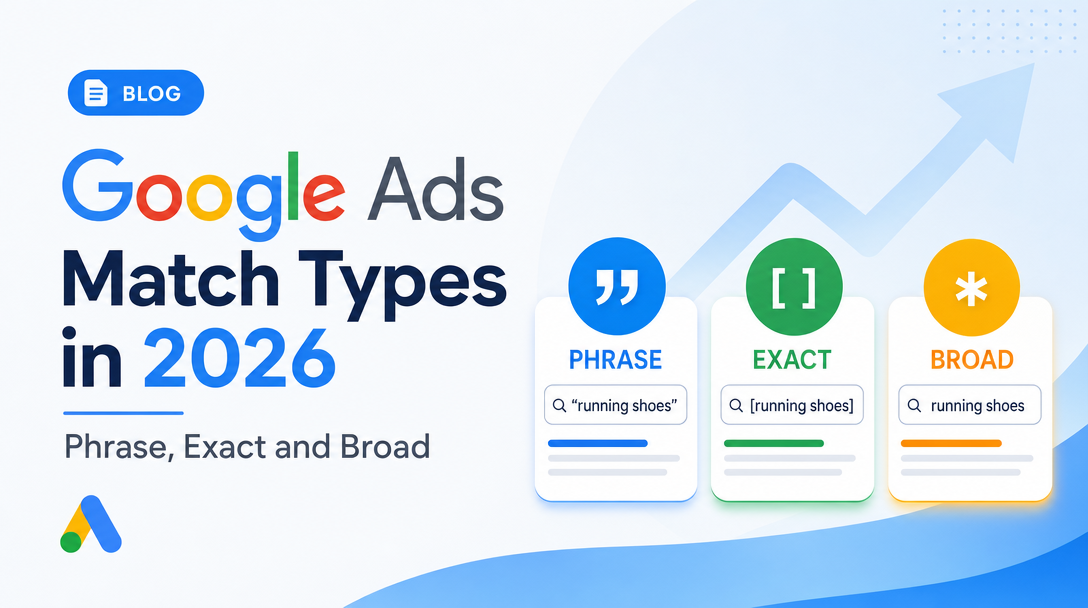
Broad match — the default, no syntax:
Ads may show on searches that are related to your keyword, which can include searches that don't contain the direct meaning of your keywords.
Note "don't contain the direct meaning." Broad is not a looser string match; it is a semantic and contextual reach mechanism. Google documents three signals it uses beyond the keyword itself: the user's recent search activity, the content of your landing pages and assets, and the other keywords in the same ad group.
That third signal has a structural consequence people consistently miss: the other keywords in an ad group change what a broad keyword matches. An ad group is not a folder. It is context that feeds the matching system.
Phrase match — quotation marks, "tennis shoes":
Ads may show on searches that include the meaning of your keyword. The meaning of the keyword can be implied, and user searches can be a more specific form of the meaning.
"The meaning of the keyword can be implied" is the operative clause. Word order is no longer the rule; containment of meaning is. A phrase keyword can match a search that shares no word order and adds specificity.
Exact match — square brackets, [red shoe]:
Ads may show on searches that have the same meaning or same intent as the keyword.
Exact match has not meant "exact string" for years. It means same meaning or same intent. Google describes it as giving "the most steering over who views your ad", while reaching fewer searches than phrase or broad — and "steering" is a notably weaker word than "control."
And the rule underneath all three:
By default, all keyword match types are eligible to match to close variants. There's no way to opt out.
That last sentence is the one to read twice. There is no setting, anywhere, that restores literal matching. Misspellings, singular/plural, stemming, abbreviations, accents and reordering are all in scope for every match type. Any strategy premised on locking delivery to a literal string is built on a mechanism Google removed.
What this actually changes
The three match types are no longer three different matching algorithms. They are three points on a single axis of how far from your keyword's meaning Google may travel:
| Reach | Steering | Google's own framing | |
|---|---|---|---|
| Exact | Narrowest | Most | "same meaning or same intent" |
| Phrase | Middle | Middle | "include the meaning", meaning "can be implied" |
| Broad | Widest | Least | "related to", may not "contain the direct meaning" |
Soku's reading of the practical consequences:
Exact match is not a guarantee, so stop treating it as one. Teams still build "brand protection" or compliance structures on the assumption that [our brand name] serves only on that string. It does not. It serves on same meaning or same intent, subject to close variants you cannot disable. If you need certainty about which searches you appear on, match types are the wrong instrument — negatives are.
Phrase match lost most of its distinctiveness. When word order stopped being the rule, phrase became "narrower broad" rather than a structurally different thing. It still has a real place, but the classic reason to use it — controlling word order — is gone.
Broad match became viable, conditionally. Broad genuinely works now in a way it did not in 2019, and the condition is not optional: Google's documentation ties broad match to Smart Bidding, on the reasoning that "every search query is different" and the bid must respond to context at auction time. Broad match on manual CPC is the worst of both worlds — maximum query variance, one flat bid, no ability to price the difference between a great match and a terrible one. If you are not on Smart Bidding, do not run broad.
The rule that breaks the old account structure
For years the standard advice was to run the same keyword in exact, phrase and broad, in separate ad groups or campaigns, often with different bids, and let a web of negatives route each search to the intended tier. That structure — SKAG-adjacent, "alpha/beta", three-tier, whatever your agency called it — is now unnecessary at best and harmful at worst, and Google's own documentation explains why.
Identical keywords win automatically:
An exact match keyword that is identical to a query is now always preferred as long as it's eligible to match.
And it is not exact-only:
Both phrase and broad match keywords will follow the same behavior.
So the entire apparatus of negatives whose job was "make sure the exact match keyword catches this search" is doing nothing. The routing you were hand-building is now the default behaviour of the system.
When nothing matches identically, relevance comes before Ad Rank:
We consider relevance signals in addition to Ad Rank when determining which keyword is selected. Relevance is determined by looking at the meaning of the search term, the meaning of all the keywords in the ad group, and the landing pages within the ad group.
Read that list again, because it is the strongest argument for tight thematic ad groups that Google has ever published — and the argument has nothing to do with Quality Score. The meaning of every keyword in the ad group, and the ad group's landing pages, determine which of your keywords is chosen. A grab-bag ad group is not merely untidy; it actively degrades keyword selection.
Across match types, relevance can beat match type, and Ad Rank breaks ties:
If you have exact match or phrase match keywords that are deemed more relevant than these broad match keywords, the exact or phrase match keyword will be selected.
If you have exact match or phrase match keywords that are deemed similar or less relevant than these broad match keywords, there is still a chance the exact or phrase match keyword will be selected if it has a higher Ad Rank.
The hierarchy is therefore: identical match first, then relevance, then Ad Rank. Match type is not a priority order. It is one input among several.
One further consequence, in Google's words: even when several of your similar keywords are eligible for the same search, "you'll have only one bid in the ad auction." You are not competing with yourself in the auction. The old fear that duplicate keywords inflate your own CPCs is not how it works — but duplicates do still fragment your conversion data across rows, which is a reporting problem rather than an auction one.
How to actually structure an account in 2026
Soku's recommendation, following from the documented mechanics above:
Group by intent and landing page, tightly. Not because of Quality Score, but because ad group composition is a documented input to keyword selection. Every keyword in an ad group should plausibly be served by the same landing page and the same ad. If you cannot write one ad that suits all of them, split.
Do not duplicate the same keyword across match types. It creates no auction advantage and splits your conversion data across rows, which matters most at low volume where Smart Bidding is already short of signal.
Pick a default and deviate deliberately. Two defensible defaults:
- Exact-led: exact match for your known, proven, high-value terms, with broad match in a separate campaign for discovery. Suits accounts with a well-mapped query space and a strong preference for predictability.
- Broad-led: broad match plus Smart Bidding plus a disciplined negative programme, letting the system find the query space. Suits accounts with good conversion volume, clean conversion tracking, and a genuine willingness to let the system explore.
The failure mode is running both half-heartedly: broad match without Smart Bidding, or exact-led with so many keywords that no single one accumulates enough conversions to bid on.
Negatives are now your real control surface. This is the honest bottom line of the whole shift. Match types set how far the system may roam; negatives are the only mechanism that reliably stops it going somewhere specific. If you have moved toward broad, your negative-keyword process is no longer hygiene — it is the steering wheel. Budget real, recurring time for search-term review, and treat the negative list as a maintained asset rather than a one-time cleanup.
Review search terms on a fixed cadence. Weekly at meaningful spend. You are looking for two things: searches to exclude, and searches converting well enough to deserve their own exact match keyword and their own ad. That loop is the whole job now, and it fits naturally into a recurring Google Ads optimisation cadence.
What match types will not fix
Three things worth stating plainly, because match-type tinkering is a popular substitute for harder work.
They will not fix a bad conversion signal. Broad match with Smart Bidding is only as good as what you tell it to optimise toward. If your conversion event is a shallow proxy, wider matching finds more of the wrong people faster. Fix measurement first — the same failure that makes rewarded video traffic look worthless on Meta shows up here as broad match "not working."
They will not fix insufficient volume. Smart Bidding needs conversions. Below a real weekly conversion count, no match-type configuration rescues an account; you need a higher-volume conversion event or a bidding strategy that does not demand as much.
They will not fix a weak landing page. Landing-page content is a documented input to both broad matching and keyword selection. A thin or off-topic page degrades the matching system's understanding of what you sell, before it touches conversion rate at all.
If you are choosing tooling to run this loop rather than choosing the loop itself, Google Ads management software covers what that category does and what it costs.
Sources
Google Ads Help, verified 2026-08-12: