 Soku AI
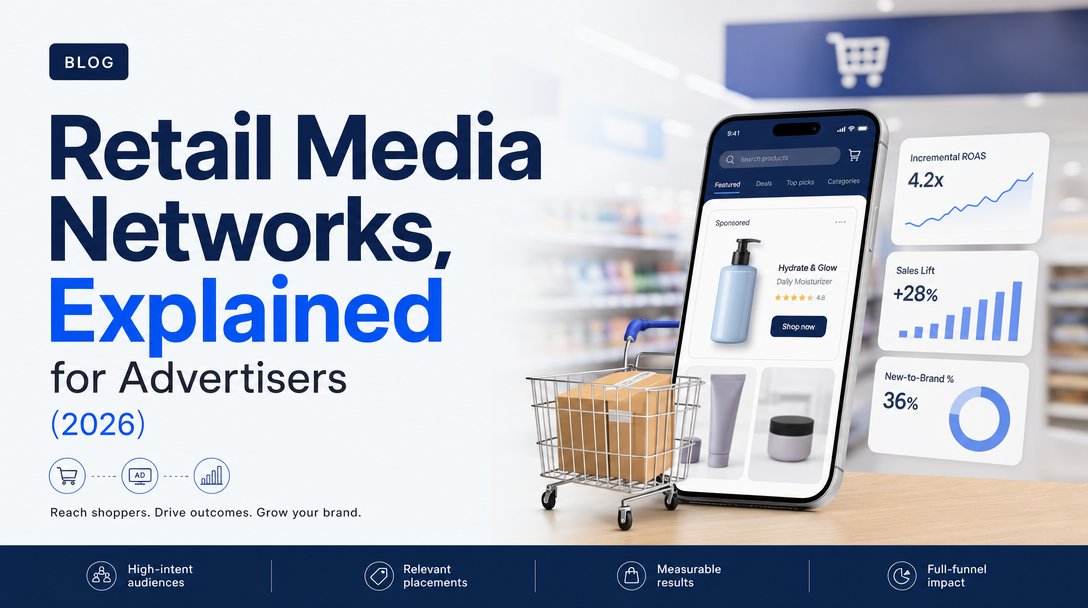
Retail media is the third wave of digital advertising, after search and social, and it is the only one where the platform selling you the ad also owns the cash register. That single fact explains almost everything that is good about the channel and everything you should be careful about.
This is the explainer we wanted when we started buying it: what an RMN actually is, who has the money, what the three inventory types really are, why the measurement looks better than it is, and how to decide whether it belongs in your plan at all.
If you are placing retail media inside a wider buy, the layer model in best programmatic advertising tools shows where it sits — it is simultaneously an identity layer, an inventory source and a measurement system, which is unusual and part of why it is confusing.
What a retail media network is
A retail media network is a retailer selling advertising against its own shopper data and its own surfaces. Three things make it different from every other ad channel:
- The audience is logged in and buying. Not inferred from browsing signals — actually authenticated, with a purchase history attached.
- The conversion is observed, not modelled. When someone buys the product on the retailer's own site, the retailer sees it. No pixel, no attribution window argument, no signal loss.
- The retailer sells the media and clears the transaction. Which is the conflict of interest you have to manage, because the same party reports the ad exposure and the sale.
That combination is why retail media grew through the privacy changes that damaged everything else. Cookie deprecation does not matter much when your audience is signed in.
Where the money actually is
The headline growth number obscures the real structure of the market, which is extreme concentration.
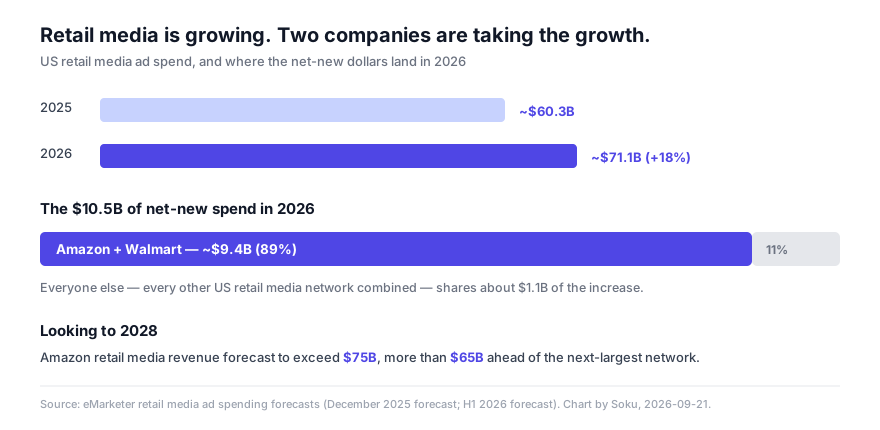
US retail media ad spend is forecast at roughly $71 billion in 2026, up about 18% from around $60 billion in 2025, on eMarketer's December 2025 forecast. But the growth is not spread across the dozens of networks that have launched: eMarketer projects Amazon and Walmart will capture about 89% of the incremental spend in 2026 — roughly $9.4 billion of $10.5 billion in net-new investment. Looking further out, eMarketer forecasts that by 2028 Amazon's retail media revenues will exceed $75 billion, more than $65 billion ahead of the next-largest RMN.
The practical read for a media plan: retail media is not one channel with 60 options. It is Amazon, then Walmart, then a long tail of networks that are individually small, operationally expensive to run, and frequently sold with a minimum that does not match the reach you get. Every additional RMN you add costs a separate integration, a separate taxonomy and a separate reporting export.
That does not make the long tail worthless — a category-dominant retailer in your vertical can outperform Amazon on relevance — but it does mean the burden of proof is on the smaller network, not on you.
The three kinds of retail media inventory
Almost all confusion in RMN conversations comes from treating these as one product.
On-site. Sponsored product listings, banners and search placements on the retailer's own properties. This is the majority of spend and the highest-intent inventory in digital advertising: the shopper is on a product page, with a basket. It behaves like search, it is auction-based, and it is where a new advertiser should start. Amazon's Sponsored Products is the canonical example — it is bought on a daily budget with no contract minimum, and Amazon notes that daily budgets are not paced through the day, so a small budget can be consumed in minutes on a high-traffic product.
Off-site. The retailer uses its shopper data to target you across the open web, CTV and social — inventory it does not own, audience it does. This is where retail media meets programmatic, and where the measurement claim gets weaker, because now exposure happens somewhere the retailer does not control while the conversion is still measured in its own store.
In-store. Digital screens, shelf displays, audio and increasingly smart-cart surfaces inside physical locations. The fastest-growing and least standardised of the three. Measurement is store-level and lagged; treat any in-store ROAS quoted to two decimal places with suspicion.
Most RMN pitches blend all three into one number. Insist on the split before you compare it to anything.
The measurement advantage, and its asterisk
Retail media's closed loop is genuinely better than what most channels can offer. Exposure and purchase are observed in the same system, so you get real sales attribution without a pixel surviving three browsers.
Three asterisks, all of which matter:
The retailer marks its own homework. The seller of the ad is the reporter of the result. This is not an accusation of dishonesty; it is a structural fact that would be flagged immediately in any other channel. Independent verification of retail media is immature.
Attributed sales are not incremental sales. A sponsored listing on a branded search for your own product will report excellent ROAS while largely capturing a purchase that would have happened anyway. This is the single biggest source of overstated retail media performance, and it is entirely avoidable: run a holdout.
Measurement stops at the store boundary. An off-site RMN campaign that drives a purchase in a different retailer, or in your own DTC store, is invisible to the network that caused it. RMN reporting systematically under-credits cross-retailer effects and over-credits on-site ones.
The discipline that fixes all three is the same one that fixes programmatic generally: periodic incrementality testing. Hold out a matched set of products or geographies, measure total category sales, and compare it to the attributed number. The gap between them is your real calibration factor, and it is worth knowing before you scale.
When retail media belongs in your plan
| Situation | Verdict |
|---|---|
| You sell physical products through retailers | Yes — on-site first, on the retailers that carry you |
| DTC only, no retail distribution | Off-site RMN audiences only, and treat it as a data buy |
| B2B or services | Almost never — the shopper graph does not describe your buyer |
| Category challenger fighting for shelf visibility | Yes, aggressively — on-site is the digital shelf |
| Brand-building budget | Off-site and in-store, measured by lift, not by ROAS |
The most common mistake is the reverse of what you would expect. It is not advertisers over-investing in retail media; it is advertisers moving budget into it on the strength of an attributed ROAS number that was never comparable to the number it replaced.
A practical starting sequence
- Start on-site, on the one retailer where you have the most distribution. One network, done properly, beats four networks done partially.
- Separate branded from non-branded from the first day. Branded defence and category conquesting are different jobs with different economics; a blended number tells you nothing.
- Fix the product detail pages before increasing the budget. Retail media sends traffic to a page you do not fully control the design of but do control the content of. Images, titles, bullets, reviews and stock status convert or waste every click you buy.
- Run a holdout in the first quarter, not the third. Hold out a matched set of SKUs for four weeks and compare total sales, not attributed sales.
- Only add off-site once on-site is efficient. Off-site is a harder buy with weaker measurement; it is not the place to learn the channel.
- Ask every smaller RMN for reach, not just for a minimum. The long tail's problem is rarely quality; it is scale relative to the operational cost of running it.
Where Soku fits
Soku does not sell retail media inventory and does not bid in RMN auctions. Where it is useful to a retail media programme is the creative and operating layer around it: producing the volume of product-level creative that on-site and off-site placements consume, and keeping the Google and Meta side of the same demand plan running with approval-gated changes. If your honest constraint is that nobody has time to refresh 300 product creatives or reconcile four reporting exports every week, that is the work. If the constraint is access to Walmart's audience graph, buy Walmart Connect.
FAQ
Is retail media the same as commerce media?
Commerce media is the broader term — it includes retailers plus any business monetising its transaction data, such as airlines, banks, delivery apps and marketplaces. Retail media is the retailer subset, and it is where most of the money currently is.
Is Amazon Ads a retail media network?
Yes, and it is by a wide margin the largest. eMarketer's forecast has Amazon's retail media revenues exceeding $75 billion by 2028, more than $65 billion ahead of the next network.
What is a realistic minimum to start?
On-site sponsored listings on Amazon run on a daily budget with no contract minimum, which makes them the lowest-friction entry into the channel. Larger managed programmes and off-site deals carry negotiated minimums that are rarely published.
Does retail media cannibalise my search budget?
It overlaps with it. Both capture high-intent demand near the purchase. Treat them as one demand-capture budget with two venues and measure incrementality across both, rather than optimising each to its own reported ROAS.
Why is reported retail media ROAS so high?
Largely because much of it is measured on branded and already-decided purchases, and because the network reports its own result. High reported ROAS is the expected output of that setup, not evidence that the setup is working.
Forecast figures are eMarketer's, as published on their retail media ad spending forecast pages. Platform mechanics were checked against Amazon Ads' own documentation on 2026-09-21.