 Soku AI
Search "programmatic advertising tools" and almost every result hands you the same thing: a list of demand-side platforms with the word "tools" in the title. That is a category error. A DSP is one layer of a programmatic buy. It is the layer everybody names because it is the one that sends the invoice, but a working programmatic operation touches six others, and most of the money wasted in this channel is wasted in the layers nobody shortlisted.
This article maps the whole stack. For each layer we name the real tools, say what the layer is actually for, flag what is published about cost, and — the part the listicles skip — tell you at what spend level the layer starts to be worth paying for. If you specifically want a head-to-head of buying platforms rather than the stack around them, that is a different question, and layer 1 below covers the shortlist. This page is about everything the DSP does not do.
For the creative layer specifically, the deeper treatment is in best dynamic creative optimization tools. For the automation layer that sits across all of this, see best AI media buying tools.
The stack, in one picture
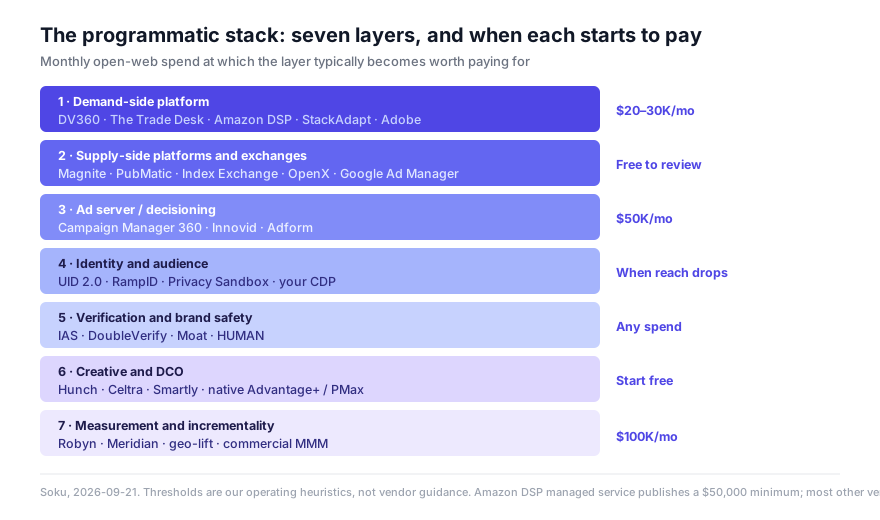
The ordering matters. Layers 1 and 2 are how the impression gets bought and sold. Layer 3 decides what gets shown. Layers 4 and 5 decide whether the impression was real and who saw it. Layers 6 and 7 decide whether you learn anything. A team that buys layer 1 and skips 5 and 7 is running a programmatic budget without an answer to "did a human being see this ad" — which, across the open web, is not a rhetorical question.
Layer 1 — Demand-side platforms (the buying layer)
This is the part everyone means by "programmatic". A DSP bids on impressions across exchanges on your behalf.
The practical shortlist in 2026 is short: Google Display & Video 360, The Trade Desk, Amazon DSP, StackAdapt, Adobe Advertising Cloud, and the walled-garden buying interfaces (Meta Ads Manager, LinkedIn Campaign Manager) which are technically not DSPs but consume the same budget.
The single most useful published fact in this layer is Amazon's, because it states a number out loud: Amazon DSP offers both self-service and managed service, and the managed-service option typically requires a minimum spend of $50,000 USD, with the minimum varying by country. Self-service carries no published minimum. Most other DSPs publish no minimum at all, which in practice means the minimum is whatever the salesperson decides your account is worth.
When this layer is worth it: the moment you want inventory that is not inside Google or Meta — CTV, audio, open-web display, retail media off-site. Below roughly $20–30K/month in open-web budget, the platform fee and the learning curve usually eat the arbitrage.
Layer 2 — Supply-side platforms and exchanges (the selling layer)
Magnite, PubMatic, Index Exchange, OpenX, Google Ad Manager. As a buyer you do not purchase these, but you should know they exist, because two buyer-side realities come straight from this layer.
First, the same impression is frequently available through several paths — a phenomenon called supply-path optimisation, and the reason two DSPs can quote wildly different CPMs for the same audience. Second, curated marketplaces and private deals are negotiated here; if a vendor tells you their inventory is "premium", the honest follow-up is which SSPs and which deal IDs.
When this layer is worth attention: as soon as your open-web CPMs look inexplicable. A supply-path review is free and routinely recovers 10–20% of working media by removing duplicate hops. Ask your DSP for a seller-path report before you buy any new tool.
Layer 3 — The ad server (the decisioning layer)
Google Campaign Manager 360, Innovid (which absorbed Flashtalking), Adform. The ad server is what actually decides which creative renders in a won impression, holds the frequency cap across channels, and produces the one set of numbers that is not the DSP marking its own homework.
This is the most commonly skipped layer among mid-market advertisers, and skipping it has one specific cost: you lose cross-DSP frequency capping. If you run The Trade Desk and Amazon DSP against the same audience without a shared ad server, you are paying twice to annoy the same person.
When this layer is worth it: two or more DSPs, or any campaign where frequency is a brand-safety or brand-fatigue concern. Roughly $50K/month upward.
Layer 4 — Identity and audience (the who layer)
Unified ID 2.0, RampID (LiveRamp), Google's Privacy Sandbox surfaces, plus your own CDP — Segment, Rudderstack, or the customer data platform your data team already runs.
Third-party cookie deprecation turned this from plumbing into strategy. The practical question in 2026 is not "which identity graph is best" but "how much of my addressable audience survives without a cookie, and what is my fallback" — contextual, cohort-based, publisher first-party data, or retail media's logged-in graph. Retail media is the fastest-growing answer here, and worth understanding on its own terms: see retail media networks, explained.
When this layer is worth it: the moment retargeting reach drops and nobody can explain why. Before that, your CDP is enough.
Layer 5 — Verification and brand safety (the was-it-real layer)
Integral Ad Science, DoubleVerify, Moat (Oracle's, now much diminished), HUMAN Security for the fraud-specific case.
This is the layer performance teams most often decline and most often regret. Verification answers three separate questions that are frequently conflated: was the impression viewable, was it seen by a human, and did it appear next to content you would be comfortable defending. A DSP will report on delivery; it has a structural conflict of interest in reporting on quality.
Pricing is per-impression and negotiated, typically quoted as a CPM add-on. No major verification vendor publishes a rate card.
When this layer is worth it: any open-web or CTV buy at all. This is the one layer we would argue is non-optional the moment you leave the walled gardens, at any spend level.
Layer 6 — Creative and DCO (the what-they-see layer)
Hunch, Celtra, Smartly, Innovid's creative side, plus the platform-native systems — Meta Advantage+ Creative and Google Performance Max — which cost nothing extra.
The programmatic-specific point is that creative is the highest-leverage variable in the stack and the one least likely to have a tool attached to it. Teams will spend four weeks selecting a DSP and then run three banner sizes of the same static image for a quarter. Our full ranking of this layer, including the finding that only one independent vendor in the category publishes a price, is in best dynamic creative optimization tools.
When this layer is worth it: immediately, but start with the free native versions. Pay for it when creative volume — not creative decisioning — is the constraint.
Layer 7 — Measurement and incrementality (the did-it-work layer)
Marketing mix modelling (Meta's Robyn, Google's Meridian, Recast, commercial MMM vendors), incrementality testing (geo-lift, platform-native conversion lift studies), and multi-touch attribution tools, which are less credible than they were and should be treated as a directional diagnostic rather than truth.
The honest 2026 position: MTA degraded with signal loss, so incrementality experiments and MMM are carrying the load. Both Robyn and Meridian are open source and free to run if you have an analyst; that is the cheapest genuine upgrade available to most programmatic teams.
When this layer is worth it: above roughly $100K/month, or any time a channel's reported ROAS is high enough to be suspicious. Below that, geo holdout tests cost nothing but discipline.
What you actually need, by spend level
| Monthly open-web spend | Layers worth paying for | What to skip for now |
|---|---|---|
| Under $20K | Native platforms + verification if you leave walled gardens | DSP, ad server, MMM, identity vendor |
| $20K–$50K | Self-service DSP, verification, native creative tools | Ad server, paid identity graph, MMM vendor |
| $50K–$150K | Add an ad server, paid creative/DCO, geo-lift testing | Commercial MMM, multi-DSP sprawl |
| $150K+ | Full stack, plus MMM and a supply-path review every quarter | Multi-touch attribution as a source of truth |
The most common over-buy we see is a team at $30K/month with a DSP, a DMP contract and an attribution tool, and no verification. The most common under-buy is a team at $200K/month with no ad server, paying twice to reach the same person through two DSPs.
Five questions to ask any programmatic vendor
- What is the total take rate, including platform fee, data fees and any managed-service margin? The number that matters is working media as a percentage of gross, and it is often 20–40 points lower than buyers assume.
- Can I see a seller-path report? If the answer is no, the supply path is not being optimised.
- Is my audience portable if I leave? Identity lock-in is the main reason switching costs in this category are real.
- Who verifies quality — you, or a third party? Self-reported viewability is not verification.
- What is the contract minimum and the ramp period? Quote-only vendors often bundle a minimum into the first-year term rather than the rate.
Where Soku fits
Soku is not a DSP and does not sit in the open-web buying path. Where it operates is the operating layer above Google Ads and Meta Ads: reading performance, generating and shipping creative variants, and executing changes behind approval gates. If the honest description of your programmatic problem is "the stack is fine, nobody has time to work it every day", that is the gap we fill. If the problem is CTV inventory access or open-web fraud, buy a DSP and a verification vendor — we are not a substitute for either and will not pretend otherwise.
FAQ
Is programmatic advertising the same as display advertising?
No. Programmatic is a buying method — automated, auction-based, per-impression. Display is one format bought that way. CTV, audio, digital out-of-home and much of retail media are also bought programmatically.
Do I need a DSP to run programmatic ads?
Not necessarily. Meta, Google and Amazon's self-service interfaces are programmatic buying without a third-party DSP. You need a DSP when you want inventory those platforms do not sell.
What is a realistic programmatic take rate?
It varies enough that any single number would be misleading, which is exactly why the question should be asked directly and answered in writing. Ask for working media as a percentage of gross spend, including data and managed-service fees.
Is multi-touch attribution dead?
Not dead, but demoted. Signal loss makes path-level attribution unreliable enough that it should inform hypotheses rather than settle budget arguments. Incrementality tests and MMM settle budget arguments.
What is the cheapest meaningful upgrade to a programmatic programme?
A supply-path review from your existing DSP, and a geo holdout test. Both cost nothing but attention, and both routinely change how the budget is allocated.
Vendor facts in this article were checked against the vendors' own public documentation on 2026-09-21. Where a vendor publishes no figure, we say so rather than estimating.