 Soku AI
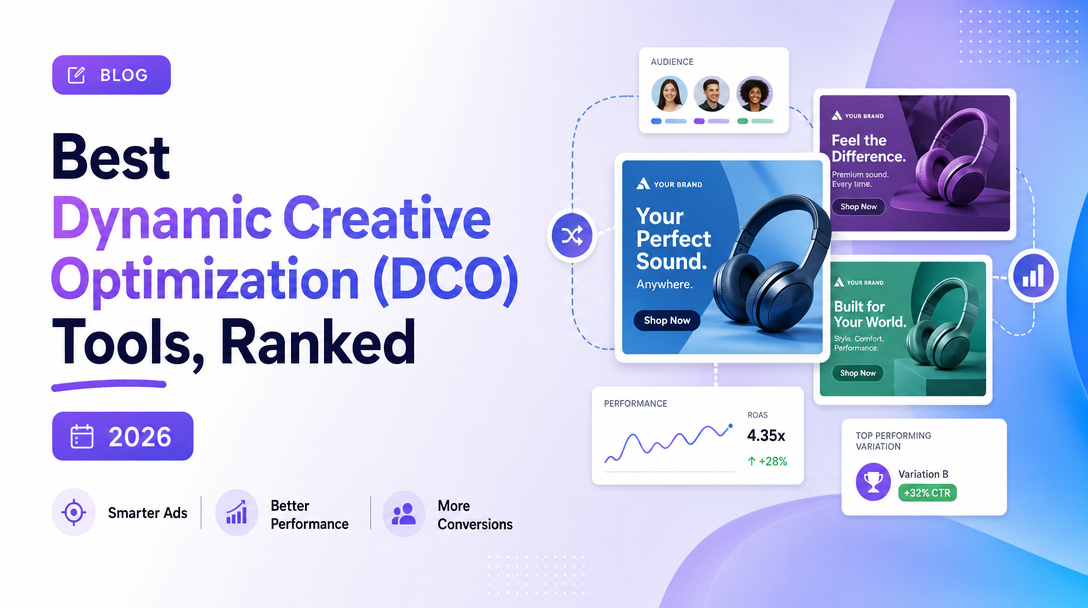
Dynamic creative optimization is the oldest idea in programmatic advertising that most teams still cannot buy sensibly. The concept is simple: instead of shipping one finished ad, you ship components — headlines, product images, price fields, CTAs, backgrounds — plus a rule set or a model that assembles the right combination for each impression. The execution is where it gets expensive, and the buying process is where it gets opaque.
We went looking for the actual price of every serious DCO platform on 2026-09-21. Of the eight vendors below, exactly one publishes a number you can read without talking to a salesperson. That finding shaped this ranking more than any feature checklist, because in a category where the cheapest enterprise contracts start in the five figures, "request a quote" is itself a product decision that rules a tool out for most teams.
If you want the wider automation picture rather than the creative layer specifically, start with our ranking of the best AI media buying tools. For the buy-side plumbing that sits underneath DCO, see best programmatic advertising tools. And if the reason you are shopping for DCO is that your ads stopped working after two weeks, read ad fatigue: how to diagnose and fix it first — DCO is one answer to that problem, but it is not the only one and it is rarely the cheapest.
What DCO actually is (and the three things vendors call DCO)
The term has been stretched to cover three genuinely different products, and vendors rarely tell you which one they are selling.
1. Feed-driven DCO. A product catalogue drives the creative. Each impression pulls a SKU, its image, its live price and its stock status into a template. This is the original DCO and it is still the highest-ROI version for anyone with a catalogue: the personalisation is factual, not guessed. Meta's Advantage+ catalogue ads and Google's dynamic remarketing are the free platform-native versions; Hunch and Celtra are the independent ones.
2. Combinatorial DCO. You upload N headlines, M images and P CTAs and the platform tests combinations. Meta Advantage+ Creative and Google Responsive Search Ads / Performance Max do this natively at no extra software cost. Independent vendors sell it with better reporting and cross-channel reach.
3. Generative DCO. The newest and the loosest. Instead of combining assets you already have, a model produces new ones — new backgrounds, new copy angles, new aspect-ratio crops — and the system tests them. This is where the category has moved in 2026, and it is also where the claims get hardest to verify, because "AI-generated" is not the same as "AI-generated and measured".
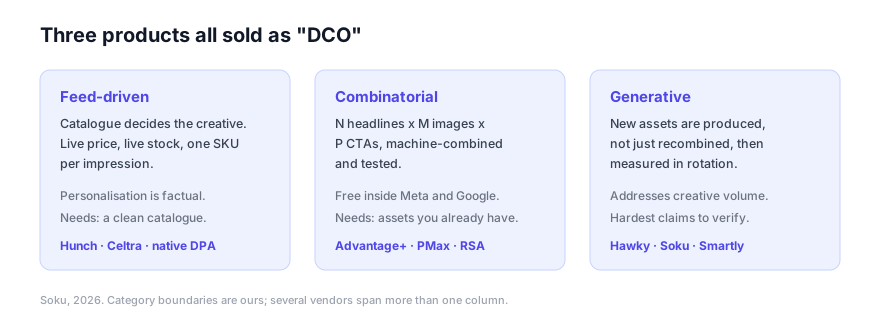
The distinction matters commercially. If you have a catalogue, feed-driven DCO pays for itself fastest. If you have one product and five messages, combinatorial DCO is largely free inside Meta and Google and you are paying an independent vendor for reporting and workflow, not for the optimisation itself. If your bottleneck is that you cannot produce enough distinct creative to test, generative DCO is the only one of the three that addresses your actual constraint.
How we scored
Six dimensions, weighted the way a performance team would weigh them:
- Creative production depth (25%) — can it make new assets, or only recombine ones you supply?
- Feed and catalogue handling (20%) — real-time price and stock, or a nightly CSV?
- Channel coverage (20%) — which platforms it can actually deliver to, not just report on.
- Measurement granularity (15%) — element-level attribution (which headline won) versus variant-level.
- Pricing transparency (10%) — can a buyer size the cost before a sales call?
- Time to first live test (10%) — realistic days from signup to a running DCO campaign.
Every price below was fetched on 2026-09-21. Where a vendor publishes no number, we say so rather than estimating; a made-up price is worse than no price.
The published-pricing audit
This is the original finding of this article, and the reason we built the table before the ranking.
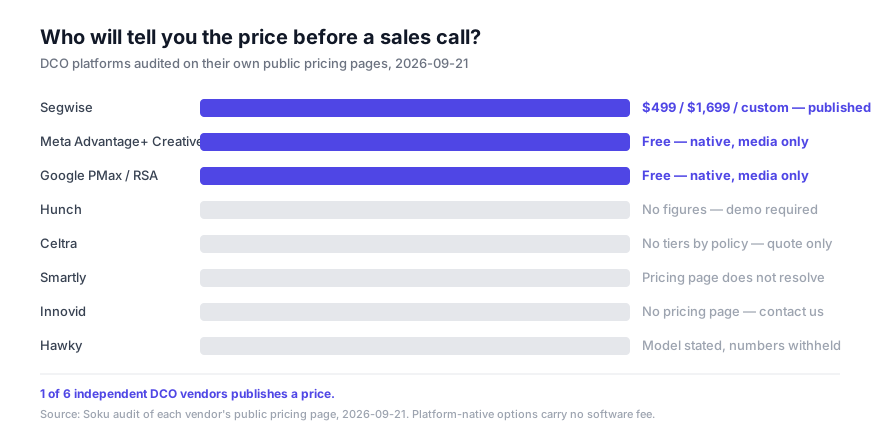
| Platform | Public price list? | What we found on 2026-09-21 |
|---|---|---|
| Segwise | Yes | $499/mo up to $250K monthly ad spend; $1,699/mo for $250K–$500K; custom above $500K. A $250/mo startup rate is advertised for accounts under $50K/mo spend. |
| Hunch | No | Pricing page describes "pay for what you use", "no hidden fees, no seat limits" — no tiers or figures shown; routes to a demo request. |
| Celtra | No | Explicitly rejects tiers: "We don't believe in rigid tiers or cookie-cutter plans… a bespoke package based on the solutions you need and the volume you require." Quote only. |
| Smartly | No | smartly.io/pricing returns a not-found page; the site routes all pricing questions to sales. |
| Innovid | No | No pricing page; "Contact us" / "Let's talk" only. |
| Hawky | No | Pricing page states it is per brand and scales with creative volume, with no per-seat fees, then routes to sales. |
| Meta Advantage+ Creative | Free (native) | No software fee — you pay media only. |
| Google Performance Max / RSA | Free (native) | No software fee — you pay media only. |
Two things follow from that table. First, the two most widely used DCO systems in the world cost nothing extra, because they are built into the ad platforms. Any independent vendor has to beat free before it has to beat a competitor. Second, if you are a team under roughly $100K/month in spend, most of this category is not really selling to you; the quote-only motion exists because the contracts are sized for brands and agencies, not for growth teams.
The ranking
1. Hunch — best feed-driven DCO for Meta and TikTok commerce
Hunch is the clearest expression of feed-driven DCO for social. You connect a product feed, build a template once, and every SKU renders as a native-looking video or image ad with live price and availability. Its strength is that the automation is boring in the right way: the same template produces thousands of correct ads, and when a product goes out of stock the ad stops rather than burning budget on an unbuyable item.
What it is not is a creative-strategy tool. Hunch will render your template beautifully across a catalogue; it will not tell you that the template itself is the problem. Pair it with an analytics layer.
Pricing: no public figures; usage-based, sold through a demo (checked 2026-09-21).
Best for: ecommerce and travel catalogues on Meta and TikTok.
2. Celtra — best for brand-side creative operations at scale
Celtra is a creative automation platform first and a DCO engine second, which is exactly right for large brands whose real bottleneck is producing 400 compliant variants across 12 markets, not choosing between two headlines. Brand governance, versioning and localisation are genuinely strong here, and its dynamic product ad product covers the catalogue case.
The trade-off is that Celtra is an operations investment. It rewards a team with a creative ops function and punishes a team of three who wanted to test some headlines. Its pricing stance — an explicit refusal to publish tiers — tells you which of those two it is built for.
Pricing: bespoke quote only, no public tiers (checked 2026-09-21).
Best for: enterprise brands with multi-market creative operations.
3. Smartly — best cross-channel coverage, including CTV
Smartly is the broadest of the independents: social, video, connected TV across a claimed 200+ streaming services, open web through major DSPs, and creative templating across all of it. If your DCO requirement genuinely spans paid social and CTV in one system, the shortlist is short and Smartly is on it. Its CTV reach is the specific reason to consider it over a social-only tool — see our CTV advertising platforms ranking for how that layer fits.
The cost of that breadth is that it is an enterprise platform with an enterprise motion. Its pricing page does not resolve, and every route leads to a conversation.
Pricing: no public price; smartly.io/pricing does not resolve (checked 2026-09-21).
Best for: large advertisers running social and CTV creative from one system.
4. Innovid — best for CTV-first DCO and converged measurement
Innovid approaches DCO from the ad-serving and measurement side rather than the creative-production side, and that heritage shows. If your DCO problem is personalising a CTV or converged-TV campaign and then proving what it did, Innovid's measurement stack is the differentiator, not its creative editor.
It is also the least relevant option if you are a performance team running Meta and Google only. This is a TV-shaped tool.
Pricing: no published pricing; contact-sales only (checked 2026-09-21).
Best for: CTV and converged-TV advertisers who need creative personalisation and measurement in one vendor.
5. Segwise — best creative analytics, and the only transparent price
Segwise is not a creative production tool and does not pretend to be. It is the element-level analytics layer: which hook, which first frame, which CTA is actually carrying performance, read across networks. That is the half of DCO most teams are missing, because the platforms will happily optimise a combination without ever telling you why it won.
It is also the only vendor in this ranking that publishes a price, which for a buyer is worth real points. At $499/mo up to $250K in monthly spend — or $250/mo under $50K — a growth team can size it in an afternoon instead of a quarter.
The honest limitation: buy Segwise and you still need something to produce the creative. It closes the measurement loop, not the production loop.
Pricing: $499/mo (≤$250K spend), $1,699/mo ($250K–$500K), custom above; $250/mo startup rate under $50K spend (checked 2026-09-21).
Best for: performance teams who want to know which creative element is working.
6. Hawky — agent-driven generation plus delivery optimisation
Hawky sits in the generative-DCO camp: agents that produce creative and agents that decide what runs next, sold as a loop rather than as two products. Its pricing model — per brand, scaling with creative volume, no per-seat fee — is the right shape for creative work, and it is stated plainly even though the numbers are not.
The category-wide caution applies here more than anywhere: generative DCO claims are easy to make and hard to verify from outside. Ask, in the trial, to see element-level results attributed to generated assets rather than aggregate lift.
Pricing: per brand, volume-scaled, no per-seat fees; figures on request (checked 2026-09-21).
Best for: performance marketers whose bottleneck is creative volume.
7. Meta Advantage+ Creative — the free default you should exhaust first
Meta will automatically test asset combinations, generate background variations, crop to placement and adjust text, at no software cost. For a very large share of advertisers this is all the DCO they need, and every independent vendor's pitch should be evaluated against it rather than against a blank page.
Its limits are real: the optimisation is a black box, reporting is at the combination level rather than the element level, and none of it travels outside Meta. But it is free, it is already in your account, and it is a fair baseline.
Pricing: no software fee; media cost only.
Best for: anyone who has not yet proven they need to pay for DCO.
8. Google Performance Max and Responsive Search Ads — free, native, and deliberately opaque
The same argument as Meta, with the same caveat sharpened. Performance Max assembles creative across Search, Display, YouTube, Discover, Gmail and Maps, and Responsive Search Ads does the combinatorial work in Search. You pay nothing extra and you see very little. If you want to understand what Google's newer automation actually changes at the campaign level, we broke that down in AI Max vs Performance Max.
Pricing: no software fee; media cost only.
Best for: Google-centric advertisers who accept the reporting trade.
Where Soku fits
Soku is an ad-automation agent rather than a DCO platform, so we are not going to place ourselves at number one in a category we do not compete in head-on. What Soku does that overlaps here is the production-and-iteration half: generating ad creative, pushing variants into Google Ads and Meta Ads, and acting on results with approval gates. If your constraint is "we cannot produce enough distinct creative to feed a test", that is our lane. If your constraint is "we need a rules engine that renders 40,000 SKUs with live prices", Hunch or Celtra is the correct answer and we will say so.
The decision, in one table
| If your situation is… | Buy | Why |
|---|---|---|
| Large catalogue, Meta/TikTok | Hunch | Feed-driven rendering is the whole job |
| Enterprise brand, many markets | Celtra | Governance and localisation, not just optimisation |
| Social + CTV in one system | Smartly | Only realistic single-vendor answer |
| CTV-first with measurement burden | Innovid | Ad serving and measurement heritage |
| You don't know which element wins | Segwise | Element-level analytics, transparent price |
| Not enough creative to test | Hawky or Soku | Production is the constraint, not decisioning |
| Under ~$50K/mo total spend | Meta/Google native | Exhaust free before paying |
How to run a DCO test that actually tells you something
Most DCO pilots fail for methodological reasons rather than product ones.
- Change one layer at a time. If you switch platform and introduce generated assets and expand to a new placement in the same fortnight, you will not know which caused the delta.
- Hold the audience fixed. DCO lift and audience-expansion lift are routinely confused, and audience expansion usually explains more of the movement.
- Insist on element-level reporting before you sign. If a vendor can only show you which variant won and not which element carried it, you are buying a slot machine, not a learning system.
- Budget for the feed, not just the software. The most common reason feed-driven DCO underperforms is a dirty catalogue — missing images, stale prices, inconsistent titles. That work is yours, and it is usually the larger cost.
- Set a kill date. Give the pilot a fixed window and a pre-registered success metric. Quote-only vendors are very good at extending pilots.
FAQ
Is DCO the same as A/B testing?
No. A/B testing compares whole ads and picks a winner for everyone. DCO assembles a different combination per impression based on signals, so there is no single winner — there is a policy. That difference is why DCO needs element-level reporting to be interpretable at all.
Do I need a product feed to use DCO?
For feed-driven DCO, yes. Combinatorial and generative DCO work without one, and that is the version most lead-gen and SaaS advertisers end up using.
Does DCO fix ad fatigue?
Partly. It extends the life of a creative concept by varying its surface, but it cannot rescue a concept the audience has rejected. See ad fatigue: how to diagnose and fix it for the distinction between surface fatigue and concept fatigue.
Why won't these vendors publish prices?
Because the contracts are negotiated on spend volume, creative volume and services, and because quote-only pricing lets a vendor charge different customers differently. It is a legitimate enterprise practice and also a real cost to buyers — you cannot shortlist what you cannot size.
What is the cheapest way to start?
Meta Advantage+ Creative and Google Performance Max, which cost nothing beyond media. Add Segwise if you need to know which element is working before you commit to a paid production platform.
All pricing in this article was fetched from the vendors' own public pages on 2026-09-21. Where no public figure exists, we have said so rather than estimating.