Soku AI
Connected TV advertising has a marketing problem and a buying problem, and they point in opposite directions. The marketing says CTV is now accessible to any advertiser. The buying reality is that most of the good inventory is still sold through routes that assume you have a media agency, a five-figure test budget and somebody who can read a reach-and-frequency plan.
So we ranked CTV platforms on the thing that actually determines whether a team can use them: the real entry point. Not the feature grid — the published minimum, the self-serve route, and what it costs to find out whether CTV works for you before committing a quarter's budget.
Every figure below was checked against the platform's own public documentation on 2026-09-21. Where a platform publishes nothing, we say so; a guessed minimum is worse than an admitted gap.
If you are mapping CTV into a wider buy, the layer model in best programmatic advertising tools puts it in context. The creative side is covered in best dynamic creative optimization tools.
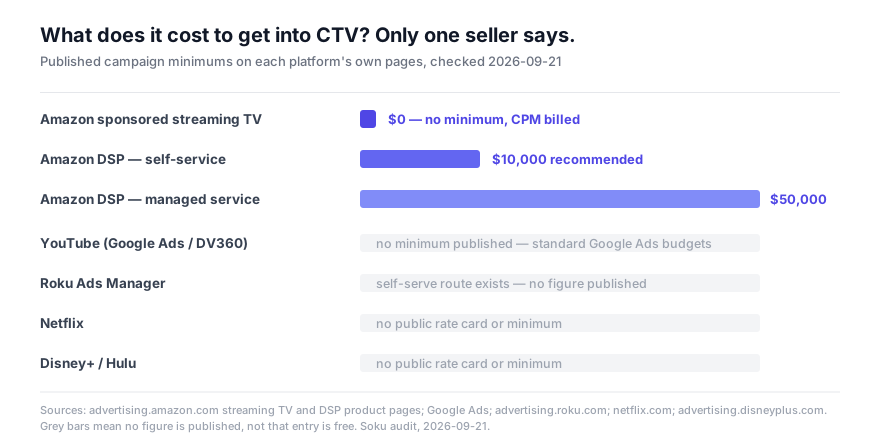
The published-minimum table (the part nobody prints)
| Route | Published minimum | Source checked 2026-09-21 |
|---|---|---|
| Amazon streaming TV ads (sponsored ads) | None — "no minimum spend requirement", billed CPM | Amazon streaming TV ads |
| Amazon DSP — self-service | $10K recommended campaign minimum | Amazon streaming TV ads |
| Amazon DSP — managed service | $50K campaign minimum | Amazon DSP |
| YouTube (Google Ads / DV360) | None published; runs on standard Google Ads budgets | Google Ads self-serve |
| Roku Ads Manager | Self-serve route exists; no minimum published on the product page | advertising.roku.com |
| Netflix ads | No public minimum or rate card | netflix.com ad pages |
| Disney+ / Hulu | No public minimum or rate card | advertising.disneyplus.com |
| The Trade Desk, DV360 (CTV via DSP) | No published minimum; negotiated | vendor sites |
| Smartly (CTV creative + delivery) | No published price; pricing page does not resolve | smartly.io |
One row does most of the work in that table. Amazon is the only major CTV seller that states its entry points in public, at three distinct levels, and the lowest of them is zero. That is not a small thing: it means an advertiser can test streaming inventory at a few hundred dollars and find out whether the format does anything for them, which is not possible with any of the premium streamers.
The ranking
1. Amazon (Streaming TV ads, Prime Video, Fire TV, Twitch) — the only true low-floor entry
Amazon wins this ranking on accessibility, not on prestige. Sponsored streaming TV ads have no minimum spend requirement and are billed on a CPM basis, available to Brand Registry sellers, vendors, agencies and brands in the US whether or not they sell on Amazon. Step up to Amazon DSP and the published figures are a $10K recommended self-service campaign minimum and a $50K managed-service campaign minimum.
The inventory is genuinely large — Prime Video, Fire TV, Twitch, plus third-party services through Amazon Publisher Direct — and the shopper-signal layer is the real differentiator for anyone selling a physical product.
The honest caveats: the measurement story is strongest inside Amazon's own graph, and reporting outside it is thinner. And "no minimum" is not the same as "works at $500" — you still need enough impressions to learn anything, which in practice means a few thousand dollars before the data means much.
Best for: anyone who wants to test CTV this month rather than next quarter.
2. YouTube (via Google Ads and DV360) — the largest reach with the lowest friction
YouTube on the living-room screen is CTV by any reasonable definition, and it is bought with the same Google Ads account you already have, at the same budget levels. No minimum, no new contract, no new team.
Its weakness is the reverse of Amazon's: the inventory is enormous but it is YouTube, which means user-generated content alongside premium, and brand-safety controls that require actual configuration rather than a checkbox. If your board's definition of CTV is "ads in premium long-form content", YouTube will not satisfy it even though the screen is the same.
Best for: performance teams who want CTV reach without a new buying relationship.
3. The Trade Desk — the best independent route to premium streaming
For advertisers who want the premium streamers without going one direct deal at a time, an independent DSP is the route, and The Trade Desk is the most established. You get cross-publisher reach, frequency management across streamers, and a supply path you can inspect.
No minimum is published, which in practice means the minimum is a conversation. Budget for a platform fee, a data fee and an onboarding period; the honest floor for a DSP-based CTV programme is usually in the tens of thousands per month before the overhead makes sense.
Best for: advertisers running premium streaming across multiple publishers.
4. DV360 — the same, inside the Google stack
If your display, video and YouTube already run through DV360, adding CTV there is the path of least resistance and keeps frequency capping in one place. The trade-off is ecosystem concentration: reporting, identity and inventory all lean Google, and the supply-path question gets harder to answer honestly when the buyer and a large seller share a parent.
Best for: teams already standardised on DV360.
5. Roku — strong device-level data, self-serve route exists
Roku's advantage is that it is the operating system on the screen, which gives it device-level reach and measurement that a publisher-by-publisher buy cannot match. Roku Ads Manager provides a self-serve route, though the product page does not publish a minimum.
The limitation is that Roku's reach is Roku's installed base. It is a strong first CTV platform in the US and a partial one internationally.
Best for: US advertisers who want device-graph reach and a self-serve interface.
6. Netflix — premium attention, opaque buying
Netflix's ad tier is the most-discussed inventory in CTV and the least buyable on a self-serve basis. There is no public rate card and no public minimum; access is through Netflix's sales organisation and selected DSP partners.
If brand-building on premium long-form content is the objective and the budget is agency-scale, it belongs on the list. If you are trying to test CTV, it does not.
Best for: brand campaigns with agency support and a real budget.
7. Disney+ / Hulu — the same shape, with deeper targeting
Disney's ad platform has invested heavily in self-service ambitions and automated guaranteed deals, and its audience-graph work is genuinely ahead of most publishers. But like Netflix, nothing about the cost of entry is public.
Best for: brands buying premium entertainment inventory with an agency.
8. Smartly — not inventory, but the creative and delivery layer across it
Worth naming because a real CTV problem is usually creative, not access. Smartly sells CTV delivery across a claimed 200+ streaming services alongside its social and open-web creative tooling, which is the single-vendor answer for teams who want one creative system feeding both social and TV. Pricing is not published and the pricing page does not resolve.
Best for: advertisers who need one creative pipeline across social and CTV.
The three things that surprise first-time CTV buyers
CTV creative is not repurposed social creative. A 9:16 hook-driven clip designed to survive a thumb-scroll on mute performs badly on a television, where the ad is unskippable, full-screen, with sound on, and watched from three metres away. Text that works at 6 inches is unreadable at 3 metres. Budget for a proper 16:9 cut with audio designed to carry the message, not captions designed to replace it.
Frequency is the number one complaint and the number one fixable problem. Because CTV impressions are bought across publishers who each cap independently, the same household routinely sees the same spot far more often than the plan intended. Cross-publisher frequency management is the main argument for buying through a single DSP or an ad server rather than direct.
Attribution is household-level, not user-level. There is no click. Measurement is by exposure-to-conversion matching, incrementality testing or MMM. Any CTV vendor quoting you a clean last-click ROAS is describing something other than what happened.
How to run a first CTV test that produces a real answer
- Start where a minimum does not gate you. Amazon's sponsored streaming TV route and YouTube both let you begin at a budget you can write off.
- Cut one purpose-built 15 or 30 second spot in 16:9. One good spot beats five resized social edits.
- Run a geo holdout. Split matched markets, hold CTV out of half. This is the only cheap way to see incremental effect without user-level tracking.
- Set frequency caps explicitly and check delivered frequency, not planned frequency.
- Give it four weeks minimum. CTV effects are slower and broader than search; a two-week read is noise.
Where Soku fits
Soku does not sell CTV inventory and is not a DSP. Where it is relevant to a CTV programme is the creative production and iteration loop — generating and versioning the variants a test needs, and running the Google and Meta side of the same campaign with approval-gated changes. If the reason your CTV test stalled is that nobody had time to produce a second spot, that is a problem we work on. If the problem is access to premium streaming inventory, buy a DSP.
FAQ
What is the actual minimum to start CTV advertising?
Amazon's sponsored streaming TV ads publish no minimum spend requirement and bill on CPM, which makes them the lowest published entry point among major sellers. Through Amazon DSP the published figures are $10K recommended for self-service and $50K for managed service. Most other platforms publish no minimum at all.
Is YouTube CTV?
When it plays on a television, yes, and it is the largest single source of living-room streaming ad impressions. Whether it satisfies a "premium video" brief is a separate, editorial question.
Can I reuse my social video for CTV?
Technically yes, effectively no. Sound-on, full-screen, three-metre viewing changes what works. Recut properly.
How do I measure CTV without clicks?
Geo holdout tests for incrementality, platform-native exposure matching for directional reads, and MMM at scale. Treat any click-based CTV metric with suspicion.
Is CTV cheaper than linear TV?
Per impression, usually not — premium CTV CPMs are often higher than broadcast. The argument for CTV is addressability and measurability, not cheapness.
All minimums and pricing statements were checked against each platform's own public pages on 2026-09-21. Where no figure is published, that is stated rather than estimated.