Soku AI
TikTok's Agentic Hub is easy to misunderstand if you only read the launch headline. It is not just another name for the TikTok Ads MCP Server. The MCP server is the connector. Agentic Hub is the place where agent-ready TikTok Ads skills can be packaged, discovered, and governed.
That distinction matters for marketers because the next phase of ad automation will not be won by the team that merely connects an AI assistant to an ad account. Everyone will get that. The advantage will come from the team that knows which skills an agent should run, which actions need approval, and how to keep a multi-account TikTok workflow from turning into uncontrolled spend.
For the full landscape, start with the pillar: TikTok Ads MCP and Agentic Hub: Official Status, Setup Options, and Limits. This article focuses on the Hub layer: what it likely changes for marketing teams, what is confirmed, and what to prepare now.
What TikTok announced
At TikTok World '26, TikTok announced an official TikTok Ads MCP Server and TikTok Ads Skills for agentic advertising workflows (TikTok Newsroom). TikTok's developer-facing blog also introduced the TikTok Ads Agentic Hub alongside the MCP server (TikTok API for Business Blog).
The practical map looks like this:
| Layer | What it does | Why marketers should care |
|---|---|---|
| TikTok Marketing API | The underlying account, campaign, creative, audience, reporting, and Events API surface | Defines what any TikTok ad agent can actually do |
| TikTok Ads MCP Server | Standardizes those capabilities as tools an AI client can call | Lets Claude, ChatGPT, or another MCP client operate TikTok Ads through a governed interface |
| TikTok Ads Skills | Packages common ad jobs like campaign creation, performance insights, creative analysis, audience discovery, and budget optimization | Turns raw API access into repeatable marketing workflows |
| Agentic Hub | A distribution and governance surface for those skills | Makes agent workflows easier to discover, approve, reuse, and standardize |
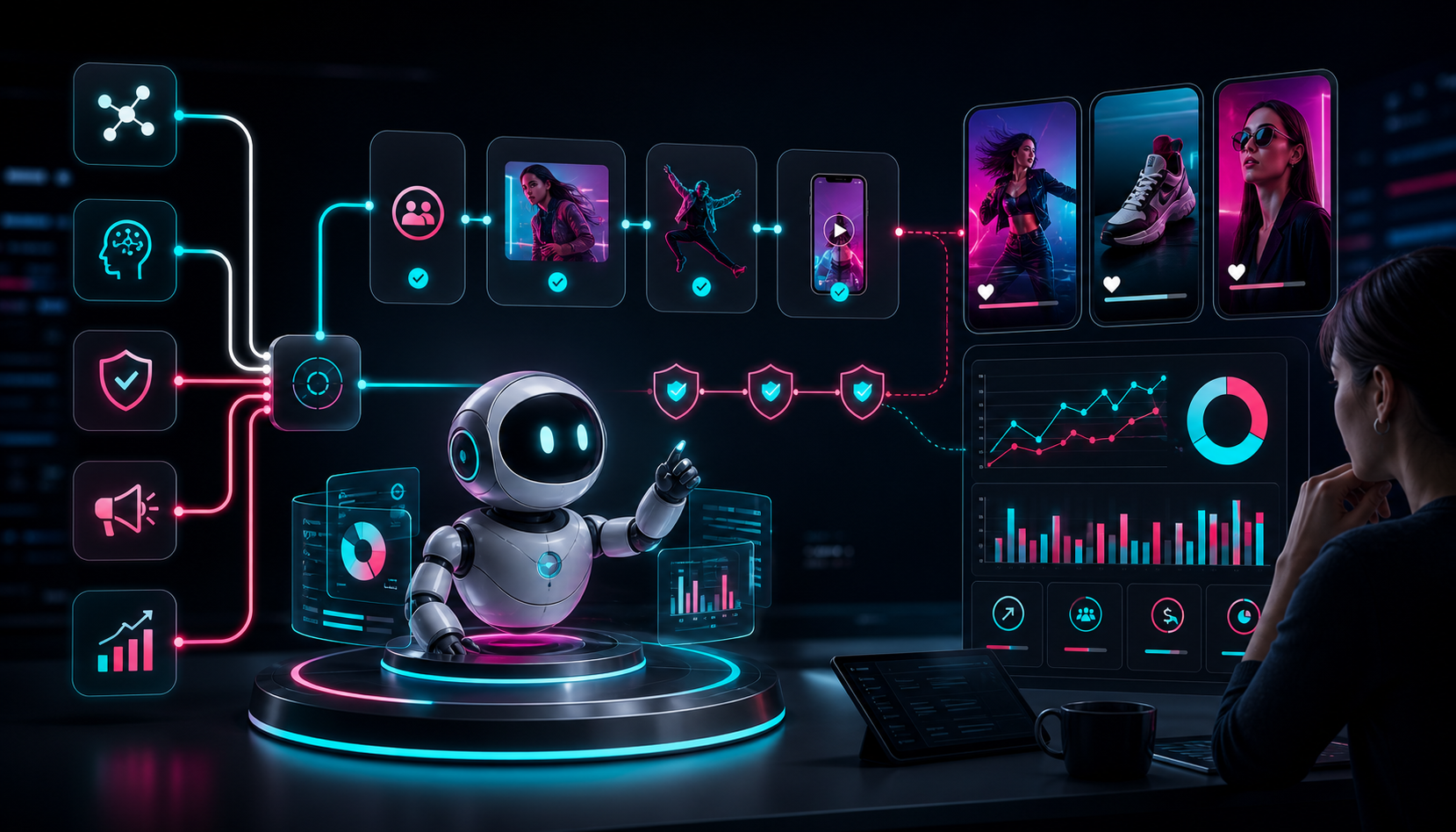
In other words: MCP is the protocol; Skills are the jobs; Agentic Hub is the operating surface.
Why Agentic Hub matters more than the connector headline
The connector headline is exciting because it says agents can reach TikTok Ads. But the Hub is where the durable workflow change lives.
Without a Hub, each team wires its own server, writes its own prompts, and invents its own guardrails. That is fine for a technical pilot. It is fragile for a brand team or agency managing live spend across multiple advertisers.
With a Hub, TikTok can move toward a more standardized model:
- A developer packages a skill for a known advertising job.
- TikTok reviews or distributes that skill through an official surface.
- A marketer or partner can enable the skill without reading raw API docs.
- Governance can move closer to the workflow: scopes, approvals, account access, and auditability.
That is the real product shift. The ad dashboard does not disappear overnight, but the unit of work changes from "click through Ads Manager" to "approve a skill-backed agent action."
What marketers can expect the Hub to cover
TikTok has not published a complete public tool spec, so treat this as an operating map, not a final feature list. Based on the announced Ads Skills categories, the first useful Hub workflows are likely to cluster around five jobs:
- Campaign creation from a brief
The agent turns a marketing brief into a campaign structure: objective, campaign, ad groups, budgets, placements, audiences, and creative requirements.
- Performance insight pulls
The agent reads campaign, ad-group, and ad-level metrics, then flags spend waste, delivery drops, CTR decay, creative fatigue, or conversion-rate drift.
- Creative analysis
The agent connects performance data to creative attributes: hook, format, asset age, message angle, creator style, offer, and landing-page fit.
- Audience discovery
The agent suggests audience tests, creative/audience pairings, or expansion paths based on campaign goals and prior data.
- Budget optimization
The agent proposes reallocations or bid changes, ideally as a draft that a human approves before anything touches live spend.
The last point is the one to watch. If TikTok follows Meta's safer pattern, create or edit actions may land paused or require approval. If not, marketers need to add that gate at the workflow layer.
What is not ready yet
As of late June 2026, do not treat Agentic Hub as a self-serve production system for every advertiser. The public gaps are still material:
- No public self-serve install flow for the official TikTok Ads MCP Server.
- No complete tool list or schema.
- No confirmed general availability date.
- No public answer yet on whether write actions land active, paused, or draft-only.
- No published standard for skill review, permissions, audit logs, or rollback.
That does not make the announcement unimportant. It means the correct move is preparation, not blind adoption.
The preparation checklist
If you run TikTok spend, the work you can do now is operational:
Write the jobs before you connect the tool.
Define the recurring questions your team asks every week:
- Which TikTok campaigns wasted spend yesterday?
- Which creatives are showing fatigue?
- Which ad groups should get more budget?
- Which audience tests should we stop?
- Which hooks should we remake for the next creative batch?
Those become your first skill candidates.
Separate read workflows from write workflows.
Read workflows can run daily. Write workflows should require human review. Budget changes, audience edits, and new campaign launches should never execute just because an agent sounded confident.
Create account boundaries.
Agencies need brand-to-ad-account mapping before any agent can operate safely. A bare connector does not know that one advertiser belongs to one client and another advertiser belongs to a different brand with a different voice, budget, and approval chain.
Build a prompt library now.
The prompt library matters even after TikTok ships the official server. The connector changes; the operating patterns do not. Prompts should pin date ranges, campaign IDs, attribution windows, and output format.
Example prompt patterns
Use these as starting points when testing third-party TikTok MCP servers today, and later when the official server opens.
List the authorized TikTok ad accounts you can access.
For each account, show advertiser_id, account name, currency, and whether you have read or write access.
Do not modify anything.
For advertiser_id [ID], compare the last 7 days vs the prior 7 days.
Return campaign | spend | [CPA](/glossary/cpa) | CTR change | conversion-rate change | likely issue.
Use campaign-level data only. Do not make recommendations that require edits yet.Take the 3 campaigns with the largest CPA increase.
Pull ad-group and ad-level performance for those campaigns.
Draft a change plan, but do not execute it: action | object | reason | expected risk | approval needed.That last phrase is non-negotiable: draft, do not execute. It keeps the agent in the role of analyst and planner until your governance is proven.
How this compares to Meta and Google
Google Ads MCP is the conservative model: official, useful, and read-only. Meta's Ads MCP is the aggressive model: official, remote, OAuth-gated, and read/write from day one. TikTok appears to be aiming at the agentic workflow layer rather than only a connector endpoint.
That could make TikTok more powerful for marketers if the Hub ships with strong guardrails. It could also make early usage riskier if the first workflows emphasize action before auditability.
The comparison matters because each platform teaches a different lesson:
- Google: read-only access is enough to make agents useful for reporting and diagnosis.
- Meta: write access needs paused creates, approval gates, and explicit scopes.
- TikTok: creative, audience, and optimization skills need brand context or they will make plausible but unsafe suggestions.
For the full platform-by-platform breakdown, read TikTok vs Meta vs Google Ads MCP, Compared.
How Soku fits
Soku already treats TikTok as part of a governed ad-agent workflow: connect the account, assign it to the right brand, read performance, generate creative, propose changes, and keep a human in the loop before anything affects spend.
That is the same operating model Agentic Hub points toward. The raw connector is useful, but it is not enough. A marketer needs account mapping, brand context, creative context, approval rules, and reporting discipline. Soku packages those pieces around the ad platforms rather than leaving each team to wire them together one MCP server at a time.
When TikTok's official MCP and Agentic Hub become generally available, the connection layer should get simpler. The hard part will still be the same: deciding what the agent is allowed to do, when a person must approve it, and how to keep every recommendation tied to real performance data.
FAQ
Is TikTok Agentic Hub the same as TikTok Ads MCP?
No. The MCP server is the connector that exposes TikTok Ads tools to AI clients. Agentic Hub is the broader surface for packaging, discovering, and governing agent-ready skills.
Can marketers use Agentic Hub today?
Not as a fully public, self-serve production path. TikTok has announced the direction, but public docs and general availability details are still limited as of late June 2026.
Should agencies prepare now?
Yes. The useful preparation is not technical setup alone. Agencies should define read-first workflows, approval gates, brand-account mapping, and prompt libraries before giving any agent write access.
What should I read next?
Start with the pillar: TikTok Ads MCP and Agentic Hub: Official Status, Setup Options, and Limits. Then use Connect TikTok Ads to Claude for today's third-party setup path and TikTok Marketing API v1.3 Explained for the API surface underneath.