 Soku AI
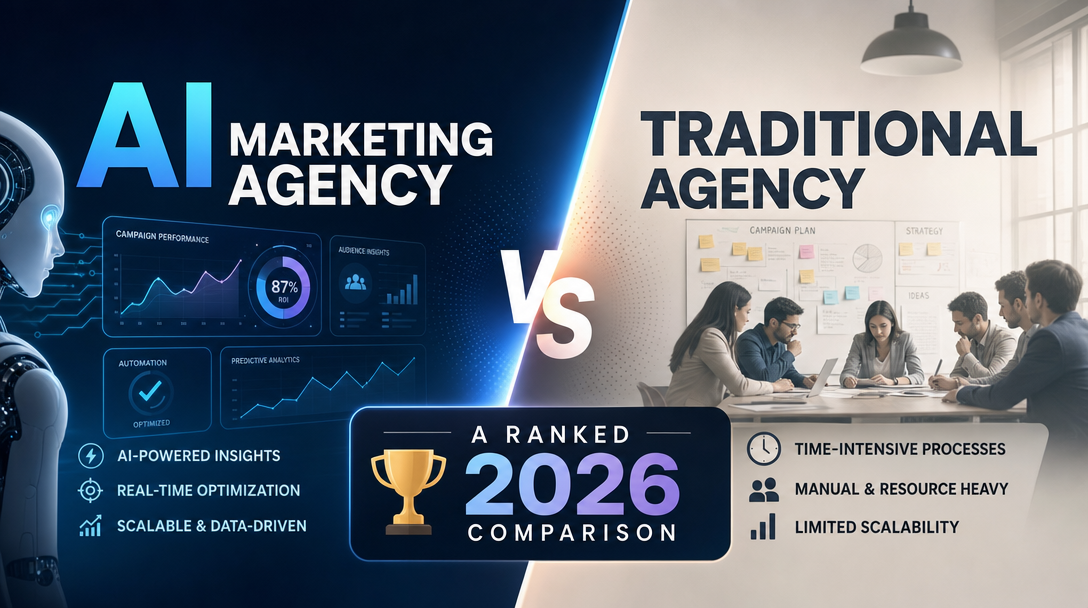
Every AI-agency landing page runs the same play: a table where AI wins every row. Every traditional-agency page runs the reverse. Neither helps you decide. This post ranks the four dimensions that actually move the decision — speed, cost, transparency, and scope — and tells you where each model genuinely wins, so you can match the model to the work instead of to the sales pitch.
This is a spoke of our AI Marketing Agency buyer's guide — start there for the full overview of what an AI marketing agency is and how the operating model works. It targets the specific query "ai marketing agency vs traditional agency"; if you're mainly comparing prices, jump to How Much Does an AI Marketing Agency Cost?, and if you've decided on AI, our how to choose guide helps you vet vendors.
One disclosure: Soku is an AI ad-automation agent, so we sit on the AI side of this comparison. We've kept the ranking honest — including two dimensions where a traditional agency still wins.

The ranking method (what we actually weigh)
We don't score every feature equally, because buyers don't experience them equally. Across the accounts we see, four dimensions decide satisfaction: how fast you can launch and iterate (speed), what you pay for the output (cost), whether you can see what's happening (transparency), and whether the model fits the job (scope). We rank each below and name the winner — not a blanket "AI wins," but a per-dimension call.
1. Speed — AI agency wins, decisively
This is the least ambiguous dimension. A traditional agency's speed is bounded by human hours: a creative brief, a round of concepts, revisions, a media plan, a launch — that's weeks, and every iteration adds a business day or two of turnaround.
An AI marketing agency compresses the same cycle to hours because the bottleneck moves from headcount to compute. It can generate 30 ad variants while a human team is still scheduling the kickoff, launch them the same day, and start reading results that night. More important than launch speed is iteration speed: an agent runs the optimization loop every 15 to 60 minutes, around the clock, versus a human buyer's once- or twice-daily review. Over a month, that's the difference between a few dozen adjustments and thousands.
Winner: AI agency. The gap isn't close, and it compounds — faster iteration means faster learning, which is the whole game in performance marketing.
2. Cost — AI agency wins on production, traditional wins on judgment
Here's where the honest answer diverges from the sales deck. On a straight retainer-to-retainer basis, AI is dramatically cheaper.
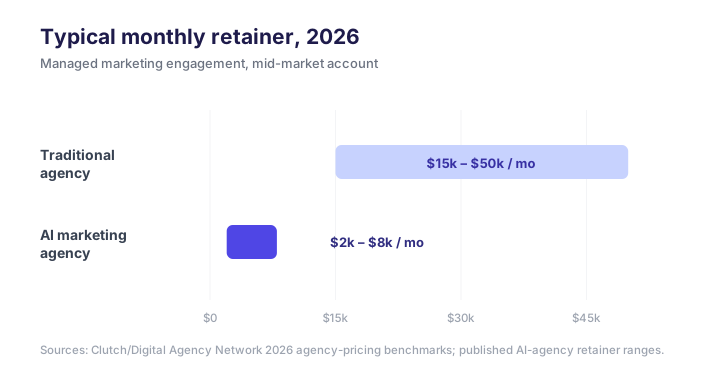
A traditional marketing agency typically runs $15,000–$50,000 per month for a managed mid-market engagement. An AI marketing agency serves comparable production scope at roughly $2,000–$8,000/mo, because adding a client costs mostly software plus a few hours of human review rather than another hire. That's the structural edge, and it's real.
But the cost advantage is not uniform. AI agencies run about 30–60% cheaper on production-heavy work — paid-media management, content, reporting, first-draft creative. On strategy, brand, crisis, and category-defining work, they cost about the same or more than a traditional agency, because the product there is human judgment, and you're paying a senior human either way.
Winner: AI agency on production; traditional agency on strategy. If 80% of your spend is execution, AI wins the cost dimension outright. If most of your budget buys big-idea thinking, the cost edge mostly disappears. For the full worked numbers — including the in-house-agent path — see AI Media Buyer Cost vs an Agency.
3. Transparency — a genuine split
Transparency cuts both ways, and it's the dimension buyers underrate.
A traditional agency gives you human transparency: a named account lead you can call, who can explain the reasoning behind a decision in plain language and absorb ambiguity. What you often don't get is line-item visibility — the classic complaint is a monthly retainer with a fuzzy breakdown of where the hours went.
An AI marketing agency gives you operational transparency: real-time dashboards, every change logged, and the ability to see exactly what was adjusted and when. The risk is the black box — if a vendor says "the AI decides" but can't show you the models, the automated-vs-human split, or the logic, that's opacity dressed up as sophistication.
Winner: split. AI wins on data visibility and auditability; traditional wins on human explainability. The best AI agencies close the gap by pairing dashboards with a named human who owns the account — which is exactly what you should screen for. Our how to choose guide turns transparency into concrete green and red flags.
4. Scope — depends entirely on the work
The final dimension isn't a contest; it's a matching problem. Neither model is better in the abstract — they're better at different things.
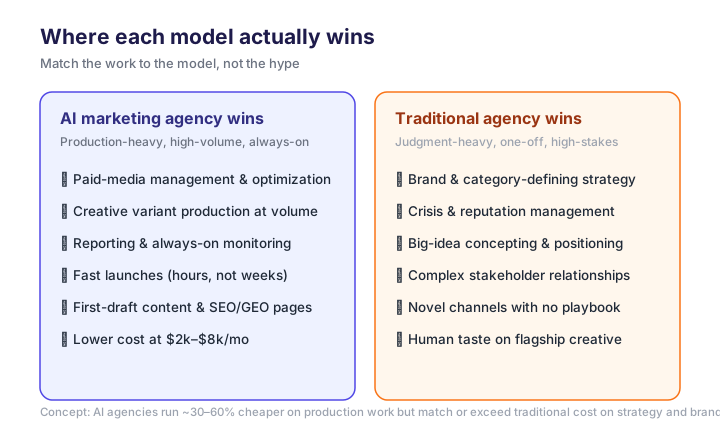
- AI agency wins when the work is high-volume, repeatable, and always-on: paid-media management, creative variant production, always-on optimization, reporting, first-draft content, and fast launches.
- Traditional agency wins when the work is judgment-heavy, high-stakes, or one-off: brand and category strategy, crisis and reputation management, big-idea concepting, complex stakeholder relationships, and flagship creative where human taste is the point.
Winner: whichever matches your dominant workload. Write down where your next two quarters of marketing effort will actually go. If most of it is execution, AI. If most of it is judgment, traditional. If it's genuinely split — as it is for most brands — the answer is both.
The scorecard
| Dimension | Traditional agency | AI marketing agency | Winner |
|---|---|---|---|
| Speed | Weeks to launch; 1–2 checks/day | Hours to launch; 15–60 min loop | AI |
| Cost (production) | $15k–$50k/mo | $2k–$8k/mo | AI |
| Cost (strategy) | Senior human time | Same or more | Traditional |
| Transparency | Human explainability | Data auditability | Split |
| Scope | Brand, crisis, big ideas | Paid media, creative volume, always-on | Depends on work |
So which should you hire?
The pattern that's winning in 2026 isn't "replace the agency with AI." It's the hybrid: a strategist — in-house or a traditional shop kept on a lighter scope — owns brand, positioning, and taste, while an AI agent runs the daily execution loop. You buy judgment once and stop paying humans to push buttons full-time.
If your marketing is execution-dominant and cost-sensitive, an AI marketing agency (or an in-house agent) is the clear call. If your next quarter lives or dies on a brand campaign, keep the humans who are good at that and let AI handle everything downstream of the big idea.
Soku is the execution half of that hybrid: an ad-automation agent that connects to your Google, Meta, and TikTok accounts, launches and optimizes campaigns continuously, and produces creative variants at volume — while you (or your strategist) keep the judgment. For the full decision framework, start with the AI Marketing Agency buyer's guide.
Frequently asked questions
Is an AI marketing agency always cheaper than a traditional one?
On production-heavy work, yes — typically 30–60% cheaper. On strategy, brand, and one-off creative, no; costs converge because you're paying for senior human judgment either way.
Can I use both at the same time?
Yes, and most brands should. Keep a strategist or traditional shop for brand and big ideas; use an AI agent for the always-on execution. It's the dominant 2026 pattern.
Do AI agencies produce lower-quality work?
On volume execution — variant testing, reporting, first drafts — quality is comparable or better because of the iteration speed. On flagship creative and novel strategy, a strong human still wins. Quality tracks the type of work, not the label.
How do I evaluate an AI agency's transparency?
Ask it to name its models and platforms, show the automated-vs-human split, and separate platform fees from its strategy fee. If it can't, that's the black-box risk. See our how to choose guide.