 Soku AI
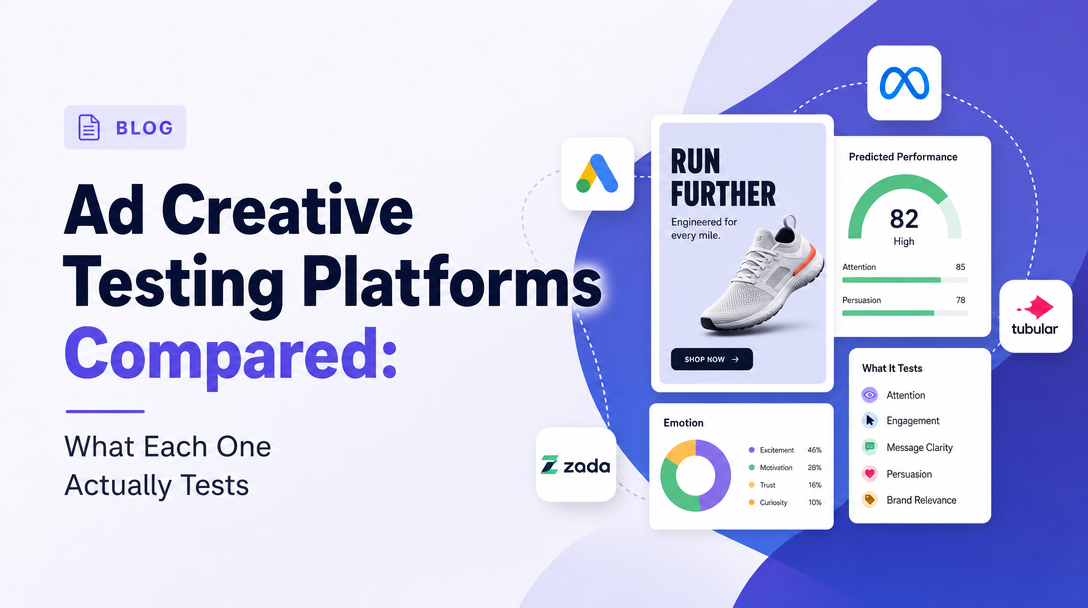
Search for an ad creative testing platform and you get a list that puts creative analytics dashboards, ad libraries, automated rule engines and AI generators in the same ranking, as though they were interchangeable. They are not. Most of them never run a test at all.
This is a comparison by what the tool actually does to a creative decision, because that is the thing that varies. Three categories do most of the work, and the reason teams end up disappointed is almost always that they bought from one category expecting the job of another.
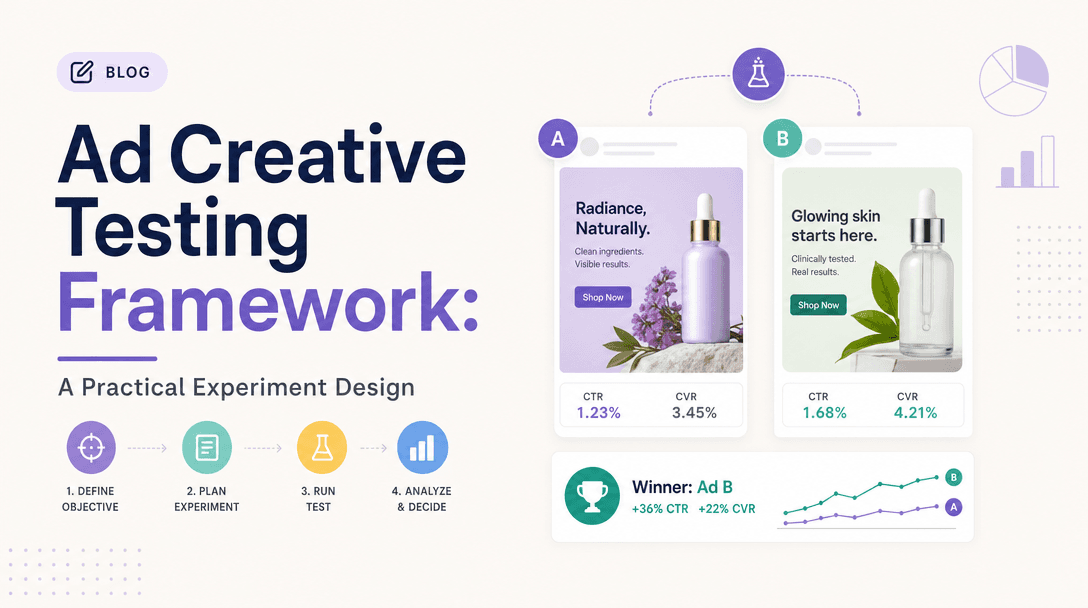
If you want the experiment design itself — sample sizes, stopping rules, the concept-versus-execution hierarchy — that is a separate piece: the ad creative testing framework. This page is about the software.
The three categories, and the question each one answers
Creative analytics answers what already worked, and what did the winners have in common? It reads your ad accounts after the fact, tags each asset by visual and structural attributes — hook type, format, whether there is a face in the first second, whether there is on-screen text — and correlates those tags with performance. It is retrospective by construction.
Testing infrastructure answers is this difference real? It builds the campaign structure that isolates a variable, holds the rest constant, and reports a result you can act on without fooling yourself. This is the smallest category and the one people most often assume they are buying.
Generation loops answer can I produce enough distinct candidates to have something worth testing? They make the creative. Some of them also launch it. The test, if there is one, is a downstream consequence of having volume.
A useful diagnostic: ask a vendor what happens if your test comes back inconclusive. An analytics tool has no answer, because it did not design the test. Infrastructure tells you the sample size you needed. A generation loop offers you more variants.
Category 1 — Creative analytics
These platforms connect to Meta, TikTok, Google and sometimes LinkedIn, pull creative-level performance, and apply computer vision or manual tagging so you can slice results by creative attribute rather than by ad ID.
What they genuinely give you. Attribute-level reporting is real and hard to build yourself. Knowing that your hook-first videos outperform your product-first videos across 400 ads is a legitimate finding that no spreadsheet is going to hand you. They are also excellent at creative inventory — knowing what you have, what is live, and what has been run before.
What they cannot tell you. Correlation across historical ads is not a test. If your hook-first videos were made later, by a better editor, and launched into a warmer audience, the tag "hook-first" is carrying credit for three other things. Every attribute-level insight from an observational dataset has this problem, and no amount of tagging fixes it. Treat these findings as hypothesis generators, not conclusions.
Where the swipe-file tools sit. Research and inspiration platforms belong to this category even though they are usually sold separately. Foreplay, for instance, is a creative research platform — a large ad library, brand tracking, briefs and creative analytics, priced from $59/month — and it is explicit that it does not launch or manage campaigns. That is a deliberate scope, not a gap, but it means the testing happens somewhere else.
Category 2 — Testing infrastructure
This is the category that actually earns the name, and it is thin.
What it has to do. Construct the test so that exactly one thing varies. On Meta that means fighting the platform's own optimiser, which is designed to find a winner fast and will happily starve your variant B before it has accumulated enough conversions to say anything. Real infrastructure handles budget-splitting, audience isolation, holdouts, and — the part almost everyone skips — a stopping rule set before the test starts.
Why so few products do it. Because the honest version of this feature tells the customer to wait. A tool that says "you need 8 more days and 60 more conversions before this is readable" is a worse demo than one that shows a green winner on day two. The rule-based automation platforms — Revealbot (Bïrch) is the mature example — are adjacent but not the same thing: they execute rules you write against live metrics, which is powerful for budget management and dangerous as a stopping rule, because "pause anything under 1.5 ROAS after 3 days" will kill a good creative that simply had not converted yet.
What to check before you buy. Does it split budget at the ad-set level or rely on the platform's delivery? Does it report a confidence interval or just a number? Does it let you pre-register the metric and the duration? If the answer to all three is no, you have bought analytics with a testing label on it.
Category 3 — Generation loops
Tools that make the creative. This category has expanded fastest and is the most crowded — AdCreative.ai, Superscale, Madgicx and a long tail of newer AI-video products all live here in different proportions.
Why volume matters for testing. The binding constraint on most creative programmes is not analysis, it is candidates. A team that can produce four new concepts a month cannot run a meaningful concept test, because the test needs distinct concepts and four is barely enough for one comparison. Generation is genuinely upstream of testing capability.
The trap. Volume of executions is not volume of concepts. Fifty variants of the same idea — same hook, same claim, different colour grade and font — is one concept tested fifty times, and it will produce fifty near-identical results that look like noise because they are noise. The variance that matters is between ideas, not within them. A generator that makes resizing and recolouring cheap has solved the easy half.
The other trap. Most generation tools stop at the asset. Someone still has to build the campaign, structure the test, and read the result. If the reason you wanted a creative testing platform was that nobody on the team has time to run tests, a tool that hands you more files has increased the workload.
The comparison, by decision
| You need to decide | Analytics | Testing infrastructure | Generation loop |
|---|---|---|---|
| Which past creative worked | Yes, this is its job | Partially | No |
| Whether a difference is real | No | Yes | No |
| What to make next | Hypotheses only | No | Yes |
| Whether creative is fatiguing | Yes, with a caveat | Yes | No |
| How to get from insight to a live ad | No | Partially | Varies |
| Cost floor | Mid — per-seat is common | Usually bundled | Low to mid |
The caveat on fatigue: analytics tools show decay well, but decay in a metric is not the same as creative fatigue — frequency, audience saturation and seasonality produce identical-looking curves. We went through the actual decay thresholds by platform in creative fatigue benchmarks.
How to choose, honestly
If you have volume but no clarity, buy analytics. You have enough historical ads for attribute correlation to be worth something, and your problem is that nobody can say why last quarter worked.
If you have clarity but no confidence, buy testing infrastructure — the shortlist of ad testing tools covers what is actually on the market and what each one refuses to do — or build it, which for a disciplined team is a campaign-structure convention and a spreadsheet rather than a product. Most teams in this position do not need software; they need a stopping rule.
If you have neither, and the real problem is that only four ideas ship a month, the honest answer is that a testing platform will not help yet. Fix production first. Testing is a luxury of teams that have candidates to test.
If the trigger was a campaign that decayed rather than a roadmap, diagnose before you buy anything. A performance drop has at least five causes and only two of them are creative — the sequence for telling them apart is in ad fatigue: how to diagnose and fix it.
If the bottleneck is the handoffs between all three, that is the case for a single loop rather than three tools. This is where Soku sits: it generates the creative, launches it across Meta, Google and TikTok, reads the ad-account and GA4 data back, and moves budget toward your ROAS or CAC target — so the insight, the asset and the campaign are not in three different systems owned by three different people. The honest trade is that a dedicated analytics platform will out-report it on attribute tagging, and a dedicated research library will out-browse it.
What almost nobody sells
Two things are missing from essentially every product in this market, and it is worth knowing that so you stop looking for them.
Pre-registration. Naming the metric, the minimum sample and the stop date before the test runs is the single highest-leverage practice in creative testing, and it is a text field. No vendor sells it because it is not a feature, it is a discipline.
Negative results storage. Every team accumulates a large, valuable set of things that did not work, and almost no tool keeps it in a form anyone will read again. The consequence is that teams re-run the same failed concept every eighteen months as people turn over.
Both are free. Neither requires a purchase.
Frequently asked questions
What is an ad creative testing platform?
In practice the phrase covers three different product types: creative analytics that reports on past performance by creative attribute, testing infrastructure that runs controlled experiments, and generation tools that produce the variants. Only the second actually tests anything.
Do I need a dedicated tool to test ad creative?
No. Meta, Google and TikTok all support the campaign structures needed for a clean test. A dedicated tool saves setup time and enforces consistency; it does not unlock a capability the platforms lack.
Why do my creative tests keep coming back inconclusive?
Almost always sample size. Creative differences are usually small relative to the noise in a conversion metric, and most tests are stopped days before they could have been read. The testing framework guide works through the arithmetic.
Can AI pick the winning creative for me?
It can rank candidates by predicted performance, and those predictions are better than chance and worse than a real test. Use them to decide what to test, not what to run.
Is creative analytics tagging accurate?
Reasonably, for structural attributes — format, length, presence of text or faces. Less so for subjective ones like tone or hook quality, where different tools disagree with each other, which is worth checking before you build a strategy on a single vendor's taxonomy.