Soku AI

A brand lift study is a randomized experiment that tells you whether your ads changed what people think about your brand. The platform holds back a random slice of your audience, shows the same short survey to people who could see your ads and to people who couldn't, and reports the gap. If 36% of the exposed group says they remember your ad and 30% of the holdout says the same thing, that 6-point gap is your lift.
Google, Meta and TikTok all sell this as a free product. None of them make it easy to see who qualifies. The minimums sit on different help pages, use different time windows and, in a few places, contradict each other. And every SERP result we read covers one platform, or covers brand lift in the abstract.
So this guide puts the three side by side.
Last verified: 2026-10-26. On that date we read Google Ads Help's About Brand Lift, Set up Brand Lift (including its budgeting table and Country A, B and C lists), Understand Lift measurement statuses and metrics, About Search Lift budget recommendations and About Conversion Lift. For Meta we read nine Business Help Center articles on Brand Lift and Conversion Lift, all linked below. For TikTok we read the Business Help Center's About TikTok Brand Lift Studies (last updated September 2026) and About Conversion Lift Study. Where we quote a number, the link next to it is the page it came from.
What's original here. We put every published minimum into one table and chart it by market. We also list each place where a platform's own docs disagree, quoting both sides, and work through one illustrative result so you can see how the same answer becomes four different numbers. We did not run a brand lift study for this article; nothing below is a result we measured.
If you are deciding between measurement methods, read this alongside our guides to incrementality testing and marketing mix modeling. Brand lift answers a narrower question than either.
What a brand lift study measures (and what it doesn't)
Every platform describes the same core design. Google says its surveys go to "people who have seen your ads" and "people who were eligible to see your ads, but didn't see them because the ad was not shown," and that the difference in responses "will determine the influence your ads have on key brand metrics, such as ad recall, association, awareness, consideration and more" (Google). Meta says Brand Lift selects "a representative sample of people eligible to see your advertising," randomly divides it into test and holdout groups, and uses "causal inference techniques" to measure the impact (Meta). TikTok "will create two randomized groups from a portion of your campaign's target audience: an Exposed Group that sees your promoted content and a Control Group that does not" (TikTok).
That design gives brand lift one big advantage over attribution: because the groups are random, the gap is caused by the ads, not by who happened to see them. It also sets three limits that are easy to forget:
- It measures stated attitudes, not sales. Ad recall, awareness, favorability and intent are survey answers. If you need incremental purchases, that's a Conversion Lift study, which all three platforms sell separately.
- It only sees one platform. A YouTube study can't tell you what your Meta campaign did to the same people, and other channels can blur the control group. Meta says outright that you shouldn't use Brand Lift if you have other active campaigns for the same brand or product on its apps, because the holdout group might see them (Meta).
- It answers one question per respondent. Google says that if you measure several metrics, each viewer "will view only one of those questions which will be chosen at random" (Google). Meta says "only a single question appears when someone sees your brand survey" (Meta). Every extra question splits your sample, which is why both platforms raise the spend bar as you add questions.
The three platforms side by side
This is the table no single platform publishes. Everything in it comes from the official pages read on 2026-10-26.
| Google Ads Brand Lift (YouTube) | Meta Brand Lift (Experiments) | TikTok Brand Lift Study | |
|---|---|---|---|
| Who can set it up | Not every account. "You'll need to contact your Google account representative" (About Brand Lift) | Self-serve in Experiments, or through a Meta account representative (Meta) | "Can only be set up by your account manager" (TikTok) |
| Eligible campaigns | Video, audio or Demand Gen; Demand Gen measured on YouTube only | A specific campaign, or all ads in an ad account | A single campaign or all your TikTok promoted content |
| Minimum spend | $5,000 to $60,000 USD across 10 days, by country bucket and question count | Country campaign minimum ($175,000 in the US; $15,000 default) plus $120,000 ad spend in the last 90 days | Not published |
| Duration | Standard: 3 to 14 days. Enhanced: 9 to 14 days | At least 2 weeks to 90 days, or at least 4 weeks (the docs disagree) | Not published |
| Questions | Up to 3 of: ad recall, awareness, association, consideration, favorability, purchase intent, custom | Up to 3; standard ad recall required, plus up to 2 of awareness, favorability, familiarity, recommendation | Not published on the help page; TikTok's announcements name awareness, ad recall, attitude, favorability and intent |
| Answer options | Your brand plus up to 3 competitor brands | Your Page name appears in the question | Not published |
| Survey surface | YouTube, before a video starts | Facebook and other Meta technologies; respondents over 18 | In-feed poll |
| Sample guidance | Lift visible from about 2,000 responses per metric; about 4,100 at the minimum budget; none after 16,800 may mean no detectable lift | Results can appear from 250 responses; aim for 500 | Not published |
| How lift is reported | Absolute, relative and headroom lift, lifted users, cost per lifted user, baseline and exposed positive rates | Percentage point lift, estimated incremental people, cost per brand lift, confidence %, region and vertical norms | Not published on the help page |
| Significance | Only statistically significant positive lift is reported; ranges usually at 90% confidence | Confidence above 90% means Meta "reliably" believes the ads caused lift | Not published |
TikTok's column is mostly "Not published", and that is the finding. Its help page has no spend floor, no duration and no question list. TikTok's 2021 launch announcement describes "an immersive, in-feed polling experience" measuring "awareness, attitudes, favorability, and intent," with Kantar as a third-party verification partner. Its Marketing Partners announcement names "Ad Recall, Awareness, Attitude, and Favorability." TikTok's measurement solutions page also lists a Unified Lift product that measures "both brand lift and conversion lift, together." Third-party guides quote TikTok minimums anywhere from about $10,000 to six figures. None of them cite a TikTok source, so we haven't used any of them.
Google Ads Brand Lift: the minimums in full
Google's budgeting table sets a "minimum budget requirement across 10 days," summed across every active campaign measuring the same product or brand:
| Questions measured | Country A | Country B | Country C |
|---|---|---|---|
| 1 question | $5,000 | $10,000 | $15,000 |
| 2 questions | $10,000 | $20,000 | $30,000 |
| 3 questions | $20,000 | $60,000 | $60,000 |
The country buckets are hidden behind an expandable section on the same page. On 2026-10-26 they read:
- Country B (11 markets): Croatia, France, Greece, Ireland, Israel, New Zealand, Spain, Sweden, Taiwan, United Kingdom, United States.
- Country C (14 markets): Australia, Austria, Belgium, Canada, Denmark, Finland, Germany, Italy, Japan, Netherlands, Norway, Qatar, South Korea, Switzerland.
- Country A (84 markets): everything else on the list, including Brazil, India, Indonesia, Mexico, Poland, Saudi Arabia, Singapore, Thailand, Turkey, the UAE and Vietnam.
Five rules on that page decide whether you actually qualify:
- The highest bucket wins. If you target countries in different buckets, Google uses the highest one. If you target a country not on the list, or no specific country, "we default to the highest budget bucket."
- Budget counts, spend to date doesn't. The eligibility calculator "only looks at the campaign budget and study dates." Paused campaigns and campaigns with future start dates count as $0 until they run.
- But spend decides results. The troubleshooting section says to fix "Not enough data" you need to "spend your budget in full" and make sure "the actual spend in your campaigns meets the minimums, and not just the budget" (Google).
- Campaign total budgets can quietly disqualify you. Google divides a campaign total budget by the number of campaign days. Extend the end date and the daily figure drops; Google's example takes a $50 budget from $5 a day over 10 days to $1 a day over 50 days, which may make the study ineligible.
- Enhanced Lift costs 3x. Enhanced Lift collects about three times the surveys and needs "3x minimum budget required for Standard Lift." Google recommends it when earlier studies came back "No lift" or "Not enough data" despite significant investment.
Google also caps how often a viewer is surveyed: "at most, viewers may receive one survey in a day and 3 surveys in a week," and one response per product or brand every 14 days. Surveys take up to 48 hours to be approved, and spelling mistakes in your answer options are a common reason for rejection.
Search Lift shares the same entry bar: "the minimum budget required for Search lift is the same as the minimum for 1 Brand Lift question," and the two aren't additive, so a US advertiser measuring both still needs $10,000, not $20,000 (Google). Google also recommends at least 1.5 million impressions for Search Lift.
Meta Brand Lift: the minimums in full
Meta's Brand Lift minimum requirements page lists a minimum campaign budget per country, "as of September 15, 2026," with the note that "product requirements are subject to change." With several target countries, "the system will leverage the country with the highest" requirement. A selection:
| Market | Poll language | Meta minimum (USD) |
|---|---|---|
| United States | English (en_US) | $175,000 |
| Germany | German | $110,000 |
| Australia | English (en_GB) | $80,000 |
| France | French | $79,000 |
| United Kingdom | English (en_GB) | $64,000 |
| Norway, Sweden | Norwegian, Swedish | $63,000 |
| Brazil | Portuguese (pt_BR) | $58,000 |
| Hong Kong, South Korea | Chinese (zh_HK), Korean | $58,000 |
| Canada | English (en_US) | $54,000 |
| Japan, India, Mexico | Japanese, English, Spanish | $44,000 |
| Hungary, Ukraine | Hungarian, Russian | $16,000 |
| Not listed | $15,000 |
On top of the country minimum, Meta's About Experiments comparison table lists the Brand Lift requirement as "a minimum of $120,000 USD in ad spend in the last 90 days." That makes Meta the only one of the three with an account-history requirement as well as a campaign budget.
The other rules from Meta's setup, best practices and poll questions pages:
- One language per test. The survey runs in one of 30 supported languages, which must match your campaign audience, and "only people who use Facebook in this language will have the opportunity to see your brand survey."
- Adults only. "Brand Lift tests will only survey people over 18 years old on Facebook."
- Ad recall is mandatory. "We require every brand lift test to include a standard ad recall poll question," for example "Do you recall seeing an ad for [Page name] online or on a mobile device in the last 2 days?"
- No overlapping tests. A campaign can't be active in two lift tests at once, and the test can't overlap any other ongoing test.
- Start a new campaign. Meta warns that adding budget to a campaign that's several weeks old means the test "won't capture its prior impact."
- Some categories are blocked. For example, "brands promoting the sale of alcohol can't use the Experiments tool to run brand surveys in certain locations."
Meta's US floor has also moved a lot. In December 2023, Jon Loomer reported that the self-serve US minimum was $30,000. Meta's own page now says $175,000. If you're working from a plan or an agency deck more than a few months old, check the number again.
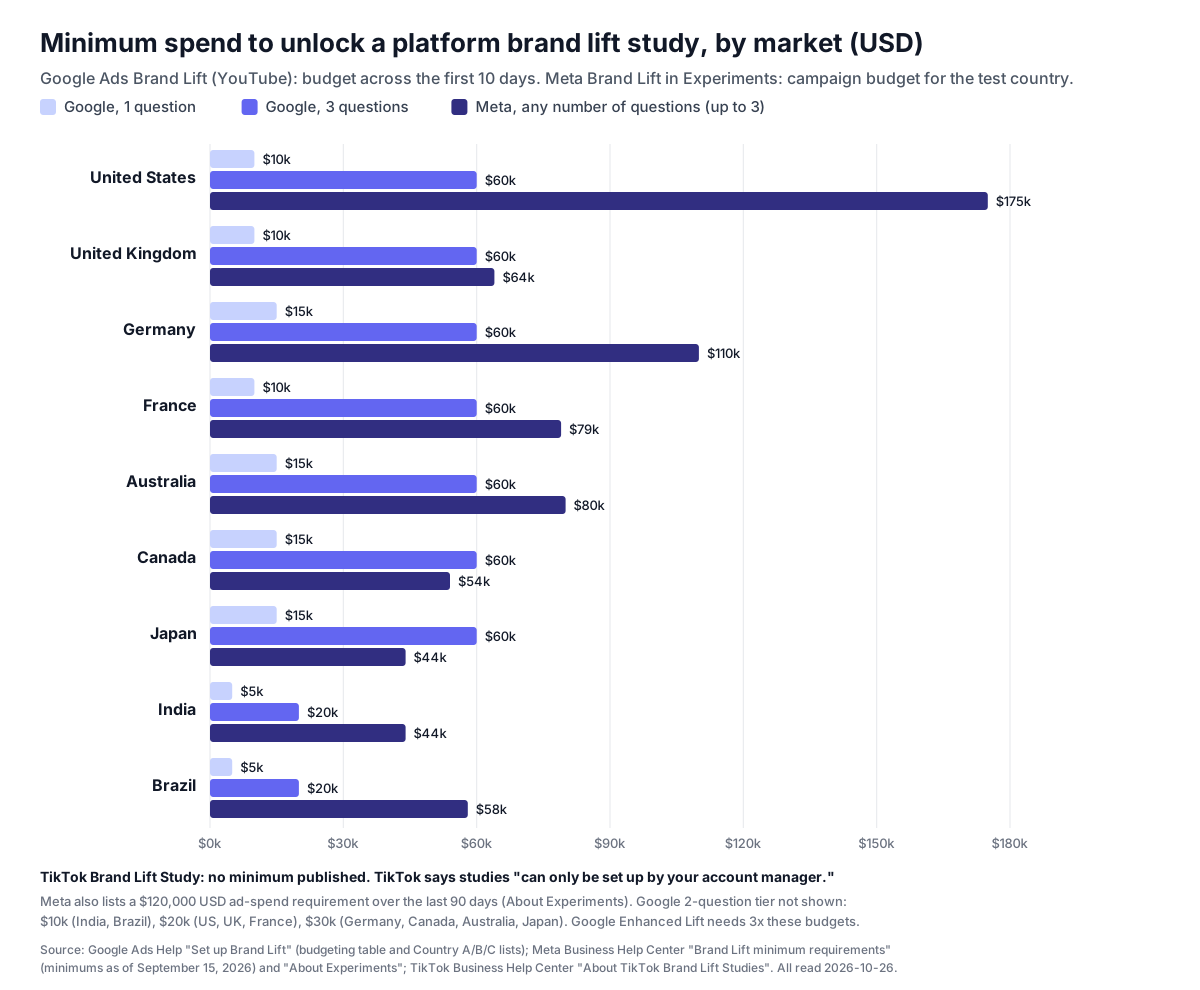
The chart shows two things. First, a single-question Google study is cheap compared with Meta everywhere: $10,000 versus $175,000 in the US. Second, the gap closes when you ask more questions. In Canada and Japan, a three-question Google study ($60,000) needs more than Meta's whole minimum ($54,000 and $44,000). The windows are different too. Google's figure is a 10-day budget, while Meta's applies to the test's campaigns plus the 90-day spend requirement, so the numbers aren't perfectly comparable. They still tell you which platform a given market can afford.
Where the official docs contradict each other
We found seven places where a platform's own pages disagree or leave a gap. We quote both sides so you can raise them with your rep.
1. Meta: how many responses, and for how long. The setup page says "run the test long enough to get more than 250 survey responses" and "we recommend you run your test for at least 4 weeks" (Create a brand survey test). The best practices page says "we suggest tests run for at least 2 weeks and up to 90 days, depending on how long it takes to get at least 500 responses" (Best practices). Plan for the stricter pair: 4 weeks and 500 responses.
2. Meta: which spend requirement applies. About Experiments lists "a minimum of $120,000 USD in ad spend in the last 90 days" (About Experiments). The minimum requirements page lists a campaign budget by country, $175,000 for the US (Minimum requirements). Neither page mentions the other. Read literally, a US advertiser needs both, and a $15,000-minimum market still needs $120,000 of recent spend.
3. Meta: how big the control group is. The results page says "for single-cell brand survey tests, the control group will be 10 percent of the size of your test group," then scaled up for reporting (View and understand results). The results-guidance page recommends that lift tests "have a control group of at least 20% of your audience" (Taking action on results). You don't pick the split in self-serve Experiments, so ask which one your test used.
4. Google: the three-question tier isn't proportional. One question costs $5,000, $10,000 and $15,000 in Countries A, B and C. Three questions cost $20,000, $60,000 and $60,000 (Set up Brand Lift). That's 4x in A and C but 6x in B, and B (which includes the US and UK) ends up costing the same as C. The table appears twice on the page with the same values, so it doesn't look like a typo. Google gives no reason.
5. Google: "free" but gated. Google calls Brand Lift "a free tool," then says "Brand Lift isn't available for all Google Ads accounts. You'll need to contact your Google account representative to use Brand Lift. Without a representative, you won't be able to use this feature" (About Brand Lift). No published spend level gets you a representative.
6. Google: Search Lift uses a different window. The Search Lift page says its minimum "is the same as the minimum for 1 Brand Lift question," but labels its table "minimum budget requirement across 28 days," while Brand Lift's is "across 10 days" (Search Lift). The same dollar figure over 28 days is a much lower daily bar, so the two aren't really the same requirement.
7. TikTok: blurry lift definitions. TikTok's Conversion Lift page defines absolute lift as "the percentage increase in conversions driven by your ads" and relative lift as "the difference in conversion rate between the test and control users, expressed as a percentage of the control group's conversion rate" (TikTok). A "percentage increase" usually means relative lift, so the two definitions overlap. TikTok's Brand Lift page defines no metrics at all. When an account manager sends a TikTok report, ask whether each lift figure is in percentage points or a percentage of the control rate.
How to read a brand lift report
Every platform starts from two numbers: the share of the control group who gave the desired answer, and the share of the exposed group who did. Everything else is arithmetic on those two, which is why the same result can be quoted four different ways.
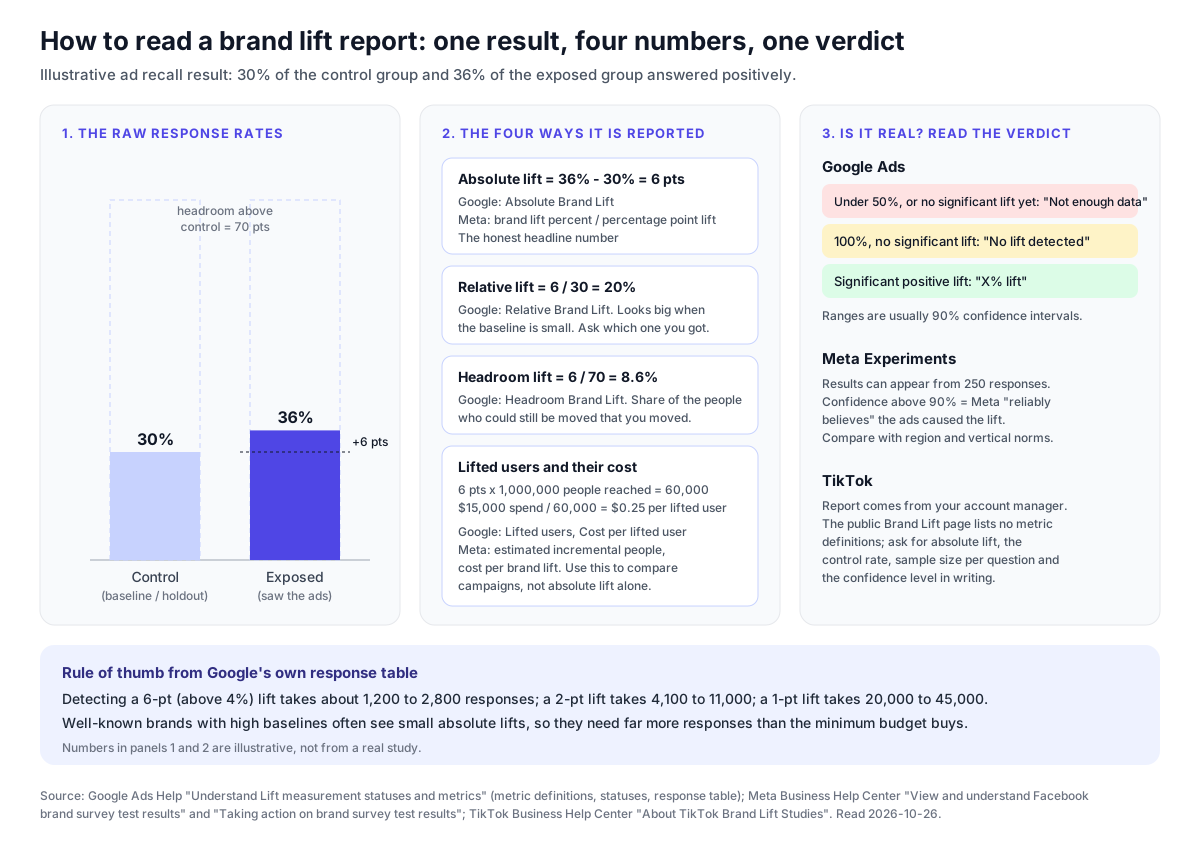
Using Google's definitions, with a 30% control rate and a 36% exposed rate:
| Metric | Formula | Our example | What it's good for |
|---|---|---|---|
| Absolute lift | Exposed rate minus control rate | 6 points | The headline. Meta's "brand lift percent" is this number |
| Relative lift | Absolute lift / control rate | 20% | Comparing brands with different baselines; flatters small brands |
| Headroom lift | Absolute lift / (1 minus control rate) | 8.6% | How much of the persuadable audience you moved; fairer for big brands |
| Lifted users | Absolute lift x people reached (Google's estimate) | 60,000 at 1M reach | Scale |
| Cost per lifted user | Spend / lifted users | $0.25 at $15,000 | Comparing campaigns and creatives |
Google's own worked example uses 20% control and 40% exposed: absolute lift 20%, relative lift 100%, headroom lift 25%. It also argues against judging on absolute lift alone. In its comparison, Campaign 1 shows a 10% absolute lift and Campaign 2 only 5%. But at the same $100 cost, Campaign 2's lower CPM reaches 20,000 people instead of 6,666, so it drives 1,000 lifted users at $0.10 each against 667 at $0.15. Google's advice: focus "on a metric like cost per lifted user as the primary success metric of your campaign, because it factors in both reach and cost."
Meta reports the same core numbers under different names: "estimated incremental number of people," "cost per estimated incremental person" and "percentage point lift" (Meta). Its worked example is 10% of the test group and 3% of the control group giving the desired answer, for a brand lift percent of 7 (Meta). Meta adds region and vertical norms (median lift from similar studies), and breakdowns by age, gender, modeled TV viewership (with Nielsen) and video view length.
Is the lift real?
The two platforms that publish their rules handle significance differently.
Google only shows a number when it has a statistically significant positive lift. While the study runs, under 50% progress shows "Not enough data." Between 50% and 100%, you get the lift if it's significant, or "Not enough data" if it isn't. At 100% with no significant lift, the status becomes "No lift detected." Google says ranges usually use a 90% confidence interval (Google).
Meta gives you a confidence percentage, "the chance that your Meta ads caused lift based on the conditions of your test," and says "a confidence percentage above 90 percent means we reliably believe that your Meta ads caused brand lift" (Meta). Results can appear from 250 responses, but Meta recommends waiting until the test is finalized before acting on them.
Google also publishes the sample sizes it needs, which tells you more about feasibility than any spend table:
| Detectable absolute lift | Total responses needed (Google) |
|---|---|
| More than 4% | 1,200 to 2,800 |
| 3% | 2,800 to 5,000 |
| 2% | 4,100 to 11,000 |
| 1.5% | 11,000 to 20,000 |
| 1% | 20,000 to 45,000 |
| 0.5% | 45,000 to 180,000 |
| Less than 0.5% | More than 180,000 |
Detecting a 1-point lift takes roughly ten times the responses of a 4-point lift. Well-known brands, whose recall and awareness are already high, usually see small absolute lifts, so they need the bigger samples. Google says that if a campaign "has not shown any lift after reaching 16,800 responses per metric, you may not be able to detect your lift."
What to do with "no lift"
A null result means the lift was smaller than the study could detect. It doesn't prove the lift was zero. Both platforms list similar reasons for weak results:
- Contamination. Other campaigns for the same brand reached the control group. Google suggests limiting "exposure to your creative outside the lift study," and TikTok asks you to "include all active TikTok campaigns in your study."
- A question that doesn't match the ad. Meta's example: an ad recall question about "Jasper's Market" when the campaign was really about "Jasper's Market Home Delivery Service."
- Too little weight. Meta recommends "a frequency of 1-2 impressions per person per week, or more," reaching "50% or more of your target audience."
- Mid-flight changes. Meta lists budget, bid, runtime or creative changes during the study.
- Delivery problems on Google. CPV bids set too low, targeting that's too narrow, non-English surveys shown in every language, or too many campaigns in one study.
Before you write the campaign off, check segments. Google says "if you don't have lift at the study level, check if you have lift in specific segments (for example, age, gender, campaign or device)."
Brand lift vs Conversion Lift vs Search Lift
All three platforms use the same randomized design for different outcomes, with very different entry bars:
| Study | Google Ads | Meta | TikTok |
|---|---|---|---|
| Brand Lift | Survey-based; $5,000+ over 10 days; needs a rep | Survey-based; country minimum plus $120,000 over 90 days | Survey-based; account manager only |
| Conversion Lift | User- or geography-based; reports incremental conversions, iCPA and iROAS; needs a rep (Google) | A campaign from the past year with $5,000+ spend and 500+ conversions, plus Conversions API with Event Match Quality above 5 or another supported data source (Meta) | Managed service; minimum spend "based on your objectives and study scope," not published (TikTok) |
| Search Lift | Same minimum as one Brand Lift question, across 28 days | No equivalent product found | Not on the help pages we read |
On Meta, Conversion Lift is far easier to qualify for than Brand Lift. You can also add conversion lift to a brand survey test in Experiments, if you're already measuring conversions (Meta). If your real question is "did this campaign sell anything," start there, and see our incrementality testing guide for the sample-size math. If you want one model across every channel, use marketing mix modeling, with lift studies as the calibration points.
If you can't meet the minimums
Most advertisers can't. A US brand needs $175,000 for Meta, a Google rep for YouTube and a TikTok account manager. Here's what's left, roughly from most to least rigorous:
- Pick the cheapest platform-market pair. One question on YouTube in a Country A market is $5,000 over 10 days, if you have access through a rep.
- Ask one question, not three. On Google that cuts the US bar from $60,000 to $10,000. On Meta it doesn't lower the minimum, but it gives each question more responses.
- Use Meta's modeled ad recall metric for direction. Meta labels its ad recall lift column "estimated" and "in development." It's calculated from the accounts you reached and "how likely they are to recall the ads they saw," calibrated "with ad recall lift surveys" (Meta). It's useful for comparing creatives inside one account. It isn't an experiment.
- Run a geo holdout and watch branded search. Turn ads off in matched regions and compare branded search and direct traffic. Our incrementality guide covers the design.
- Get the delivery right first. Brand lift studies fail on frequency and reach as often as on creative. For YouTube, our video campaign groups guide covers how reach and frequency feed into brand measurement.
A pre-flight checklist
Run through this before you ask a rep for a study, or before you open Experiments:
- Write down the one question you need answered, and pick the survey metric that matches it (recall for a new campaign, consideration or intent for a launch).
- Check the market's minimum for your question count, and use the highest bucket or country you target.
- On Meta, confirm the $120,000 of spend over the last 90 days as well as the country minimum.
- Launch a new campaign for the study, fund it for the whole window, and don't change budget, bid or creative mid-flight.
- Pause or include every other campaign for the same brand on that platform, so the control group stays clean.
- Match the survey language to the ad's language, and spell your brand and competitor answers exactly as they're marketed.
- Show the brand clearly and early. Meta recommends "featuring your brand prominently in your ad creative" for recall questions, and its report breaks recall down by video view length, so you can see whether short views carried the result.
- Decide in advance which number you'll judge on (we suggest absolute lift and cost per lifted user) and what confidence level counts as a pass.
Where Soku fits, and where it doesn't
We checked Soku's code before writing this section.
- Soku can't read brand lift results. It doesn't pull Brand Lift, Conversion Lift or Search Lift results from Google Ads, Meta or TikTok, and it can't create or configure a lift study on any of them. Lift reports stay in each platform's UI, or come from your account manager for TikTok.
- It does read the delivery data around a study. For connected accounts, Soku pulls impressions, reach, frequency and CPM from Meta, impressions and average CPM from Google Ads, and reach, frequency and 2-second, 6-second and quartile video views from TikTok. That's the data you need to check the "too little weight" and "mid-flight changes" causes of a null result.
- It knows one Meta lift-related rule. When Soku drafts a Meta ad set write, its preflight check blocks the cost cap bid strategy for the ad recall lift optimization goal, because Meta rejects that combination. That's validation on a write, not lift measurement.
Every write Soku proposes goes to a review card first, so nothing changes in your account mid-study unless you approve it.
Frequently asked questions
What is a brand lift study?
A randomized experiment that measures whether your ads changed what people think about your brand. The platform splits your target audience into an exposed group and a control (holdout) group, asks both the same short survey question, and reports the difference in positive answers as lift.
How much do I need to spend to run a brand lift study?
The study is free; the requirement is media spend. As of 2026-10-26, Google Ads asks for $5,000 to $15,000 over 10 days for one question depending on the country ($10,000 in the US), and $20,000 to $60,000 for three. Meta asks for a country campaign minimum ($175,000 US, $64,000 UK, $15,000 default) and lists $120,000 in ad spend over the last 90 days. TikTok publishes no minimum.
How long does a brand lift study take?
On Google, Standard studies usually finish in 3 to 14 days and Enhanced Lift in 9 to 14, with the budget measured over a 10-day window. Meta's pages disagree: at least 4 weeks and 250+ responses on one page, at least 2 weeks (up to 90 days) and 500 responses on another. TikTok doesn't publish a duration.
What is the difference between absolute, relative and headroom lift?
Absolute lift is exposed rate minus control rate, in points. Relative lift divides that by the control rate. Headroom lift divides it by the share of the control group that didn't answer positively. At 30% control and 36% exposed: 6 points, 20% and about 8.6%.
What does "Not enough data" or "No lift detected" mean in Google Ads?
"Not enough data" appears under 50% progress, or between 50% and 100% without a significant positive lift. "No lift detected" means the study reached 100% with no statistically significant difference between the groups.
Can a small advertiser run a brand lift study?
Rarely through the native tools. Google needs an account representative, Meta's US minimum is $175,000, and TikTok studies are set up only by an account manager. Smaller advertisers usually use Meta's modeled ad recall lift metric, branded search trends or a geo holdout instead.
Is Meta's ad recall lift metric the same as a Brand Lift test?
No. The Ads Manager metric is labeled estimated and in development. It's modeled from reach and predicted recall, then calibrated with surveys. A Brand Lift test uses a randomized holdout and real poll responses.
Can Soku read my brand lift results?
No. Soku doesn't read lift study results from Google Ads, Meta or TikTok, and it can't set up a lift study. It reads the delivery data around one (impressions, reach, frequency, CPM and, on TikTok, video quartile views) from connected accounts.