 Soku AI
Every creative-fatigue article opens with a number of days. Meta ads last three weeks, TikTok ads last seven days, YouTube ads run for months. Those numbers are averages of wildly different accounts and they will not describe yours, because the variable that actually drives fatigue is not time.
Fatigue is a function of how many times the average reachable person has seen the ad. Calendar days are a proxy for that, and a bad one: the same creative at $500/day into a 400,000-person audience and at $500/day into a 40,000-person audience will "last" ten times as long in the first case, and it has nothing to do with the creative.
This piece gives you the arithmetic to compute your own threshold, the mechanism differences between the three big platforms, and — the part that saves the most money — the four common decay patterns that look exactly like fatigue and are not.
The one calculation that replaces the benchmark
Frequency is the number of impressions divided by the number of unique people reached. Fatigue is what happens as that number climbs past the point where an additional exposure stops adding persuasion and starts adding irritation.
You can estimate where your own ceiling sits before you spend a dollar:
Daily reachable audience  ≈  audience size × (daily budget / [CPM](/glossary/cpm) ÷ 1000) / audience size
Days until frequency N    ≈  (audience size × N) / daily impressions
Concretely: a 250,000-person audience, $600/day, a $12 CPM. That is 50,000 impressions a day. To reach frequency 3 across the whole audience takes 750,000 impressions, or fifteen days. Halve the audience and it takes seven and a half. The creative did not change.
This is why "how long does an ad last" has no answer and "at what frequency does this creative stop working" has a very good one. Compute the second, and the first falls out.
Where the ceiling actually sits, and how to find yours
Published benchmarks cluster around frequency 2–3 for prospecting and 5–8 for retargeting before performance meaningfully degrades, but the spread inside those ranges is enormous and mostly driven by two things: how distinctive the creative is, and how considered the purchase is. A visually distinctive ad for a $40 impulse product tolerates far more repetition than a generic one for a $4,000 considered purchase.
Rather than adopting a number, derive yours once:
- Pull the last 90 days of ad-level data with impressions, reach, spend and conversions.
- Compute frequency per ad per week — not lifetime frequency, which smooths away the signal.
- Plot CPA against weekly frequency across all ads.
- Find the frequency at which CPA crosses your target. That is your ceiling, for your product, on that platform.
Most accounts that run this find their real ceiling is meaningfully different from the published benchmark — usually lower for prospecting than people expect, and higher for retargeting. Once you have the number, it becomes an operational threshold rather than a judgement call.
The three platforms fatigue differently
The mechanism matters, because it decides which intervention works.
Meta — audience saturation
Meta's delivery system finds the most responsive slice of your audience first and spends there. Performance decays because that slice gets exhausted, not because the creative "gets old" in a psychological sense. The tell is that frequency climbs while reach flattens: you are buying more impressions against the same people.
Because the mechanism is audience exhaustion, the effective interventions are audience-side as much as creative-side. Broadening the audience, excluding recent converters, or adding a genuinely different creative concept that appeals to a different slice all work. Re-cutting the same concept with new music usually does not, because it is still fishing in the emptied pool.
Frequency is directly reportable in Ads Manager, so Meta is the platform where you can operationalise the threshold most cleanly.
TikTok — feed velocity and the first two seconds
TikTok's feed turns over far faster and the audience's tolerance for repetition is lower, so fatigue arrives sooner in calendar terms even at similar frequencies. The decay also shows up in a distinctive place: hook retention degrades before CPA does. Watch the 2-second and 6-second view rates. When a creative starts fatiguing on TikTok, people are recognising it and scrolling past within the first beat, so retention falls while the conversion rate of the people who do watch stays roughly flat.
That gives you an early-warning metric that Meta does not offer as cleanly. If 2-second view rate has dropped 20–30% from the creative's own first-week baseline, the ad is going, regardless of what CPA says this week.
The intervention that works on TikTok is disproportionately the hook. The same body and offer with a genuinely new first two seconds frequently recovers most of the lost performance, which is not true on Meta.
YouTube — long runways, different failure mode
YouTube creative genuinely lasts longer, for a structural reason: reach is broader, frequency accumulates more slowly, and the format is less dependent on novelty. Campaigns can run for months without fatiguing in the Meta sense.
The failure mode is different. YouTube ads tend to fail on relevance drift rather than repetition — the audience the algorithm serves them to gradually diverges from the audience the creative was written for. The tell is not rising frequency but falling view-through rate paired with a shifting placement or demographic mix. The fix is targeting hygiene, not new creative.
Four things that look like fatigue and are not
This is where most fatigue budgets get wasted: a team replaces perfectly good creative because a number went down.
Auction pressure. A competitor entered your auction and CPMs rose. Your creative is performing identically per impression; impressions got more expensive. Check CPM trend before touching the creative — if CPM is up and CTR is flat, this is not fatigue.
Seasonality and day-of-week. Comparing a creative's second week against its first when the first contained a payday weekend produces a decay curve out of nothing. Always compare like periods.
Attribution window shifts. A change in tracking, consent rates or attribution settings will drop reported conversions across every ad simultaneously. Fatigue is creative-specific; if all your creative "fatigued" in the same week, it did not.
Learning-phase exit. New creative often performs unusually well in its first days because delivery is exploring, and then settles to its true level. That settling is not decay — it is the honest number arriving. Do not benchmark a creative against its own first 72 hours.
A good rule: before declaring fatigue, confirm that the decline is (a) specific to this creative, (b) accompanied by rising frequency, and (c) visible in a rate metric like CTR or view rate, not only in a cost metric. If all three do not hold, look elsewhere first.
The refresh cadence that follows from this
Once fatigue is defined by frequency rather than days, refresh planning becomes arithmetic instead of ritual.
- Know your ceiling for each platform and campaign type, computed as above.
- Forecast the date you will hit it from current spend, audience size and CPM. You now know when you need new creative, weeks ahead, instead of discovering it.
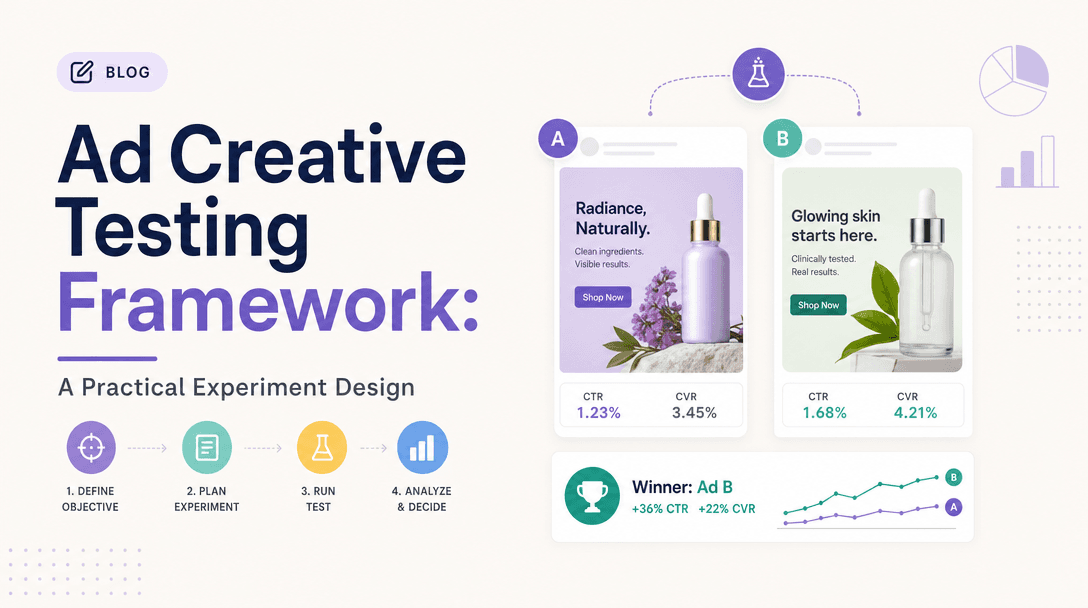
- Queue concepts, not executions. What buys you a genuine reset is a different idea, not a different colourway of the same idea — this is the same concept-versus-execution distinction that governs creative testing design.
- Rotate on the leading indicator, not the lagging one. On TikTok that is hook retention; on Meta it is frequency against flat reach; on YouTube it is view-through rate against placement mix.
- Retire, but keep. A fatigued creative is not a bad creative. Audiences recover, and a concept that is spent against your current pool is often still strong against a new market, a new season, or the same pool six months later.
The teams that handle fatigue well are not the ones producing the most creative. They are the ones who know their threshold, see it coming, and are not making the decision in a panic on the day CPA breaks.
Producing enough genuinely distinct concepts to feed that queue is the practical constraint for most teams — which is where the comparison of creative testing platforms and generation tooling becomes relevant, since the bottleneck is usually candidate supply rather than analysis.
Frequently asked questions
How often should I refresh ad creative?
When frequency approaches your measured ceiling, not on a calendar. For most prospecting campaigns that lands somewhere between two and six weeks depending on audience size and spend, which is exactly why a fixed rule performs badly.
What frequency is too high?
For cold prospecting, degradation commonly begins between 2 and 3 weekly frequency; retargeting tolerates far more, often 5–8. Derive your own from the CPA-against-frequency plot rather than adopting these.
Does creative fatigue affect all platforms equally?
No. Meta fatigues on audience saturation, TikTok on feed velocity and hook recognition, YouTube barely fatigues in the same sense and tends to fail on relevance drift instead. The interventions differ accordingly.
Can I fix fatigue by changing the thumbnail or music?
Sometimes on TikTok, where the hook carries disproportionate weight. Rarely on Meta, where the constraint is that you have exhausted the responsive audience and a cosmetic change does not reach anyone new.
Is rising CPM a sign of creative fatigue?
Usually not on its own. Rising CPM with flat CTR points to auction pressure. Fatigue shows up first in engagement rates — CTR, view rate, hook retention — because the same people are seeing it and responding less.