 Soku AI
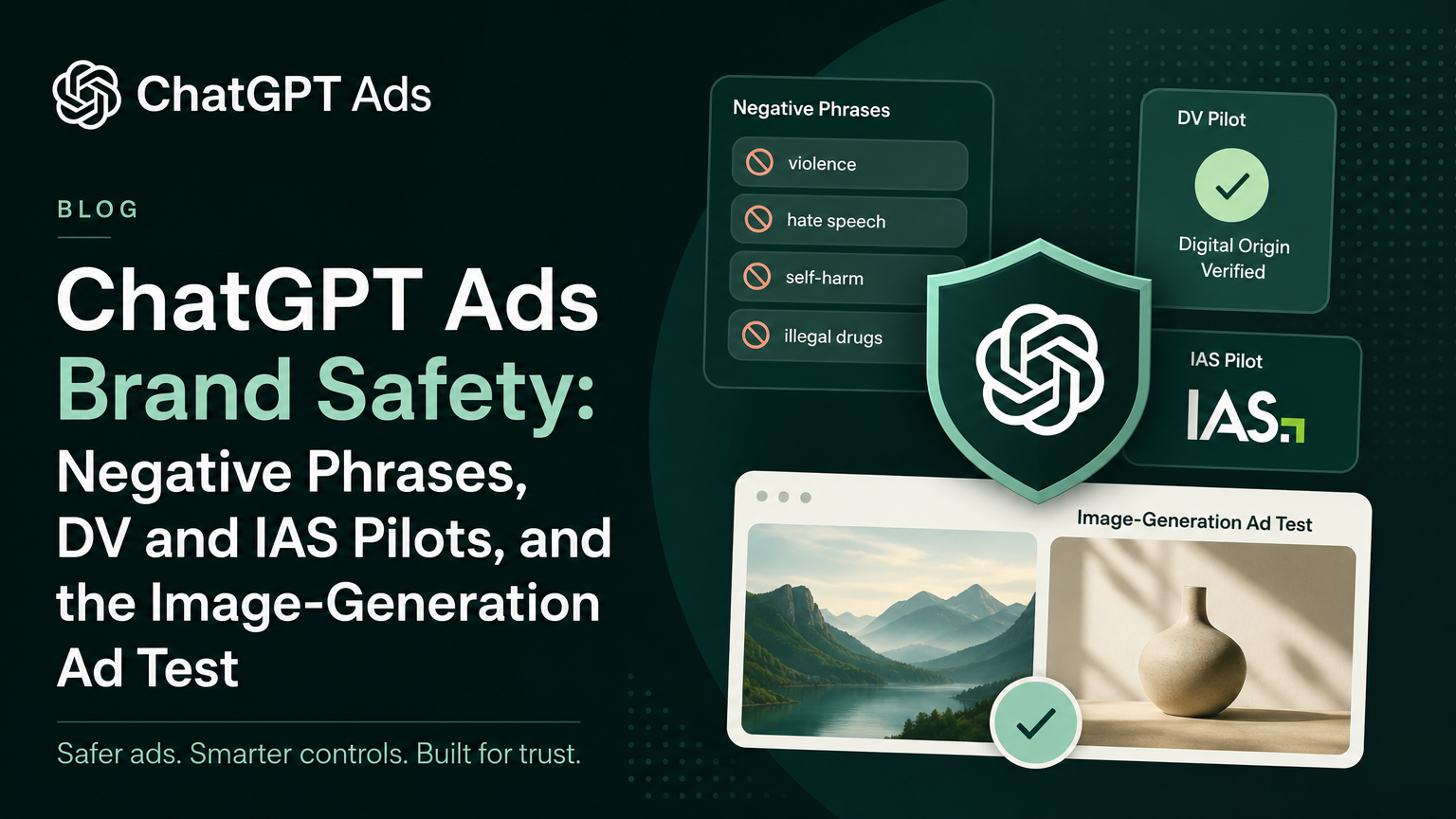
On 2026-10-05 OpenAI published two posts: Building advertising for the way people use AI on openai.com, and More ways to measure ChatGPT Ads on the ChatGPT Ads blog. Most coverage led with the new visual ad format for image generation and the measurement partner list. The part that changes how advertisers operate today is shorter and easier to miss: a brand-safety control called Negative Phrases, now "available to qualifying advertisers", and brand suitability pilots with DoubleVerify and Integral Ad Science.
Here is the catch. We crawl OpenAI's ChatGPT Ads help centre (34 articles), its Advertiser API documentation (23 pages) and its Ad Policies every day. In our capture taken at 00:36 UTC on 2026-10-06, none of those surfaces mentions Negative Phrases, DoubleVerify, IAS, Kantar, Cint, or ads during image generation. Everything new in this announcement exists, for now, only in two blog posts.
That gap is the story. This piece separates three things that are easy to blur: what OpenAI's documentation says, what OpenAI has only announced, and what we think it means. The last is labelled as Soku analysis every time it appears.
If you are new to the channel, start with everything you need to know about ChatGPT Ads and come back.
What OpenAI announced on 2026-10-05
The brand-safety passage appears word for word in both posts. In full:
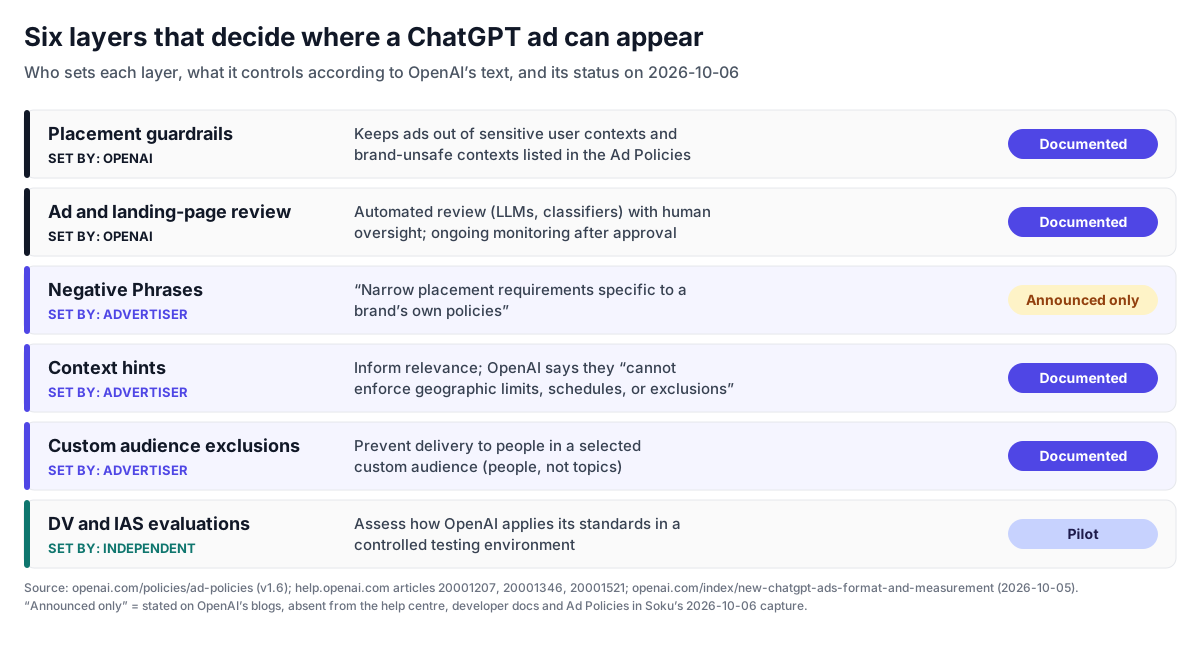
"Confidence in advertising also depends on understanding the environment where ads can appear. OpenAI's advertising policies and guardrails are designed to protect users, preserve trust, and give brands confidence in their ad placements. Our placement guardrails assess whether a conversation is appropriate for advertising, helping keep ads out of emotionally vulnerable, sensitive, or otherwise unsuitable contexts."
"Automated review, human oversight, and ongoing monitoring help us identify and address policy violations and improve our safeguards over time. For narrow placement requirements specific to a brand's own policies, Negative Phrases are now available to qualifying advertisers."
"We're also developing brand suitability evaluation pilots with DoubleVerify (DV) and Integral Ad Science (IAS) to help advertisers build a better understanding of the ads environment. This approach allows independent partners to assess how our brand safety standards are applied in a controlled testing environment, without accessing private user conversations."
The image-generation format is described on openai.com:
"Initially, we'll test this new ad format during image generation in ChatGPT. Ads will be clearly labeled, and remain separate from the image being created. As with our other ad formats, advertising does not influence the answers ChatGPT provides. Testing will begin later this month in the US with an initial group of advertisers."
And the Ads blog adds one line that does not appear on openai.com: "as we begin experimenting with new placements, we are also in early-stage testing with Kantar and Cint to measure the impact of ChatGPT Ads on brand resonance metrics."
Verified facts: what is documented and what is only announced
We grepped every page in the 2026-10-06 capture for each announcement item. The result:
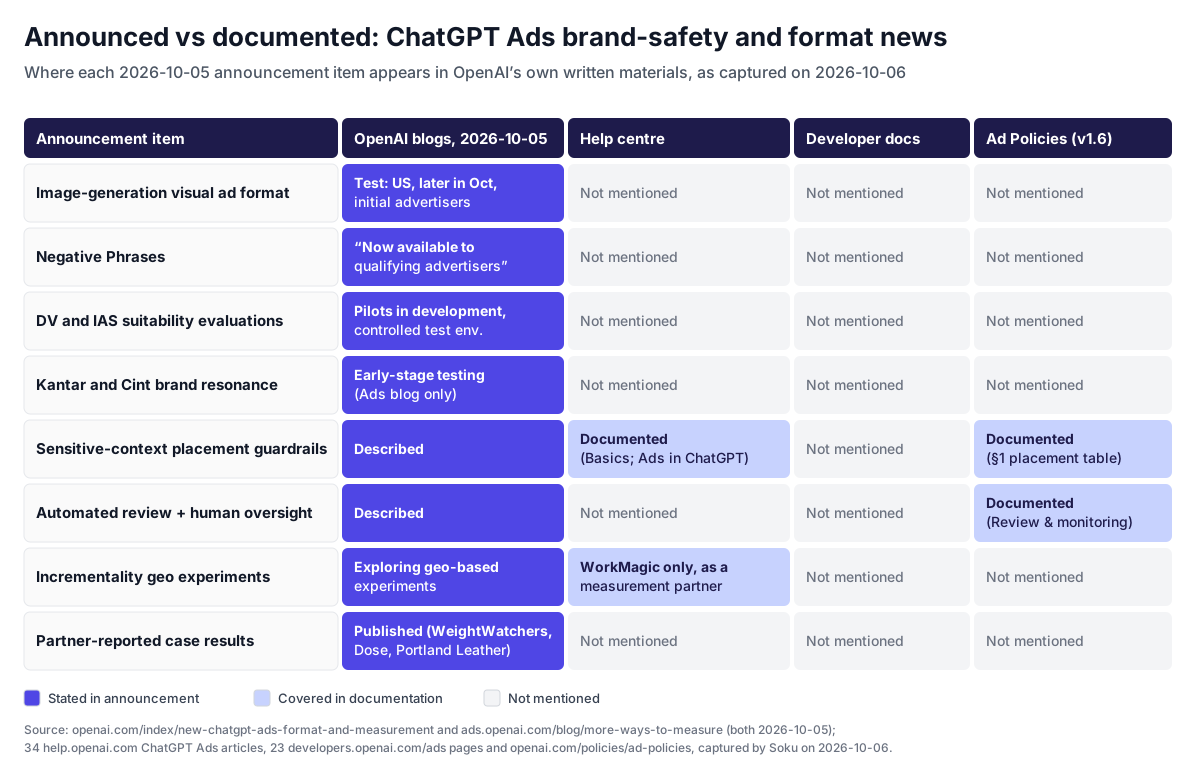
| Item | OpenAI blogs (2026-10-05) | Help centre | Developer docs | Ad Policies v1.6 |
|---|---|---|---|---|
| Visual ad format during image generation | Test, US, "later this month", initial group of advertisers | Not mentioned | Not mentioned | Not mentioned |
| Negative Phrases | "Now available to qualifying advertisers" | Not mentioned | Not mentioned | Not mentioned |
| DoubleVerify and IAS suitability evaluations | Pilots being developed, controlled testing environment | Not mentioned | Not mentioned | Not mentioned |
| Kantar and Cint brand-resonance measurement | "Early-stage testing" (Ads blog only) | Not mentioned | Not mentioned | Not mentioned |
| Placement guardrails for sensitive contexts | Described | Documented in two articles | Not mentioned | Documented in section 1 |
| Automated review with human oversight | Described | Not described | Not mentioned | Documented under Review and monitoring |
| Haus, Measured, WorkMagic geo experiments | "Exploring" | WorkMagic listed only as a measurement partner | Not mentioned | Not mentioned |
| Partner-reported case results | Published | Not mentioned | Not mentioned | Not mentioned |
Three things in that table are worth stating plainly.
The guardrails are not new. The "placement guardrails" passage restates policy that has been public since the Ad Policies launched in March 2026. The policies page still reads "Updated: September 10, 2026", its latest changelog entry is still v1.6 (which we covered in ChatGPT Ads Policy v1.6), and we found no change to it on 2026-10-06.
The new controls are undocumented. Negative Phrases is the only item in the announcement that an advertiser can supposedly act on today, and there is no help article, API field, policy reference, limit or eligibility rule for it anywhere in OpenAI's documentation.
The tests are labelled as tests. OpenAI's own words are "test", "pilots", "developing" and "early-stage testing". We use the same words below.
The guardrails you already have, in OpenAI's words
Before getting to what is new, it is worth being exact about what OpenAI already documents, because Negative Phrases sits on top of it rather than replacing it.
The Ad Policies open with a placement policy. OpenAI says its safeguards "are designed to prevent ad placements in sensitive user contexts and brand unsafe contexts", and defines both:
- Sensitive user contexts are "conversations involving personal, high-stakes, or emotionally vulnerable situations where ads could undermine user trust or create a poor experience". The listed examples are emotionally reliant contexts, mental and personal health conversations, and sensitive user journeys.
- Brand unsafe contexts are "conversations where ad adjacency would be unsuitable for advertisers, including contexts that violate OpenAI's Usage Policies, as well as contexts that map to widely recognized brand safety frameworks that advertisers commonly treat as unsuitable for ad placement."
The "contexts inappropriate for ads" list names nineteen categories: child safety, circumventing safeguards, cyber abuse, dangerous activities, debated social content, fraud and deception, graphic or exploitative sexual content, graphic violence, hate and harassment, illicit content, IP infringement, misinformation, obscenity and profanity, political content, privacy, regulated goods such as gambling or tobacco, suicide and self-harm, terrorism, and weapons.
The help centre says the same thing in shorter form. The ChatGPT Ads basics article has a "Brand safety" section stating that OpenAI's policy "is to place ads only near chats that are safe, appropriate, and aligned with user trust and brand safety". The consumer-facing Ads in ChatGPT article answers "Will ads appear in sensitive or regulated chats?" with "No. Ads are not eligible to appear near sensitive or regulated topics, including personal health, mental health, or politics." It also states that ads are not shown to accounts identified as belonging to users under 18, which we covered in ChatGPT Ads age assurance.
The "automated review, human oversight" line also maps to existing policy text. Under Review and monitoring, the Ad Policies say "Most reviews are conducted through automated systems with human oversight and calibration", that OpenAI uses "machine learning systems, including LLMs and classifiers" to review ads, landing pages and advertiser signals, that "Some decisions are escalated for human review based on severity, confidence, or potential risk", and that "Ads or landing pages that cannot be reviewed or evaluated by our systems are not eligible to run." That last line is one reason OAI-AdsBot crawlability matters.
One more piece of v1.1 history is relevant. In April 2026 OpenAI changed the placement policy so that "Medical, legal, and financial advice contexts are no longer categorically blocked from ads by default", while "Sensitive conversations and other prohibited contexts remain ineligible for ads." In other words, the platform-level line already moved once from category blocking towards per-conversation judgement.
Negative Phrases: what is known
Everything OpenAI has published about Negative Phrases is one sentence: "For narrow placement requirements specific to a brand's own policies, Negative Phrases are now available to qualifying advertisers."
From that sentence, three things are stated:
- It exists and is live for some advertisers. "Now available", not "coming".
- It is gated. "Qualifying advertisers". OpenAI does not say what qualifies.
- It has a stated purpose. "Narrow placement requirements specific to a brand's own policies". That is a brand-specific suitability tool, positioned after the platform-wide guardrails described in the preceding sentence.
There is one earlier third-party sighting. On 2026-08-21 Adthena published ChatGPT Ads quietly adds negative phrases, reporting that it had seen, "inside a UK advertiser's ChatGPT Ads Manager account", a field under Settings "called Negative phrases: a place for advertisers to list words or phrases, up to 100 of them at 100 characters each, that block an ad from showing whenever a user's message contains them." Adthena's post includes a screenshot. We have not seen the field in an account ourselves, and OpenAI has not documented the location, limits or matching behaviour Adthena describes. Treat those details as a credible but unofficial report, and check them in your own account.
If Adthena's observation reflects the shipped feature, it means the control appeared in at least one account roughly six weeks before OpenAI mentioned it publicly. That pattern is consistent with how ChatGPT Ads features have tended to arrive: in product first, in documentation later.
Negative Phrases: what is not known
Read narrowly, the official text leaves every operational question open. As of 2026-10-06 OpenAI has not published:
- Eligibility. What makes an advertiser "qualifying": spend, vertical, region, managed versus self-serve, or something else.
- Scope. Whether phrases apply at account, campaign or ad-group level. Adthena's report places the field under Settings, which suggests account level, but OpenAI has not said so.
- Matching. Whether matching is literal, case-insensitive, stemmed or semantic, and whether it reads only the user's latest message or the whole conversation, the model's answer, or any attached content.
- Limits. Adthena's 100 phrases of up to 100 characters is the only figure available, and it is not OpenAI's.
- Reporting. Whether you can see how often a phrase blocked delivery. The Insights API reference documents breakdowns by country or device only, and there is no conversation-level or topic-level report, so there is currently nothing like a search terms report to audit phrases against.
- API support. No
negative_phrasesfield, or anything similar, appears in the campaign, ad group, ad account or Bulk API references. - Format coverage. Whether Negative Phrases apply to the image-generation test placement, or to Sponsored Agents.
Soku analysis: how this differs from Google and Meta brand-safety tooling
This section is our editorial reading. OpenAI has not compared Negative Phrases to any other platform's controls.
It is not a negative keyword, even if it looks like one. On Google Ads, negative keywords exclude search queries. There is a keyword to negate, documented match types, campaign-level and account-level lists, and a search terms report that shows you exactly which queries triggered spend, so you can find the next negative. Negatives on Google are primarily an efficiency tool. ChatGPT Ads has none of that scaffolding. There are no keywords, delivery is driven by the conversation plus your creative, landing page and context hints, and there is no query report. A phrase list without a query report is a blind control: you can add phrases, but you cannot see what they caught.
OpenAI's framing is suitability, not efficiency. The sentence says "narrow placement requirements specific to a brand's own policies". Read literally, it is for the brand that must never appear next to, say, a named competitor's recall, its own litigation, or a topic its legal team has ruled out, after OpenAI's platform-wide guardrails have already removed the categories that standard brand safety frameworks cover. Adthena's post argued the opposite emphasis, that brands can "keep spend out of conversations that would never convert". Both may turn out to be true in practice, but only the suitability reading is in OpenAI's text.
It is closer to Meta's and YouTube's model than to search, with one big difference. On Meta, brand safety for feed and in-stream placements is mostly platform-managed (inventory filters, block lists, topic exclusions), and advertisers rely on third-party verification from vendors such as DoubleVerify and IAS to check how it performs. ChatGPT Ads now has the same shape: a platform guardrail layer, a thin advertiser-side exclusion control, and verification partners in pilot. The difference is the unit of context. On a feed, the thing an ad sits next to is a post or a video that a verifier can scan. In ChatGPT it is a private conversation that nobody outside OpenAI can read, which is why OpenAI stresses that DV and IAS work "without accessing private user conversations".
Context hints cannot do this job. OpenAI's context hints article is explicit that hints "are not targeting rules or delivery instructions" and "cannot enforce geographic limits, schedules, or exclusions". Writing "not for people asking about X" into a hint is not an exclusion. Until Negative Phrases is available in your account, there is no documented advertiser-side way to exclude conversations. Custom audience exclusions exclude people, not topics.
Over-blocking is the likely failure mode. If matching works the way Adthena describes, a phrase blocks the ad whenever a user's message contains it. Broad phrases would therefore remove reach silently, with no report to tell you. The habit of pasting a long brand-safety keyword list from another platform into this field is the thing to avoid, especially since OpenAI's guardrails already cover most of what those lists target.
DoubleVerify and IAS: pilots, not a product
What OpenAI states: it is "developing brand suitability evaluation pilots" with DoubleVerify and Integral Ad Science; the partners "assess how our brand safety standards are applied in a controlled testing environment, without accessing private user conversations"; and the goal is "greater transparency into how those safeguards work while protecting conversation privacy". Both CEOs are quoted. Lidiane Jones of IAS says IAS's "independent evaluation will assess how OpenAI's safeguards perform across a broad and evolving range of scenarios". Mark Zagorski of DoubleVerify describes the goal as bringing "independent measurement to this dynamic environment while respecting user privacy".
What third parties report: PPC Land reported on 2026-10-05 that IAS's offering is "currently limited to a trial with a select group of advertisers, with plans for wider availability to follow", that no date for broader access was given, and that "the measurement method is also unstated". Adweek reported that the announcement was made during Advertising Week New York.
Soku analysis. "A controlled testing environment" reads as evaluating the guardrails against test scenarios, not verifying the live placements your ads actually received. That is a meaningful difference from how DV and IAS work on open-web and social inventory, where they report on real impressions. Neither OpenAI nor the partners have said whether advertisers will eventually get per-campaign suitability reporting. Until they do, do not make ChatGPT Ads spend conditional on DV or IAS reporting, and do not tell stakeholders it exists. If your organisation requires third-party verification for every channel, the honest position today is that ChatGPT Ads does not yet meet that requirement, with a pilot underway.
The image-generation ad format is a test
What OpenAI states: a "new visual ad format" using "images showing product inspiration, product usage, or the experiences they make possible"; it will be tested "during image generation in ChatGPT"; ads "will be clearly labeled, and remain separate from the image being created"; "advertising does not influence the answers ChatGPT provides"; and testing "will begin later this month in the US with an initial group of advertisers." The hero image on OpenAI's post shows two mobile screens with visual ads and "Learn more" buttons during image generation.
What the documentation says today: the ChatGPT Ads basics article still describes a single ad format, where "Ads appear below ChatGPT responses", made up of advertiser name, favicon, title, copy, landing page and an image asset. There is no help article, creative specification, campaign setting or API field for the image-generation placement. Compare that with Sponsored Agents, which has its own help article saying the format is "currently available only to selected advertisers in a limited alpha test" and that OpenAI is "not accepting early access requests at this time". The image format does not have even that.
Not published: how advertisers join the "initial group", pricing or bidding, creative specs, whether it uses your existing image assets, how it is reported, and whether Negative Phrases or any other placement control applies to it.
Soku analysis. Two documented facts shape who this format will reach. The basics article says OpenAI does not show ads "to users on Plus, Pro, or any Business plan". And the Ads in ChatGPT article says Free users who switch to Ads-Free get "reduced feature access (for example, fewer messages and no access to some tools like image generation or deep research)". So, on current documentation, in markets where ads are being tested, a Free-plan user who is generating images is a user who has kept ads on. That makes image generation an unusually clean ad-supported surface. The brand-safety question also changes shape: suitability now depends on what the user is asking the model to draw, not only on what they are talking about, and nothing published yet says how placement guardrails evaluate image prompts. That is precisely the kind of question the DV and IAS pilots exist to answer, and why it is reasonable for the format to stay a small test for now.
Measurement news, in brief
The rest of the announcement is measurement, and we cover it in depth elsewhere, so this is a summary only.
- Partners. OpenAI lists Hightouch, Tealium and LiveRamp for sending conversion data; AppsFlyer, Triple Whale, Adjust, DV Rockerbox, Northbeam, Branch, Singular, Kochava, Airbridge and Tenjin as attribution partners; and Fospha, Measured and INCRMNTAL as full-funnel partners. Tealium and Measured do not appear in the help centre's partner articles as of 2026-10-06. Setup details are in ChatGPT Ads measurement partners.
- Incrementality. OpenAI says its incrementality work "is still in its early stages" and that it is partnering with Haus, Measured and WorkMagic "to explore geo-based experiments".
- Brand resonance. "Early-stage testing" with Kantar and Cint, tied to "experimenting with new placements".
- View-through. OpenAI says that "in an early analysis of global campaigns optimized for deeper-funnel outcomes, 52.7% of eligible one-day view-through conversions occurred within an hour of the matched ad impression." Background in view-through conversions and flexible attribution windows. OpenAI also restates that attribution settings "control attribution in reports; they do not change how campaigns optimize", and points to Event Quality Score, covered in ChatGPT Ads event quality.
Partner-reported case results. These are single-advertiser figures that OpenAI attributes to partners. No methodology, spend, date range or sample size is published, and they are not independent benchmarks:
| Advertiser | Figure as published by OpenAI | Reported by |
|---|---|---|
| WeightWatchers | Attributed CPA on ChatGPT Ads 15.3% below its blended paid-search benchmark | DV Rockerbox |
| Dose | Statistically significant lift, with 67% of incremental purchases from net-new customers | WorkMagic |
| Dose | Geo-lift study estimated 2.3x more incremental orders than last-click attribution captured | WorkMagic |
| Portland Leather | 93% of visitors from ChatGPT Ads were new | Triple Whale |
The Ads blog describes these as "validated by these partners". They are useful as evidence that the measurement plumbing works end to end. They are not evidence of what the channel will do for you.
What advertisers should do now
- Check your own Settings for Negative Phrases. If the field is there, you qualify. If it is not, ask your OpenAI contact what "qualifying" means, and write down the answer, because nothing public does.
- Write a short list from your brand's own policy, not a generic one. OpenAI's guardrails already exclude the standard brand-unsafe categories. Use phrases for the brand-specific requirements those categories do not cover: product recalls, litigation, named crises, regulated claims your legal team prohibits.
- Keep phrases specific. Without a report showing what a phrase blocked, a broad phrase removes reach invisibly. Prefer multi-word phrases over single common words.
- Keep a change log. Record each phrase, why it was added and the date. Compare delivery and CTR in the week before and after any change, since that is the only feedback available.
- Do not use context hints as exclusions. OpenAI says they cannot enforce exclusions. Use hints for relevance and Negative Phrases, where available, for exclusions.
- Do not plan around DV or IAS reporting. If verification is a hard requirement, document that ChatGPT Ads is in pilot with both vendors and revisit when there is a product with a documented scope.
- Do not plan budget around image-generation ads. If you want in, ask your OpenAI contact about the US test. Otherwise make sure your image assets already meet the ad creative guidance and wait for documentation.
- Re-read the Ad Policies for your vertical. Content policy and placement policy are separate. An allowed category can still be blocked in a sensitive context. For restricted verticals, see also housing and job listings.
- Treat case results as partner marketing. Run your own test with conversion tracking wired before comparing ChatGPT Ads against search, as in our ChatGPT Ads vs Google Ads vs Meta Ads comparison.
What we will be watching
The test of whether Negative Phrases is a real control is documentation: a help article with eligibility, scope, matching rules and limits, and an API field so it can be managed at scale. The test for DV and IAS is whether "pilot" becomes per-campaign reporting on live delivery. The test for the image format is a help article like the one Sponsored Agents already has. We check OpenAI's ChatGPT Ads documentation daily and will update this page when any of the three appears.
Sources
Official OpenAI sources, read on 2026-10-06:
- Building advertising for the way people use AI, OpenAI, 2026-10-05
- More ways to measure ChatGPT Ads, ChatGPT Ads blog, 2026-10-05
- Ad Policies, version 1.6, updated 10 September 2026
- Ads in ChatGPT: the basics, Ads in ChatGPT, Write context hints for ChatGPT Ads, Set up Custom Audiences for your campaign, Sponsored Agents in ChatGPT Ads and Set up Measurement Partner Integrations, OpenAI Help Center
- OpenAI Ads developer documentation, including the Insights API reference
Third-party reporting, cited as such and not confirmed by OpenAI documentation:
- ChatGPT Ads quietly adds negative phrases, Adthena, 2026-08-21
- ChatGPT Ads gains IAS brand safety measurement in closed pilot, PPC Land, 2026-10-05
- OpenAI is piloting brand suitability controls with DoubleVerify and IAS, Adweek
Last verified 2026-10-06 against Soku's capture of 34 OpenAI help-centre articles, 23 developer documentation pages and the Ad Policies, taken at 00:36 UTC, and a live re-read of the Ad Policies and both announcement posts the same day. None of the documentation surfaces mentioned Negative Phrases, DoubleVerify, IAS, Kantar, Cint or the image-generation ad format at that time.