Soku AI
OpenAI has published documentation for conversion-optimized (oCPC) campaigns in ChatGPT Ads Manager Beta — the campaign type you get when you set a campaign's Objective to Conversions.
Most of what is written about ChatGPT Ads bidding is speculation. This is not: every factual claim below is taken from OpenAI's own help documentation, read on 2026-08-04, and the source URLs are listed at the end. Where we are offering judgement rather than reporting OpenAI's words, we label it.
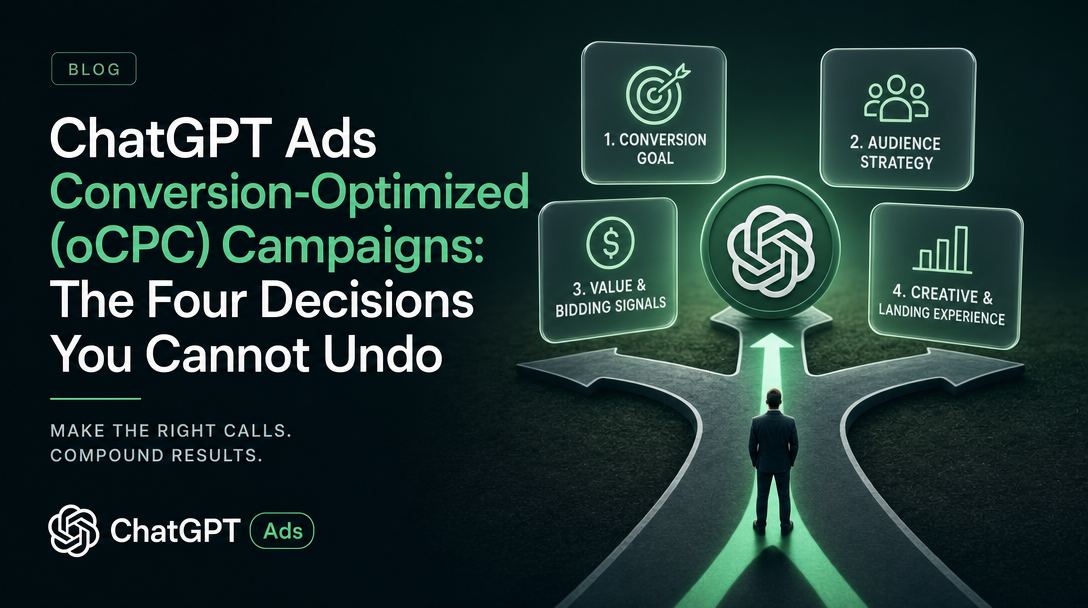
The short version: oCPC is a conventional conversion-optimizing bid strategy with one unconventional property — almost every important decision is permanent. Four settings are locked at campaign creation, and the only way to change any of them is to build a new campaign.
What oCPC Actually Is
OpenAI's definition:
Use Conversion-optimized (oCPC) campaigns when you want ChatGPT Ads to optimize toward a specific conversion event after someone clicks your ad.
Two things follow from that sentence, and both are frequently misread.
First, the optimization target is downstream of the click. oCPC is not optimizing for clicks that look good; it is optimizing for clicks that are more likely to be followed by the specific event you nominated — a purchase, a sign-up, a lead submission.
Second, you are still buying clicks. OpenAI is unusually direct about this in its FAQ:
Does oCPC mean I pay per conversion? No. oCPC optimizes delivery toward your selected conversion event, but billing is still based on valid clicks.
This is the single most important thing to internalise before setting a budget. The "o" changes which clicks the system pursues. It does not change what you are charged for. OpenAI reinforces the point in its reporting guidance: because oCPC is click-billed, Average CPC remains the main cost metric for what you pay, while Conversions is the outcome metric to watch.
There is no cost-per-conversion metric handed to you. OpenAI tells you to compute it: "you may also calculate cost per conversion by dividing spend by conversions."
The Four Decisions You Cannot Undo
This is the section to read twice. ChatGPT Ads oCPC has an unusually rigid creation flow, and OpenAI documents each constraint separately — which means it is easy to encounter all four one at a time, after launch, the hard way.
1. The campaign objective is permanent
The campaign objective cannot be changed after campaign creation. If you need a different objective later, create a new campaign.
2. The conversion event is permanent
Each oCPC campaign uses one selected conversion event. The conversion event cannot be changed after campaign creation. To optimize toward a different event, create a new campaign.
One event. Forever. If you launch optimizing toward AddToCart and later decide Purchase was the right target, that campaign cannot be repointed.
3. Existing campaigns cannot be migrated
You cannot modify existing CPM or CPC campaigns to use oCPC at this time. Create a new campaign with the Conversions objective in Ads Manager.
There is no upgrade path. Whatever delivery history, learnings and performance data a CPM or CPC campaign has accumulated does not transfer — moving to conversion optimization means a cold start.
4. Custom conversion events are not supported
oCPC currently supports one standard conversion event per campaign. Custom conversion events are not currently supported for oCPC.
If your business's real success metric is a custom event, oCPC cannot optimize toward it today. You must pick the closest supported standard event, and accept that the system is optimizing toward a proxy.
Our read, not OpenAI's: taken together these four turn campaign setup into a design decision rather than a configuration step. On Google or Meta, a mis-set conversion goal is an afternoon's annoyance. Here it is a rebuild. Whatever pre-launch review process you have, this is the platform to apply it to most rigorously — and the argument for writing the intended objective and event down, and having a second person check them, before anything goes live.
The Prerequisites Are Real Prerequisites
OpenAI's "before you start" list is not advisory. An oCPC campaign requires:
- Conversion tracking already live on the ad account, via the Conversions API, the JavaScript measurement pixel, or both.
- At least one supported standard conversion event available. Custom events do not qualify.
- A decision about which event to optimize toward — which, given constraint 2 above, is the decision, not a detail.
- Readiness to create a new campaign, because you cannot convert an existing one.
OpenAI separately recommends enabling automatic advanced matching on the website pixel to "help improve conversion matching and provide additional measurement signals for campaign optimization."
That recommendation deserves emphasis. A conversion-optimizing bid strategy is only as good as its conversion signal. If matching is weak, the system is optimizing against a partial and biased sample of your actual conversions — and it will do so confidently. Getting measurement right is not preparation for the campaign; on this campaign type it is a component of the campaign.
Setup, Step by Step
Following OpenAI's documented flow:
1. Create the campaign and set Objective to Conversions. This is what selects oCPC. There is no separate "bid strategy" control to find — the objective is the selection.
2. Choose the conversion event. OpenAI describes it as "the downstream action, such as a purchase, sign-up, lead submission, or other supported standard conversion event, that ChatGPT Ads will use to guide delivery." Permanent, per constraint 2.
3. Set budget, dates and locations. OpenAI's instruction here is more meaningful than boilerplate: "Choose settings that give the campaign enough time and budget to gather meaningful performance data." A conversion optimizer needs volume to learn from; a campaign that is starved or short-dated cannot supply it. (If you are working out how the daily budget behaves in practice, we cover that in ChatGPT Ads daily budget pacing.)
4. Create ad groups and set a Bid Cap. The Bid Cap lives at the ad-group level, not the campaign. OpenAI now defines it as "the maximum amount you are willing to bid for a conversion", and states that "the system uses predicted conversion likelihood to determine a per-click auction bid while optimizing toward your selected conversion event. Billing remains based on valid clicks, and your actual cost per click is determined by the auction."
Correction, 2026-08-06. This article originally quoted OpenAI's earlier definition of Bid Cap as "the maximum amount you can pay for a click in an auction", which was the documented wording on 2026-08-04. OpenAI replaced that text on 2026-08-06 with the conversion-denominated definition above, and added that the cap "is not the price charged for a conversion or a guaranteed achieved cost per acquisition". This is not a cosmetic edit — it changes what number belongs in the field by a factor of your conversion rate. If you set a Bid Cap using this article before that date, re-read ChatGPT Ads redefined the oCPC Bid Cap, which covers the before-and-after wording and the arithmetic, and revisit your caps.
5. Launch and monitor. Ads Manager shows standard delivery and spend metrics alongside conversion reporting.
The Bid Cap Problem OpenAI Is Honest About
Buried in the optimization tips is a sentence worth pulling out:
Monitor performance and adjust your Bid Cap based on campaign delivery and results. There is no recommended bid amount at this time.
We would rather have this admission than a fabricated benchmark, but it does leave you without a starting anchor — and it means any confident "typical ChatGPT Ads CPC" figure you encounter elsewhere is not coming from OpenAI.
Our approach, clearly labelled as ours: in the absence of a platform benchmark, the only defensible starting bid is derived from your own economics rather than the platform's. Since the 2026-08-06 wording change, the quantity the field wants is a cost per conversion, not a cost per click — so start from the CPA you are genuinely willing to pay for the selected event, and do not multiply it down by your conversion rate. Then follow OpenAI's actual guidance, which is directional rather than numeric:
- Choose the event that best represents your campaign goal.
- Use an event with enough signal — "events that happen too rarely can make performance harder to evaluate."
- Keep tracking healthy — "incomplete or misconfigured tracking can make reporting and optimization less effective."
- Review over enough volume before making large changes to bids, budgets or creative.
That last point interacts badly with an under-funded campaign. If you set a small budget and a low Bid Cap and nominate a rare conversion event, you can end up in a state where the campaign never accumulates enough data to justify a change — and you have no way to fix the event choice without rebuilding.
Choosing the Conversion Event: the Genuine Trade-off
Because the event is permanent, and because OpenAI warns that rare events "can make performance harder to evaluate", event selection is a real trade-off rather than an obvious choice:
| Event choice | Signal volume | Alignment with what you want | Risk |
|---|---|---|---|
| Deep event (purchase, qualified lead) | Lower | High | May be too rare to optimize or evaluate on |
| Shallow event (page view, add to cart) | Higher | Lower | Optimizes toward users who browse, not users who buy |
Our judgement: pick the deepest event that still produces enough weekly volume to read, and be honest about what "enough" means for your account rather than defaulting to the deepest event available. If your true goal event fires a handful of times a month, oCPC optimizing toward it is unlikely to have anything to learn from — and because you cannot change the event later, this is the moment to be realistic rather than aspirational.
What This Does Not Tell You
Worth stating plainly, because ChatGPT Ads coverage is full of confident claims the documentation does not support:
- No CPC benchmarks. OpenAI explicitly declines to recommend a bid.
- No stated learning period. OpenAI advises reviewing "over enough volume" without defining a threshold, minimum conversion count, or duration.
- No documented bid automation beyond the cap. There is no target-CPA or target-ROAS equivalent described.
- No multi-event or custom-event optimization. One standard event per campaign.
- Product-feed campaigns — resolved on 2026-08-06, but only in the developer documentation. When this article was published, the oCPC help article did not describe how conversion bidding and feeds combined. OpenAI's developer documentation now states that "product-feed conversion bidding is available in open beta", created through the same endpoint with
mode: "product_feed". The help-centre article on conversion-optimized campaigns still does not mention feeds at all. We cover the beta, its prerequisites and the remaining gaps in conversion bidding for ChatGPT Ads product feed campaigns; the feed setup itself is in ChatGPT Ads product feed campaigns.
We are not going to fill these gaps with estimates. Where OpenAI has not published a number, this article does not have one either.
What We Would Actually Do
Judgement, not documentation:
- Get measurement fully live first, including automatic advanced matching, and confirm the standard event is firing and matching before creating anything.
- Write down the objective and the event, and have someone else check them. Four irreversible settings justify a two-minute review.
- Choose the deepest event with readable weekly volume — not the deepest event that exists.
- Fund it properly. OpenAI's own guidance about gathering meaningful data means an underfunded oCPC test is not a cheap test, it is an uninformative one.
- Keep the CPM or CPC campaign running while the oCPC campaign establishes itself, since there is no migration and therefore nothing to lose by not cutting over immediately.
- Judge on cost per conversion you calculate yourself, since the platform does not present it.
Sources
All claims attributed to OpenAI above come from these pages, read on 2026-08-04:
- Conversion-optimized Campaigns — the primary source for this article
- Create Campaigns for ChatGPT
- Conversion measurement / automatic advanced matching
- Measure Results
- Conversions API and measurement pixel
Last verified: 2026-08-04. ChatGPT Ads is in beta and OpenAI's documentation changes frequently — we monitor these pages daily and update when the wording actually changes, rather than when the "updated" timestamp moves.