 Soku AI
OpenAI rewrote the campaign objective section of the ChatGPT Ads help centre this week, and it is not a wording change. The objective picker that advertisers have been using since Ads Manager Beta opened — CPM, CPC, oCPC — no longer exists in the documentation. In its place are Views, Clicks and Conversions, and Conversions is not one thing. It is a goal with two billing methods underneath it.
The new one is oCPM: a conversion-optimized campaign billed per thousand impressions.
This was announced as "coming soon" in OpenAI's advertiser product-update email on 2026-09-03. As of this week it is documented, it is in beta, and it is selectable in Ads Manager. Everything below is read from OpenAI's own published documentation, verified 2026-09-15, with the exact previous wording where it matters.
What changed, in OpenAI's words
The objective section of Create Campaigns for ChatGPT Ads previously read:
"Your campaign objective determines how your ads are priced and how delivery is optimized. You can currently choose from CPM, CPC, and oCPC objectives. See the table below for more information about each."
…followed by a four-column table in which oCPC was defined as "Conversion-optimized cost per click", with "How you pay: Per valid click, not per conversion."
It now reads:
"Your campaign objective determines how your ads are priced and how delivery is optimized. Choose Views (CPM), Clicks (CPC), or Conversions."
- Views (CPM): Best for maximizing visibility and exposure. You pay per 1,000 impressions served. - Clicks (CPC): Best for driving users to click through to your website or product. You pay per valid click. - Conversions: Best for optimizing toward a selected supported conversion event. Select a billing method: valid clicks (oCPC), billed per valid click, or impressions served (oCPM), billed per 1,000 impressions served. You do not pay per conversion.
Three structural things happened at once, and they are worth separating because they have different consequences.
One: the objective and the billing method are now different fields. Previously "oCPC" was an objective — one item in a list of three. Now the objective is Conversions, and oCPC is one of two ways to be charged for it. This is the same model Meta and Google settled on years ago, and it means the question "what is my objective" and the question "how am I billed" have been formally separated.
Two: the comparison table is gone. The old four-row table (Definition / Marketing Objective / Best for / How you pay / System optimization) has been replaced by three prose bullets. Less precise, but the table had become wrong: it could not represent one objective with two billing methods.
Three: the oCPC guide was renamed. The article at ID 20001412 was "Create oCPC Campaigns" at /20001412-create-ocpc-campaigns. It is now Conversion-optimized Campaigns, and the old slug no longer resolves. The rename is the clearest signal that this is a taxonomy change rather than a feature bolt-on — OpenAI stopped naming the document after the billing method.
What oCPM actually is
From the renamed guide, verbatim:
"Note: oCPM is currently in beta, and access is rapidly expanding."
"oCPC campaigns are billed based on valid clicks and optimize toward conversions that happen after someone clicks your ad. oCPM campaigns are billed based on impressions served and optimize toward conversions while accounting for a broader set of eligible conversion signals, including actions that follow ad clicks and ad views."
And OpenAI's stated rationale, which is unusually explicit about the behaviour it is targeting:
"oCPM can help advertisers better reflect how people discover, evaluate, and choose products through ChatGPT. Someone may see an ad while exploring an idea, return later, and complete a conversion without a direct ad click."
That sentence is the whole argument. ChatGPT is a research surface. A user exploring a decision sees an ad, keeps exploring, and buys later — possibly in another session, possibly by typing the brand into a browser. Under oCPC that journey is invisible to the optimizer, because the optimizer only learns from conversions that followed a click. oCPM is OpenAI's answer: pay for impressions, and let the system learn from views as well as clicks.
The distinction that will get misread
oCPM optimizing on view signals is not the same as view-through conversions being added to your Conversions total. These are different claims and the documentation only supports the first.
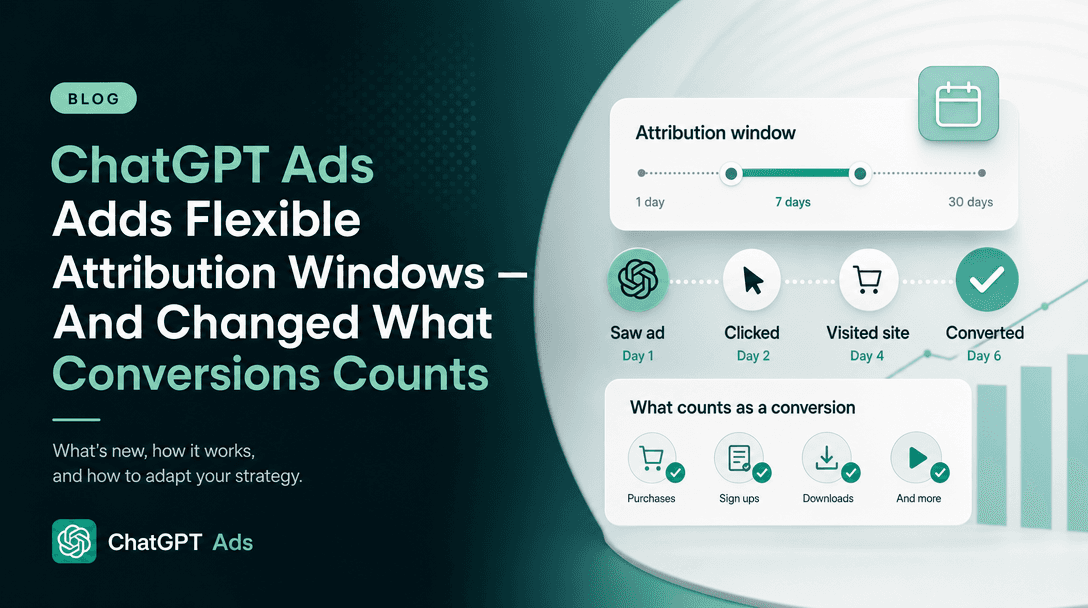
When view-through conversions arrived on 2026-08-12, the developer documentation was explicit that they use a fixed one-day window, are reported separately at campaign level, and are excluded from Conversions, CPA, bidding and billing. The new oCPM documentation does not retract that. What it says is that oCPM delivery accounts for "a broader set of eligible conversion signals, including actions that follow ad clicks and ad views," and that for oCPM you should "review both click-through and view-through conversion reporting when available."
Read precisely: the optimizer now uses view signals in an oCPM campaign. The documentation does not state that your reported Conversions figure now includes them. Until OpenAI says otherwise, continue to treat view-through as a separate line, and be careful comparing an oCPM campaign's efficiency against an oCPC campaign's — they are not learning from the same evidence.
The four things that are still permanent
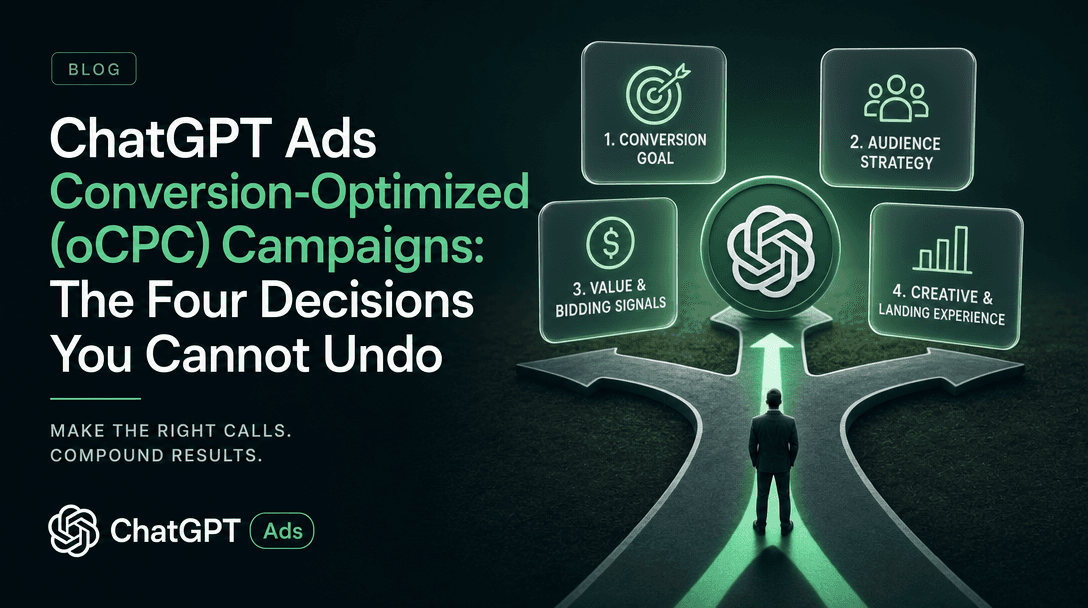
This is the part most likely to cost someone money, and the new billing method makes it worse rather than better, because there is now a fourth locked field.
From the current documentation:
"You are ready to create a new campaign. Existing CPM, CPC, oCPC, or oCPM campaigns cannot be changed to a different objective or billing model at this time."
"The campaign objective and billing model cannot be changed after campaign creation. If you need a different objective or billing model later, create a new campaign."
"Each conversion-optimized campaign uses one selected conversion event. The conversion event cannot be changed after campaign creation. To optimize toward a different event, create a new campaign."
| Decision | Changeable after launch? |
|---|---|
| Campaign objective (Views / Clicks / Conversions) | No |
| Billing method (oCPC vs oCPM) | No — new since this change |
| Conversion event | No |
| Conversion tracking setup | Yes, but must exist first |
| Bid Cap | Yes |
| Budget, dates, locations | Yes |
So the practical consequence of oCPM arriving is that you now have to be right about one more thing before you click create. Choosing oCPM and discovering your account does not have the view-side volume to justify impression billing is not a settings change; it is a rebuild, with a fresh learning period.
There is one mitigation worth knowing, documented since the 2026-08-06 update: you can clone an existing CPC campaign into a conversion-optimized one. Cloning creates a new campaign rather than converting the original, which is why it coexists with the "cannot be changed" rule rather than contradicting it. It saves the setup work, not the learning period.
What you need before you can use it
The prerequisites are unchanged in substance but worth restating, because one of them still catches people:
- Conversion tracking must be live on the ad account, via the Conversions API, the JavaScript Measurement Pixel, or both.
- At least one supported standard conversion event must be available.
- Custom conversion events are still not supported for conversion-optimized campaigns — oCPC or oCPM. If your most meaningful action is a custom event, you cannot optimize toward it, and you have to pick the nearest standard event instead.
That last constraint is the one that quietly decides whether this feature is usable. A B2B advertiser whose real goal is "requested a demo of the enterprise tier" does not get to optimize toward it.
Bid Cap under oCPM
The guide restates the definition established on 2026-08-06:
"For conversion-optimized campaigns, Bid Cap is the maximum amount you are willing to bid for a conversion. The system uses predicted conversion likelihood to determine an auction bid while optimizing toward your selected conversion event. Billing remains based on your preferred optimization model, and your actual cost per conversion is determined by the auction."
The important half is the second sentence: your Bid Cap is expressed in conversions, but your billing is in impressions. Those are different units and the documentation does not publish the translation between them. OpenAI also states plainly:
"There is no recommended bid amount at this time."
So there is no floor, no suggested starting point, and no published relationship between a conversion bid and a CPM outcome. Start conservative and read the delivery, because there is nothing else to read.
Which metrics to watch
The guide separates them explicitly, and the split matters for anyone building a reporting view:
| oCPC | oCPM | |
|---|---|---|
| Primary cost metric | Average CPC | Average CPM |
| Primary delivery metric | Clicks | Impressions |
| Key outcome metric | Conversions | Conversions, cost per conversion |
| Also monitor | — | Click-through and view-through conversion reporting |
And a caution that applies to both: OpenAI recommends evaluating "conversion volume together with spend, impressions, clicks, and the attribution windows selected for the campaign," and notes you can calculate cost per conversion by dividing spend by conversions. That division is doing more work under oCPM, because spend no longer moves with clicks.
What we would actually do
Three recommendations, all of them conservative, because oCPM is in beta and there is no published benchmark for it.
Do not migrate a working oCPC campaign. There is nothing to migrate to — it would be a rebuild with a new learning period, traded for a billing model with no public performance data. If oCPC is delivering, leave it.
Test oCPM where the click model is structurally wrong. Specifically: considered purchases, long research cycles, and categories where users compare for days. That is exactly the behaviour OpenAI's own rationale describes, and it is where the click-only optimizer is losing the most information.
Do not plan around the reporting changing. View-through conversions are still documented as excluded from Conversions, CPA, bidding and billing. oCPM changes what the optimizer learns from. Treat anything beyond that as unannounced.
One thing the documentation still does not say
Neither surface states which countries or account types the oCPM beta covers. "Access is rapidly expanding" is the only availability language, and it appears nowhere in Ads Manager Availability, which also changed this week without gaining an oCPM note. If the billing option is not in your Ads Manager, that is the expected state for most accounts and not a misconfiguration.
Note also that the developer documentation at developers.openai.com/ads did not change this week. This entire update is help-centre-only, which means the Advertiser API's own description of campaign objectives has not yet been reconciled with the new Views / Clicks / Conversions taxonomy. If you create campaigns through the API rather than the UI, verify against the API reference before assuming the objective enum changed.
Also changed this week, briefly
Two smaller updates landed in the same pass and are worth a line each:
- EEA and Switzerland custom audiences. Create Campaigns gained: "For campaigns targeting the EEA or Switzerland, avoid custom audiences while ads personalization is unavailable there. Inclusion targeting requires at least 25,000 matched users; exclusions can use smaller audiences." The 25,000 floor is now official help-centre text rather than an email claim — see our EEA custom audiences gap coverage.
- US geo targeting terminology. "supported state, designated market area (DMA), and ZIP code targeting" became "supported state, market, and ZIP code targeting". DMA is an industry term with a specific Nielsen definition; "market" is not. Check the location picker rather than assuming DMA-equivalent granularity.
Sources, all verified 2026-09-15:
- Conversion-optimized Campaigns — renamed this week from "Create oCPC Campaigns"
- Create Campaigns for ChatGPT Ads — objective model rewritten
- Ads Manager Availability
- Conversions API and Measurement Pixel
- OpenAI advertiser product-update email, 2026-09-03, which pre-announced impression-based conversion billing as "coming soon". Cited here only for the timeline; every capability statement above is sourced to the documentation.
Verified facts above are quoted from OpenAI's published documentation. The recommendations, the permanence table and the oCPM-versus-view-through-reporting distinction are Soku's editorial analysis. If you are running ChatGPT Ads through Soku, see how to run ChatGPT Ads and the conversion mapping guide.