 Soku AI
OpenAI changed the definition of the single number you type into every conversion-optimized ChatGPT Ads campaign. Not the label, not the placement — the meaning.
Until 2026-08-05, Bid Cap was documented as the most you could pay for a click. As of the version captured on 2026-08-06, it is the most you are willing to bid for a conversion.
Those are not the same quantity. They differ by your conversion rate, which for most advertisers means they differ by one to two orders of magnitude. Anyone who set a bid cap by asking "what is the most I would pay for a click?" — which is precisely what the documentation instructed until yesterday — now has a campaign bidding a small fraction of what they intended.
Everything below is quoted from OpenAI's own documentation, with the previous wording taken from the prior captured snapshot of the same article. Where the documentation is silent, this article says so.
What changed, exactly
In step 4 of Conversion-optimized Campaigns, the previous text read:
Bid Cap is the maximum amount you can pay for a click in an auction. oCPC uses this cap while optimizing toward clicks that are more likely to lead to your selected conversion event. Your actual CPC is determined by the auction and may be lower than your Bid Cap.
That has been replaced with:
For conversion-optimized campaigns, Bid Cap is the maximum amount you are willing to bid for a conversion. The system uses predicted conversion likelihood to determine a per-click auction bid while optimizing toward your selected conversion event. Billing remains based on valid clicks, and your actual cost per click is determined by the auction.
The FAQ was rewritten in the same pass. The old question was:
Will I always pay my Bid Cap?
No. Your Bid Cap is the maximum you can pay for a click. Your actual CPC is determined by the auction and may be lower than your Bid Cap.
It is now:
How does my Bid Cap affect what I pay?
For an oCPC campaign, Bid Cap is a conversion-oriented bid used to determine how the campaign competes in click auctions; it is not the price charged for a conversion or a guaranteed achieved cost per acquisition. You are billed for valid clicks, and your actual cost per click is determined by the auction.
Read the two versions side by side and the shift is unambiguous.
| Previous wording | Current wording | |
|---|---|---|
| What the cap is denominated in | A click | A conversion |
| What it bounds | What you can pay | What you are willing to bid |
| Relationship to your CPC | Your CPC will be at or below it | Your CPC comes out of the auction; no stated relationship to the cap |
| Explicit disclaimers | None | Not a conversion price, not a guaranteed CPA |
The old text made a promise — your actual CPC "may be lower than your Bid Cap", implying it could never be higher. The new text withdraws that promise entirely and replaces it with two explicit denials.
Source: help.openai.com — Conversion-optimized Campaigns, captured 2026-08-06. Previous wording from the prior captured snapshot of the same article, 2026-08-05.
The developer documentation was already saying this
The help centre is not the only place OpenAI documents oCPC. The developer documentation for conversion-optimized campaigns describes the same field through the API, and it states:
For an oCPC campaign,
max_bid_microsis the CPA bid even though billing uses valid clicks.
And separately:
Billing does not change to pay per conversion. OpenAI charges you only when a valid click occurs.
That is the new help-centre definition, stated plainly, in documentation aimed at engineers. Which means the two surfaces were contradicting each other until today: the API docs called the field a CPA bid while the Ads Manager docs called it a click cap, for the same underlying value.
This matters for how you should interpret the change. The most probable reading is not that OpenAI altered its auction on 2026-08-06 — it is that the help-centre article had been describing the field incorrectly since launch, and has now been corrected to match the mechanics the API documentation described all along.
That is worse for advertisers, not better. A behaviour change starts a clock you can plan around. A corrected description means every bid cap set through Ads Manager since the oCPC launch was chosen against a wrong mental model, and has been running that way for as long as it has been running.
OpenAI has published no changelog entry, no in-product notice, and no advisory email about this specific edit. It was not among the items in OpenAI's 2026-08-05 advertiser product-update email, which covered oCPC cloning, bulk creation, dynamic URL parameters, pixel diagnostics and automatic advanced matching, but said nothing about the meaning of Bid Cap.
Why the difference is large, not subtle
Suppose you sell a product with a 2% landing-page conversion rate and you are willing to pay $60 to acquire a customer.
Under the old reading, "the maximum I can pay for a click" is a CPC question. You would reason: $60 target CPA × 2% conversion rate = $1.20 is what a click is worth to me. You set the Bid Cap to $1.20.
Under the current reading, the field wants your maximum acceptable cost per conversion. That is $60.
The correctly-specified bid is fifty times the one the old documentation led you to enter. A campaign carrying the old number is not slightly conservative. It is bidding two percent of intent, and in a competitive auction the practical outcome is that it barely delivers — which is easy to misread as "ChatGPT Ads has no inventory for us" or "oCPC does not work".
The multiplier is exactly the reciprocal of your conversion rate:
| Conversion rate | Old-model cap on a $60 target CPA | Correct cap | Underbid factor |
|---|---|---|---|
| 10% | $6.00 | $60 | 10× |
| 5% | $3.00 | $60 | 20× |
| 2% | $1.20 | $60 | 50× |
| 1% | $0.60 | $60 | 100× |
The lower your conversion rate, the worse the error — which means the advertisers most affected are the ones with long consideration cycles and expensive customers, exactly the segment for which a $60 CPA is normal.
There is a mirror-image risk too, and it is the one that costs money rather than volume. If you read "willing to bid for a conversion" and entered a number you meant as a target CPA on the assumption the platform would hold you to it, OpenAI has now told you plainly that it will not: the cap is "not a guaranteed achieved cost per acquisition". Your realised cost per conversion can land above it, and no documented mechanism prevents that.
What "predicted conversion likelihood" actually implies
The new sentence contains a mechanism description that the old one did not:
The system uses predicted conversion likelihood to determine a per-click auction bid.
This is the standard shape of conversion-optimised bidding across ad platforms: you supply a value per conversion, the platform estimates a probability per click, and the click bid is the product of the two. It is worth being precise about what follows from it, because these consequences are real even though OpenAI does not spell them out.
Your bid varies per auction, and you do not control the variation. Two clicks under the same Bid Cap can be bid at very different levels, because the predicted likelihood differs. The cap sets the ceiling of the conversion-denominated bid, not the floor or the average of what gets bid per click.
The prediction needs data, and the quality of the prediction is the quality of your tracking. OpenAI's own optimisation tips point in this direction: use a conversion event "with enough signal", keep tracking healthy, and — added in the same article — "enable automatic advanced matching for your website pixel to help improve conversion matching and provide additional measurement signals for campaign optimization." A prediction model fed by an under-matching pixel systematically underestimates likelihood, which under this bidding model directly suppresses your bids.
A cold campaign has no basis for prediction. OpenAI does not document a learning period, a minimum conversion volume before optimisation engages, or what the system does before it has a prediction to work with. Every comparable platform has one. This one does not say.
What the documentation still does not say
Whether the auction behaviour changed or only the description did. There is no changelog, no dated note, no "we have updated how oCPC bidding works" statement. The alignment with pre-existing developer documentation is evidence for "description corrected", but it is inference, not a statement.
Whether existing campaigns were affected. If the mechanics were always as now described, nothing changed for a running campaign and only your understanding was wrong. If the mechanics changed, every live oCPC campaign was silently re-based. The documentation does not distinguish these cases, and it is the single most consequential thing an advertiser would want to know.
Whether there is a learning period. Not documented. OpenAI says only to "review performance over enough volume before making large changes to bids, budgets, or creative", and separately that "there is no recommended bid amount at this time".
What happens when you change the Bid Cap mid-flight. Whether the campaign re-learns, resets, or continues is unstated.
Any relationship between Bid Cap and daily budget pacing. ChatGPT Ads daily budgets run on a seven-day average with 2× daily and 7× weekly caps, which we covered in ChatGPT Ads daily budget pacing. How a conversion-denominated bid interacts with that pacing model is not described.
No recommended or suggested bid. Stated outright: "There is no recommended bid amount at this time." There is no floor, no suggested range, and no in-product estimate — so the field offers no guardrail against an order-of-magnitude error in either direction.
What to do this week
- Look at every live oCPC campaign's Bid Cap and ask what question you answered when you set it. If the answer was "the most I would pay for a click", the number is wrong for the current definition.
- Recompute the cap as a cost per acquisition. Take the CPA you are actually willing to pay for the selected conversion event. Do not multiply it by your conversion rate — that was the old model's arithmetic, and it is the specific step that produces the underbid.
- Change it before you draw conclusions from the data. Performance collected under a 50×-underbid cap is not evidence about the channel. Discard that read rather than reasoning from it.
- Do not treat the new cap as a CPA guarantee. OpenAI has explicitly said it is not one. Monitor realised cost per conversion — spend divided by conversions, which you calculate yourself — and be prepared for it to sit above the cap.
- Check your conversion matching before you raise bids. Under a predicted-likelihood model, an under-matching pixel suppresses bids on its own. If you have not yet handled OpenAI's automatic advanced matching change landing 17 August 2026, do that first — it moves the same lever.
- Watch this article, not the product updates email. This change was not announced. The only way it surfaced was a diff of the documentation itself.
The wider point
ChatGPT Ads is a beta, and betas rewrite their documentation. But there is a difference between adding a feature and redefining an input that advertisers have already set. The first is announced; the second was not.
The practical defence is to treat platform documentation as versioned source material rather than as a stable reference — capture it, diff it, and re-read your own configuration whenever the definition of a field moves. That is a boring discipline, and on 2026-08-06 it was the only thing standing between a media buyer and a campaign bidding two percent of what they meant.
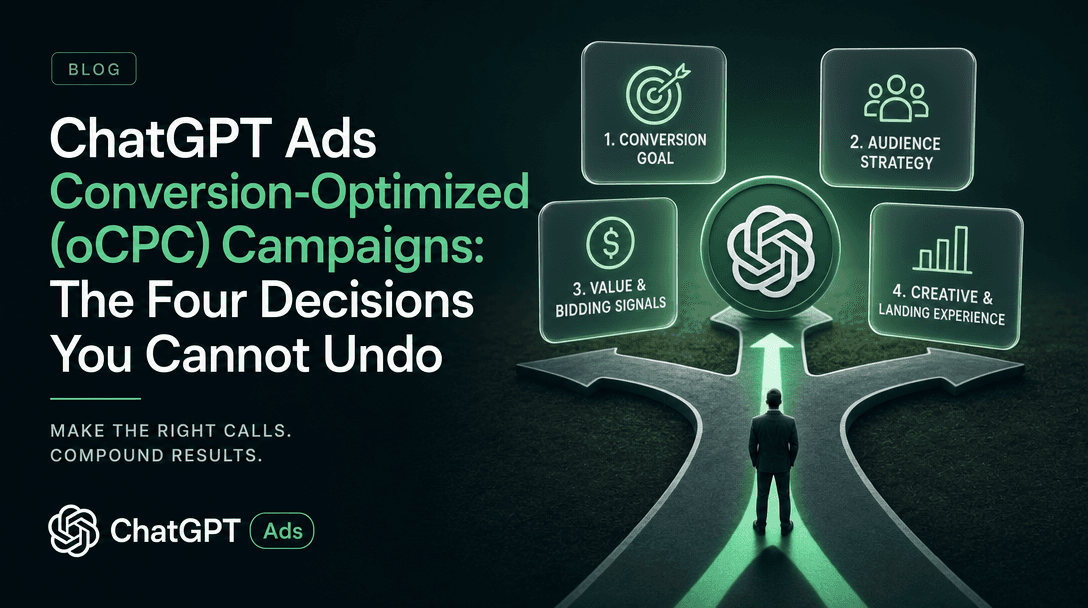
For the full setup walkthrough and the four decisions that are locked at campaign creation, see ChatGPT Ads conversion-optimized (oCPC) campaigns. For where conversion bidding is going next, see conversion bidding for product feed campaigns.
Sources: help.openai.com — Conversion-optimized Campaigns (Bid Cap definition, FAQ, optimisation tips, campaign creation steps), captured 2026-08-06; the prior captured snapshot of the same article, 2026-08-05, for the previous wording; developers.openai.com — Conversion-optimized campaigns (max_bid_micros as CPA bid, click-based billing). The worked examples are illustrative arithmetic, not platform benchmarks. Statements about what the documentation does not say are statements about the documentation, not about the product.