 Soku AI
Consultants who work with marketing agencies do not need another generic chatbot. They need a system that helps an agency client make its own delivery method repeatable without flattening every advertiser into the same account.
That is the operating model in this walkthrough. Firewire Digital is the marketing agency receiving consulting support. Ridge is one advertiser account Firewire manages. The consultancy helps Firewire shape and improve the operating model; Soku connects Firewire's methods, Ridge-specific context, the tools where work happens, and the controls the agency needs to manage its advertiser portfolio.
The core idea: standardize the agency's method, isolate each advertiser's context, connect the execution tools, and manage exceptions from one agency portfolio view.
The model in one view
The system has five layers. Each solves a different scaling problem in a consultant-to-agency engagement.
| Layer | What it contains | What it prevents |
|---|---|---|
| Connected capability | Ads, analytics, research, email, meetings, files, and project tools used by the agency | Agency operators jumping between disconnected tabs and copying context by hand |
| Agency method | Private skills for onboarding, status updates, decision research, SOP capture, and more | Every operator or advertiser engagement starting from a blank prompt |
| Advertiser context | A dedicated brand workspace, files, guardrails, integrations, and memory for each advertiser | One advertiser's facts or preferences leaking into another advertiser's work |
| Grounded execution | Agent work that reads live sources, checks anomalies, and produces a traceable deliverable | Polished answers built on stale or incorrect account assumptions |
| Agency portfolio governance | Organization-level usage, activity, approvals, and advertiser health across the agency's portfolio | Agency leadership managing delivery through scattered advertiser account views |
The important design choice is separation. The Soku organization represents Firewire Digital, the agency. Each brand workspace represents an advertiser Firewire serves, such as Ridge. A shared skill is not an advertiser profile, an integration is not a workflow, and a chat is not a system of record. Each layer has one job, and Soku composes them only when a task requires it.
Layer 1: Connect the agency's work, not just its data
A consultant advising an agency has to understand a workflow that crosses many systems. A meeting may live in Fireflies, follow-up context in Gmail, source material in Drive, delivery tasks in Asana, campaign truth in Meta or Google Ads, and market evidence in Ahrefs or DataForSEO.
Soku brings those systems into Firewire's execution surface. The point is not to build another dashboard that merely displays data. The point is to let Firewire's team, supported by the consultancy, move through the same workflow a strong operator would: find the right source, read the relevant evidence, compare it, and produce the next advertiser deliverable.
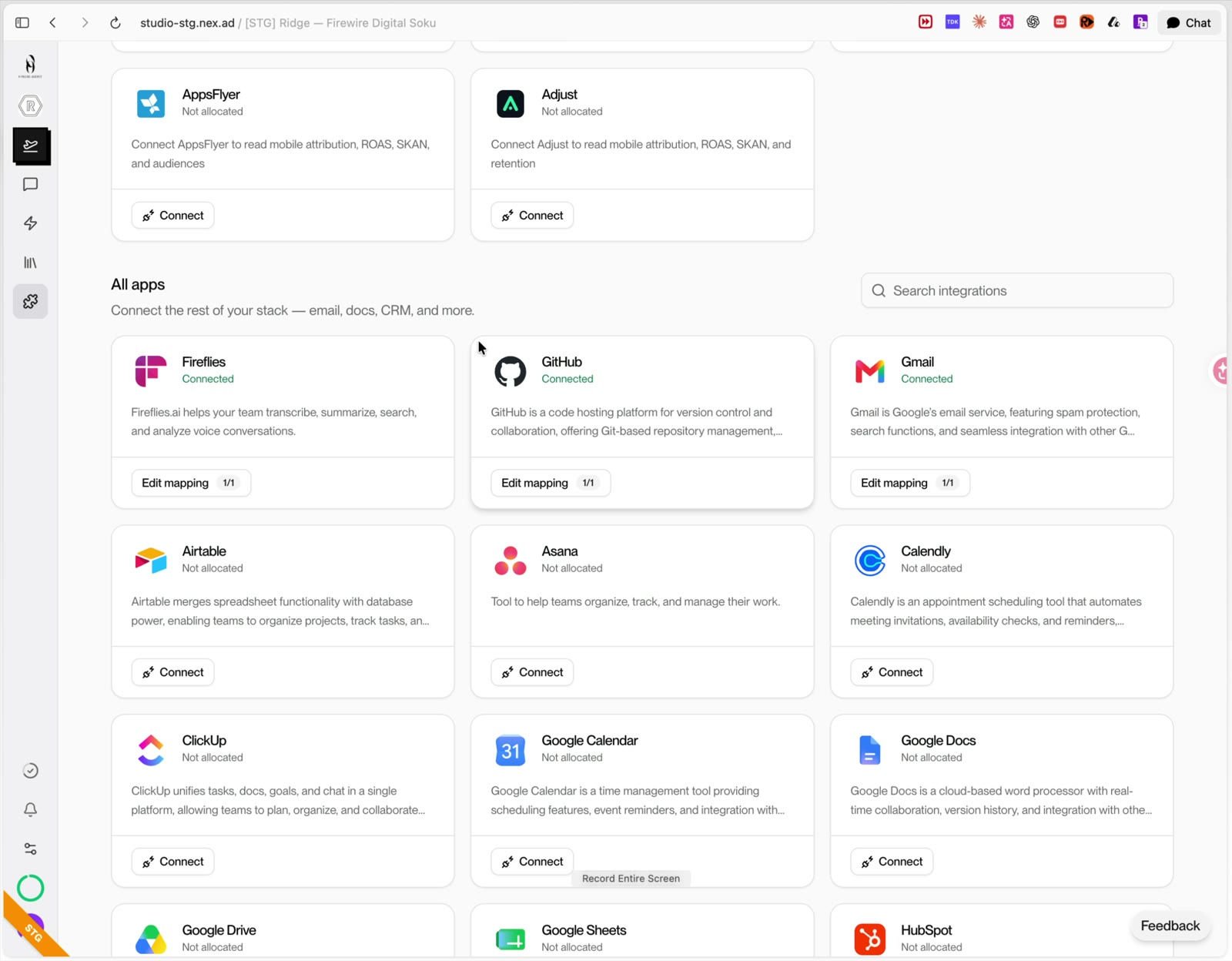
This changes the unit of automation. Instead of automating one app at a time, the agency can automate an outcome such as "prepare Ridge's status update" or "research this advertiser decision" across every source that outcome depends on.
Layer 2: Turn the agency's method into skills
A skill can start in whatever form the consultancy's method already takes. Firewire can import one from GitHub, upload an existing .md file, or ask the Agent to read a consultant-client meeting recording and automatically turn the demonstrated workflow, decisions, and standards into a draft skill for review.
Connections give the agent reach. Skills give Firewire's operating method structure and judgment.
In the demo, Firewire's delivery playbooks are imported as private, versioned skills. The consultancy can help agency leaders capture, test, and improve those playbooks, but the resulting skills belong to Firewire's delivery system. They cover recurring moments in an advertiser relationship:
- Approval follow-up that reconstructs the blocked decision and chooses an appropriate escalation level
- Advertiser onboarding that turns proposals, contracts, kickoff notes, and access records into a verified launch pack
- Account status updates that organize outcomes, blockers, decisions, and next milestones
- Decision research that produces a source-backed recommendation rather than a search summary
- Delivery health checks that flag advertiser risk and propose recovery actions
- Meeting follow-through that converts transcripts and email context into decisions and owned next steps
- SOP capture that turns a walkthrough into a reusable agency operating procedure
- Case study building that converts verified advertiser evidence into a proof asset
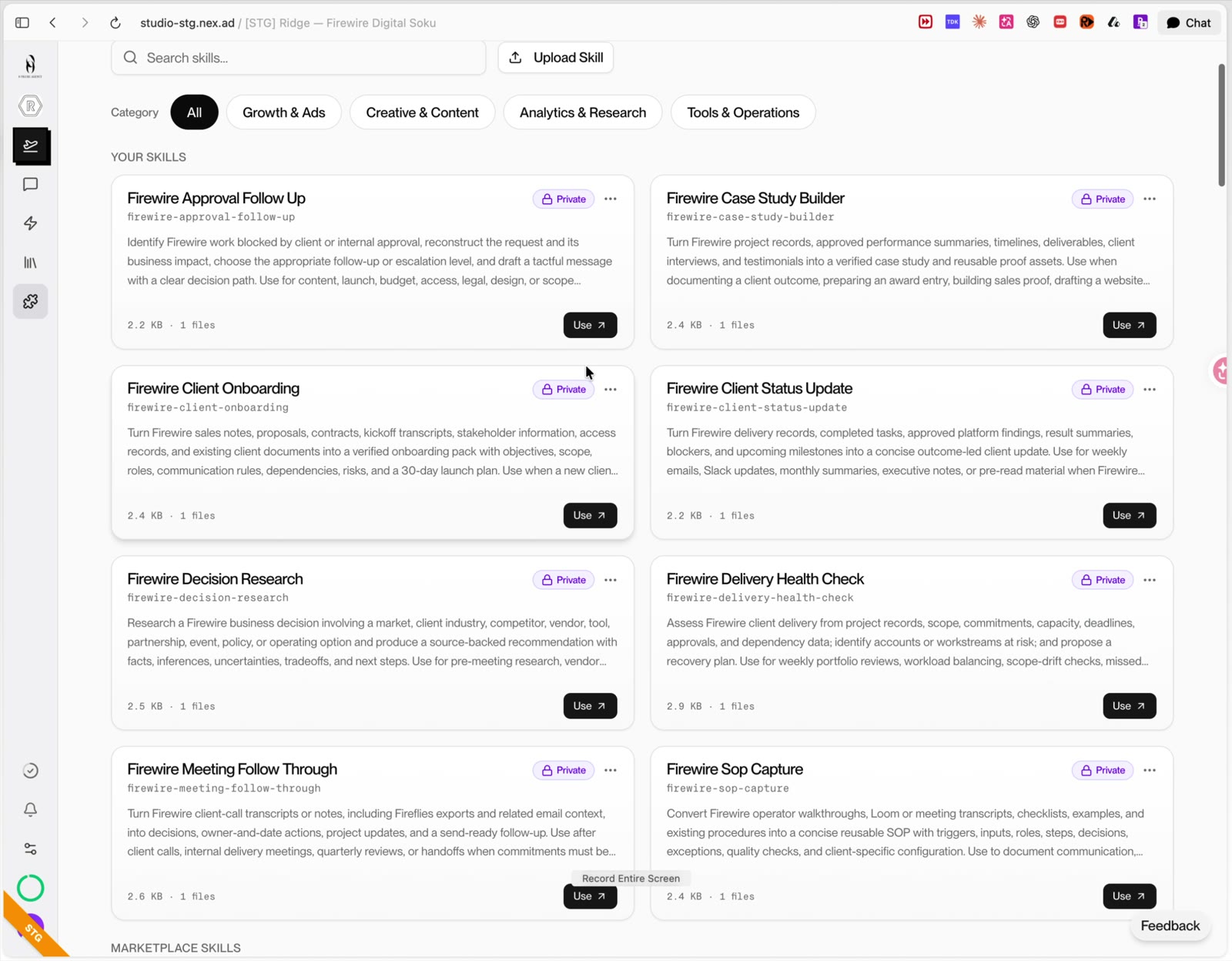
This is the difference between a prompt library and an operating system. A prompt suggests what to say. A skill defines when to run, what evidence to collect, what sequence to follow, what quality checks to apply, and what a finished deliverable must contain.
Because the skills are versioned, Firewire can improve its method once and make the better method available across its team and advertiser portfolio. The consultancy can guide that improvement without becoming the person who manually reconstructs the process for every account.
Layer 3: Give every advertiser an isolated workspace
Standardizing the agency's method does not mean blending its advertisers.
Firewire Digital is the agency organization in Soku. Ridge is one advertiser brand inside that organization. Ridge has its own files, connected ad and analytics accounts, conversations, instructions, and operating memory.
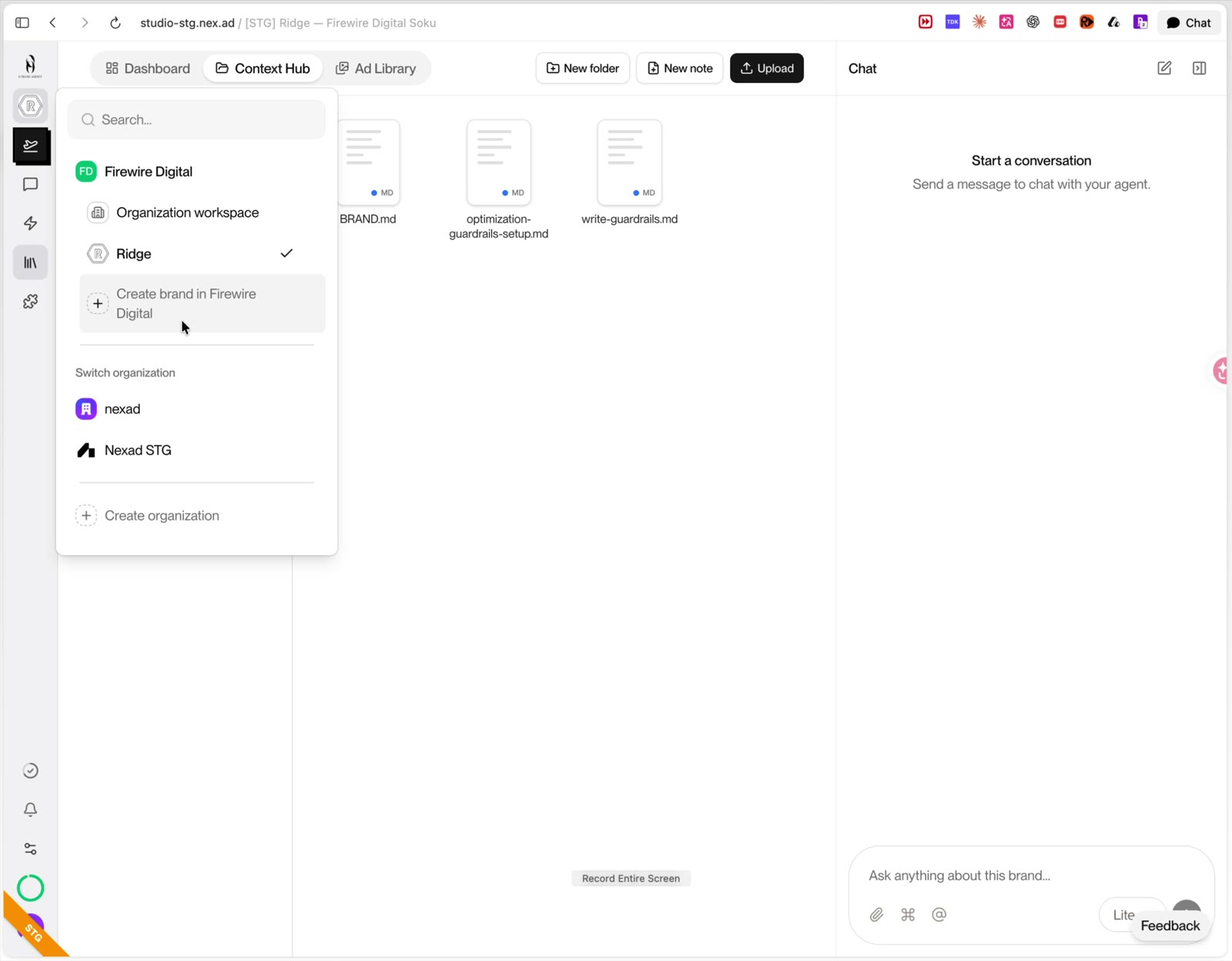
That boundary matters for quality and trust. The same Firewire status-update skill can run for ten advertisers, but it should receive a different evidence set every time. Ridge's brand guidelines, competitors, campaign defaults, meeting history, and approvals belong to Ridge alone.
The structure gives Firewire and its consultant a repeatable setup path for a new advertiser account:
- Create the advertiser brand inside Firewire's agency organization.
- Connect only that advertiser's approved systems and accounts.
- Add the advertiser's files, guardrails, and known preferences.
- Apply Firewire's shared agency skills.
- Run a small set of verified starter workflows before expanding access.
If the consultancy also supports another marketing agency, that agency's people, methods, and advertiser portfolio belong in a separate organization. The consultant can reuse an advisory framework without mixing one agency client's operating data into another's environment.
Layer 4: Ground every advertiser deliverable in live context
Once Firewire's method and the advertiser boundary are in place, the agent can do real account work.
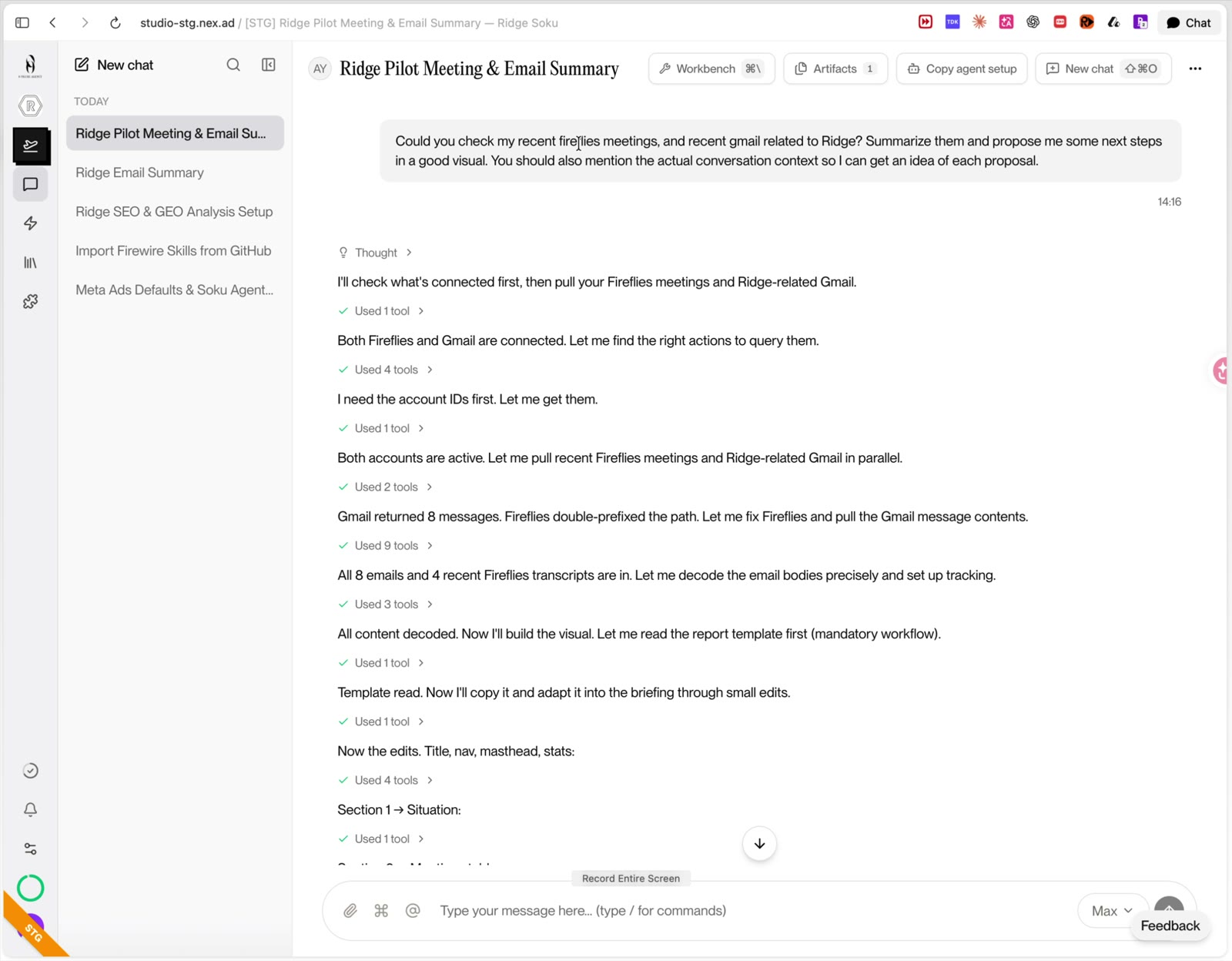
One walkthrough task asks Soku to review recent Fireflies meetings and Ridge-related Gmail, summarize the situation, and propose next steps in a clear visual. The agent first confirms both connections, resolves the correct accounts, pulls the relevant records, reads the required report template, and only then assembles the briefing for Firewire's Ridge team.
Another task sets up an SEO and GEO comparison for Ridge. The useful part is not simply that the agent can call Ahrefs. It notices that two established competitors return zero US organic keywords, treats that as a likely coverage artifact instead of an advertiser conclusion, tests a different domain scope, and continues only after the data becomes comparable.
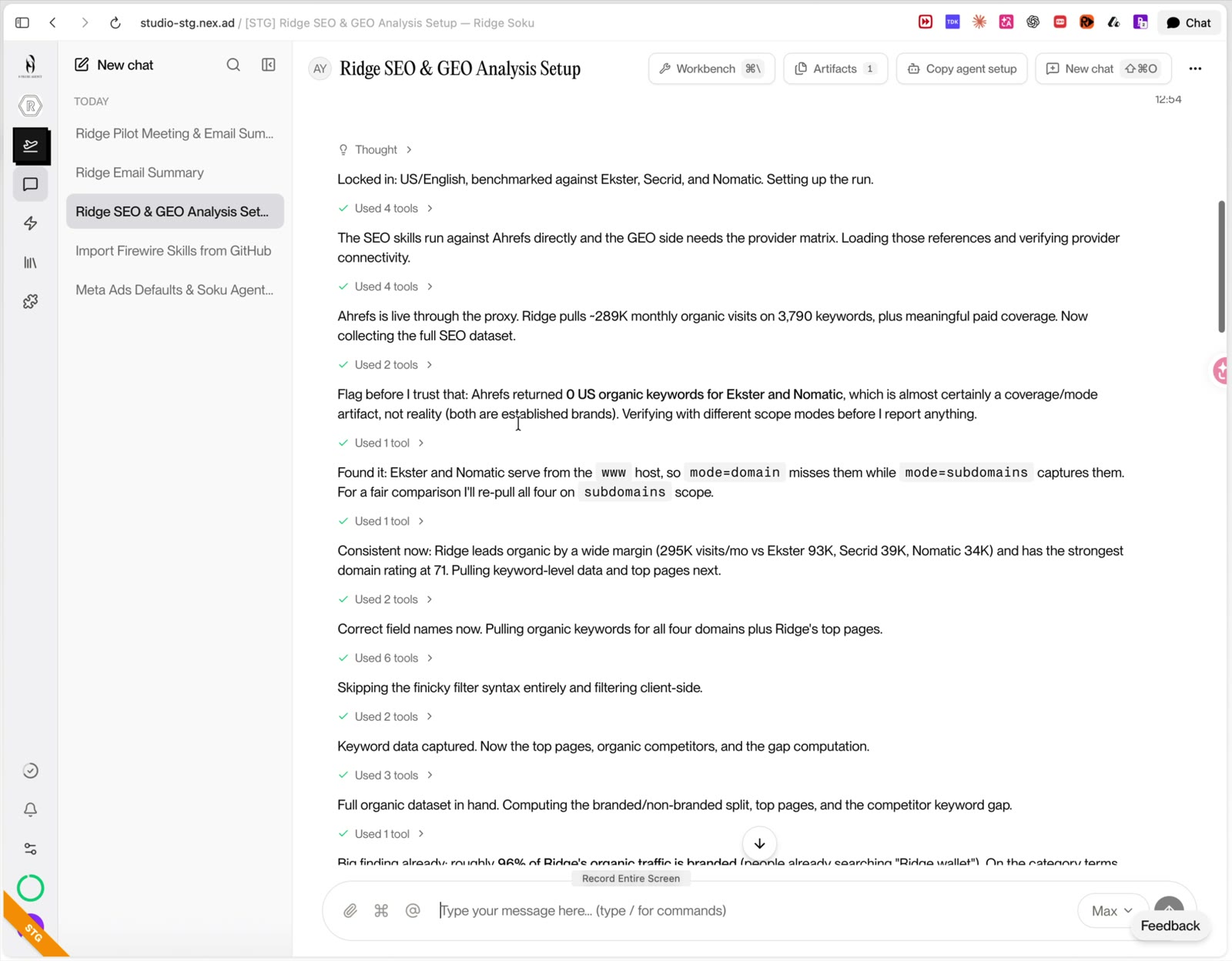
That behavior is essential in agency delivery. Tool access without verification only produces mistakes faster. A strong operating workflow includes the skeptical steps a consultant would want the agency to preserve: inspect an outlier, name uncertainty, change the query, and keep the evidence trail visible.
Layer 5: Preserve agency judgment, advertiser memory, and control
Agency work contains advertiser preferences that are too specific for a global product default. Ridge may have a campaign rule, reporting convention, review threshold, or brand constraint that should persist across future work.
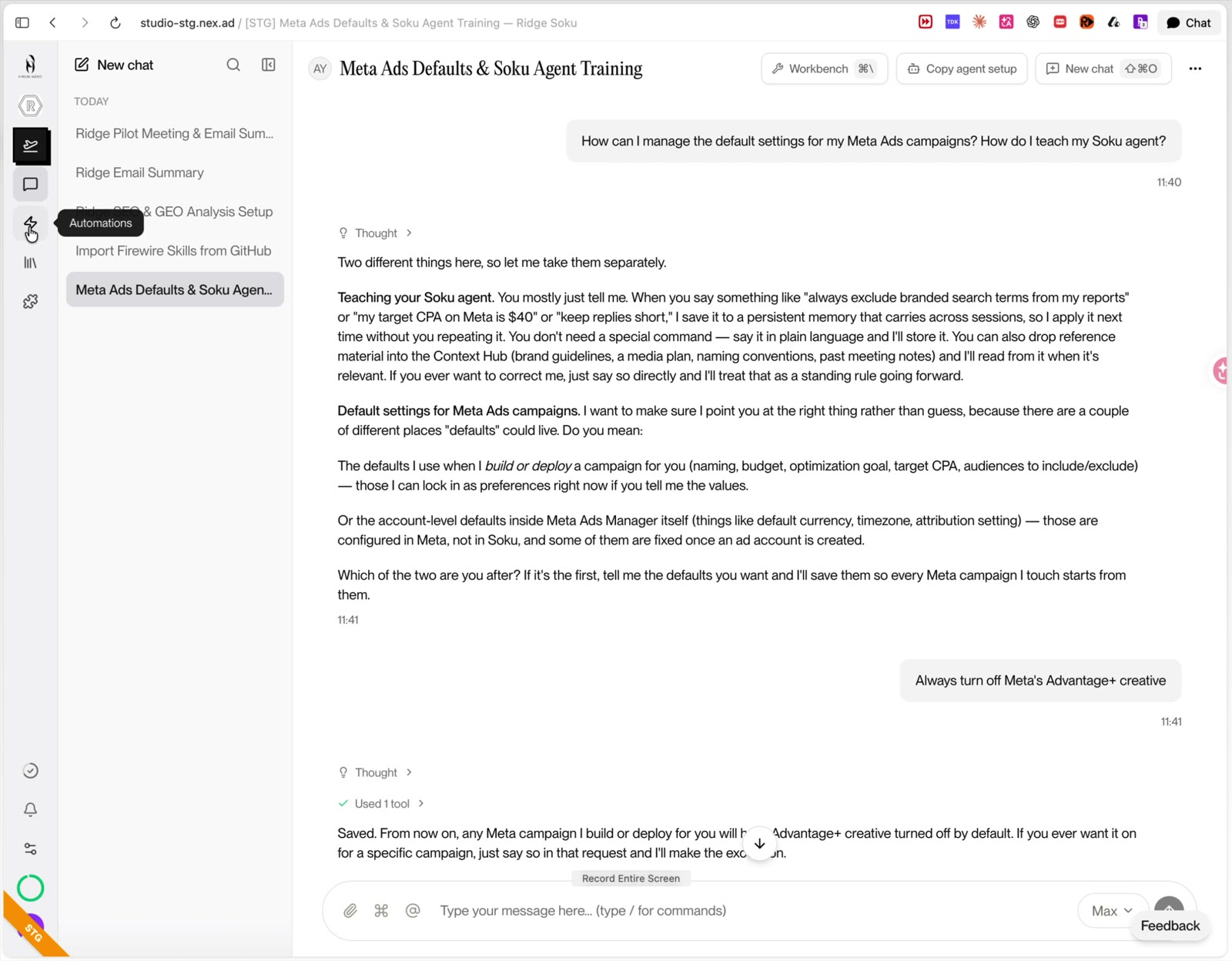
In the demo, a Firewire operator tells the agent to keep Meta Advantage+ creative turned off by default for Ridge. Soku saves the preference to Ridge's advertiser context so the next campaign task starts with the correct account rule while still allowing an explicit exception.
The separation is deliberate:
- Shared skills hold Firewire's agency method.
- Advertiser context holds Ridge's facts and defaults.
- Consulting guidance becomes a reviewed skill change or explicit advisory direction.
- The current request holds one-time intent.
- Approvals hold the decisions that still require Firewire or its advertiser to act.
Keeping those sources separate makes the system easier to audit and change. A Ridge preference can be updated without forking Firewire's whole skill. An agency skill can improve without overwriting advertiser-specific constraints. The consultancy's advice stays visible as a change to the operating model rather than disappearing into a private prompt.
At the portfolio level, Firewire leadership should not need to open every advertiser workspace to understand what is happening. The organization view can answer the agency management questions: where agent work is concentrated, which approvals are waiting, which account needs attention, and how activity is distributed across advertisers. The advertiser workspace keeps the detailed record; the agency organization manages the exceptions. The consultancy can review agreed operating signals without requiring indiscriminate access to every account detail.
What the end-to-end workflow looks like
Put the layers together and a consultant-to-agency engagement can run like this:
- Confirm the operating boundary. Treat Firewire as the agency organization and create Ridge as an advertiser brand inside it.
- Encode the agency method. Help Firewire turn its best delivery practices into private, versioned skills.
- Add advertiser truth. Connect Ridge's approved systems and store its brand documents, guardrails, competitors, and preferences.
- Run grounded account work. Let the skill collect live evidence across the connected stack and challenge suspicious results.
- Review the decision points. Route agency or advertiser approvals to the right human instead of silently guessing.
- Deliver and remember. Produce the advertiser artifact, retain verified Ridge context, and make the next run better.
- Manage by exception. Use Firewire's organization view to see risk, activity, and pending decisions across the advertiser portfolio.
The consultancy remains responsible for advisory judgment and improving the operating model. Firewire remains responsible for its advertiser relationships, account execution, and final delivery decisions. Soku takes on the expensive coordination work: finding evidence, following the agency playbook, maintaining the right context, and preparing a reviewable result.
The practical outcome
This model does not try to make every agency or advertiser identical. It makes the reliable parts of agency delivery repeatable while protecting the differences that make each account valuable.
For a consultancy supporting a marketing agency, that creates a more useful form of scale:
- The consultant can transfer a repeatable operating framework without becoming the manual routing layer for every advertiser task.
- Firewire's team starts from the agency's real method, not an empty chat box.
- Every advertiser gets a clean context boundary and a consistent delivery standard.
- Research and reporting pull from live account sources instead of copied snapshots.
- Advertiser-specific decisions persist without contaminating Firewire's shared playbooks.
- Firewire's leaders can manage a growing advertiser portfolio while the consultancy focuses on higher-value guidance.
The result is not "AI replacing the consultant" or "AI replacing the agency." It is a consultancy that helps an agency make its expertise operational, and an agency that can deliver that expertise across more advertisers with greater consistency, clearer boundaries, and a stronger audit trail.