Soku AI

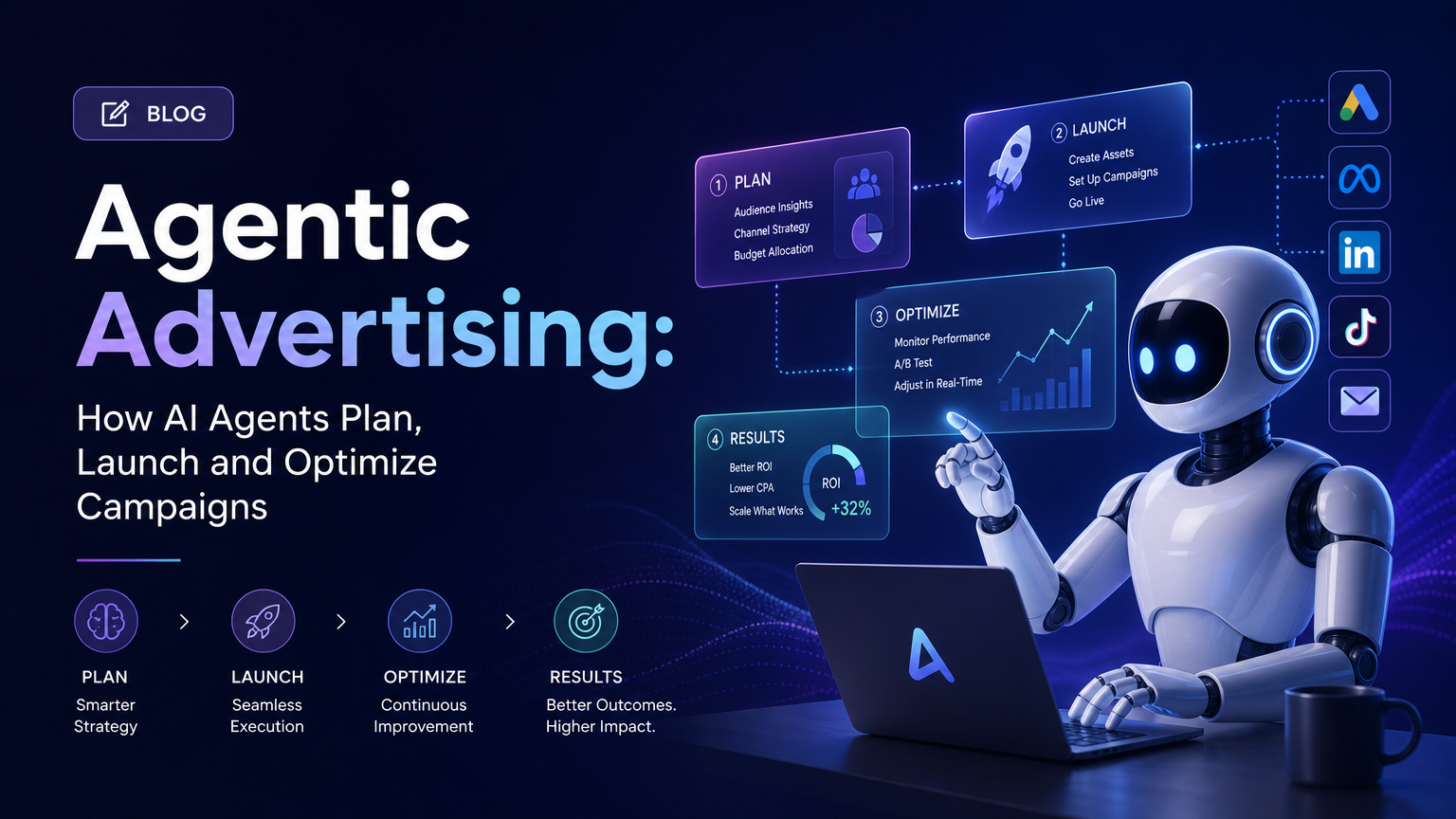
Agentic advertising is paid media run by an AI agent that works toward a goal instead of following a rule. The agent reads your ad account, decides what should change, makes the change through the platform's API, then measures whether it worked before deciding what to do next. Plan, launch, optimize, repeat. A rules engine can pause an ad set when CPA crosses a line. An agent can ask why CPA crossed the line, restructure the campaign, write the new ads and come back a week later to check its own work.
In 2026 the term stopped being a pitch-deck word. Every major ad platform has now shipped an agent surface: Meta's ads MCP server and an agentic AI business assistant in testing, Google's Ask Advisor, TikTok's MCP server and Agentic Hub, and OpenAI's ChatGPT Ads Manager plugin. In programmatic, buyer and seller agents now have their own protocol. And Gartner predicts that over 40% of agentic AI projects will be canceled by the end of 2027, citing "escalating costs, unclear business value or inadequate risk controls."
That last phrase is the gap in most of what ranks for this term. The pages on page one define agentic advertising and list vendors, but none show what the risk controls actually look like. This post does. Below: what makes advertising agentic, the plan, launch and optimize loop stage by stage, where each platform stands as of today, and a guardrail reference architecture built from the real thresholds Soku enforces in production, including the exact budget envelope an agent can move without asking.
Last verified: 2026-10-19. Every platform claim links to the official page we read that day. For the broader, marketing-wide definition of agents (email, content, CRM), see the pillar: AI marketing agents. This page is about the paid-media part, where every action spends money.
What makes advertising "agentic"
"AI-powered" has been on every ad product for a decade, so the word needs a test. We use four. An ad system is agentic when it:
- Works from a goal, not a rule. "Get CPA under $40 on prospecting" rather than "pause any ad set with CPA above $40."
- Reads state and chooses its own next action. It decides which report to pull, which campaign to inspect and which change to propose. Nobody scripted the sequence.
- Acts through write access. It can create, edit and pause real objects in the account, not just recommend.
- Closes the loop. It measures the effect of its own change and uses that to decide the next one.
Most tools that call themselves agents pass one or two of these. Gartner calls the rest "agent washing" and estimates only about 130 of the thousands of agentic AI vendors are real. The table shows where common ad tools sit.
| Type | Example | Goal-driven | Chooses actions | Writes to the account | Closes the loop |
|---|---|---|---|---|---|
| Rules engine | Meta automated rules, Google Ads scripts | No, fixed condition | No | Yes | No |
| Platform optimization | Advantage+, Performance Max, AI Max for Search | Yes, inside one campaign | Within its own campaign only | Yes, inside its campaign | Yes, for bids, audiences and assets |
| Copilot | Most "AI assistant" chat panels | Partly | Suggests | No | No |
| Ad agent | Third-party agents, MCP-connected LLMs, the platforms' new agent surfaces | Yes | Yes | Yes, with approval | Yes, if it re-measures |
The second row matters. Platform optimization is genuinely agentic inside its box: Google describes AI Max for Search as "a continuous optimization layer" that refines targeting and creative from real-time signals. But it optimizes the campaign you gave it. It doesn't decide to split a campaign, move budget from Search to TikTok, or rewrite the brief. An ad agent operates one level up, on the account, and often across several of them. That's also why the two can fight: an agent adding negative keywords while AI Max expands search terms will oscillate unless you decide who owns what (we cover AI Max's controls here).
Three things people mean by "agentic advertising"
The term is used for three different shifts, and the SERP mixes them freely:
- Agents that operate ad accounts. An agent plans, launches and optimizes campaigns on Meta, Google, TikTok, LinkedIn or ChatGPT Ads, for an advertiser or agency. This is most of this page.
- Agent-to-agent media buying. In programmatic, a buyer's agent negotiates with publishers' and platforms' sell-side agents. This needs shared protocols, covered below.
- Ads aimed at agents. As shopping assistants act for people, ads and product data have to be readable by an agent. OpenAI is testing Sponsored Agents, which let people start a conversation with a business's agent after clicking an ad in ChatGPT.
The plan, launch and optimize loop
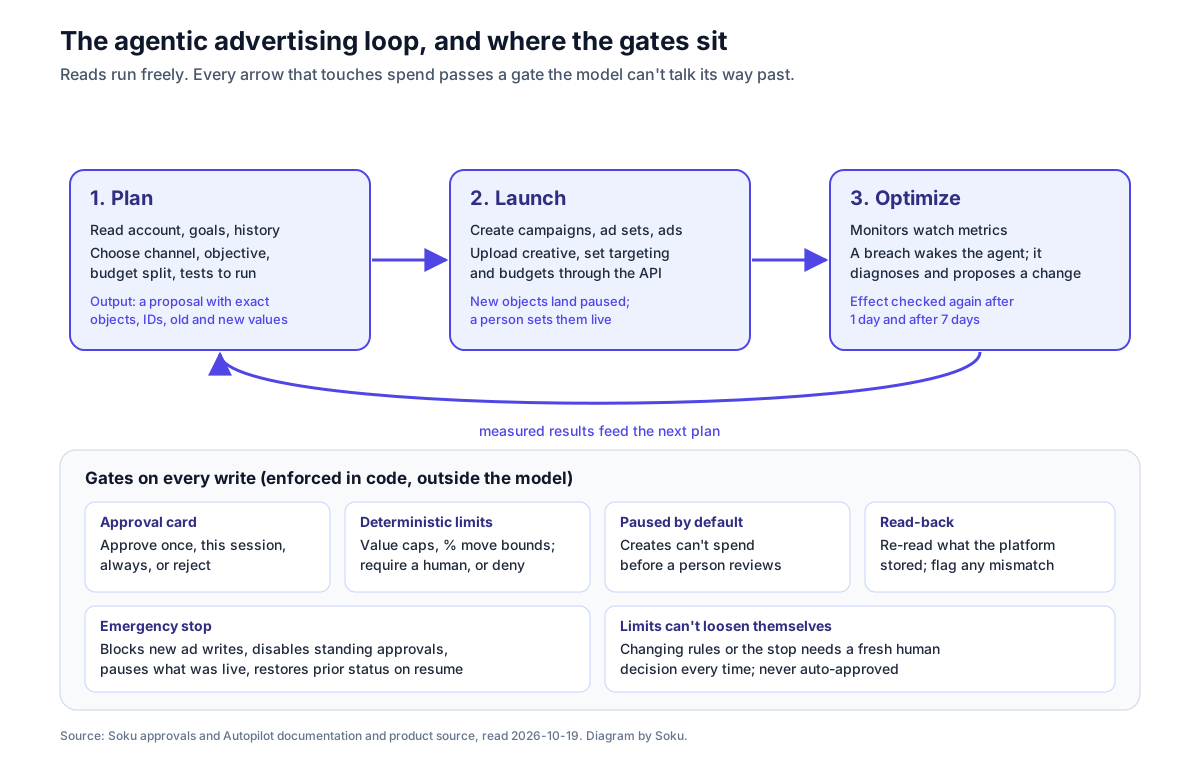
Here's the loop stage by stage: what an agent reads, what it writes, and where it typically breaks.
Plan
The agent reads the account (structure, spend, conversions, change history), the brand's goals and any prior results, then produces a plan: which channel, which objective, how to split budget, what to test. A good plan ends in a proposal you can approve: exact objects, IDs, current values and new values. "Shift budget to what's working" can't be approved. "Ad set US Prospecting, daily budget 400 → 320" can.
Where it breaks: the agent plans from incomplete data. Reporting lags (ChatGPT Ads spend can be delayed 7 to 8 hours; see our note on reporting delays), conversions arrive late, and a plan built on yesterday's partial numbers looks like a crisis. A careful agent says what it couldn't see. A careless one fills the gap with confidence.
Launch
The agent creates the objects: campaigns, ad sets or ad groups, ads, creative uploads, audiences, tracking. This is where agentic advertising differs most from copywriting AI. A whole campaign structure gets built through the API in minutes, and every object it creates can spend money.
Where it breaks: a created-and-live campaign with a wrong budget, wrong geo or a policy-violating ad. The fix is boring and effective: new objects land paused, and a person sets them live. Meta now says work staged by agents through its ads MCP server "lands as a draft in Ads Manager". Policy is the other failure: an agent that launches noncompliant ads at scale gets accounts restricted (how to avoid that).
Optimize
Once things are live, the agent watches metrics and acts when something moves: a CPA spike, a budget that's pacing out by noon, creative fatigue, a tracking break. In a mature setup, nobody prompts it. Monitors wake it, it diagnoses the cause, and it proposes a change.
Where it breaks: three ways. Overreaction: changing the same campaign every few hours, so the platform's learning phase never settles. Self-confirmation: declaring a change a success one day later, before conversions have arrived. Automation fighting automation: the agent and the platform's own optimization pulling the same lever in opposite directions. The loop needs a cooldown, a delayed second measurement and clear ownership of each lever.
Where the platforms themselves are going agentic
The biggest change in 2026 is that the ad platforms built agent surfaces themselves, in two shapes: an agent inside the platform (Meta's assistant, Google's Ask Advisor, OpenAI's plugin) and a door for outside agents (MCP servers). What we read on each platform's official pages, on 2026-10-19:
| Platform | Agent inside the platform | Door for outside agents | Writes today? | Approval model |
|---|---|---|---|---|
| Meta | AI business assistant in Ads Manager; on Oct 6, 2026 Meta said it is "beginning to test" planning, creating campaigns and changing budgets through conversation | Ads MCP server and CLI ("Meta ads AI connectors"), open beta since Apr 29, 2026 | Yes, via MCP; agentic assistant actions in testing | Advertiser-set permissions and "explicit approval before anything goes live"; agent work lands as a draft |
| Ask Advisor (beta, English): "an agentic conversational experience" across Google Ads, Analytics and Merchant Center | Google Ads MCP server | Ask Advisor can set up campaigns; the MCP server is read-only in its current release | In-product review; outside agents must use the full Google Ads API to write | |
| TikTok | Agentic Hub: a marketplace of first- and third-party AI Skills (launched Jun 30, 2026) | TikTok for Business MCP server, about 400 tools in full mode or about 40 in progressive mode | Yes | Set by whichever Skill or agent you connect |
| OpenAI | ChatGPT Ads Manager plugin, in ChatGPT and Codex | Ads Manager API | Yes | Confirms the exact action before every write; reads back after updates |
A few details from those pages are worth knowing before you connect anything.
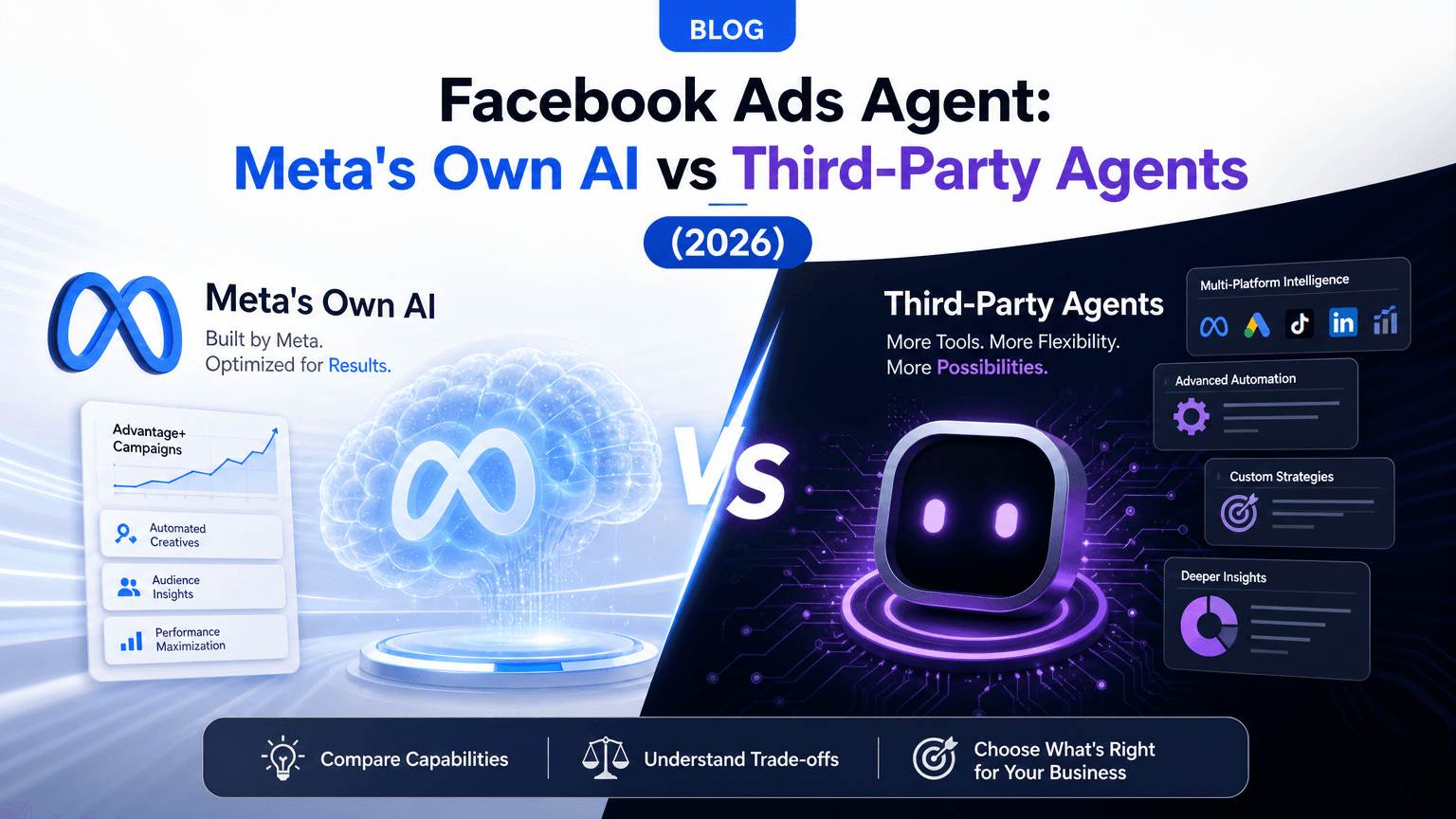
Meta. Meta has two agents under one name, and they face opposite ends of the funnel. Meta Business Agent, announced June 3, 2026, is the customer-facing one: it answers customers on WhatsApp, Messenger and Instagram, and Meta says more than one million businesses already use it. The advertiser-facing one is the AI business assistant in Ads Manager. Meta's October 6 update says marketers will be able to plan and create a campaign, update targeting or change a budget through conversation, and that it is testing scheduled tasks such as performance monitoring and budget-review reminders. Outside agents use the ads AI connectors, which since a July 16 update let people with full control of a business portfolio set rules on what agents can do, including budget changes. Our Meta Business Agent guide and Facebook ads agent comparison go deeper.
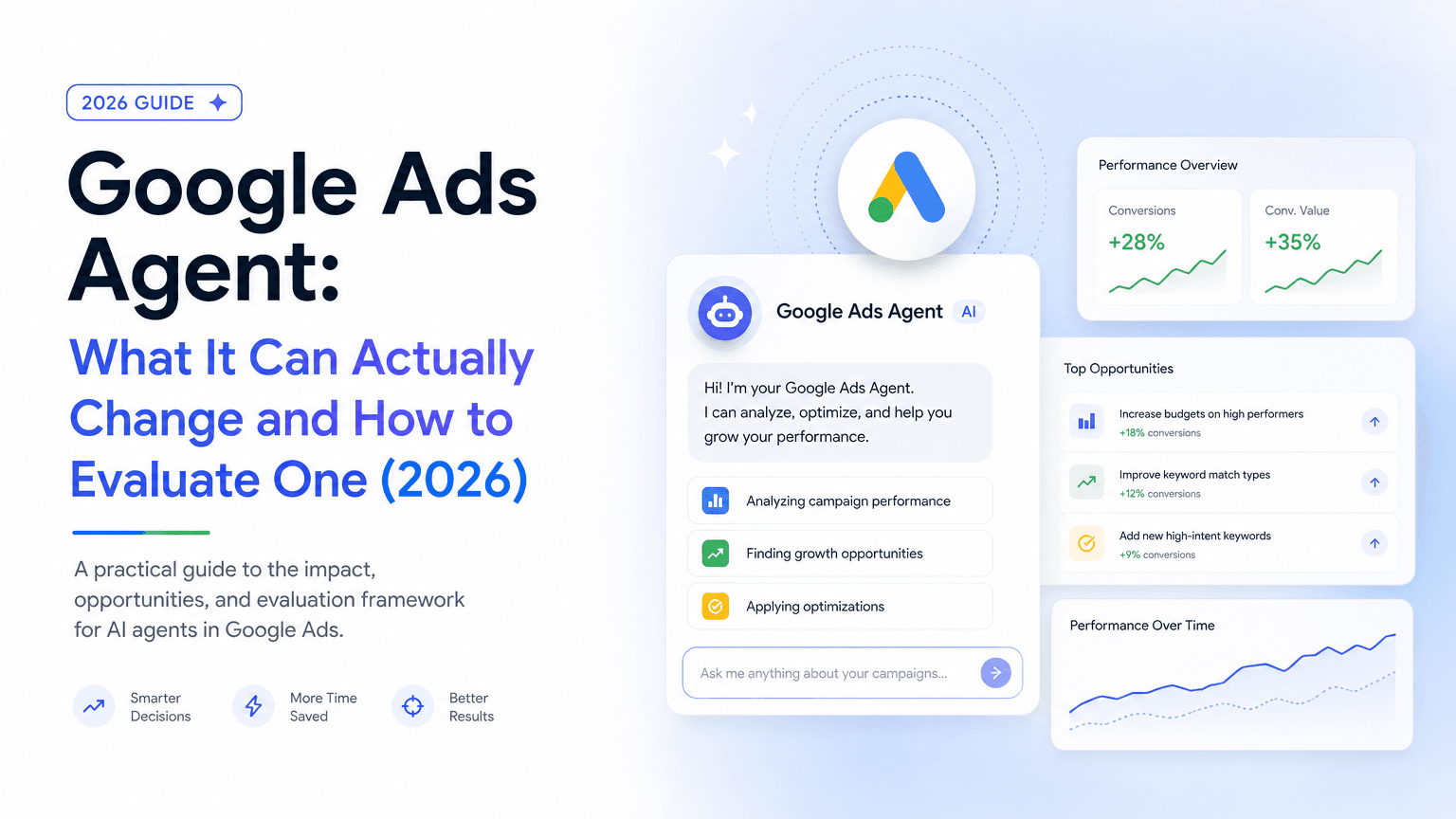
Google. Ask Advisor "orchestrates a team of expert agents across Google products"; Google's example is "find new customers for my hair care products" turning into a campaign built from Merchant Center data. The developer side is more conservative: the Google Ads MCP server is listed as "Read-only (current release)," and Google dropped developer tokens on September 9, 2026. AI Max is not an agent in our sense, but its defaults are instructive. In the API, turning AI Max on enables only search term matching; text customization and final URL expansion stay opted out until you opt in. See our Google Ads agent guide for the write surface.
TikTok. The TikTok for Business MCP server needs no developer credentials and exposes campaign management, reporting, audiences and creative. Agentic Hub, launched June 30, 2026, is a marketplace of Skills built on it, from TikTok and partners such as HubSpot, Wix and Kochava. On October 5, TikTok reported a more than 200% increase in advertisers using the MCP for campaign activation and management, and said it's now available as a connector in Claude, Perplexity, Manus, Snowflake and others, and in the IAB Tech Lab Agent Registry. One caution from browsing the Hub's Skill listings: each Skill brings its own guardrails. One third-party optimizer advertises "2x spend caps," while one TikTok-built creative Skill is fully read-only. Read the listing before you install a Skill. Background: our Agentic Hub explainer and TikTok Ads MCP guide.
OpenAI. OpenAI announced on September 16 that advertisers can "create, update, and analyze campaigns directly in ChatGPT with the Ads Manager plugin." Its help article is the clearest published approval model of any platform agent. Reads, analysis and troubleshooting never change the account. Every write "requires confirmation of the exact action," showing "the account, current state, proposed state, and exact values that will change." The plugin reads the resource back after a successful update. Recurring daily or weekly reviews are "recommendation-only and do not make automatic campaign changes." Limits: at most 50 new ads per request, and it doesn't receive conversion value, so it can't report revenue or ROAS. Related: Ads Manager inside ChatGPT.
The pattern. All four platforms landed on the same design: reads run freely, writes wait for a person, and scheduled autonomy is either recommendation-only (OpenAI) or still in testing (Meta). None of them lets its own agent spend unattended by default. That's the right bar for a third-party agent too.
The programmatic side: agent-to-agent buying
In open-web programmatic, "agentic advertising" means something more structural: agents on both sides of a trade.
- AdCP (Ad Context Protocol). An open protocol, launched October 15, 2025 with more than 20 ad tech companies including Yahoo, PubMatic, Magnite and Scope3, built on MCP. It lets agents discover inventory, activate signals and execute media buys through one interface. AgenticAdvertising.org, which publishes it, says the first agent-to-agent media buy ran on October 16, 2025, with LG Ads inventory and "human oversight," and that 154+ companies have since joined.
- ARTF (Agentic RTB Framework). IAB Tech Lab's framework, released for comment on November 13, 2025, runs agent services in containers inside DSPs and SSPs, and Tech Lab says it can cut bid request and response time by up to 80%.
The two work at different layers. AdCP is how buyer and seller agents negotiate; ARTF is how agent services act on individual bid requests. For a brand or agency running social and search, neither changes much this quarter. The governance idea carries over, though: AdCP's publishers call it "Embedded Human Judgment," meaning humans stay in the loop on decisions with real consequences.
A guardrail reference architecture (how Soku does it)
Here's the original part. Saying an agent has "human oversight" is easy. Below are the actual layers Soku runs, with the values in the product source as of 2026-10-19. Soku is an ad agent across Meta, Google, TikTok, LinkedIn and ChatGPT Ads, so these layers sit between the model and real spend every day. Copy the structure even if you never use Soku. Each layer answers a question you should ask any vendor.
Layer 1: reads are free, unauthorized writes stop at a card
Any action that writes stops at an action review card in Chat unless you have already authorized it, either with a standing grant from an earlier card ("Allow this session" or "Always allow") or by opting Autopilot into L2. Those pre-authorized writes skip the fresh card but still pass the Layer 3 rules below. The card offers four choices (documented here):
- Approve: this one call, as shown.
- Allow this session: this command for the rest of this conversation, for up to 24 hours.
- Always allow: this command in this brand until revoked, listed under Settings → Auto Approvals.
- Reject: nothing runs.
The grant is scoped to the command on a platform, not the run. Approving a Google Ads budget change doesn't approve the same change on Meta, and approving "send a Slack message" doesn't approve "delete a Slack message."
Layer 2: new objects can't spend before review
Campaign creation is paused at the code level, not left to the prompt. On Meta, campaigns, ad sets and ads are always created with status PAUSED. On Google, campaigns are always created paused "to prevent accidental activation." On TikTok, a new campaign defaults to disabled unless the call explicitly asks to enable it, and that call is itself a write that waits on a card.
Layer 3: hard limits enforced outside the model
This is the layer most agents skip. Soku's guardrail rules are evaluated by a deterministic function: no model and no clock, with the same answer for the same inputs. Each rule sits on one action and one parameter (for example, a campaign's daily budget) and uses one of four limit types: a maximum value, a minimum value (a bid pushed to near zero is as much an incident as one pushed too high), a maximum percentage move, or an allowed-values list. A violation has one of two outcomes:
- Require a human: an auto-approved write is downgraded back to a review card, and the card says why.
- Deny: the write is rejected no matter who approved it.
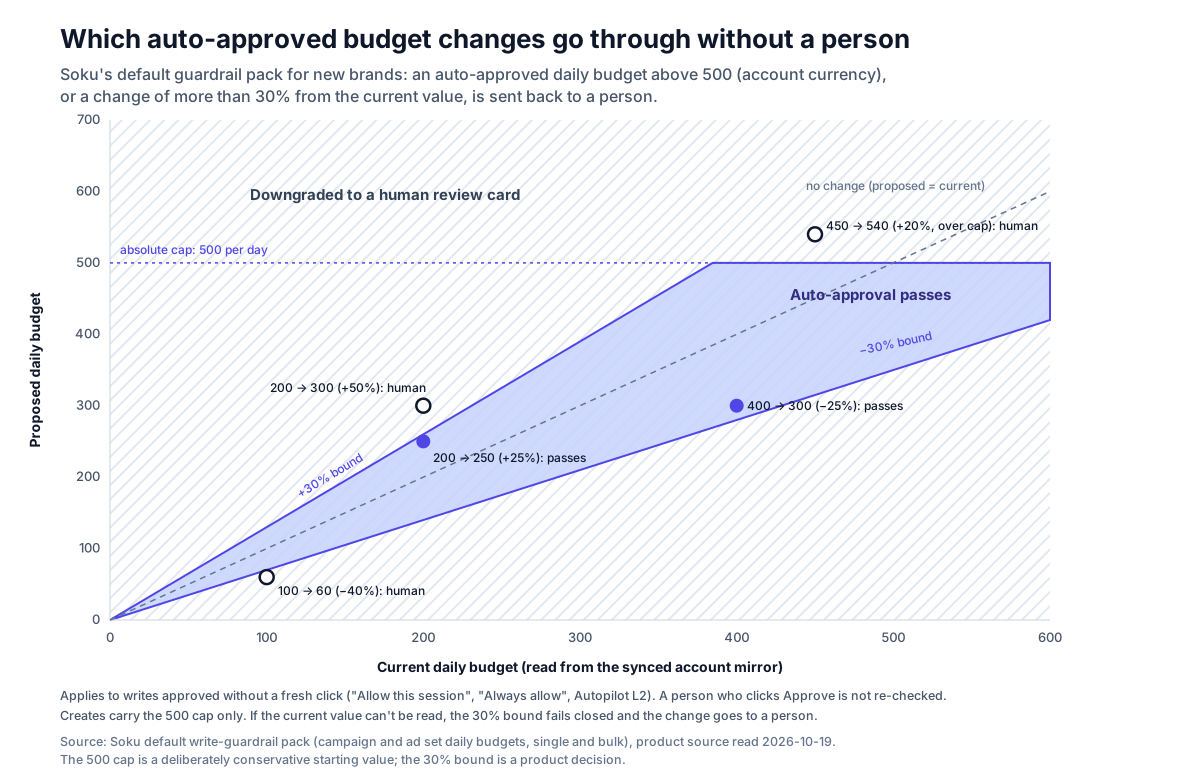
Every new brand starts with a factory rule pack. It applies to budget writes that were approved without a fresh click, meaning "Allow this session," "Always allow" or Autopilot at L2:
- An auto-approved daily budget above 500 in the account's currency goes to a human.
- An auto-approved budget update that moves more than 30% from the current value goes to a human.
- Both cover campaign and ad set budgets, for single writes and for every item in a bulk write, so bulk can't bypass the gate. Creates carry only the 500 cap, because there's no previous value to move from.
- The outcome is "require a human," never "deny." The factory pack slows money down; it doesn't forbid it.
Three design decisions are worth copying:
- Fail closed. The 30% bound needs the current budget, read from Soku's synced copy of the account. If that value is missing, the rule doesn't assume it's fine. It sends the change to a person.
- No ledger-based "daily total" rule. An earlier version capped the total budget increase a brand could commit in a rolling day. It was removed deliberately: a brand's total spend is better capped by the ad platform's own account-level spending limit, which the platform enforces, than by an agent inferring it from its own write history. If you run agents, set that platform cap.
- Honest calibration. The 500 cap is a conservative starting value, meant to over-trigger rather than under-trigger until it's calibrated on production data. The 30% bound was a product decision and isn't up for tuning.
Bids get the same treatment. Meta sends bids in cents and TikTok in account currency, so Soku converts both to one unit before judging them, which means a single rule means the same money on every platform.
One caveat: brands that existed before the factory pack start with no rules. After the first reviewed ad write, the agent offers to install the defaults, and it can be asked at any time. The rules also don't apply to a person who clicks Approve on a card. A human decision is the required review, and that's what stops the system from escalating forever.
Layer 4: the limits can't loosen themselves
A standing approval delegates every future decision on a command to the agent. If "Always allow" covered the guardrail settings, one click would let the agent rewrite its own limits. So the guardrail configuration commands (setting or removing rules, installing the defaults, clearing the emergency stop) can never be covered by Session or Always grants, and an Autopilot proposal that tries to change them is rejected outright. Only a fresh human decision moves the brand's bottom line.
Layer 5: an emergency stop that actually pauses
The brand-level emergency stop (engaged in conversation, and separate from Autopilot's own runtime switch) blocks every new ad write on both the chat and Autopilot paths, turns off "Always allow" grants, and stops queued batches from executing. It also snapshots every campaign the brand owns and pauses them, including ones that look paused already, since the synced copy isn't treated as proof. Clearing it restores each campaign's prior status, so a campaign you'd paused yourself stays paused.
Layer 6: read back what the platform stored
A success response means the platform accepted a request, not that it stored what was sent. After every write, Soku re-reads the object and compares field by field. A mismatch is reported as a partial result, listing what was intended and what's actually there. A field the platform doesn't return makes the result "unverified," never a clean success.
Layer 7: autonomy is a setting, and it starts low
Autopilot, the unattended part of the loop, is a Labs feature that's off by default. When it's on, it runs at one of three autonomy levels: L0 (review only), L1 (approval required, the default) and L2 (opt-in automation). The defaults in the product source:
| Control | Default | What it prevents |
|---|---|---|
| Autonomy level | L1, approval required | Unattended writes until someone opts in |
| Monitor evaluation | Every 60 minutes | Constant re-triggering on noisy data |
| Daily wake budget | 5 monitor-triggered wakes per day | A runaway loop of agent runs |
| Monitor cap | 50 per brand | Monitor sprawl |
| Cooldown | 24 hours per target | Changing the same campaign over and over before it settles |
| Effect check | After 1 day, then again after 7 days | Declaring victory before conversions arrive |
At L2, an auto-approved proposal goes through the same Layer 3 rules just before it writes. A deny rejects it. A require-a-human result sends it back to "Needs You" for a person. Before that, the proposal guardrail checks that the action is executable, the payload is valid, nothing conflicting is in flight, and the target isn't in cooldown.

How to use this architecture with any agent
You don't need Soku to apply this. Before an agent touches your budget, whether it's a platform's own assistant, an MCP-connected LLM or a vendor's product, run through each layer:
| Layer | Ask the vendor or check yourself | Red flag |
|---|---|---|
| Approval | Does every write show the object, its ID, the old value and the new value? | "The agent optimizes continuously" with no per-change record |
| Safe defaults | Are new campaigns and ads created paused or as drafts? | Campaigns go live on creation |
| Hard limits | Are budget and bid limits enforced in code, outside the prompt? | Limits that live only in a system prompt or a chat instruction |
| Self-protection | Can a standing approval let the agent change its own limits? | One "allow all" switch |
| Kill switch | Is there one switch that blocks writes and pauses spend? | Revoking the token is the only stop |
| Verification | Does it re-read what the platform stored? | "Success" is just the API's 200 response |
| Autonomy | What are the cooldown, wake limits and measurement windows? | Same-day success claims on conversion campaigns |
Then set the platform-side controls the agent can't override: an account-level spending limit, Meta's ads MCP server rules if you use that route, and the narrowest account access that works. We go deeper on the judgment side in five checks before you let an agent spend your ad budget, and compare how far 12 agents can act without you in best AI marketing agents.
Where agentic advertising still falls short
- Measurement lag decides everything. An agent is only as good as the data it reads, and ad data arrives late and gets revised. Platforms' own agents state this: OpenAI's plugin notes its results include "normal reporting and attribution delays."
- No agent sees causality on its own. It can tell you CPA rose after a budget change. Whether the change caused it, or a competitor, a holiday or tracking did, is still a hypothesis. Good agents say so.
- Platform agents stay inside their own walls. Meta's assistant doesn't move budget to Google, and Ask Advisor doesn't see TikTok. Cross-channel allocation is still a third-party or human job.
- Prompt injection is a new attack surface. An agent that reads landing pages, comments or feeds can be fed instructions. Deterministic limits outside the model are the defense, because they don't care what the model was persuaded to do.
- Write coverage is uneven. Google's MCP server can't write, the ChatGPT plugin can't create business-agent ads, and every platform keeps billing, verification and appeals for humans.
Where Soku fits
Soku is an AI agent for paid media. It connects to Meta, Google Ads, TikTok, LinkedIn and ChatGPT Ads, and runs the plan, launch and optimize loop from one conversation: reading performance across channels, building campaign structures, writing ads and proposing budget moves. Every architecture layer above is in the product today. Writes wait on a review card, new campaigns land paused, the default budget envelope applies to anything auto-approved, and Autopilot adds monitors and scheduled reviews at the autonomy level you choose.
Honest limits. Approval-first is slower than a script that runs at 3am with nobody watching, and that's by design. Soku works through each platform's API, so it can't use features that live only inside a platform's own interface, such as Meta's assistant memory or Ask Advisor's Merchant Center hand-offs. Autopilot is still a Labs feature.
Frequently Asked Questions
What is agentic advertising?
Agentic advertising is paid media run by an AI agent that works toward a goal rather than a fixed rule. The agent reads the ad account, decides what to change, makes the change through the platform's API, and then measures whether the change worked before deciding what to do next. That closed plan, launch and optimize loop is what separates it from a rules engine or from platform automation such as Advantage+ or Performance Max, which optimize inside one campaign but don't plan or restructure the account.
What is the difference between agentic marketing and agentic advertising?
Agentic marketing is the broad term: AI agents doing any marketing work, from email and content to CRM and lifecycle. Agentic advertising is the paid-media part, where the agent's actions spend money: creating campaigns, setting budgets and bids, launching creative. Because every write in advertising moves budget, it needs harder guardrails than most other marketing agent work.
Do Meta, Google, TikTok and ChatGPT Ads have their own ad agents?
Each has shipped an agent surface, at different stages, as of 2026-10-19. Meta's ads MCP server and CLI let outside agents create and edit campaigns, and on October 6, 2026 Meta said it was beginning to test campaign actions in its AI business assistant. Google's Ask Advisor is a cross-product agent in beta, and Google's own Ads MCP server is read-only. TikTok's MCP server exposes around 400 tools, with Agentic Hub as a marketplace of AI Skills. OpenAI's ChatGPT Ads Manager plugin creates and updates campaigns from ChatGPT after confirming each change.
Is agentic advertising the same as programmatic advertising?
No, though they now overlap. Programmatic advertising automates the buying of individual impressions through real-time auctions. Agentic advertising is about agents doing the planning and operating work. In programmatic, the two meet in new standards: the Ad Context Protocol (AdCP), launched in October 2025, lets buyer and seller agents discover inventory and execute media buys, and IAB Tech Lab's Agentic RTB Framework lets agent services run inside the bidstream.
Is it safe to let an AI agent change ad budgets?
It's safe in proportion to the guardrails around it. The minimum: new campaigns are created paused, every write is shown as an exact change you approve, hard limits on budget size and percentage moves are enforced in code rather than in the prompt, the agent re-reads what the platform stored after each write, and an emergency stop pauses everything. Soku's default pack for new brands, for example, sends any auto-approved daily budget above 500 or any move of more than 30% back to a person.
Will agentic advertising replace media buyers?
It changes the job rather than removing it. Agents take over the repetitive operating work: pulling reports, building campaign structures, catching delivery problems and proposing changes. People still set the goals, decide the guardrails, approve the changes that matter and own the strategy and creative judgment. The platforms' own designs assume this: Meta and OpenAI both describe their ad agents as asking for approval before changing a live account.
Related reading
- AI marketing agents: the pillar, with the marketing-wide definition and deployment model
- Best AI marketing agents, compared: 12 platforms ranked by how far they act without you
- Five checks before you let an agent spend your ad budget: the judgment layer on top of these guardrails
- Facebook ads agent and Google Ads agent: the write surface, platform by platform
- Meta Business Agent guide: Meta's customer-facing and advertiser-facing agents
- TikTok Agentic Hub: Skills, MCP and what to prepare
- Approving actions in Soku and Autopilot controls: the product documentation behind the architecture above