 Soku AI
Update, 2026-08-25: OpenAI revised both the Daily Budgets and the Billing and Payment articles. The documentation contradiction described below is now resolved — the billing page was corrected — and a new mechanic was added: unspent daily budget can be used later in the same seven-day period. See ChatGPT Ads now rolls unspent daily budget forward for the full breakdown.
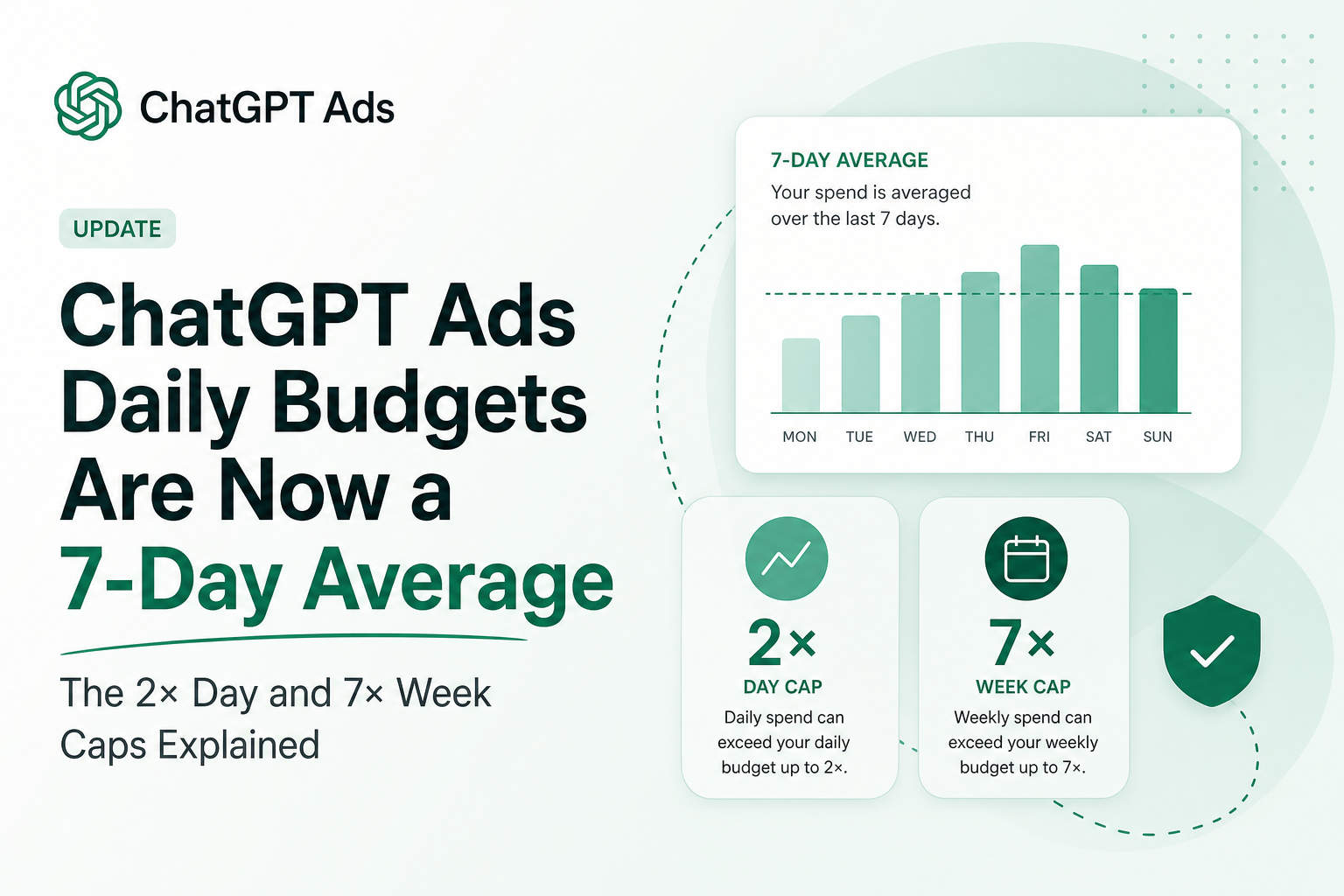
OpenAI has changed what a daily budget means in ChatGPT Ads. It is no longer a per-day ceiling. It is now an average over a seven-day period, with a hard cap at twice your daily budget on any single day and seven times your daily budget across the week.
If you run ChatGPT Ads, that is a real operational change with an immediate consequence: any alert, reconciliation script or client expectation built on "daily budget = the most it can spend today" is now wrong, and wrong by up to 100%.
We know the timing because we crawl OpenAI's ChatGPT Ads documentation every day. The Daily Budgets article (help.openai.com/en/articles/20001413-daily-budgets) appeared in our first capture on 2026-07-29 at 11:34 UTC carrying OpenAI's own "Updated: 3 hours ago" stamp — pinning the edit to roughly 08:34 UTC on 2026-07-29. Everything relevant has been stable since. This article reflects the official text as verified on 2026-07-31.
Everything in the "What OpenAI Actually Says" section below is OpenAI's published wording or a direct arithmetic consequence of it. Everything under "What This Changes In Practice" is our analysis and is labelled as such.
What OpenAI Actually Says
The official article is unusually direct, and opens by naming the change itself:
"Daily budgets will now represent the average amount you want to spend per day over a seven day period."
The two mechanical rules that follow are the whole story:
"Your maximum daily spend is twice your daily budget. If you change your daily budget during a day, the maximum daily spend for that day is based on the highest daily budget amount that was active at any point during that day."
"Your maximum seven-day spend is seven times your daily budget. If you change your daily budget partway through the week, your seven-day spending limit is prorated from the time of the latest budget change through the next Sunday at midnight."
And OpenAI's own worked example:
"If your campaign runs for 7 days with a $100 average daily budget, your total campaign media spend limit is $700. Your campaign may spend more than $100 on some days and less than $100 on others. Across the full 7-day campaign, billed media spend will not exceed $700."
On migration, the article is explicit that this is automatic:
"Existing campaigns will automatically use average daily budgets after this update. You do not need to recreate, pause, or edit your campaigns."
And on labelling — which matters, because it means the change is invisible in the interface unless you look for it:
"Ads Manager will continue to use the Daily budget label and will display the applicable spending limits during campaign creation."
The Arithmetic, At The Numbers You Actually Run
OpenAI's example uses $100 because it divides nicely. Here is the same arithmetic at the numbers advertisers actually use, including the platform minimum.
OpenAI's campaign guidance states: "The current minimum daily spend is $25 per campaign."
| Daily budget | Max single day (2×) | Max 7-day (7×) | What a naive daily-cap assumption underestimates by |
|---|---|---|---|
| $25 (minimum) | $50 | $175 | $25/day |
| $50 | $100 | $350 | $50/day |
| $100 (OpenAI's example) | $200 | $700 | $100/day |
| $250 | $500 | $1,750 | $250/day |
| $1,000 | $2,000 | $7,000 | $1,000/day |
The column on the right is the point. A single day's overshoot can equal your entire daily budget again. For one campaign at $250/day, that is an unbudgeted $250 appearing on a Tuesday — recovered later in the week, but not recovered that day, and not recovered before an automated alert fires.
Now multiply by campaign count. Five test campaigns at the $25 minimum look like a $125/day programme. Their true single-day exposure is $250, and their true weekly exposure is $875. Nothing is broken when that happens; it is the documented design. But it is not the number most people would have written on the plan.
The Mid-Week Rule Almost Nobody Will Read
The two proration rules are where this gets genuinely fiddly, and they behave differently from each other.
Within a day, the rule is high-water-mark. OpenAI's example:
"if your daily budget is set to $100 and you increase it to $110 later that day, your maximum daily spend for that day would be up to $220, which is twice the highest budget active that day."
So the ceiling for a day is set by the highest value that was ever live during it — not the value at midnight, not a time-weighted blend. A budget you raised at 4pm and lowered again at 5pm still governs the whole day's ceiling. Analysis: that makes intraday budget experimentation more expensive than it looks, and it means the safe direction to test is downward, since a temporary increase raises the day's ceiling permanently for that day.
Across the week, the rule is anchored to Sunday. OpenAI states the seven-day limit is "prorated from the time of the latest budget change through the next Sunday at midnight."
Analysis: read that carefully, because it is not a rolling seven-day window from the moment you changed the budget. It runs to the next Sunday at midnight. The practical consequence is that a budget change made on a Saturday governs a very short remaining window, while the same change made on a Monday governs almost a full week. If you make meaningful budget changes, making them early in the week gives the pacing system the most room to use the new number — and a Friday or Saturday change is being applied to a stub of a period.
Neither rule is unusual by the standards of mature ad platforms. Both are the kind of detail that only shows up when you are reconciling an invoice and cannot work out where a number came from.
OpenAI's Own Docs Currently Disagree
This is the finding we would most want to know as an advertiser, and it comes straight out of reading the full corpus rather than the one article.
The Daily Budgets article says:
"Your maximum daily spend is twice your daily budget."
The Billing and Payment article (help.openai.com/en/articles/20001216-billing-payment) still says:
"A daily budget sets the maximum you are willing to spend per day, while a campaign budget sets the maximum you are willing to spend across the campaign."
Both articles carried recent "Updated" stamps in our 2026-07-31 crawl — the billing article at roughly five hours before capture, the campaign-creation article at nine hours. So this is not a stale page nobody has touched; it is a page that was edited recently and still carries the pre-change wording on this specific sentence.
Analysis: treat the dedicated Daily Budgets article as authoritative — it is the more specific document, it is the one announcing the change, and its wording is internally consistent with the worked example and the FAQ beneath it. Expect the billing page to be corrected. But if you are quoting OpenAI documentation to a client or a finance team this week, quote the right article, because the other one will tell them something that is no longer true.
Related, and not a contradiction so much as an inconsistency worth noting: the campaign-creation article describes the objective choices as "CPM, CPC, and oCPC", while the billing article describes selecting "a Views objective to buy on a cost per thousand impressions basis (CPM)". Same mechanism, two vocabularies. Expect the naming to settle.
What This Changes In Practice
This section is Soku's analysis, not OpenAI's published guidance.
1. Your daily anomaly alerts need a new threshold. If you alert on "spend exceeded daily budget", that alert now fires as designed behaviour on any normal day where delivery ran hot. The meaningful alert is now at the seven-day level, or at 2× daily — because 1.4× daily is no longer an incident, it is Tuesday.
2. The seven-day total is the only real cap on the daily-budget option. OpenAI is explicit that billed media spend will not exceed 7× across the period. That is the number to put in a plan and the number to reconcile against. Daily figures are now a distribution, not a control.
3. If you need a hard ceiling, the budget type is the lever — and you only get to choose once. OpenAI describes the campaign-total budget as "the stricter control for total spend". But note the warning attached to it: "This is a total spending limit, not a pacing control. The budget isn't distributed evenly across campaign dates, and spend may accumulate quickly." So campaign-total buys you a firm total and gives up pacing entirely; daily budget buys you pacing with a 2×/7× band. Pick deliberately, because OpenAI states you cannot change the budget type after creation — only the amount. Getting it wrong means building a new campaign.
4. Weekly reporting cadence now matches the product's own cadence. A platform that paces over seven days and prorates to Sunday midnight is telling you what its natural reporting period is. Daily pacing reports on ChatGPT Ads will show variance that means nothing; week-over-week is where the signal is.
5. The minimum just got more expensive to test with. At $25/day minimum per campaign, a portfolio of small structured tests carries 2× single-day and 7× weekly exposure each. Multi-campaign test designs on ChatGPT Ads should be budgeted at the 7× figure per campaign, not the nominal daily figure.
What OpenAI Has Not Said
Worth being precise about the boundaries of the official text, because this is where speculation usually creeps in:
- No pacing algorithm detail. OpenAI says spend "may be higher or lower" and that it "can account for that in later pacing". It does not describe how delivery decides to run hot on a given day, and nothing in the text supports inferring one.
- No statement that the 7× limit is prorated for campaigns shorter than seven days. The article's example is a 7-day campaign. For a 3-day campaign the applicable limit is not spelled out beyond the general rules.
- No change to the payment threshold mechanics. These remain separate: OpenAI states plainly that "your payment threshold controls when your saved payment method is charged for accrued spend" and that it "is not the same as a campaign budget and is not an account spend cap." A 2× day may pull a threshold charge forward. It does not change what you owe.
- No stated interaction with the campaign-total budget option. The change is described for daily budgets.
Where OpenAI has not stated something, we have not filled it in.
The One-Paragraph Version
A ChatGPT Ads daily budget is now a seven-day average, not a daily ceiling. Any day can bill up to 2×; the week cannot exceed 7×. Existing campaigns migrated automatically and the field is still labelled "Daily budget", so nothing in the interface announces it. Budget type is fixed at creation, so if you need a genuine hard cap you needed to choose campaign-total — which explicitly does not pace. Move your alerting to the weekly total, make budget changes early in the week rather than late, and if you are quoting OpenAI's own docs this week, quote the Daily Budgets article rather than the billing page, because the two currently disagree.
Sources
All verified 2026-07-31:
- Daily Budgets — OpenAI Help Center
- Create Campaigns for ChatGPT — OpenAI Help Center
- Billing & Payment — OpenAI Help Center
- Edit Campaigns — OpenAI Help Center
Related Reading
- ChatGPT Ads: everything you need to know — the full platform overview.
- ChatGPT Ads measurement partners — Hightouch, LiveRamp and Triple Whale setup.
- ChatGPT Ads product feed campaigns — catalogue-driven campaigns.
- ChatGPT Ads vs Google Ads vs Meta Ads — where the budget behaves differently from what you are used to.