 Soku AI
Most bad Meta accounts are not badly optimised. They are badly shaped — too many ad sets, each too small to accumulate enough conversions to learn from, all bidding against each other for the same people. No amount of bid tuning fixes a structure problem, because the structure is what determines whether optimisation is possible at all.
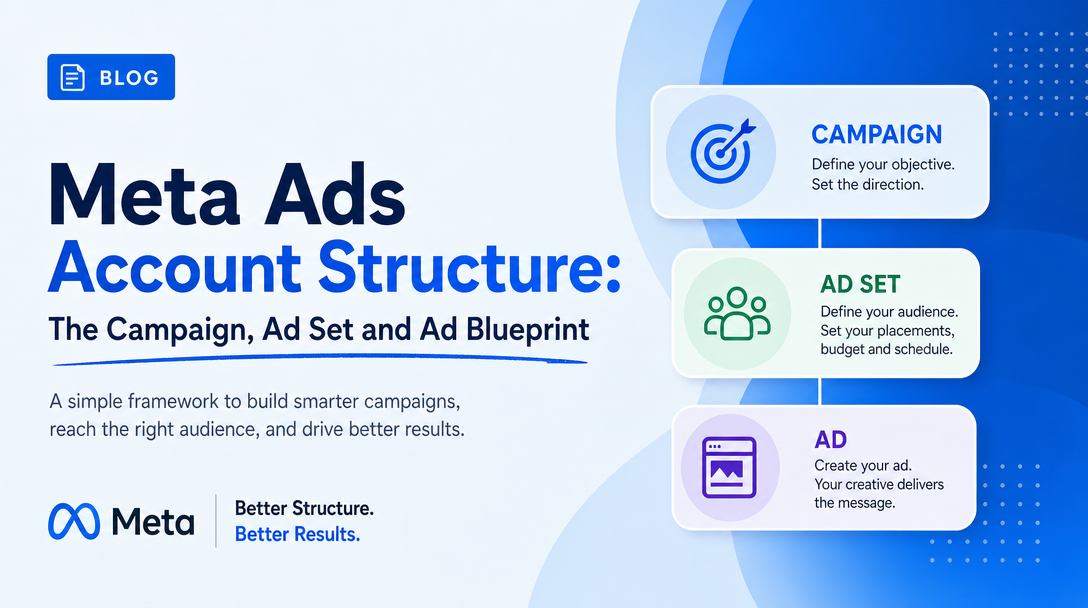
Meta has three levels, and getting the account right is mostly a matter of putting each decision at the level that owns it.
What each level actually controls
Campaign owns the objective and the buying-level budget option. The objective is the most consequential single choice in the account, because it determines which optimisation event Meta's delivery system pursues and — critically — which auctions you are even eligible for. It cannot be changed after creation. If the objective is wrong, the campaign is wrong, and the fix is a new campaign, not an edit.
Ad set owns audience, placements, schedule, budget (when not set at campaign level), optimisation event and bid strategy. This is the level where delivery decisions live, and therefore the level where structural mistakes are most expensive. The ad set is the unit of learning — Meta's delivery system optimises per ad set, and everything about how many ad sets you run follows from that one fact.
Ad owns the creative: the media, the copy, the destination, the call to action. This is where most of your performance variance actually comes from, and it is the level where you should be doing the overwhelming majority of your changing.
The organising principle falls out of this: make structural decisions at campaign and ad set level rarely and deliberately; make creative decisions at ad level constantly.
The consolidation rule, and the arithmetic behind it
The most repeated piece of Meta advice is "consolidate". It is correct, but it is usually given as a slogan rather than as arithmetic, which is why people apply it inconsistently.
The reasoning is this. Meta's delivery system needs a meaningful volume of the optimisation event within an ad set before its model can distinguish signal from noise — the widely cited working threshold is roughly 50 optimisation events per ad set per week, and while Meta's exact machinery is not public, the shape of the constraint is well established and directly observable in any account you run. Below that volume, delivery stays in an exploratory state, costs are higher and less stable, and the ad set never reaches its efficient range.
Now do the division. If your target cost per purchase is $40 and you want an ad set to clear 50 purchases a week, that ad set needs roughly $2,000 a week — about $285 a day. Which means:
Your total weekly budget ÷ (your target CPA × 50) = the maximum number of ad sets you can support.
At $5,000 a week and a $40 CPA, that is 5,000 ÷ 2,000 = 2.5 ad sets. Not eight. Not fifteen. Two, maybe three.
This is the single most useful calculation in this article, because it converts a philosophical argument about consolidation into a number specific to your account. Most over-fragmented accounts are not the result of a bad theory; they are the result of nobody having done this division.
Two consequences worth stating. First, if the arithmetic says one ad set, run one ad set — do not split for tidiness. Second, if you genuinely need more segments than your budget supports, the answer is to test them sequentially rather than concurrently, or to accept a higher optimisation event further up the funnel (add-to-cart rather than purchase) where volume is sufficient. That second option trades signal quality for signal quantity and is a real trade-off, not a free win.
Campaign budget versus ad set budget
Advantage campaign budget — budget set at campaign level and distributed across ad sets by the delivery system — is the right default, for the same reason consolidation is: it pools your volume. Meta shifts spend toward whichever ad set is finding results, so a campaign with one strong and one weak ad set behaves better than two separately budgeted ad sets, where the weak one keeps spending its allocation regardless.
Set budgets at ad set level only when you have a reason that overrides that, and there are exactly two good ones:
- A committed spend floor. A market, product line or partner obligation that must receive a specific amount regardless of performance.
- A protected test. A structured test where uneven distribution would invalidate the comparison — the delivery system reallocating budget mid-test is exactly what you are trying to prevent.
"I want more control" is not one of the two. Control at this level usually means overriding a system with more information than you have.
Where Advantage+ changes the answer
Advantage+ campaigns collapse much of the ad set layer: targeting, placements and to a large extent budget distribution move into the delivery system, and you supply creative, budget and a small number of constraints.
The honest framing is that Advantage+ is the consolidation argument taken to its endpoint. If the reason to consolidate is that the algorithm optimises better with more volume and fewer artificial partitions, then a structure with almost no partitions is the logical conclusion. That is why it works well for accounts with broad addressable audiences and enough creative variety to give the system something to choose between.
It works less well in two situations, and both are structural rather than tactical. If your addressable audience is genuinely narrow — a specific job title, a licensed profession, a small geography — removing targeting control removes the thing that was making delivery viable. And if you have very few creative assets, Advantage+ has nothing to explore with; it is a system for choosing among options, and it degrades when there are no options.
The practical pattern most accounts land on is a small number of Advantage+ campaigns carrying the bulk of prospecting spend, with a manual campaign alongside for the cases that genuinely need control — an excluded audience you must exclude, a market with a committed budget, a structured test. Do not run both against the same audience and then compare them; they will compete in the auction and the comparison will be meaningless.
Audience overlap: what it actually costs
The conventional warning is that overlapping audiences make you bid against yourself and inflate your own costs. That is directionally true but frequently overstated, and the overstatement causes real damage by pushing people toward exhaustive exclusion rules that fragment the account.
What is true: Meta's auction does not serve two of your ad sets to the same person in the same placement simultaneously, and there is de-duplication logic. What is also true: overlapping ad sets do split your conversion volume across ad sets, and that is the real cost. Not auction inflation — learning dilution. Two ad sets each getting 30 conversions a week both stay under the threshold; one ad set getting 60 clears it.
Which reframes the whole issue. The reason to avoid overlap is the same as the reason to consolidate, and it has the same fix. You do not need an elaborate exclusion matrix. You need fewer ad sets.
The one exclusion that always earns its place is funnel-stage separation: prospecting should exclude your existing customers and, usually, your recent site visitors. That exclusion is not about auction mechanics — it is about not spending prospecting budget re-acquiring people who are already yours, which shows up as suspiciously good prospecting CPAs that never translate into new customers.
A testing architecture that survives scaling
Structure and testing are the same problem, because a test is just a structure you intend to dismantle.
Test creative at the ad level, inside the ad set that is already working. This is where nearly all of your testing should happen, for two reasons: creative is the largest source of performance variance on Meta, and testing at ad level does not fragment your budget or reset ad-set learning. Add new ads to a proven ad set, let the delivery system allocate, and retire the losers.
Group ads by creative concept rather than by individual asset, so that your conclusions generalise. Three executions of a founder-story angle winning together is a finding you can act on; one video winning is an anecdote. Our campaign naming convention template covers encoding concept, format, ratio and version in the ad name so this grouping is actually possible in a report.
Test audiences at the ad set level, sparingly, and only when you can afford the volume. Use the arithmetic above. If a new audience cannot be given enough budget to clear the learning threshold, testing it concurrently will produce a result you cannot trust — and you will probably conclude the audience is bad when what was actually bad was the sample.
Test objectives by building a new campaign. Objectives cannot be edited, and a campaign optimising for a different event is a different animal. Run it alongside, not as a replacement, and compare on downstream business outcomes rather than on the optimisation event itself — a traffic campaign will always beat a conversion campaign on clicks and that tells you nothing.
Do not restart learning casually. Significant edits to an ad set — budget changes beyond a modest margin, audience changes, optimisation event changes — re-enter the learning phase and discard accumulated signal. Batch your changes: make several at once, deliberately, rather than nudging something every day. An account that is edited daily never leaves the learning phase, and its costs will be permanently worse than an account that is left alone.
The blueprint, assembled
For a typical direct-response account, this is the shape that follows from everything above:
Campaign 1 — Prospecting (conversions objective, campaign budget).
One or two ad sets maximum, sized by the learning arithmetic. Broad or Advantage+ audience. Excludes existing customers. Five to eight ads spanning three to four distinct creative concepts.
Campaign 2 — Retargeting (conversions objective, campaign budget).
One ad set covering engaged non-purchasers within a window appropriate to your consideration cycle. Excludes purchasers. Fewer ads, more offer-driven.
Campaign 3 — Retention or Advantage+ Catalogue, if applicable.
Existing customers, or dynamic product ads against your catalogue.
A structured test campaign, only while a test is running.
Torn down when the test concludes. Not a permanent fixture.
That is three or four campaigns and four to six ad sets for most accounts, which will feel sparse if you are used to a sprawling account. The sparseness is the point: every additional ad set divides your conversion volume, and volume is what the system optimises with.
For the Google Ads equivalent of this reasoning — where the boundaries fall differently because the auction and the match types work differently — see our Google Ads campaign structure guide. And if you are deciding what to report on top of this structure, the free PPC report template covers the cross-channel view.
Where to go next
- Google Ads campaign structure — the search-side companion to this blueprint.
- Campaign naming convention template — how to encode funnel stage and creative concept so structure is legible in reporting.
- Reach vs impressions vs frequency — the delivery metrics that tell you when an ad set is saturating.
- Free PPC report template — reporting across this structure and the others.
- Facebook Ads management software — tooling for accounts past the point of manual management.
FAQ
How many ad sets should a Meta campaign have?
As many as your budget can feed to roughly 50 optimisation events per week each, and no more. Divide your weekly budget by (target CPA × 50) to get the maximum. For most accounts that number is one to three, not eight.
Should I use campaign budget or ad set budget?
Campaign budget by default, because it pools volume and lets the delivery system move spend toward what is working. Use ad set budgets only for a committed spend floor or a structured test where reallocation would invalidate the comparison.
Does audience overlap really raise my costs?
The auction-inflation effect is smaller than commonly claimed. The real cost is learning dilution — overlapping ad sets split conversion volume so neither accumulates enough signal. The fix is fewer ad sets rather than more exclusions.
Should I exclude purchasers from prospecting?
Yes. That exclusion is about budget allocation rather than auction mechanics: prospecting that reaches existing customers produces flattering CPAs and few genuinely new customers.
When should I use Advantage+ instead of manual campaigns?
When your addressable audience is broad and you have enough distinct creative for the system to choose between. It works poorly with narrow audiences, where targeting control is what makes delivery viable, and with very few assets, where there is nothing to explore.
What triggers the learning phase to reset?
Significant ad set edits — meaningful budget changes, audience changes, optimisation event or bid strategy changes. Adding a new ad to an existing ad set generally does not. Batch structural changes rather than making them continuously.