 Soku AI
Most Facebook Ads checklists are a list of settings. Settings are not where campaigns fail. They fail because a pixel stopped firing three weeks ago, because an edit reset the learning phase on the only ad set that was working, or because nobody noticed that two ad sets were bidding against each other for the same people.
This checklist is organised by when the failure happens rather than by where the setting lives.
Last verified: 2026-08-18. Where this page states a Meta platform behaviour, it reflects Meta's published documentation as of that date; ad platform mechanics change, so re-verify anything load-bearing before relying on it.
Part 1 — Pre-launch (before any money moves)
Account and access
- [ ] Business Manager owns the assets, not a person. Pixel, pages, ad account and catalogue all owned by the Business Manager. The single most expensive Meta failure is a contractor leaving with the pixel attached to their personal profile.
- [ ] Two admins minimum. One admin is a single point of failure and Meta account recovery is slow.
- [ ] Payment method is a company card with headroom. A declined card pauses delivery, and restarting resets learning.
- [ ] Domain verified in Business Settings. Required for configuring Aggregated Event Measurement; unverified domains lose event priority control.
Offer and destination
- [ ] Landing page loads under 3 seconds on mobile 4G. Test on a real throttled connection, not desktop.
- [ ] The page repeats the ad's promise in its first screen. Message-match failure looks exactly like a targeting failure in the reporting, and it is far more common.
- [ ] The conversion actually works. Complete a real purchase or lead submission yourself, end to end, before launch.
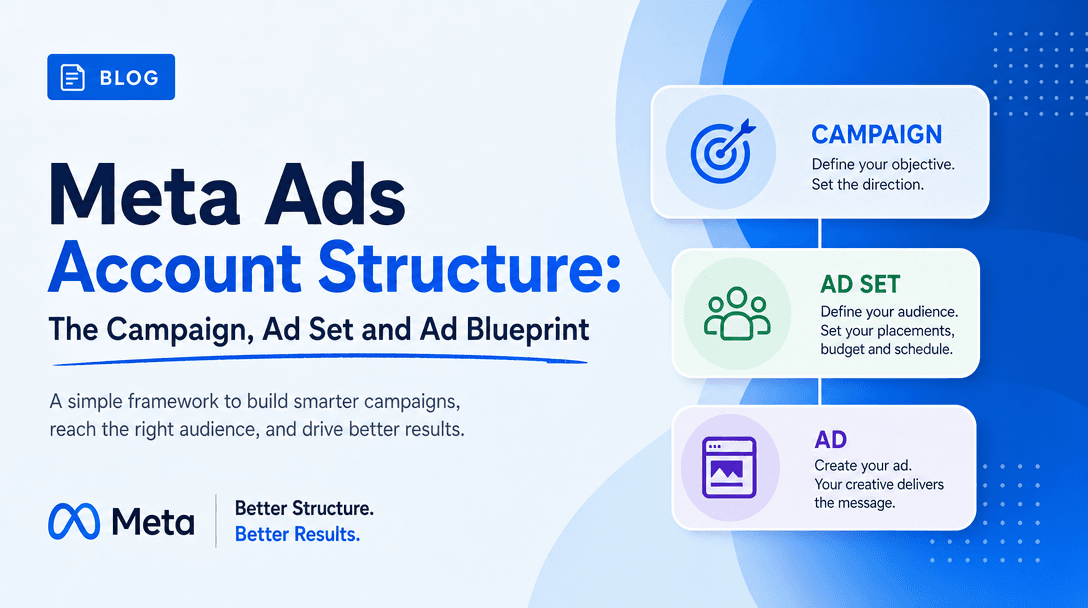
Structure
- [ ] One conversion event per ad set. Mixing optimisation events in one campaign splits signal.
- [ ] Audiences do not overlap materially. Use Meta's Audience Overlap tool. Two ad sets chasing the same people raise each other's costs — self-competition reads as "rising CPMs" in the report and is invisible unless you look for it.
- [ ] Budget is enough to exit the learning phase. Meta's published guidance is roughly 50 optimisation events per ad set per week. Work backwards: if your CPA is $40, an ad set needs about $2,000/week to learn on purchases. If it cannot, optimise for a higher-funnel event instead — this is the most common structural mistake in small accounts.
- [ ] Naming convention agreed and written down. See campaign naming convention. You cannot report on what you cannot parse.
Creative
- [ ] Correct sizes and safe zones per placement. See Facebook & Instagram ad sizes and safe zones.
- [ ] At least 3 genuinely different creative concepts — not three colours of one concept. Variation within a concept tests execution; you want to test the concept first.
- [ ] Vertical 9:16 exists for Stories and Reels. Auto-cropped 1:1 into Reels is the cheapest avoidable waste in paid social.
- [ ] First 3 seconds hold without sound. Captions burned in.
Part 2 — Tracking (the part that silently breaks)
This section deserves more attention than the rest of the checklist combined, because tracking failures do not announce themselves — they look like performance decline.
- [ ] Pixel fires on every key page. Verify with Meta Pixel Helper on the live site, not staging.
- [ ] Conversions API is live, not just planned. Browser-only tracking loses a material share of events to ad blockers and ITP.
- [ ] Deduplication is working. This is the check almost everyone skips. Pixel and CAPI must send the same
event_idfor the same event. Without it Meta counts the conversion twice, your reported ROAS is inflated, and you scale on a number that is not real. Verify in Events Manager that deduplication is being detected — not merely that both sources are sending. - [ ] Event match quality is acceptable. Check the score in Events Manager. Passing hashed email, phone, name and IP materially improves matching. Low match quality degrades both attribution and optimisation.
- [ ] Aggregated Event Measurement configured — eight events prioritised in the order that matters to you, on the verified domain.
- [ ] Attribution window is recorded somewhere. Default is 7-day click, 1-day view. Whatever you choose, write it down, because every future comparison depends on it and nobody remembers.
- [ ] UTMs on every ad, generated from one convention. Then confirm the traffic actually appears in GA4 under those parameters.
- [ ] View-through conversions understood before reporting. They are counted differently from click conversions and inflate apparent performance if reported together without saying so.
The recurring check that matters most: put a monthly reminder in a calendar to re-verify that the pixel and CAPI are still firing and still deduplicating. Tracking breaks during site deploys, and nobody tells the media team about site deploys.
Part 3 — Launch day
- [ ] Campaigns start paused, then go live deliberately. Never let a scheduling mistake launch overnight unattended.
- [ ] Check delivery within the first hour. Zero impressions after an hour usually means rejected ads, not slow ramp.
- [ ] Check ad review status explicitly. A rejected ad in an otherwise live ad set skews the whole ad set's early learning.
- [ ] Confirm the first conversion lands in Events Manager with correct value and currency. Currency mismatches are silent and corrupt every ROAS figure downstream.
- [ ] Screenshot the starting state. In two weeks you will want to know what you actually launched.
Part 4 — The weekly loop
Daily fiddling is the enemy. Meta needs stable signal; most accounts are edited far more often than they are analysed.
Weekly
- [ ] Frequency check. Rising frequency with falling CTR is creative fatigue, not an audience problem — the fix is new creative, not a new audience. See reach vs impressions vs frequency.
- [ ] Creative refresh queued before fatigue lands, not after.
- [ ] Check learning-phase status. Any ad set stuck in "Learning limited" is telling you its budget or event volume is too low for the optimisation event you chose.
- [ ] Do not edit winning ad sets. Budget changes above roughly 20%, audience edits and optimisation-event changes all restart learning. Duplicate to test instead of editing what works.
- [ ] Pacing check. Spend against plan. Over 110% or under 80% needs a reason.
- [ ] Placement breakdown. If Audience Network is consuming budget at poor quality, exclude it explicitly.
Monthly
- [ ] Re-verify tracking end to end (Part 2 again — this is the one that pays for itself).
- [ ] Audience overlap re-check. Overlap grows as audiences are added over time.
- [ ] Spend audit against authorisation. Every campaign spending money should map to something someone approved.
- [ ] Compare Meta-reported conversions against your source of truth — GA4, CRM, or the backend. A widening gap between platform-reported and actual is the earliest signal of a tracking or dedup regression.
- [ ] Cross-channel view. Meta does not know what Google spent on the same customer. See cross-channel marketing attribution and MER vs ROAS.
The five failures this checklist exists to catch
- Broken CAPI deduplication — inflated ROAS, scaling on a number that is not real. Caught in Part 2.
- Learning phase never completing — budget too low for the chosen event. Caught pre-launch and weekly.
- Self-competition between overlapping ad sets — reads as rising CPMs. Caught pre-launch and monthly.
- Creative fatigue mistaken for audience exhaustion — teams change targeting when they needed new creative. Caught weekly via frequency.
- A pixel that stopped firing during a site deploy — looks like a performance cliff. Caught monthly, and only if someone actually checks.
Frequently asked questions
What should I check before launching a Facebook ad campaign?
In order: that Business Manager owns the pixel and page, that the conversion path works end to end when you test it yourself, that the pixel and Conversions API are both firing and deduplicating, that ad sets have enough budget for roughly 50 optimisation events per week, and that audiences do not materially overlap.
How often should I check Facebook Ads?
Delivery daily in week one, then a structured weekly review. Avoid daily edits — budget and audience changes reset the learning phase and cost you more than the change gains.
Why are my Facebook ads not spending?
Usually ad rejection, an audience too narrow to deliver, a bid cap below market, a declined payment method, or a schedule that has not started. Check ad review status first — it is the most common cause and the easiest to miss.
How do I know if my Facebook pixel is working?
Meta Pixel Helper confirms firing. Events Manager confirms receipt. Neither confirms deduplication against CAPI — check that separately in Events Manager, because double-counted conversions inflate ROAS while everything appears healthy.
What is the Facebook Ads learning phase?
The period where Meta's delivery system gathers enough conversion data to optimise, generally around 50 optimisation events per ad set per week. Significant edits restart it, which is why editing a winning ad set is usually a mistake.