 Soku AI
"Ad fatigue" has become the default explanation for any campaign that was working and stopped. It is a comfortable diagnosis because the fix is obvious and feels productive: make new creative. It is also wrong often enough that the refresh cycle itself becomes the problem — teams burn their production capacity replacing ads that were never the cause of the decline, and the number keeps falling.
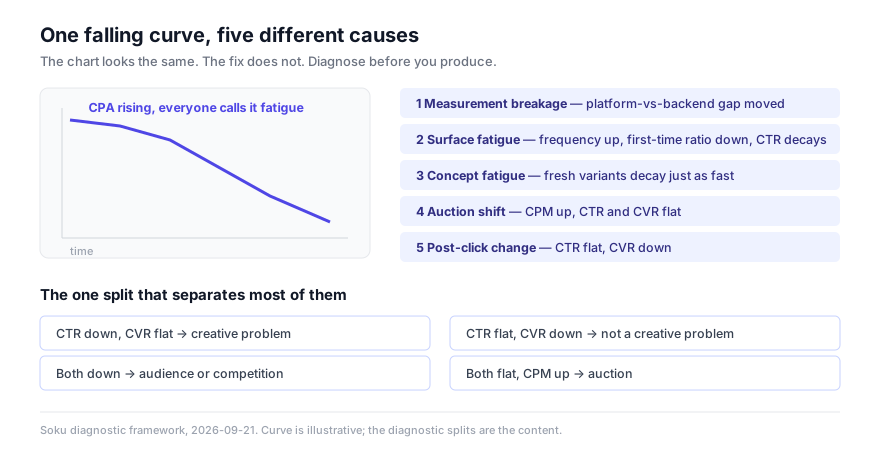
Ad fatigue is real. It is also only one of at least five things that produce an identically shaped chart. This article is the diagnostic sequence we use to tell them apart, and the fix that matches each.
If your conclusion is that you genuinely need more creative throughput, the tooling side of that is covered in best dynamic creative optimization tools — but read this first, because DCO applied to the wrong cause is an expensive way to change nothing.
The two fatigues people conflate
Before the diagnostics, one distinction does most of the work.
Surface fatigue is when the audience has seen this execution too many times. The concept still resonates; the specific image, hook or opening frame has gone stale. The fix is cheap: new variants of the same idea. New first frame, new hook line, new colourway, new testimonial.
Concept fatigue is when the audience has rejected the idea. The angle, the offer, the promise no longer persuades this audience — possibly because everyone who found it persuasive has already converted. The fix is expensive and is not a refresh: a new angle, a new offer, or a new audience.
Teams overwhelmingly diagnose surface fatigue and apply surface fixes, because those are cheap. When the fifth variant of the same concept also decays in ten days, that is the signal that it was concept fatigue all along.
The diagnostic sequence
Run these in order. Each step is cheap and each one eliminates a cause. Do not skip to step 5 because it is the fun one.
Step 1 — Check that the decline is real
Before diagnosing anything, confirm the number moved for a reason other than measurement.
Look for: a pixel or conversion API change, a consent-banner change, an attribution-window change, a site migration, a checkout change, an analytics tag that stopped firing, a platform-side reporting change. Compare the platform's reported conversions against your own backend orders for the same window. If the gap changed, your ads may be fine and your measurement is not.
This step catches more "fatigue" than anyone likes to admit, and it costs fifteen minutes.
Step 2 — Look at frequency, not at time
True surface fatigue is a function of exposures per person, not of days since launch. A creative running two weeks at frequency 1.4 is not fatigued; a creative running four days at frequency 6 might be.
Pull frequency for the affected ad set over the decline window. Then pull first-time impression ratio — the share of impressions going to people who have not seen the ad before. That second metric is the one that actually predicts fatigue, and almost nobody looks at it. When first-time impression ratio collapses, you are re-serving the same people, and performance will follow regardless of how good the creative is.
The signature of true frequency fatigue: frequency climbing, first-time impression ratio falling, CTR falling faster than CVR. If CTR is stable and CVR fell, the problem is after the click and creative refresh will not fix it.
Step 3 — Separate CTR decay from CVR decay
This is the single most diagnostic split available and it takes one report.
- CTR down, CVR flat → the ad stopped earning attention. Creative problem. Surface fatigue is likely.
- CTR flat, CVR down → the ad is still working; the landing page, offer, price, stock, checkout or audience quality changed. Creative refresh will do nothing.
- Both down → usually audience exhaustion or a competitive shift, not the creative.
- Both flat, CPM up → an auction problem, not a creative problem. See step 4.
We have watched teams spend a month producing new creative against a CVR-only decline caused by a competitor's price cut. The creative was never the variable.
Step 4 — Check the auction, not just your account
Rising CPMs with stable creative performance is a market event, not a fatigue event. Seasonality, a competitor entering your auction, a platform-wide demand spike (retail Q4, an election window, a major sale period) all raise the price of the same result.
Compare your CPM trend against your CPA trend. If CPM rose and CPA rose proportionally while CTR and CVR held, you did not get worse — you got more expensive. The fix is bid, budget and targeting strategy, or accepting a higher CPA, not new creative.
Step 5 — Only now, judge the creative
If measurement is intact, frequency is climbing, first-time impression ratio is falling, and CTR is decaying faster than CVR, you have a genuine creative fatigue problem. Now decide which kind.
Run a same-concept variant test: keep the angle, change the execution. New opening three seconds, new hook copy, new visual treatment, same promise.
- If the variant recovers most of the original performance, it was surface fatigue. Your fix is a variant cadence.
- If the variant decays at the same rate, it is concept fatigue. Your fix is a new angle or a new audience, and producing ten more variants of the same idea will waste a month.
The fixes, matched to cause
| Diagnosis | Signature | Fix | Roughly how long |
|---|---|---|---|
| Measurement breakage | Platform-vs-backend gap changed | Fix tracking; re-baseline | Days |
| Surface fatigue | Frequency up, first-time ratio down, CTR decaying | Variant cadence on the same concept | Continuous |
| Concept fatigue | Fresh variants decay as fast as the original | New angle, offer or audience | Weeks |
| Audience exhaustion | Reach plateaued, frequency up, both CTR and CVR down | Expand audience, new geo, new lookalike seed | Weeks |
| Auction shift | CPM up, CTR and CVR flat | Bid/budget strategy, or accept new CPA | Ongoing |
| Post-click change | CTR flat, CVR down | Landing page, price, stock, checkout | Days |
The prevention side: build a variant cadence, not a rescue habit
The teams that rarely talk about ad fatigue are not making better ads. They are making more of them, continuously, at a low cost per variant, so no single execution ever has to carry a quarter.
Three habits do most of it:
Version the hook, not the whole ad. The first three seconds carry the majority of the decline. A new opening frame on an existing edit is a fraction of the cost of a new production and captures most of the recovery.
Keep a live variant queue. Have the next two variants of the current winner already produced before the current one decays. Fatigue only becomes an emergency when production starts after the decline.
Retire on frequency, not on feeling. Set a frequency or first-time-impression-ratio threshold at which a creative rotates out automatically. Deciding by eye means deciding late.
Hold audiences fixed while you test creative. The most common way teams fool themselves is changing creative and targeting in the same week, then attributing the recovery to the creative.
Where Soku fits
The honest version of the fatigue problem for most teams is not diagnostic, it is capacity: they know they need a new variant every few days and they can produce one every few weeks. Soku is an ad-automation agent that generates ad creative and pushes variants into Google Ads and Meta Ads with approval gates, which is the production-cadence half of this problem. It will not tell you your concept is dead — that judgement is yours, and step 5 above is how you make it. But if the diagnosis comes back "surface fatigue, need a continuous variant cadence", that is a throughput problem and throughput is what we work on.
FAQ
What frequency counts as ad fatigue?
There is no universal threshold, which is why the frequency number alone is a weak diagnostic. Use it together with first-time impression ratio and the CTR-versus-CVR split. A high frequency against a large, still-growing reach is fine; a moderate frequency against a plateaued reach is not.
How often should I refresh creative?
Refresh on a signal, not a calendar. A calendar cadence retires winners early and keeps losers alive. That said, having the next variant produced on a calendar is exactly right — produce ahead, rotate on signal.
Does ad fatigue happen on search the same way?
Much less. Search ads are pulled by a query rather than pushed into a feed, so the same ad can serve for months without decay. Search declines are usually auction, query-mix or landing-page changes — steps 3 and 4, not step 5.
Will dynamic creative optimisation solve ad fatigue?
It extends surface life by varying the execution automatically, so it genuinely helps with surface fatigue. It does nothing for concept fatigue, because it recombines the idea you gave it. See best dynamic creative optimization tools.
Is a CPM increase ad fatigue?
Usually not. Rising CPM with flat CTR and CVR is an auction event. Rising CPM caused by falling relevance signals can be fatigue-adjacent, but check the engagement metrics before concluding it.