 Soku AI
Between our 2026-09-08 and 2026-09-09 documentation snapshots, OpenAI restructured the ChatGPT Ads billing article and published a new help-centre article, Budget Pacing, that did not exist in the previous day's capture. The change is small in word count and large in consequence: the campaign total budget, which the documentation previously mentioned in a single subordinate clause with no behaviour attached, is now a first-class, explicitly paced budget type with published pacing periods.
Last verified: 2026-09-09. Everything in the "what the documentation says" sections is quoted from official OpenAI pages, linked at the point of use. Everything under "what this means" is Soku editorial analysis and is labelled as such.
The change, in exact before-and-after wording
What the billing article said on 2026-09-08
One run-on paragraph. It named the two options, spent almost all its words on the daily budget, and disposed of the other in a subordinate clause:
"When you create a campaign, choose either a daily budget or a campaign budget. A daily budget is the average amount you want the campaign to spend per day over a seven day period... while a campaign budget sets the maximum you are willing to spend across the campaign. You can change the budget amount after creation, but you cannot change the budget type."
That is the entire published description of the campaign budget: a maximum. No pacing, no distribution, no schedule interaction. The only outbound link was to Daily Budgets.
What the same article says on 2026-09-09
Restructured into two named, parallel budget types — and note the second bullet, which is new behaviour, not new phrasing:
"- Daily budget: The average amount you want the campaign to spend per day over a seven-day period... billed media spend may be up to twice your selected daily budget on an individual day, but will not exceed seven times your daily budget over the applicable seven-day period...
- Campaign total budget: The maximum amount you are willing to spend across the campaign. Ads Manager paces spending over time based on your remaining budget and campaign schedule."
And a new sentence pointing at a new document:
"For how Ads Manager spreads spending over time for daily and campaign total budgets, see Budget Pacing."
The delta is the pacing clause. A budget type documented as a ceiling is now documented as a ceiling plus a delivery behaviour. The name also settled: "campaign budget" became "campaign total budget" throughout.
The new Budget Pacing article
Budget Pacing was not referenced anywhere in our 2026-09-08 snapshot and is referenced in the 2026-09-09 one. Its opening frames pacing as a general mechanism:
"Budget pacing helps spread your campaign's spending over time. As ad traffic and delivery opportunities change, Ads Manager adjusts delivery to help keep budget available for opportunities later in the day or campaign."
With an immediate limit, stated before any mechanics:
"Your spending may vary from day to day. Pacing does not guarantee equal spending or that your campaign will spend its full budget."
On campaign total budgets specifically:
"For campaigns with campaign total budgets, Ads Manager uses your remaining budget and campaign schedule to guide spending over time. If your campaign is spending ahead of pace, delivery may slow to preserve budget for later. If it is behind pace, delivery can continue so it has an opportunity to catch up. This helps reduce unexpected early budget exhaustion, though actual spending still depends on available delivery opportunities."
The two numbers worth writing down
This is the part that is genuinely new information rather than restated policy. From the Budget Pacing FAQ:
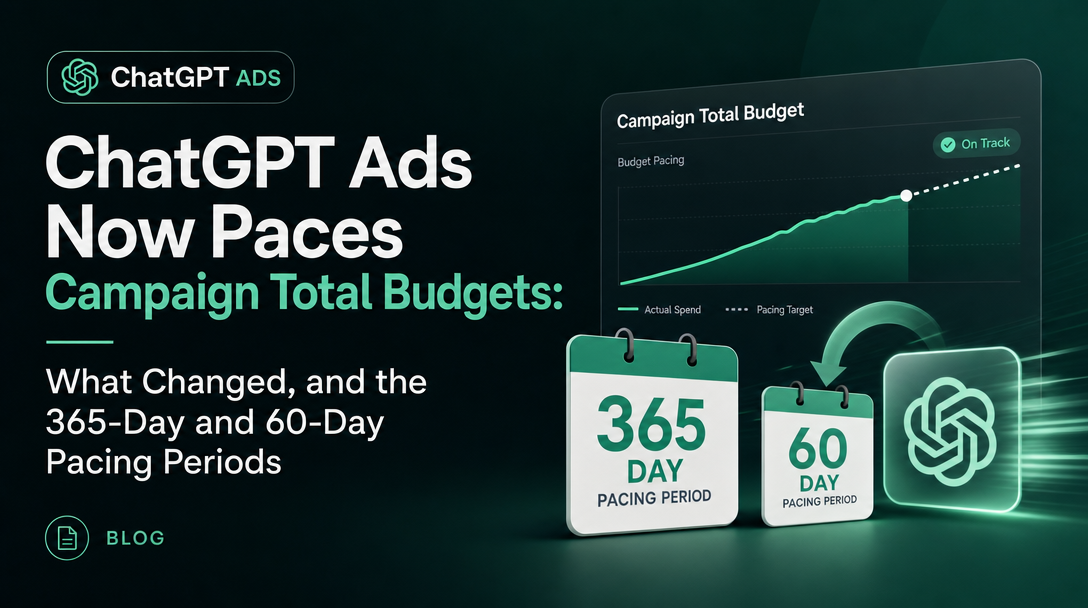
"For campaigns with an end date, Ads Manager uses the time until your campaign's end date, up to a maximum pacing period of 365 calendar days. Campaigns without an end date use a default 60-day pacing period."
| Campaign configuration | Pacing period used |
|---|---|
| Has an end date | Time until the end date, capped at 365 calendar days |
| No end date | 60 days, by default |
Soku analysis. The 60-day default is the operationally important one, and it is easy to misread. An always-on campaign with a campaign total budget and no end date is not paced "indefinitely" or "until the money runs out" — it is paced against an assumed 60-day horizon. If you loaded a budget intending it to last a quarter, the pacing model is working to a materially shorter schedule than your plan, and OpenAI's own recommendation is the fix:
"We recommend setting an end date to help align pacing with your intended campaign duration."
The 365-day cap matters at the other extreme: a campaign with an 18-month end date is still paced as though it had roughly a year, so the final months fall outside the pacing horizon entirely.
What OpenAI explicitly does not promise
The article is unusually disciplined about its own limits, and these caveats do more work than the mechanics:
- Pacing is not a guarantee of even spend. "Pacing does not guarantee equal spending or that your campaign will spend its full budget."
- An end date is a ceiling, not a commitment. From the FAQ, on whether a campaign total budget lasts until the end date: "Not necessarily. Your end date is the latest date your campaign can deliver, but your budget may be fully spent earlier."
- Pacing is bounded by supply. "Actual spending still depends on available delivery opportunities" — pacing can slow delivery but cannot manufacture inventory.
- Changing the budget re-plans, and cannot un-spend. "Ads Manager recalculates pacing using your updated budget or schedule. Your revised campaign total budget must cover the amount already spent."
Soku analysis. That last rule is the one that will surprise people mid-flight. A campaign total budget is not a dial you can turn down freely: you can lower it, but not below what the campaign has already spent. If you are running a campaign total budget and want the option to cut spend hard later, that option is bounded by your own delivery to date — and the daily budget, with its 2× day and 7× week band, remains the more responsive instrument.
What this changes in practice
1. The budget-type decision got harder, and it is still one-way. Both the old and new text say the same thing: "You can change the budget amount after creation, but you cannot change the budget type." Previously the trade-off was legible — daily budget for pacing, campaign total for a hard ceiling with no pacing. Now both types are paced, so the choice turns on the shape of the control rather than its presence: a rolling seven-day average with explicit 2×/7× bounds, versus a fixed total paced against a schedule with a 365-day cap and a 60-day default. Choose deliberately; getting it wrong still means building a new campaign.
2. If you run always-on campaign total budgets, set an end date. This is the single highest-value action from this change. Without one you are accepting a 60-day pacing assumption that you did not choose and that is invisible in the campaign UI.
3. Early exhaustion becomes a less likely failure mode — but do not plan around it. "Helps reduce unexpected early budget exhaustion" is a hedge, and the "may be fully spent earlier" FAQ answer contradicts any reading of pacing as a guarantee. Keep monitoring burn rate.
4. Re-read anything you wrote about campaign total budgets before 2026-09-09. Guidance written against the older documentation — including our own earlier note that a campaign total budget "buys you a firm total and gives up pacing entirely" — describes a state the documentation no longer asserts. Our piece on the daily budget seven-day average and the 2× / 7× caps remains accurate for daily budgets, which are unchanged by this update; the campaign-total half of that comparison is what moved.
Also changed this week: DMA is now "Market" in the ads API docs
Reported separately because it is a different surface with a different implication. Across four developer-documentation pages — api-overview, campaigns, campaign-targeting and the llms.txt index — OpenAI renamed the geo-targeting concept DMA to Market, and relabelled the location table's "Type" column to "Category".
The critical detail, which the documentation states plainly and which prevents this from being a cosmetic rename:
"The API returns
dmaas thetypevalue for Market locations."
Soku analysis. The label changed; the wire format did not. If you have code matching on the string dma, it keeps working, and you should not "update" it to market. This is a documentation-vocabulary change, not an API-contract change — and those are exactly the pairs that cause avoidable breakage when a team reads the changelog and refactors on the strength of it. The same page now also directs you to /geo_lookup/search to find locations currently available for targeting.
Source discipline for this piece
Three sources feed this analysis, and they are weighted differently:
- The help centre (billing and payment, Budget Pacing, Daily Budgets) — the source for everything stated as fact above.
- The developer documentation — the source for the DMA-to-Market rename and for the
dmawire-value note. - The OpenAI advertiser product-update email — no new email arrived in this window. The most recent "ChatGPT Ads Product Updates" message is dated 2026-09-03, outside the rolling window for this change. Nothing in this article rests on an email, and no announced-but-undocumented capability is claimed.
Where the two documentation surfaces could have disagreed, they did not: the budget change is help-centre only, and the naming change is developer-docs only. Neither contradicts the other.
The one-paragraph version
The ChatGPT Ads campaign total budget is now a paced budget type, not just a spending ceiling. Ads Manager slows delivery when a campaign runs ahead of schedule and lets it catch up when behind, using the time to your end date up to a 365-day maximum, or a 60-day default if you have not set one. Pacing guarantees neither even spend nor full spend, a lowered budget must still cover what you have already spent, and the budget type remains unchangeable after creation. If you run campaign total budgets without an end date, set one — otherwise you are being paced against a two-month assumption you never made.
Sources
- Billing & Payment — ChatGPT Ads (help centre; budget types, verified 2026-09-09)
- Budget Pacing (help centre; new article, verified 2026-09-09)
- Daily Budgets (help centre)
- Campaign Targeting (developer docs; Market rename and
dmatype value) - Ads API overview and Campaigns API reference (developer docs)
Related reading
- ChatGPT Ads daily budgets are now a seven-day average — the 2× day and 7× week caps, unchanged by this update
- Unspent ChatGPT Ads budget and rollover
- ChatGPT Ads minimum budgets by country
- Everything you need to know about ChatGPT Ads