 Soku AI
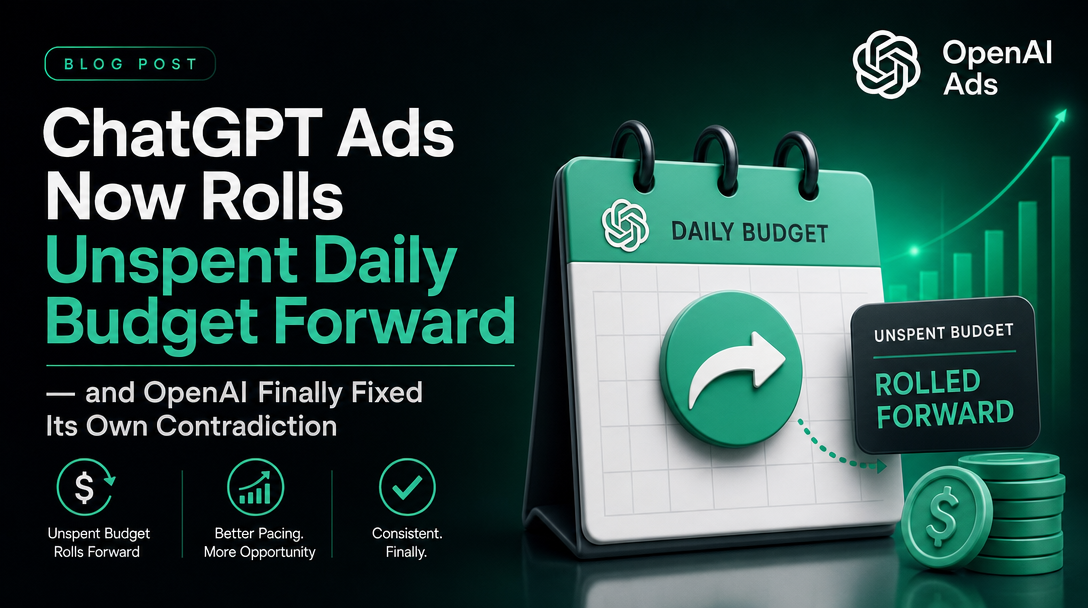
OpenAI updated two ChatGPT Ads help articles on 2026-08-25, and between them they add a mechanic that neither page carried before: unspent daily budget can now be spent later in the same seven-day period.
The same edit quietly resolved a documentation contradiction that had been live since late July — one we flagged at the time and predicted would be fixed on the billing side rather than the budgets side. It was.
This page covers what changed, in OpenAI's own words, and the operational consequence that matters most: an underdelivering ChatGPT Ads campaign is no longer a saving. It is a deferred liability.
All quotations below are from OpenAI's official help centre, captured 2026-08-25. Sources are linked at the end.
What changed today
1. Unused budget is now explicitly recoverable within the week
The Daily Budgets article's opening paragraph gained a sentence. Previously:
"A daily budget is the average amount you want your campaign to spend per day over a seven day period. Daily spend may be higher or lower than your selected budget on individual days. This helps ChatGPT Ads account for normal day-to-day changes in delivery while continuing to pace toward the campaign's overall budget."
As of 2026-08-25:
"A daily budget is the average amount you want your campaign to spend per day over a seven day period. Daily spend may be higher or lower than your selected budget on individual days. If delivery is below your daily budget on some days, unused amounts may be used later in the same seven day period. This helps ChatGPT Ads account for normal day-to-day changes in delivery while continuing to pace toward the applicable seven day spending limit."
Two things moved. The rollover sentence is new. And the closing phrase changed from "the campaign's overall budget" to "the applicable seven day spending limit" — a tighter, more literal anchor.
The article's What is changing section was rewritten symmetrically. The old text described only the overspend direction:
"This means daily spend may be higher or lower than your daily budget amount on individual days. If a campaign spends more on some days, ChatGPT Ads can account for that in later pacing so the campaign continues to pace toward its overall budget."
The new text describes both directions, and puts underspend first:
"This means daily spend may be higher or lower than your daily budget amount on individual days. If a campaign spends less on some days, the unused amount may be used later in the same seven day period. If it spends more on some days, ChatGPT Ads accounts for that when pacing delivery during the remainder of the period."
2. The rollout is described as complete, not pending
A small but load-bearing edit. The old line:
"Daily budgets will now represent the average amount you want to spend per day over a seven day period."
The new line:
"Daily budgets represent the average amount you want to spend per day over a seven day period."
Future tense to present tense. OpenAI is no longer describing average pacing as a change being introduced; it describes it as how daily budgets work. If you have been treating average pacing as a pending migration, stop — it is the current default.
3. The Billing article was corrected to match
This is the part worth dwelling on, because until today OpenAI's own documentation gave two incompatible answers to "is my daily budget a daily cap?"
The Billing and Payment article previously said:
"Your campaign budget controls the maximum amount you are willing to spend for a campaign. When you create a campaign, choose either a daily budget or a campaign budget. A daily budget sets the maximum you are willing to spend per day, while a campaign budget sets the maximum you are willing to spend across the campaign."
That was flatly inconsistent with the Daily Budgets article, which has said since late July that maximum daily spend is twice your daily budget. When we documented this change on 2026-07-31, we called the contradiction out and advised treating the dedicated Daily Budgets article as authoritative, on the expectation that the billing page wording was simply stale.
As of 2026-08-25 the Billing article reads:
"Your campaign budget controls the spending parameters for your campaign. When you create a campaign, choose either a daily budget or a campaign budget. A daily budget is the average amount you want the campaign to spend per day over a seven day period. It is not a same-day spending limit: billed media spend may be up to twice your selected daily budget on an individual day, but will not exceed seven times your daily budget over the applicable seven day period. If delivery is below your daily budget on some days, unused amounts may be used later in the same seven day period, while a campaign budget sets the maximum you are willing to spend across the campaign."
It now also links across to the Daily Budgets article. The contradiction is resolved, and it was resolved in the direction the mechanics implied: the billing page was wrong, not the budgets page.
Why this matters beyond tidiness. Billing pages are what finance teams read. For roughly four weeks, an advertiser who checked the billing documentation to answer "what is the most this campaign can bill me tomorrow?" got an answer that understated the real ceiling by a factor of two.
4. Post-pause reconciliation gained a bound
The previous line was one clause:
"Reporting and charges may also update after a pause to reflect earlier ad activity."
It is now:
"Reporting and charges may also update after a pause or campaign end to reflect earlier ad activity. Reported spend may therefore change after delivery stops, but will not exceed the applicable budget limit."
Two additions: campaign end is now explicitly included alongside pause, and — more usefully — OpenAI now states an upper bound on post-hoc revision. Restated spend stays inside the budget limit. Previously the sentence described an open-ended possibility of numbers moving after the fact with nothing capping it.
This sits alongside the existing, unchanged warning that ads may keep serving for up to 24 hours after a pause and that spend in that window remains billable.
What this actually changes operationally
Underdelivery is now a deferred liability, not a saving
This is the practical headline, and it inverts an instinct most media buyers have.
Under a true daily cap, a campaign that spends $60 against a $100 daily budget has saved you $40. That money is gone from the plan; the ceiling resets tomorrow.
Under the documented behaviour, that $40 is not saved. It is headroom that may be used later in the same seven-day period. Your weekly exposure is unchanged — it has simply been pushed to the right.
Work the arithmetic on a $100 daily budget:
| Scenario | Days 1–3 spend | Remaining weekly headroom | Max any single later day |
|---|---|---|---|
| On pace | $300 | $400 | $200 |
| Underdelivering | $150 | $550 | $200 |
The seven-day ceiling stays at $700 either way. The underdelivering campaign has $550 of runway across its last four days rather than $400, and any one of those days can still bill up to $200. A quiet Monday and Tuesday do not make Thursday safer.
The failure mode to watch for: a campaign that underdelivers early in the week because targeting is too narrow, then finds delivery once something loosens — an audience expands, a competitor pauses, a creative is approved. It can now spend into accumulated headroom at up to 2x daily. If your alerting fires on daily spend against the daily budget, it will fire late and look like an anomaly, when it is documented behaviour.
Your reconciliation window is longer than your campaign
Between the up-to-24-hour post-pause delivery tail and the explicit statement that charges may update after campaign end, a ChatGPT Ads campaign's final number is not final on the day you stop it.
The practical rule: do not close out a ChatGPT Ads campaign's spend on the day it ends. Let it settle. The new bound at least tells you where the settling stops — at the applicable budget limit — which is enough to reserve against.
What to do this week
- Re-anchor every alert to the seven-day figure. A daily-budget threshold is not a meaningful trigger any more; it is exceeded by design. Alert on seven-day spend against 7x, and on a single day exceeding 2x.
- Stop reading underdelivery as underspend. Midweek pacing reports showing a campaign at 60% of daily budget are not showing you money saved. Re-forecast the rest of the week at the seven-day ceiling.
- Reserve for post-end revision. Hold a ChatGPT Ads campaign's final invoice open until reported spend stops moving.
- Use campaign-total budgets when you need a hard cap. This is unchanged and now more clearly the distinction that matters. The average-daily mechanic applies to the daily budget option. If a client contract has a genuine not-to-exceed number, the campaign-total budget is the control that maps to it — bearing in mind OpenAI's existing warning that it is a total spending limit and not a pacing control. Budget type still cannot be changed after creation; only the amount can.
What OpenAI did not say
Being precise about the limits of today's text, because the gaps are where bad assumptions form:
- The seven-day window's boundaries are not restated in today's edit. The Daily Budgets article's existing proration guidance anchors the weekly window to Sunday at midnight when a budget changes mid-week. Today's rollover sentence says "the same seven day period" without redefining that period. Do not assume the window is a rolling seven days from the day you underdelivered.
- There is no stated rollover across periods. Unused budget is described as usable "later in the same seven day period." Nothing says leftover headroom survives into the next one, and you should not plan as if it does.
- No change to the 2x and 7x limits themselves. Those numbers are unchanged; today's edit propagates them into the billing article and adds the underspend direction.
- No new guidance on how catch-up is paced. OpenAI says unused amounts "may be used" later — permissive, not a commitment, and with no description of how aggressively the system recovers. Treat catch-up as possible, not scheduled.
Source documents
Both captured 2026-08-25, both showing an Updated: 2 hours ago timestamp at capture:
- Daily Budgets — OpenAI Help Center
- Billing and Payment — OpenAI Help Center
Related Soku coverage:
- ChatGPT Ads Daily Budgets Are Now a 7-Day Average: The 2x Day and 7x Week Caps Explained — the 2026-07-31 change that introduced average pacing
- ChatGPT Ads Minimum Budgets by Country
- ChatGPT Ads Maximize Results Bid Strategy
Verified against OpenAI's official documentation on 2026-08-25. Quoted text is OpenAI's; the pacing arithmetic, the deferred-liability framing and the operational recommendations are Soku analysis. ChatGPT Ads documentation is changing weekly — re-check the source articles before acting on a number.