 Soku AI
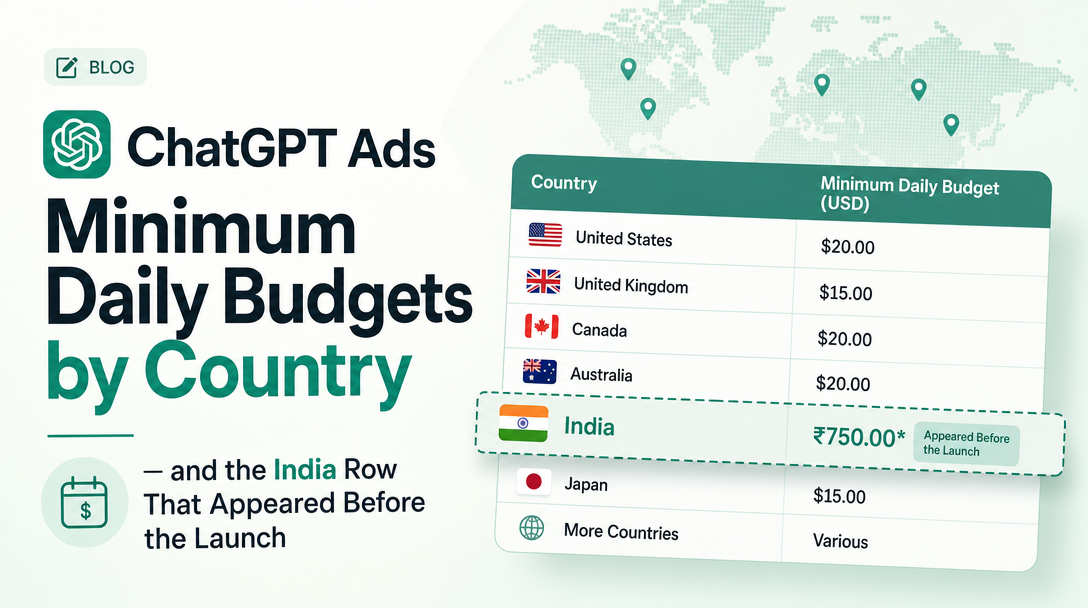
Between 18 and 19 August 2026, OpenAI added a row to the Minimum Campaign Spend table in its ChatGPT Ads campaign-creation documentation. The new row reads India — 725 INR.
India is not listed in OpenAI's Ads Manager Availability article, which still shows nine countries and does not mention India at all.
Both statements are true right now, and the gap between them is the interesting part. This page documents every published country minimum as of today, sets out precisely what the two official documents say, and explains why the budget table — not the availability table — has been the earlier indicator of where ChatGPT Ads is going next.
Every published minimum daily budget
From OpenAI's Create Campaigns for ChatGPT Ads article, Minimum Campaign Spend section, captured 2026-08-19:
| Country | Daily minimum |
|---|---|
| Australia | 25 AUD |
| Brazil | 40 BRL |
| Canada | 25 CAD |
| Czechia | 350 CZK |
| Denmark | 110 DKK |
| Europe (EUR) | 15 EUR |
| India | 725 INR |
| Japan | 2,500 JPY |
| Mexico | 150 MXN |
| New Zealand | 25 NZD |
| Norway | 160 NOK |
| Poland | 65 PLN |
| South Korea | 25,000 KRW |
| Sweden | 175 SEK |
| Switzerland | 20 CHF |
| United Kingdom | 15 GBP |
| United States | 25 USD |
The same article explains what the number governs: a daily budget is "a delivery target, so actual spend may fluctuate above or below the selected amount on an individual day," and "the current minimum daily budget varies by your ad account's billing currency." The minimum is tied to the billing currency of the ad account, not to the country you are targeting — a distinction that matters if you run a multi-market campaign from a single account.
The previous day's capture of the same article, 2026-08-18, contained nine rows. India was the only addition.
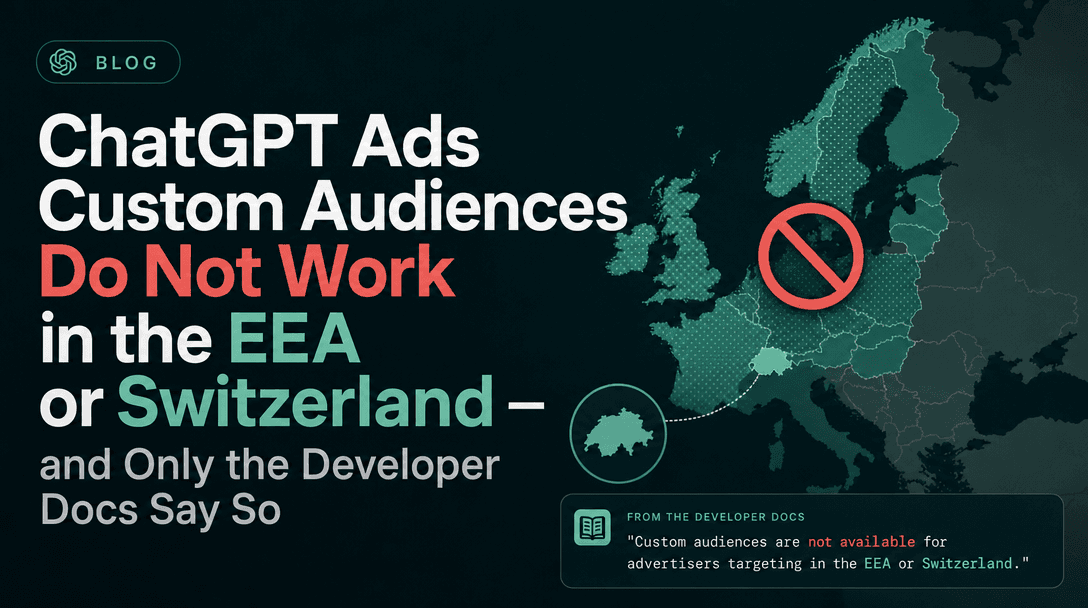
Update, 2026-09-04. The table has since grown to 17 rows. OpenAI added Czechia (350 CZK), Denmark (110 DKK), Europe (15 EUR), Norway (160 NOK), Poland (65 PLN), Sweden (175 SEK) and Switzerland (20 CHF), and the Ads Manager availability article now lists all 30 EEA member states plus Switzerland as self-service Available — so in Europe the budget table and the availability table have converged rather than disagreed. One capability has not followed: custom audiences remain unsupported for campaigns targeting the EEA or Switzerland, a restriction stated only in the developer documentation. We cover that in ChatGPT Ads custom audiences do not work in the EEA or Switzerland. Rows above are marked as verified on the date shown; the seven new rows were verified 2026-09-04.
Update, 2026-09-07. Two changes, and the first one settles an argument this article has been making since August. OpenAI re-keyed the table from country to billing currency. The header that read
| Country | Daily Minimum |now reads| Billing currency | Minimum daily budget |, and the rows that read "Australia", "Brazil", "United States" now readAUD,BRL,USD. Nothing about the amounts moved. The documentation has simply been brought into line with what the prose already said — that the minimum is tied to the ad account's billing currency, not to the market you target. If you run several markets from one account, this is now unambiguous on the face of the table.Four currencies were added: AED 70, HUF 5,500, QAR 70 and RON 80. That takes the table to 21 rows. The pattern from August holds — the budget table moves before the availability article does, and the new entries point at the United Arab Emirates, Hungary, Qatar and Romania. It also corroborates OpenAI's advertiser product-update email of 2026-09-03, which announced ChatGPT Ads rolling out "to select countries in Europe, India, the Middle East, and North Africa"; the email named no countries, and the currency table is the first documented place those markets appear.
Separately, the Ads Manager Availability article gained a note that did not exist before: "To use self-service Ads Manager, the legal entity that will advertise and be billed must be based in a country listed as available below." That is a materially new constraint and it is easy to miss. It is not about who you target or where your customers are — it is about where the billing entity is incorporated. An agency in an unlisted country cannot open a self-service account to run ads into a listed one. Verified 2026-09-07.
What the availability article says
Ads Manager Availability is the document OpenAI points advertisers to for country access. As captured on 2026-08-19 it was last updated six days earlier and lists:
Australia, Brazil, Canada, Japan, Korea, Mexico, New Zealand, United Kingdom, United States — every one marked Available.
Two details are worth noting precisely. First, India does not appear. Second, the article's own framing promises more than the table delivers: it says the table "shows where Ads Manager is currently available and where access is coming soon," but every row in it reads Available. There is no coming-soon row. So the document that would naturally announce a pending market has no mechanism in it, as published, for doing so.
For advertisers outside the listed countries, the article directs readers to register interest through the OpenAI Advertisers form.
The disagreement, stated plainly
- The campaign-creation article now prices a daily minimum in Indian rupees.
- The availability article does not list India as a country where Ads Manager is available.
- The developer documentation — all 21 Ads pages on developers.openai.com, including the campaigns and targeting references — was unchanged in this window and does not mention India or INR anywhere.
We are not going to resolve that for you by picking the more convenient reading. Both are current official text. What we can say is what each one does and does not establish:
What is established: OpenAI has published a specific minimum daily budget for INR-denominated ad accounts. That is a concrete, operational number, and setting one requires decisions — currency support, billing, a pricing floor calibrated to the market — that are not made speculatively.
What is not established: that ChatGPT Ads is available to advertisers in India today. No official document says that. If you are in India, the availability article's answer remains the interest form.
Anyone telling you this week that "ChatGPT Ads has launched in India" is reading a budget table as an announcement. It is not one.
Why the budget table is the earlier signal
There is a structural reason the ordering runs this way, and it is worth understanding because it makes the pattern predictive rather than coincidental.
A minimum daily budget is a billing-system fact. Before an advertiser in a new market can spend a rupee, the platform needs the currency configured, a floor set that is defensible against fraud and delivery economics, and the campaign-creation flow able to validate against it. That work lands in the campaign documentation because it is documentation of the form, and the form has to be correct before anyone can use it.
Availability, by contrast, is a commercial announcement. It gets published when the market opens, not when the plumbing is ready.
So the budget row is what the engineering looks like from outside, and the availability row is what the launch looks like. The first has now appeared for India. The second has not.
This is also consistent with how this documentation set has behaved before. Through 2026, capability changes have repeatedly surfaced in one official surface days before another caught up — the developer docs carried the open beta for product-feed conversion bidding before the help centre did, and the help centre has carried billing and budget mechanics that the developer docs never described. Treating any single surface as the whole truth has been wrong more often than right.
What ₹725 implies about how OpenAI is pricing the market
Convert the published minimums roughly into US dollars and a structure appears. At prevailing 2026 exchange rates, ₹725 is somewhere in the region of eight to nine US dollars — well under half the $25 United States minimum, and in the same band as Brazil's 40 BRL and Mexico's 150 MXN, which also land in the high single digits.
That grouping is unlikely to be accidental. The mature-market minimums cluster at roughly $15–25 equivalent — $25 in the US, Canada, Australia and New Zealand, £15 in the UK, ¥2,500 in Japan, ₩25,000 in Korea. The emerging-market minimums sit at roughly a third of that. India has been slotted into the second group.
For an advertiser, the practical read is that the entry cost to test the channel in India, when it opens, is designed to be low — ₹725/day is roughly ₹22,000 a month, a genuinely accessible test budget. The strategic read is that OpenAI is pricing for volume of advertisers in that market rather than for a premium tier.
A caution on the arithmetic: those dollar figures are approximate and move with the exchange rate. OpenAI publishes the minimums in local currency only, and the minimum applies to your ad account's billing currency. Do not budget off a converted number.
What to do about it
If you advertise in India: nothing has opened yet. Register through the advertisers interest form so you are in the queue, and plan on a ₹725/day floor per campaign when it does. If you already have a global account billed in another currency, note that the minimum follows the billing currency — an INR minimum is only relevant to an INR-denominated account.
If you run multi-market campaigns: re-read your account's billing currency before assuming which floor applies to you. This is the detail most likely to cause a surprise, because the intuition — that the minimum follows the country you target — is wrong.
If you are tracking the channel: watch the availability article rather than the budget table for the actual launch. And keep watching both, because they are not in sync.
Sources
All statements above are drawn from official OpenAI documentation captured on 2026-08-19:
- Create Campaigns for ChatGPT Ads — Minimum Campaign Spend table, budget mechanics, billing-currency rule
- Ads Manager Availability — country availability table
- Daily Budgets — how daily budgets pace over a seven-day period
- OpenAI Advertisers interest form
Analysis of what the change implies, the mature-versus-emerging pricing bands, and the documentation-ordering argument is Soku editorial interpretation, clearly separated above from the official text it rests on. No OpenAI advertiser product-update email was issued in this window; the most recent was 2026-08-05, and it did not mention India.
Facts verified 2026-08-19 against the official documents linked above. Documentation on this platform changes frequently — check the source articles before acting on anything time-sensitive.