 Soku AI
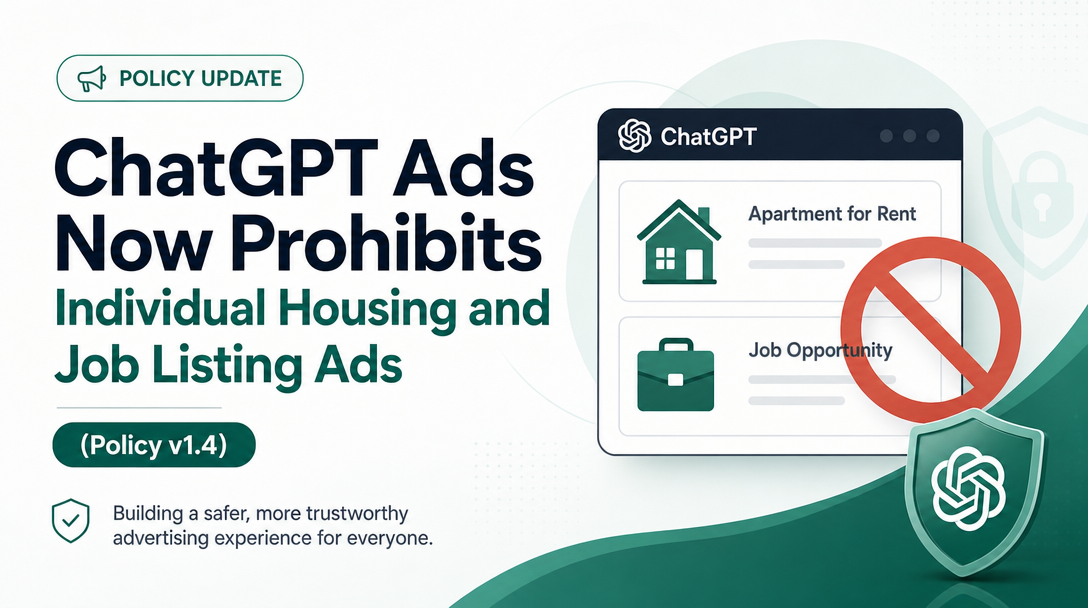
OpenAI shipped two documented changes to ChatGPT Ads in the last 24 hours. They landed on two different surfaces, they were announced in neither an advertiser email nor the help centre, and one of them prohibits an entire advertiser category.
Last verified: 2026-08-11.
- OpenAI ad policies moved to v1.4 on 10 August 2026, adding a new Housing and Jobs section under Disallowed ads.
- The Ads API reference gained an ad preview endpoint,
POST /ads/{ad_id}/preview.
A third thing happened that looks like news and is not, and it is worth naming up front so you can disregard it if you see it reported elsewhere: 26 ChatGPT Ads help-centre articles changed yesterday, and none of them changed in substance. Every one of those diffs is a site-wide "Related articles" navigation block being rolled out, plus the relative timestamp at the top of each page ticking over. No policy, mechanic, threshold or capability moved in the help centre. If you see a roundup this week claiming a sweeping ChatGPT Ads documentation update, that is what it is describing.
Everything below separates what OpenAI's documentation states from our reading of it.
What changed: the Housing and Jobs prohibition
The new section reads, in full:
### Housing and Jobs
Ads for individual job listings or housing rentals or sales are prohibited. Advertisers may link to platforms that have job or house listings as long as the landing page or ad creative does not reference a specific listing.
It sits in the Disallowed ads part of the policy, alongside Adult content, Alcohol & tobacco, Counterfeit goods, Financial services, Gambling, Graphic sexual or violent content, Health services, Legal services, Political content, Recreational drugs, Scams & fraud, Sensitive topics or events, and Wellness claims.
The changelog entry describes it as: "v1.4 (August 2026): Clarified our policy stance on housing and job listings."
One point of precision, because it changes how you should treat the date. OpenAI characterises this as a clarification. In the published document it is a new section that did not exist in v1.3 — the policy's Updated stamp moved from 15 July 2026 to 10 August 2026, and no prior version contained an explicit housing or jobs rule. Whether OpenAI was already enforcing this internally, we cannot know and OpenAI does not say. What changed on 10 August is that it became a written rule you can be held to, and that is the date that matters for compliance.
OpenAI states no reason for the change, and we are not going to invent one.
The line is drawn at the listing, not the industry
This is the most important operational detail and it is easy to read past.
The prohibition is not on housing and employment as verticals. It is on individual listings. The second sentence is a deliberate carve-out, and it has two conditions that both have to hold:
- You may link to a platform that hosts job or house listings, and
- neither the landing page nor the ad creative may reference a specific listing.
So the compliance question is not "am I in real estate?" It is "does this specific ad, and the page it lands on, point at one property or one job?"
| Scenario | Reading of the policy |
|---|---|
| A jobs marketplace advertising the marketplace, landing on its home or search page | Permitted under the carve-out |
| The same marketplace running an ad for "Senior Engineer at Acme", landing on that job's page | Prohibited — the ad and the landing page reference a specific listing |
| A property portal advertising "find rentals in Austin", landing on a filtered search | Permitted under the carve-out |
| An individual agent advertising a specific home for sale | Prohibited |
| A recruiting agency advertising its services, landing on a services page | Permitted — no listing referenced |
| An ATS or HR SaaS advertising its product | Not a listing ad at all; outside this section |
The dangerous middle case is the dynamic landing page. An ad whose creative is generic but whose destination deep-links into a single listing fails the second condition. If you run feed-driven or parameterised campaigns in these verticals, the destination URL is where this policy will catch you, not the headline.
Who this actually affects
Directly prohibited: individual real-estate agents and brokers advertising specific properties; property managers advertising specific units; employers advertising specific roles; recruiters advertising named openings.
Permitted but needs an audit: job boards, ATS vendors with job-distribution features, property portals, rental marketplaces, and any aggregator whose ads currently deep-link to individual listings. The business is fine. The campaign structure may not be.
Unaffected: HR software, proptech tooling, mortgage and moving services (subject to the separate Financial services section), and anything advertising a product rather than a listing.
If you are in the second group, the practical task this week is auditing destination URLs rather than rewriting creative. Ads pointing at /jobs/12345 or /listing/98765 are the exposure.
The second change: an ad preview endpoint
Separately, and on a completely different surface, the Ads API reference gained a new endpoint:
## Preview an ad
Preview an existing ad by ID. The preview expires 24 hours after creation.
POST /ads/{ad_id}/preview
Two things are worth noting about it.
The 24-hour expiry is a design instruction, not a footnote. A preview generated by the API is ephemeral. If you are building an internal approval workflow — creative goes to a client, client approves, campaign goes live — you cannot generate the preview at build time and store the link in a ticket. It has to be generated at view time, or your approvers will open dead links on day two. That is a small architectural decision that costs real time if you discover it after building.
It appeared only in the developer docs. The help centre says nothing about ad previews via API, and no email announced it. This is the same asymmetry we documented on 6 August, when the open beta for product-feed conversion bidding existed only in the developer docs. If your team tracks ChatGPT Ads through the help centre alone, you are systematically missing API-surface capability as it ships.
One thing this change did not do: developers.openai.com/llms.txt, which indexes the ads documentation and changes whenever a new ads doc page appears, was unchanged. So this is a new endpoint added to an existing reference page, not a new documentation surface. That is a useful signal for anyone monitoring these docs programmatically — a page-level diff would have caught it and an index-level canary would not.
What was announced by email: nothing
We checked the OpenAI advertiser product-update email for this window. There was no new product-update email — the most recent from [email protected] is dated 5 August 2026, before our previous run.
That is worth stating plainly rather than skipping, because it means both of yesterday's changes — a new prohibited advertiser category and a new API endpoint — reached advertisers only through documentation. Anyone relying on OpenAI's advertiser emails as their change feed does not currently know that individual housing and job listing ads are prohibited.
This is the third distinct pattern we have now seen across these surfaces:
- 6 August: the two largest changes (the oCPC Bid Cap redefinition and the automatic advanced matching default-on date) appeared in no email, while four announced items never reached the help centre.
- Today: both documented changes appeared with no email at all, and the help centre — which changed on 26 pages — carried none of the news.
The operational conclusion is unchanged and getting stronger: no single OpenAI surface is a complete change feed for ChatGPT Ads. The policy page, the developer docs, the help centre and the advertiser email each carry things the others do not, and the help centre is the least reliable of the four for capability changes.
What to do this week
- If you advertise in housing or jobs, audit destination URLs today. The prohibition is at the listing level. Ads landing on individual listing pages are the exposure, regardless of what the creative says.
- If you are an aggregator, restructure toward category and search landing pages. The carve-out exists and it is workable; it just requires your ads to sell the platform rather than the listing.
- If you build against the Ads API, generate previews at view time. The 24-hour expiry makes stored preview links a latent bug.
- Add
openai.com/policies/ad-policiesto whatever you monitor. It carries its own version number and changelog, it moved twice in under a month (v1.3 in July, v1.4 in August), and it is the surface that can make an entire campaign category non-compliant overnight.
Sources
All claims above were verified on 2026-08-11 against:
- OpenAI Ad policies — v1.4, updated 10 August 2026
- OpenAI Ads API reference — Ads
- OpenAI Ads documentation index (llms.txt) — unchanged this window
- The ChatGPT Ads help-centre collection — 26 articles changed, all navigation and timestamp only
Facts are quoted from those sources. The reading of the listing-level boundary, the affected-advertiser analysis and the monitoring recommendation are Soku's, not OpenAI's.
Related: ChatGPT Ads: what they are and how they work · ChatGPT Ads redefined the oCPC bid cap · Automatic advanced matching turns on by default