Soku AI

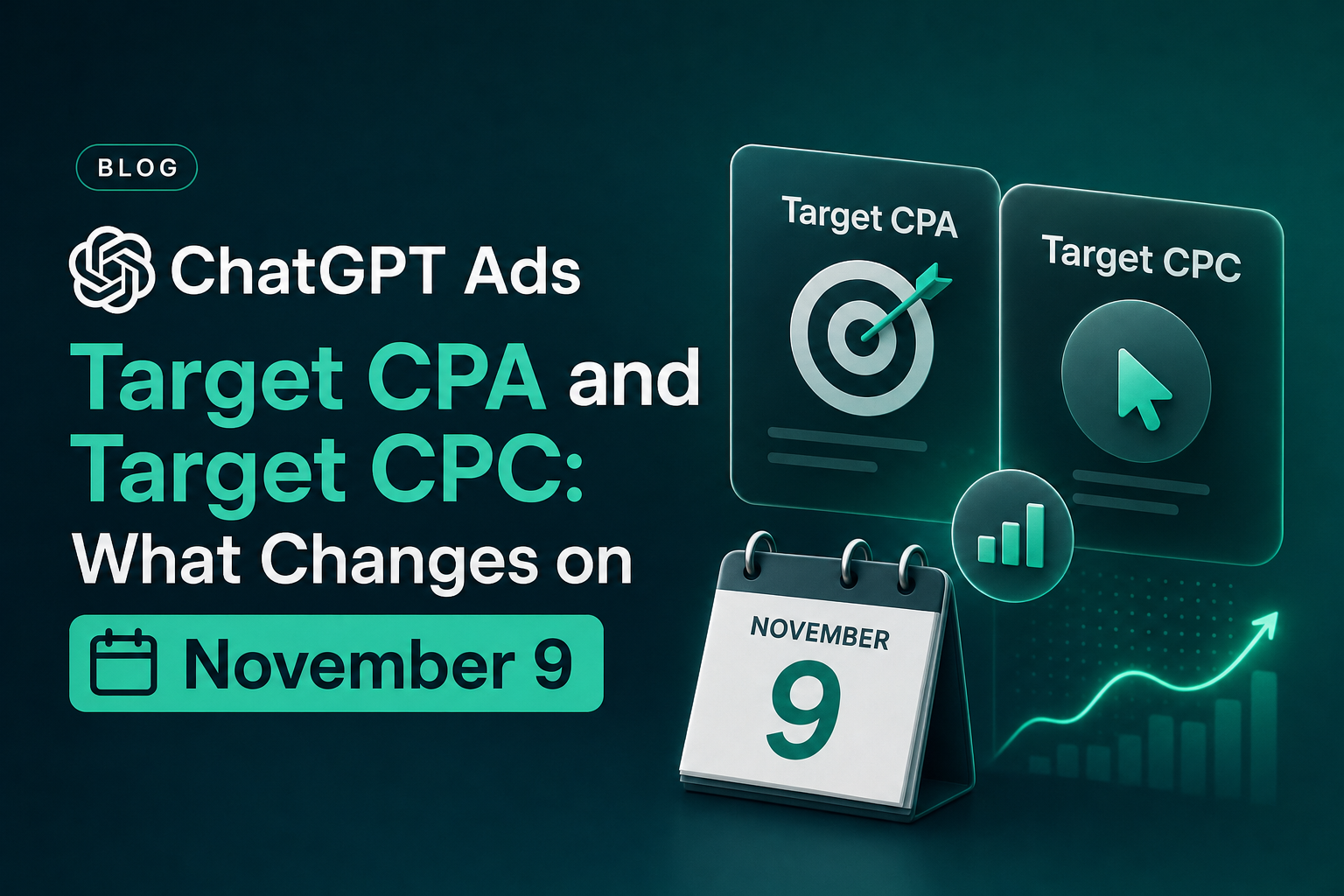
On November 5, 2026, OpenAI published a new help article, Bidding strategies and how pricing works in ChatGPT Ads, and sent advertisers an email titled "An update to your bidding options in ChatGPT Ads". Together they set out the biggest change to how bids work in ChatGPT Ads since self-serve launched. Two average-cost bidding strategies arrive on Monday, November 9: Target CPA for conversion campaigns and Target CPC for click campaigns. The bid controls advertisers have used until now, Max Bid and Max CPC, retire on January 1, 2027.
This guide covers what OpenAI's documentation says, what the email adds, where the two disagree with OpenAI's own developer docs, and what to do with your campaigns before each date. Quotes are word for word from OpenAI. Paragraphs marked Soku's reading are our analysis, not OpenAI's. For the wider picture of how ChatGPT Ads works, start with our complete ChatGPT Ads guide.
The short version
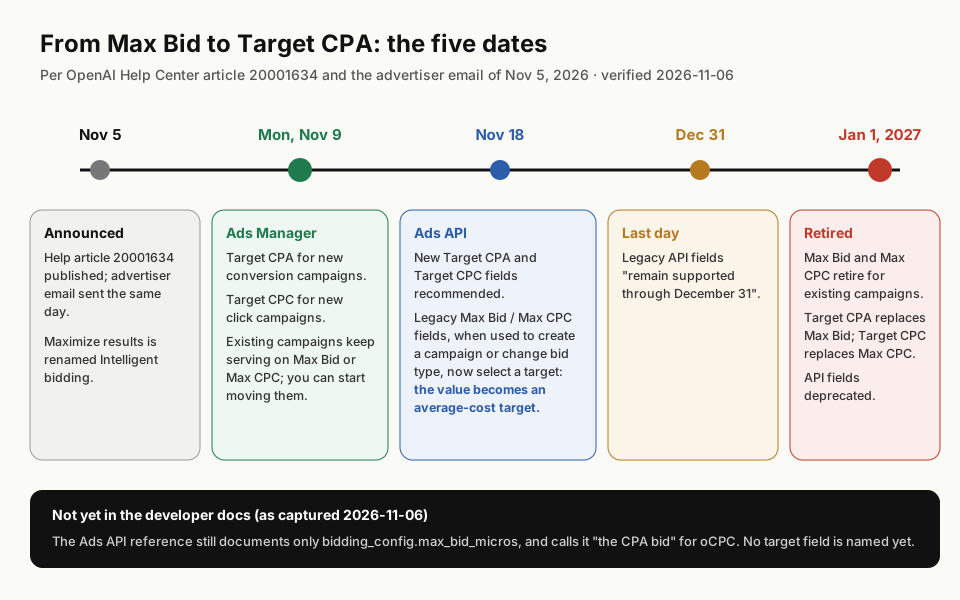
- November 9, 2026: Target CPA replaces Max Bid when you create a new conversion campaign in Ads Manager. Target CPC becomes available for new click campaigns.
- Existing campaigns keep serving on Max Bid or Max CPC for now. You can switch them to a target from November 9.
- November 18, 2026: the Ads API gets dedicated Target CPA and Target CPC fields. From then on, using the old Max Bid or Max CPC field to create a campaign or change an ad group's bid type selects a target, and the number you send is read as an average-cost target, not a maximum.
- January 1, 2027: Max Bid and Max CPC retire for existing campaigns, and the legacy API fields are deprecated.
- Maximize results is now called Intelligent bidding. It still sets no cost target.
- A target is not a cap. OpenAI says individual results "may cost more or less than your target" and the actual average "may be higher or lower".
- Billing does not change. You still pay the final winning auction bid, charged per click or per impression according to the campaign's billing setting.
What OpenAI published on November 5
The help article is new. Our documentation monitor, which captures OpenAI's ChatGPT Ads help centre and developer docs every day, first saw it in the capture of November 6, 2026, with the page reading "Updated: 4 hours ago". The email arrived at 18:21 UTC on November 5 and links to the same article.
The article opens by explaining the direction:
ChatGPT Ads is evolving to be more intelligent by default, taking on more of the work of managing campaigns so you can focus on the results that matter to your business. You tell us the outcomes you care about and the budget or target cost that works for your business, and our system adjusts bids and ad delivery to work toward those goals.
It then lists three bidding strategies. We look at each in turn.
Intelligent bidding (formerly Maximize results)
Intelligent bidding, formerly Maximize Results (Autobid), automatically adjusts bids and ad delivery to help drive your desired business outcome within your budget. You do not need to manage individual bids.
Use this option when you want the system to pursue results within your budget without specifying a target average CPA or CPC.
This is the strategy we covered when it launched, in ChatGPT Ads adds a Maximize results bid strategy. Only the name has changed. The email confirms it: "Maximize results (autobid) is part of our intelligent-by-default approach, now called intelligent bidding."
Target CPA for conversion campaigns
Target CPA, or target cost per action, is the average amount you'd like to pay for a conversion, such as a purchase or lead. While Max Bid limits individual bids, Target CPA gives our system a conversion-cost goal to work toward.
Starting Monday, November 9, Target CPA replaces Max Bid as the bidding option for advertisers creating new conversion campaigns who want to work toward a specific cost per conversion.
OpenAI's worked example: "a $50 Target CPA tells the system to work toward an average conversion cost of $50. Some conversions may cost more and others less; actual average CPA may be higher or lower than your target."
Target CPC for click campaigns
Target CPC, or target cost per click, is the average amount you'd like to pay for a click. Starting Monday, November 9, Target CPC is available for new click campaigns.
While Max CPC caps individual bids, Target CPC lets our system bid above or below your target in individual auctions, aiming to deliver as many clicks as possible from your budget while working toward your desired average CPC.
Max Bid vs Target CPA: a ceiling versus an average
The whole change comes down to one distinction, and OpenAI states it plainly:
Max Bid and Max CPC are legacy bid controls rather than average outcome-cost targets. Max Bid sets an auction-bid ceiling; Max CPC sets a maximum click bid.
Your Target CPA or Target CPC is an average-cost goal that guides the system's auction bids. It is not a fixed price per conversion or click, and actual average costs may be higher or lower than your target.
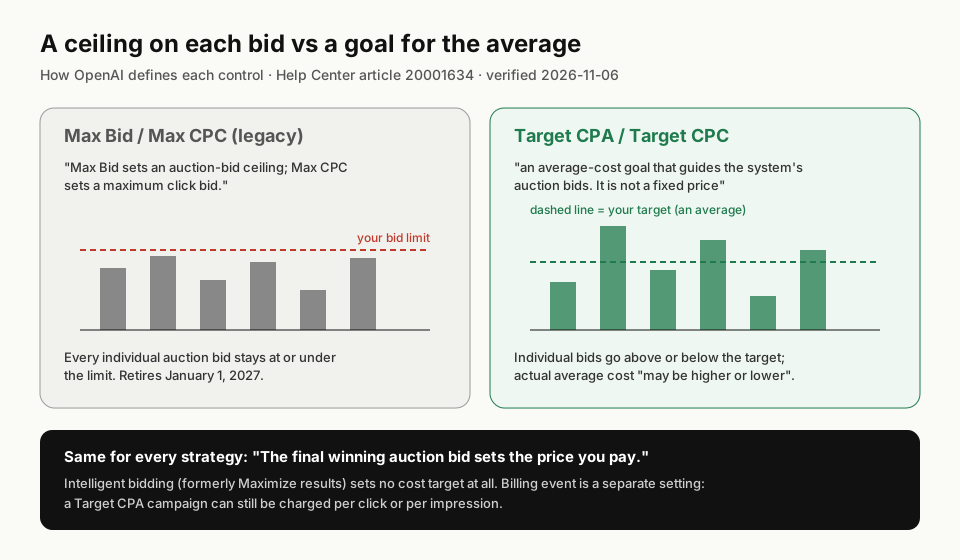
Soku's reading: with Max Bid, you set how far the system could go in any single auction. With Target CPA, you set where the average should land, and the system decides how far to go in each auction. Those are different promises. A $40 Max Bid meant no single conversion-oriented auction bid above $40. A $40 Target CPA allows a $70 bid on an auction the model rates highly, offset by cheaper ones elsewhere. That is how target bidding works on every major ad platform, and it is usually what you want, but the same number means something different under the two controls. That matters most in the migration, covered below.
What you pay does not change:
Auctions determine which eligible ads are shown. The final winning auction bid sets the price you pay. This pricing rule applies across all bidding strategies, including existing Max Bid and Max CPC campaigns.
The billing event does not change either:
Your bidding goal and billing event are separate settings. A campaign can optimize for conversions while charges are based on clicks or impressions, depending on its billing setting.
So a conversion campaign with click billing (oCPC) and a Target CPA still pays for valid clicks. Our guides to oCPC campaigns and impression-billed oCPM still apply; only the bid control on top of them is changing.
What happens to existing campaigns
The email and the help article use different wording, and both are correct.
The email:
Target CPA will replace Max Bid for new conversion campaigns in Ads Manager. [...] Existing campaigns will continue to serve as Max Bid campaigns, but advertisers will have the option to change their bidding strategy if they want to deliver towards a target CPA.
The help article:
Max Bid and Max CPC will retire on January 1, 2027 for existing campaigns. Target CPA replaces Max Bid for conversion campaigns and Target CPC replaces Max CPC for click campaigns. Begin moving campaigns to the new options in Ads Manager from November 9, 2026.
The email covers November 9 to December 31, when existing campaigns keep their Max Bid. The help article covers January 1, 2027, when they lose it. Put together, you have a seven-week window to move each campaign yourself before OpenAI moves it for you.
Soku's reading: neither source says what target value a campaign gets if you do nothing and it is moved on January 1. Nor does either say whether your old Max Bid figure carries over as the new target. If it does, a campaign whose $40 Max Bid was a hard ceiling would start treating $40 as an average, so some individual auctions would clear above $40 where they could not before. That may be fine or may be expensive, depending on how far below the ceiling your actual CPA was running. Until OpenAI documents the default, the safe assumption is that you should set every target yourself, before January 1, from your own numbers.
The API change on November 18 is the one to watch
If you, an agency tool or a partner integration creates ChatGPT Ads campaigns through the Ads API, this part of the article matters most:
We're adding dedicated Target CPA and Target CPC fields so API partners can create campaigns with target bidding or switch existing campaigns to it.
- Before November 18, 2026: The Max Bid and Max CPC fields retain their existing behavior. Partners can begin adopting the new target fields once they are available. - From November 18: We recommend using the new Target CPA and Target CPC fields. The legacy fields will remain supported through December 31, but using them to create a campaign or change an existing ad group's bid type will select Target CPA or Target CPC, respectively. For these operations, submitted values will represent average-cost targets rather than maximum bids. - Starting January 1, 2027: The Max Bid and Max CPC fields will be deprecated. Partners should update their integrations to use the new target fields before this date.
Soku's reading: this is a change in meaning without a change in syntax. From November 18, a request that sends the same field and the same number as on November 17 can produce a campaign with different bidding behaviour: the number used to be a ceiling and is now an average. Nothing in the request fails, so an integration that is not updated will not notice. If you run API-created campaigns, list every code path that creates a campaign or changes an ad group's bid type, and decide before November 18 whether those values should still be the same numbers when they become averages.
The developer docs have not caught up yet
This is where OpenAI's two documentation surfaces disagree. As captured on November 6, 2026, the Ad Groups API reference still documents only one bid field, bidding_config.max_bid_micros, and still says of oCPC:
max_bid_microsis the CPA bid even though the billing event is a click. For example,100000000is a $100.00 CPA bid for a USD account.
No Target CPA or Target CPC field name appears anywhere in the developer docs we capture. That includes the API reference, campaign management, the Bulk API and the conversion-optimized campaigns guide. The help article says partners can adopt the new fields "once they are available", which suggests the field names will be published before November 18. Until they are, the help centre is the only source for the API timeline, and nobody outside OpenAI can write code against the new fields yet.
There is a second, older inconsistency that this change settles. In August, the help centre's Conversion-optimized Campaigns article redefined the oCPC Bid Cap as "the maximum amount you are willing to bid for a conversion". We covered this in ChatGPT Ads redefined the oCPC Bid Cap. That article still says so today, while the new article calls Max Bid "an auction-bid ceiling". Both describe a limit on individual bids rather than an average, so they agree in substance. But after January 1 neither will describe a control you can still select.
Help-centre pages that still describe the old controls
As of November 6, 2026, several help-centre articles still describe the old bidding model as current:
- Maximize results bid strategy still calls it "a new bid strategy" under its old name and tells you, to use something else, to "select Manual: Max bid".
- Ads in ChatGPT: The Basics still says "Advertisers set a maximum bid at the ad-group level" and recommends "starting with a maximum bid of $3–$5 USD per click" for CPC campaigns.
- Conversion-optimized Campaigns still tells you to "adjust your Bid Cap", although it now links to the new bidding article.
Soku's reading: we expect these to be updated around November 9. Until then, where they conflict, the November 5 article is the one OpenAI's email points to and the one with dates attached, so we treat it as authoritative. We will update this guide when the older pages change.
How to set a realistic Target CPA or Target CPC
OpenAI gives three rules:
- Review recent actual CPA for the same conversion event, or actual CPC for a click campaign. Use a consistent reporting period and allow for conversion-reporting delay. - Compare recent performance with what the outcome is worth to your business. A target below recent performance may restrict delivery. - Set or adjust the target as your campaign moves to the new strategy. Review spend, results and actual average cost together as the campaign learns.
And a worked example:
For example, $400 in spend and 10 attributed purchases gives an actual CPA of $40 for that reporting scope. Use that result and your acquisition goals as a starting point. Setting a $20 target does not mean the system can deliver purchases at half the observed cost.
Soku's reading: in practice, that becomes this procedure.
- Pick the event first. Compute actual CPA for the exact conversion event the campaign optimizes toward, not for all conversions. A campaign optimizing for
order_createdshould not take its target from a blended CPA that includes leads. - Use a window that has finished reporting. OpenAI's guidance to "allow for conversion-reporting delay" is not boilerplate. ChatGPT Ads conversions arrive later than spend, which we covered in ChatGPT Ads reporting delay. A CPA computed over the last three days will overstate cost, because spend has landed and some conversions have not. Use a window that ended several days ago.
- Start at your actual CPA, not your wish. OpenAI says "A target below recent performance may restrict delivery". If actual CPA is $40 and the business can afford $45, $40 to $45 is a reasonable first target. $25 is a reason for the campaign to stop spending.
- Change one thing at a time. Moving a campaign to Target CPA is already a change. Avoid changing creative, audiences and budget in the same week, or you will not know which change moved the results.
- Check audience multipliers. OpenAI notes: "A $50 Target CPA with a 1.2× new-customer multiplier gives that segment a $60 target." If you use custom audience bid multipliers, the multiplier now raises a target average rather than a ceiling.
Target CPA depends on your conversion data
A target is only as good as the signal the system learns from. OpenAI is explicit:
Verify that real events are arriving at the data source linked to the campaign. Setup alone does not establish that usable conversion signals are being received.
Event Quality Score (EQS) describes the usefulness of received event information for measurement. Conversion volume describes how often the selected action occurs. A high score does not establish that there are enough signals to support scale.
And in the FAQ, on why a campaign may not spend its full budget:
Your campaign may not spend its full budget if targets are too restrictive, eligible opportunities are limited, or conversion signals are weak or missing.
Soku's reading: before switching a conversion campaign to Target CPA, confirm three things. The selected event is actually arriving from the Pixel or the Conversions API. Its Event Quality Score has no open warnings. And the event fires often enough to learn from. OpenAI publishes no minimum conversion volume, so we cannot give you one, but a purchase event that fires twice a week will give any target-bidding system very little to work with. If that describes you, Intelligent bidding, which has no target to miss, or optimizing for an earlier, more frequent event may serve you better until volume grows.
A checklist for the next eight weeks
Before November 9
- List every ChatGPT Ads campaign and record its strategy (Max Bid, Max CPC or Maximize results), its bid value and its actual CPA or CPC over a fully reported window.
- For conversion campaigns, confirm the optimization event is arriving and check its EQS warnings.
From November 9
- New conversion campaigns: set a Target CPA from the actual CPA of the same event, not from the old Max Bid value.
- New click campaigns: set a Target CPC from the actual CPC of comparable campaigns. Existing Max CPC campaigns keep serving until January 1.
- Move existing campaigns one at a time, starting with those that have the most conversion volume, and review spend, results and average cost after each move.
Before November 18 (API users)
- Find every code path that creates a campaign or changes an ad group's bid type with
max_bid_micros. - Decide whether those values still make sense as averages, because from November 18 they will be read as averages.
- Watch the developer docs for the new field names and switch to them.
Before January 1, 2027
- Every remaining campaign should have a target you chose yourself.
- Remove all use of the legacy bid fields from your integrations.
What OpenAI does not say
The article and the email leave several questions open. We list them so you do not build plans on assumptions:
- The default target on January 1. Neither source says which target a campaign receives when Max Bid or Max CPC is retired on it, or whether the old value carries over.
- Learning period. Neither source says whether switching an existing campaign to a target resets learning or affects delivery while it adjusts. OpenAI says only to "Review spend, results and actual average cost together as the campaign learns."
- Minimums and limits. Neither source gives a minimum Target CPA or Target CPC, or a recommended conversion volume.
- Which campaign types are covered. Neither source says whether target bidding applies to impression-billed (oCPM) conversion campaigns, product-feed campaigns or Hotel campaigns. The Ad Groups reference says Hotel groups use
fixed_bidand that automated bidding is not supported for them. - The daily budget floor. Ads Manager currently ties a campaign's minimum daily budget to its highest ad group bid, as we covered in ChatGPT Ads daily budget bid floor. OpenAI has not said how that floor works when the bid is an average target rather than a maximum.
- The new API field names. As of November 6, 2026, they are not in the developer docs.
Where Soku fits
Setting a sensible Target CPA starts with knowing your actual CPA for the right event over a properly reported window. Soku reads ChatGPT Ads results alongside Meta, Google and TikTok, so you can ask for a campaign's cost per conversion for a specific event and date range and get the number from the same reporting you use for your other channels. That gives you a starting target based on your own data rather than a guess.
One caution applies to every tool that writes ChatGPT Ads bids through the API, Soku included. Until OpenAI publishes the new target fields, the only documented bid field is max_bid_micros. From November 18, when that field is used to create a campaign or change an ad group's bid type, OpenAI will read its value as an average-cost target. Check the bid value on anything created or edited by any tool after that date.
Sources
All OpenAI sources verified on November 6, 2026.
- OpenAI Help Center: Bidding strategies and how pricing works in ChatGPT Ads (published November 5, 2026)
- OpenAI advertiser product-update email, "An update to your bidding options in ChatGPT Ads", sent November 5, 2026. Every item in it is also documented in the help article above.
- OpenAI Help Center: Maximize results bid strategy
- OpenAI Help Center: Conversion-optimized Campaigns
- OpenAI Help Center: Ads in ChatGPT: The Basics
- OpenAI Help Center: Understanding and improving event quality
- OpenAI developer docs: Ad Groups API reference
- OpenAI developer docs: OpenAI Pixel and Conversions API