 Soku AI
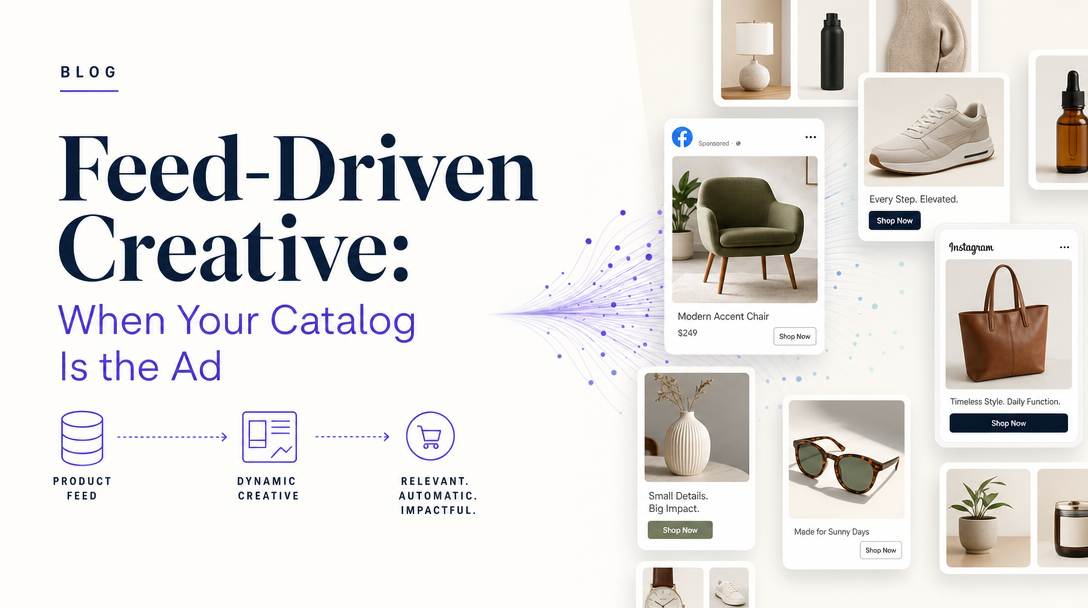
Feed-driven creative inverts how advertising normally works. Instead of designing an ad and then finding an audience, you supply a structured catalog and the platform assembles the ad at serve time — picking the product, pulling the image, writing the price into the unit, and deciding who sees it.
Meta's Advantage+ catalog ads (the renamed Dynamic Product Ads) are the canonical version. Google Performance Max does the equivalent for shopping inventory, TikTok has dynamic showcase ads, and the mechanism is spreading because it works: for retail with more than a handful of SKUs, this format routinely outperforms hand-built creative at the bottom of the funnel by a wide margin.
It also creates a problem most teams do not see coming. Nobody approved the ad that served. There is no ad to approve — there is a feed, and a set of rules for assembling one. Which means your creative quality is now a function of your data quality, and your data is usually owned by people who have never been told it is advertising copy.
What is actually happening at serve time
A catalog ad is assembled from feed attributes:
| Ad element | Feed field |
|---|---|
| Product image | image_link (and additional_image_link) |
| Headline text | title |
| Price shown in unit | price / sale_price |
| Whether it serves at all | availability |
| Where the click goes | link |
| Which products are eligible | product_type, custom_label_0-4 |
The platform picks which row of your catalog to show each user based on browse behaviour, purchase signals or predicted intent, then composes the unit around it.
Read that table again as a creative brief, because that is what it now is. Your title field is ad copy. Your image_link is the hero image. Your custom_label fields are the targeting strategy.
The three defects that produce bad ads
1. The title was written for a shopping comparison engine
Product feeds usually predate the advertising use case. They were built for Google Shopping or a marketplace, where titles are optimised for matching a query string — which produces things like:
ACME Outdoor Co. ACME Trailhead 2.0 Men's Waterproof Hiking Boot - Brown - UK 9 - SKU 44821-BRN-9
That is a reasonable Shopping title. As ad copy in a Meta feed it is terrible: the brand appears twice, the SKU is noise, and the size and colour are irrelevant to someone who has not yet decided they want boots.
The fix is a supplementary feed — an override layer that replaces ad-facing titles without touching the operational feed. Every major platform supports one. Very few teams use it, because the person who would write better titles does not know the feed exists.
2. The image field points at the wrong photo
Catalog ads pull from a specific attribute. If that attribute holds the white-background packshot your PDP uses while your lifestyle photography sits in a DAM somewhere, the packshot is your ad, regardless of how good the other photography is.
This is the single most common reason a team concludes "catalog ads look cheap." The ads are showing the images the feed pointed at. Check what image_link actually resolves to for your top 20 revenue SKUs before you conclude anything about the format.
3. Availability is stale
Ads serving for out-of-stock products waste spend and produce a click experience that damages more than the wasted impression does. Availability is the feed attribute most likely to drift, because it changes constantly and the sync interval was set by someone optimising for infrastructure cost rather than ad quality.
If your feed refreshes daily and your bestsellers sell out in hours, you are advertising phantom inventory for most of the day.
The organisational problem underneath
Here is the part that is not a technical fix.
The product feed almost always originates in ecommerce or engineering. It exists to keep the catalog synchronised, and it is judged on completeness, freshness and not breaking. Nobody in that chain is evaluated on whether the titles persuade anyone.
Once the feed drives advertising, it is also creative copy — judged on persuasion, brand voice and whether it makes someone stop scrolling. Two owners, two definitions of quality, usually no shared review, and a marketing team that reports "the ads look bad" to a channel that has no mechanism to act on it.
The practical resolution is not to move ownership of the feed. Operational integrity genuinely matters, and marketing should not be editing the pipeline that keeps the storefront correct. The resolution is a supplementary feed layer that marketing owns, mapped on top:
- Operational feed stays with ecommerce. Source of truth for price, availability, identifiers.
- Supplementary feed sits with marketing. Overrides ad-facing
title,descriptionandimage_link. - Custom labels are the shared contract — the agreed vocabulary for which products get advertised, at what priority.
That third point is where most of the value is, and it is the least glamorous.
Product sets are the biggest lever nobody pulls
The highest-leverage control in feed-driven advertising is not creative treatment. It is deciding which products are eligible to be advertised at all.
Standard exclusions worth building into custom labels:
- Low or negative margin SKUs. The platform optimises for conversions, not contribution. It will happily scale your worst-margin product because it converts well.
- Low inventory. Advertising something with four units left is a good way to spend budget on an out-of-stock experience by Thursday.
- Poor imagery. If the packshot is bad, exclude the SKU rather than accepting a bad ad.
- Price-point mismatches. Products that attract a buyer who never returns.
- Long-tail with no conversion history. They dilute the training signal without contributing.
Teams routinely spend weeks debating creative frameworks while the campaign quietly advertises 200 SKUs nobody would have chosen to promote. Fix the eligibility set first. It is faster, it is reversible, and it usually moves the number more.
Feed-driven creative vs dynamic creative optimisation
These get conflated constantly and they answer different questions:
- Feed-driven creative decides which product to show, drawing content from your catalog.
- DCO decides which variation of a treatment to show — combinations of headline, image and call to action tested against an audience.
They compose. DCO layered on feed-driven ads means the platform chooses both the product and the framing around it. If feed-driven creative is the fuel, DCO is the steering.
The practical implication of running both: your diagnostic surface gets harder. When performance moves, it could be product selection, creative variation, audience, or bidding. Change one layer at a time or accept that you will not know why anything happened.
What it is bad at
Feed-driven creative is extremely efficient at the bottom of the funnel and weak at the top, and the reason is structural rather than a maturity problem: a catalog ad cannot make an argument.
It can show someone a product they already looked at, or a product similar to one they bought. It cannot explain why a category matters, establish a brand position, or create demand that was not there. Those require a designed asset with a point of view.
The healthy pattern in most accounts is both, with a clear division of labour: designed creative builds the demand, feed-driven creative converts it efficiently. Teams that replace the former with the latter usually see good efficiency metrics for two quarters and a shrinking addressable audience underneath.
An audit worth running this week
- Pull your top 20 revenue SKUs and look at what actually renders. Not the feed spec — the assembled ad. Is that the image you would have chosen? Is that title a sentence a person would read?
- Check availability freshness against real sell-through. How long is a sold-out bestseller advertised for?
- List what is eligible. How many SKUs can serve? How many should?
- Find out who owns the feed and whether they know it is advertising copy. If the answer is no, that conversation is the highest-value thing in this list.
- Check for a supplementary feed. If there is not one, you have no marketing-controlled surface at all.
Where to go next
- Best AI tools for Facebook & Instagram ad creatives — the designed-creative half of the pair
- Generative AI display advertising is now the default — the same assembly-at-serve-time shift on Google's display inventory
- Server-side tracking is now an AI bidding input — the signal that decides which products get shown
- Best AI media buying tools, ranked — where feed tooling sits in the wider stack
The short version
Feed-driven creative moved the creative brief into a spreadsheet that the marketing team usually cannot edit and often does not know exists.
The work is not learning a new ad format. It is treating the feed as a creative surface — overriding ad-facing titles and images through a supplementary feed, controlling eligibility through custom labels, and establishing a shared contract with whoever owns the operational pipeline. Do that and the format performs. Skip it and you are letting your SKU naming convention write your ads.