 Soku AI
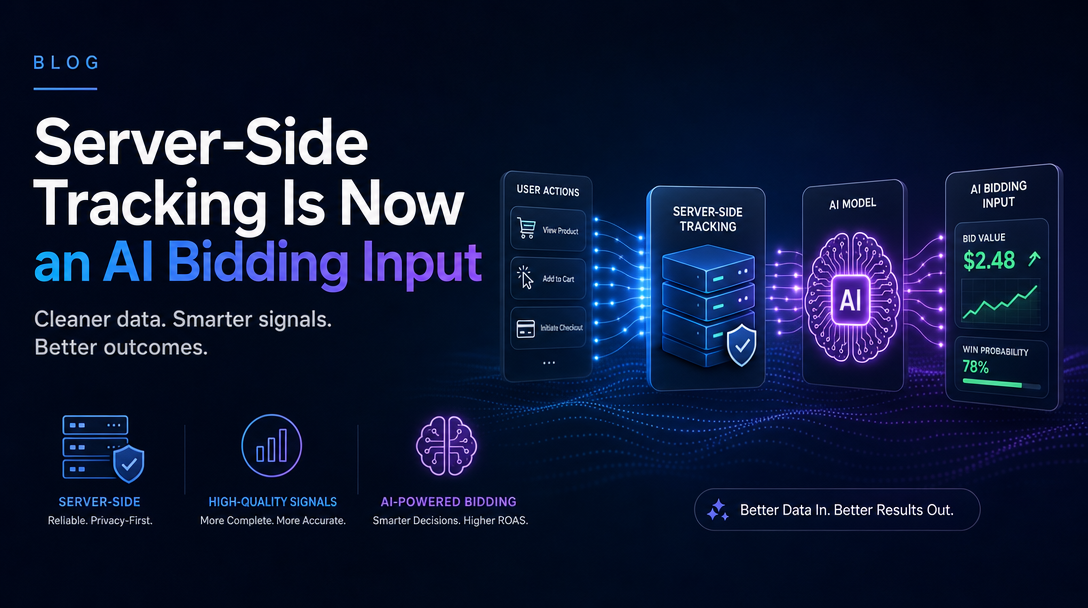
Server-side tracking has been sold for years as a measurement fix: browsers block pixels, you lose conversions, put a server in the middle and get them back. That framing was accurate and it is now incomplete, because the platforms changed what they do with the signal.
The shift is this. Meta's bid algorithms now weight CAPI-confirmed conversions more heavily than pixel-only conversions when training Advantage+ Shopping and Advantage+ App campaigns. Server-side tracking has stopped being a reporting improvement and become a model-training input.
That reframes the business case. It is no longer "we will see more of what already happened." It is "the automated bidding that spends our budget will be trained on a fuller and more trustworthy picture of who converts." Those are different arguments with different sizes.
Why the signal degraded in the first place
Nothing here is new, but it is worth stating precisely because the size of your gap determines the size of your opportunity:
- Browser restrictions. Safari's ITP caps script-writable cookie lifetimes; Firefox blocks known trackers by default. A meaningful share of returning visitors are unrecognisable to a client-side pixel.
- Ad blockers. Requests to known endpoints never fire at all.
- Consent gating. Where consent is required before the pixel loads, a portion of genuine conversions never generate a client-side event.
- Page abandonment. Conversion pixels fire on page load. Users who close the tab on the confirmation page were still customers.
None of these mean the conversion did not happen. They mean the browser did not tell anyone about it — and, crucially, that the platform's model never saw it.
The part that actually compounds
Here is the mechanism worth understanding, because it explains why this is not merely a reporting question.
Automated bidding — Advantage+, Performance Max, Target CPA, Target ROAS — learns from the conversions it can observe and attribute. Whatever it cannot see does not exist as far as the model is concerned. So a systematic gap in your signal is not neutral noise; it is a biased training set.
And the bias is not random. The conversions most likely to be lost are the ones from Safari and iOS users, from privacy-conscious segments, from people who close the tab quickly. If those users differ from your average customer in any way that matters — and on iOS, they usually differ in income — then the model is learning to find a subtly different population from the one that actually buys from you.
Fixing signal completeness does not just increase the count. It removes a systematic skew in who the model thinks your customer is. That is a larger effect than the recovery percentage suggests, and it is the reason the platforms now weight the server-confirmed events more heavily.
About those recovery numbers
Vendor benchmarks commonly claim 20-40% recovery of conversions client-side misses, and some report 95-99% total capture against 60-70% for pixels alone.
Treat these as directional, for three reasons:
- They come from vendors selling implementations.
- The baseline varies enormously — an account with 70% iOS traffic and a strict consent banner has a completely different gap from a desktop-heavy B2B account.
- "Recovered" sometimes counts deduplicated events that were already partially captured, which inflates the headline.
The honest expectation is a meaningful double-digit improvement in event completeness, sized by your browser mix and consent rate. Measure your own gap before you accept anyone's number: compare backend orders against platform-reported conversions for the same window, and the delta is your actual opportunity.
Event Match Quality is an input, not a scorecard
Meta's Event Match Quality reflects how well the identifiers you send let it resolve an event to a person. It is easy to treat as a score to maximise, which produces a specific failure: teams start sending every available parameter regardless of accuracy.
That is the wrong optimisation. A confidently wrong phone number does not improve matching. The goal is high-quality parameters you can send reliably, not a longer list. Email and a stable external ID sent accurately on every event beats seven parameters where three are guesses.
The right mental model: EMQ is an input to how many of your events get matched, matched events are what the model trains on, and the training set is what determines bidding quality. It sits three steps upstream of the number you actually care about, which is why improving it feels indirect and is nonetheless worth doing.
Implementation: three paths, different trades
Direct backend integration. Your server calls the Conversions API when an order completes. Fewest moving parts, most reliable, requires engineering capacity. Best if you have a backend team and a small number of destinations.
Server-side GTM container. The web container sends events to a server container, which fans out to Meta CAPI, GA4 via Measurement Protocol, Google Ads and others. More infrastructure, but adding a destination becomes configuration rather than a code change. The common choice for teams running many platforms.
Platform-assisted setup. Meta shipped an AI-assisted one-click CAPI setup in April 2026, explicitly aimed at teams without engineering resource. This matters less for what it does than for what it signals: Meta is removing the technical barrier because it wants CAPI to be the baseline, not an enhancement. Read it as a statement of where the platform expects everyone to be.
On the Google side the equivalent work is Enhanced Conversions — sending hashed first-party data (email, name, address, phone) alongside conversion events so Google can better attribute conversions to clicks it already knows about. The mechanism differs from Meta's: Meta is largely resolving identity to find similar people; Google is largely improving attribution of conversions to existing clicks. Both improve what automated bidding trains on, which is why they are one project rather than two.
The two failures that actually happen
Deduplication. When the pixel and the server both report the same conversion and the event IDs do not match, the platform counts it twice. This is worse than under-reporting, because inflated conversion counts train the bidding model on demand that does not exist — you scale spend toward phantom performance. Verify deduplication before you celebrate the recovery number, not after.
Silent drift. An implementation that was correct at launch degrades when the checkout flow changes and a parameter quietly stops populating. Nothing alerts you, because events still arrive — they are just thinner. This is the more insidious failure, and it argues for monitoring event completeness as an ongoing signal rather than validating once during implementation.
Both failure modes share a property: they are invisible in the campaign metrics you look at daily. Conversion volume looks fine. It just is not describing reality.
What this does not fix
Worth being explicit, because expectations get set badly here.
Server-side tracking will narrow the gap between platform-reported conversions and your backend numbers. It will not close it. The residual comes from things it does not touch: differing attribution windows, view-through versus click-through, cross-device stitching, and modelled conversions each platform estimates its own way.
If someone in finance expects the numbers to reconcile after implementation, have that conversation before the project starts rather than after.
A sequence that works
- Measure your gap. Backend orders versus platform-reported conversions, same window. That delta is your actual opportunity, and it makes the business case concrete rather than borrowed from a vendor blog.
- Pick the path — direct, server-side GTM, or platform-assisted — based on engineering capacity and destination count, not on which is most sophisticated.
- Ship deduplication first. Get event IDs matching before you send volume. Double-counting is worse than the problem you started with.
- Improve parameter quality, not parameter count. Send what you know accurately, on every event.
- Do Enhanced Conversions in the same project. Same first-party data, same plumbing, different destination.
- Monitor completeness continuously. A weekly check that event volume and parameter fill rates have not drifted catches the failure that nothing else surfaces.
- Re-baseline your targets. More visible conversions means your reported CPA drops without anything real changing. If your Target CPA stays where it was, you will under-spend against a target that is now measuring something different.
That last step is the one teams skip, and it quietly wastes the gains from the first six.
Where to go next
- AI Max vs PMax — the bidding surfaces this signal feeds
- Meta Ads MCP: the complete guide — reading signal and dataset health programmatically, including matching quality
- Google Ads MCP: the complete guide — the Google-side equivalent
- Best AI media buying tools, ranked — where measurement sits relative to optimisation tooling
The short version
The old business case for server-side tracking was "see more of what happened." The current one is stronger and less obvious: the automated bidding that spends your budget is trained on the events you manage to deliver, and the platforms now explicitly prefer the server-confirmed ones.
That makes signal quality a bidding lever rather than a reporting one — and it means the cost of not doing it is not a reporting inaccuracy you can mentally adjust for. It is a model quietly optimising toward a distorted picture of your customer.