Soku AI

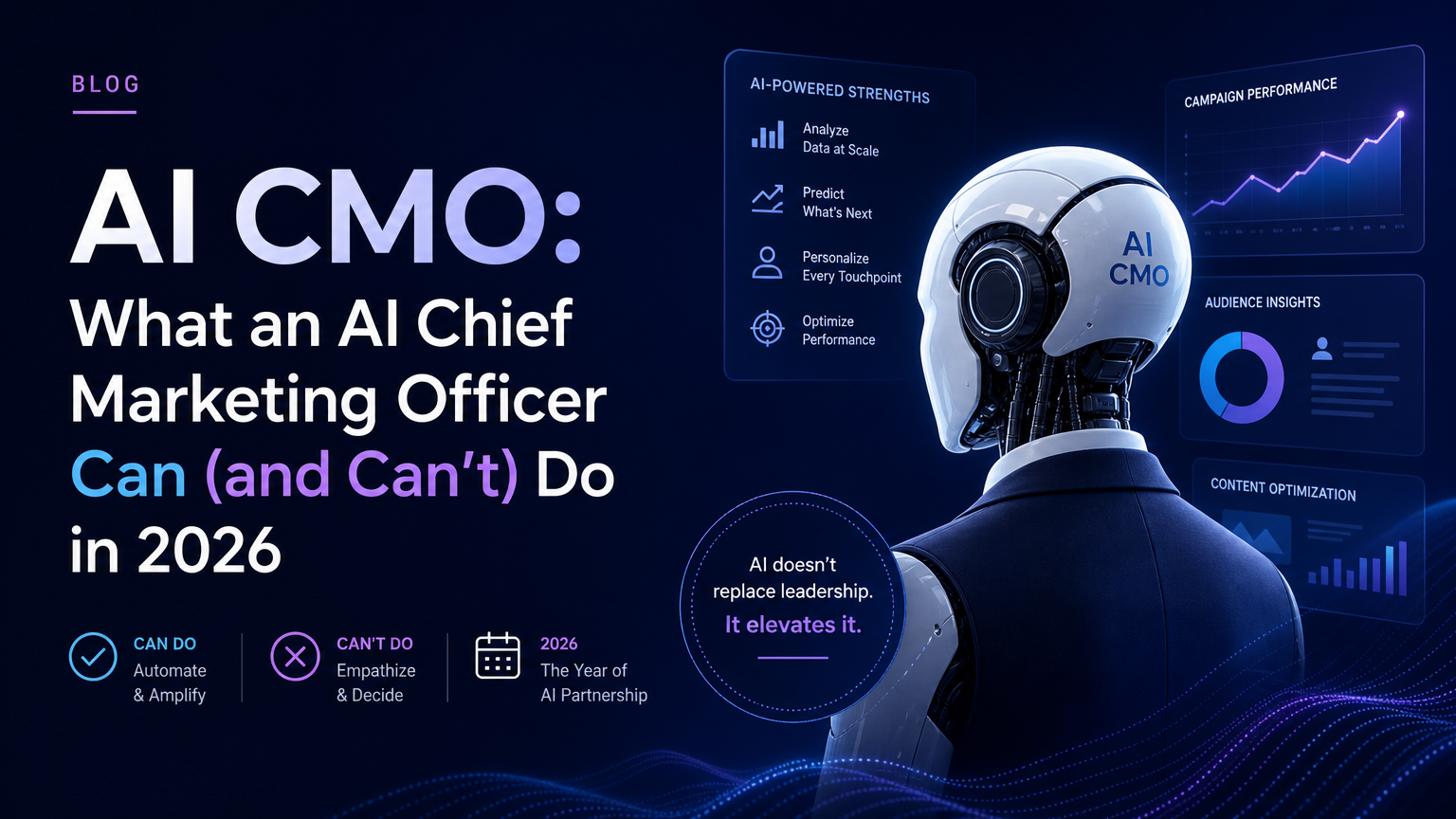
An AI CMO is software that takes on part of a chief marketing officer's job: reading the market, planning campaigns, producing creative, running channels and reporting results, usually through a set of AI agents that a person approves. No product on the market today does the whole job. The honest version of the question is not "can AI be my CMO?" but "which parts of the CMO's job can software run today, and which parts still need a person who owns the outcome?"
That is what this guide answers. We took the responsibilities a CMO actually carries, mapped each one to what an AI system can do in 2026, and then checked our own product, Soku, against that map line by line. Every cell where we say "Soku does this" was checked against Soku's source code on 2026-10-26, and every cell where the answer is "a human" says why.
For the wider picture of how marketing agents work and where they deliver, start with our pillar guide, AI Marketing Agents in 2026. This page goes deep on one narrower question: the CMO role.
Last verified: 2026-10-26. Prices for the products named below were read on their own sites on that date. Survey numbers link to the publisher.
What "AI CMO" means on the search results page
Search "AI CMO" today and you get three different things under one label.
1. Execution platforms sold as an AI CMO. These products put a coordinating "CMO" agent on top of channel agents. Okara starts from your website, writes a positioning brief and a 30-day plan, then runs SEO, AI-search, content and community agents from that shared plan. Clara (claracmo.com) sells four agents (a "Master CMO", content, media and research). AI CMO is a social listening and content distribution tool across six social networks. Nyle calls its Amazon-first ads and inventory automation an "AI CMO". The name is shared; the jobs are not.
2. Advisory personas. Some tools offer a chatbot calibrated to think like a senior marketing executive. Minds' AI CMO persona reviews positioning and challenges plans, and its own page is candid that it cannot execute, has no network and carries no accountability.
3. Articles about human CMOs using AI. The rest of page one is about the job itself changing: a CMO describing how their team uses AI, or trade press on the "AI-native CMO". Useful context, but it doesn't help you decide what to hand to software.
So when a vendor says "AI CMO", ask which of these it means. A social listening tool, an Amazon bid manager and a strategy chatbot can all wear the label.
What a CMO is actually responsible for
Before mapping anything to software, it helps to be precise about the job. Spencer Stuart's CMO Tenure 2026 study describes the traditional remit as "brand, creative media, insights and analytics", and notes that the role keeps widening into chief commercial, revenue or customer officer titles that also own sales or the in-store experience. In practice the job breaks into roughly twelve responsibilities:
- Market and competitor intelligence: knowing what buyers want and what rivals are running.
- Positioning and brand: what the company stands for, and the rules every asset follows.
- Budget allocation: how much goes to which channel, and when to move it.
- Campaign planning and launch: turning a goal into live campaigns.
- Creative production: the ads, images, video and copy.
- Testing and learning: running controlled experiments and keeping what wins.
- Performance management: watching spend and results daily and acting on drift.
- Measurement and attribution: deciding which numbers to trust.
- Reporting to the CEO and board.
- Organic channels: SEO, content, social, email and community.
- Cross-functional alignment: sales, product, pricing, finance.
- Team, agency and partner leadership: hiring, managing and holding people accountable.
The money involved is large and flat. Gartner's 2026 CMO Spend Survey of 401 marketing leaders (fielded January to March 2026, mostly companies above $1 billion in revenue) puts marketing budgets at 7.8% of company revenue, up from 7.7% in 2025. CMOs are directing 15.3% of that budget to AI. Yet 56% say they lack the budget to deliver their 2026 strategy and 54% report insufficient resources.
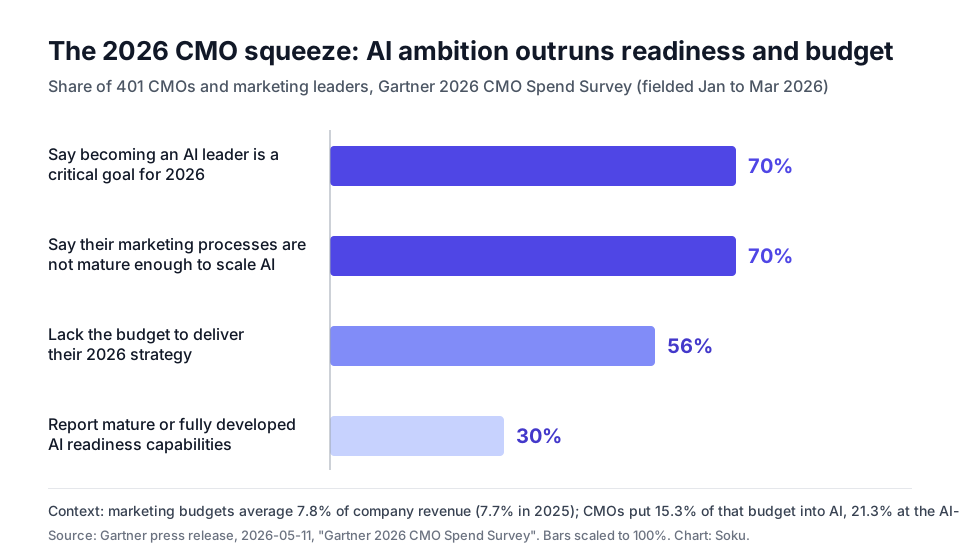
That gap between ambition and capacity is the real market for "AI CMO" software. The same survey found that 70% of CMOs call becoming an AI leader a critical goal for 2026, but only 30% report mature AI readiness. Those readier organizations put 21.3% of their marketing budget into AI and spend 8.9% of revenue on marketing.
The people are expensive and they turn over. The US Bureau of Labor Statistics reports a median annual wage of $166,790 for marketing managers in May 2025, with the top 10% above $293,610; a C-level CMO at a large company sits well above that. Spencer Stuart found average CMO tenure in the S&P 500 is 4.1 years against 5.0 for the C-suite overall, and 31% of S&P 500 companies have no enterprise CMO at all. Most smaller companies never had one. That is the gap AI CMO products are trying to fill.
The map: CMO responsibilities vs what software runs today
This is the core of the page. For each responsibility we give three answers: what an AI system can realistically do in 2026, what Soku specifically does today, and what still needs a person. We graded each row one of three ways:
- Runs it: software does the work end to end, with a person approving material changes.
- Assists: software does real work, but a person makes the decision that matters.
- Human: nothing we would trust software to own, Soku included.
Soku is an AI ad-automation agent for paid media, so the map is honest about where it stops. Each "Soku today" cell describes code that exists in Soku's codebase as of 2026-10-26; where a capability is narrower than the label suggests, the cell says so.
| CMO responsibility | Soku today | Grade | What stays with a person |
|---|---|---|---|
| Market and competitor intelligence | Pulls competitor ads through third-party ad-intelligence providers (Foreplay for Meta, TikTok, LinkedIn and Google ads; Adyntel for LinkedIn and Google ad transparency), runs web research, and reads public TikTok, X and YouTube content. It does not query the Meta Ad Library live. | Runs it | Deciding which competitor move actually matters |
| Positioning and brand | Crawls your homepage (and TikTok, Instagram, X or YouTube profiles) and extracts brand voice, selling points, target audiences and competitors into a brand profile, then keeps typed brand memory across sessions | Assists | Choosing the position and holding it |
| Budget allocation | Proposes and makes budget and status changes on Meta, Google Ads, TikTok, LinkedIn, ChatGPT Ads and Reddit; shows spend across channels. By default an auto-approved budget change above a set cap, or one that moves more than 30%, goes back to a person. An emergency stop pauses every live entity. There is no brand-wide total spend cap inside Soku; that limit stays with each ad platform. | Runs it, within limits you set | The total budget, channel ceilings and the call on big shifts |
| Campaign planning and launch | Creates campaigns, ad sets or ad groups, ads and audiences on Meta, Google Ads (including Performance Max), TikTok, LinkedIn and ChatGPT Ads. Each write waits on a review card; Meta and ChatGPT Ads launches are created paused. No Amazon, Snapchat, Pinterest or Microsoft Ads integration. | Runs it | The campaign brief and the launch decision |
| Creative production | Generates images (GPT Image 2.5 via fal in chat; GPT Image 2 and Nano Banana 2 on the Creatives canvas), video (Seedance 2.0 models, MiniMax H3), avatar and UGC-style video through Creatify, and ad copy variants | Runs it | Taste, claims and final sign-off |
| Testing and learning | Flags creative fatigue and scores Meta video ads on hook and hold rates; plans experiments. It does not set up native platform split tests. | Assists | Designing the test and accepting the result |
| Daily performance management | Autopilot evaluates your metric monitors every hour, reviews active goals, drafts proposals and, after a change runs, measures its effect. The default autonomy level (L1) needs a person to approve each proposal. | Runs it | Setting goals and approving actions |
| Measurement and attribution | Cross-checks ad-platform conversions against GA4, reads Shopify orders, accepts server-to-server revenue uploads and manages GA4 key events and GTM with your consent. No marketing mix modeling and no incrementality tests. | Assists | Choosing the source of truth and the attribution model |
| Reporting to the CEO and board | Emails saved dashboard boards on a schedule and diagnoses which account or campaign moved a metric | Runs it | The narrative, the trade-offs and the ask |
| Organic channels | Tracks up to 30 prompts across ChatGPT, Perplexity and Gemini answers (a Labs opt-in), reads Search Console, and can publish agent-written SEO pages to a domain you connect. No customer email campaigns and no scheduled organic social posting. | Assists | Editorial voice, email and social programs |
| Cross-functional alignment, pricing and product | Nothing | Human | All of it |
| Team, agency and partner leadership | Nothing | Human | All of it |
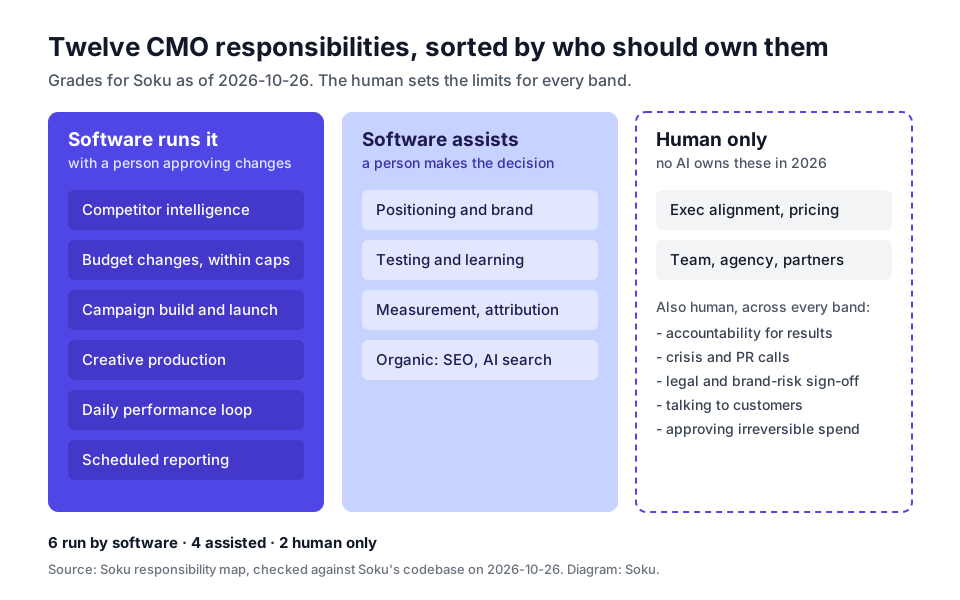
Tally it up and the shape is clear. Of twelve responsibilities, Soku runs six (inside limits a person sets), assists on four, and touches none of the last two. That is not a CMO. It is the execution and analysis layer a CMO would otherwise staff with a media buyer, a creative producer and an analyst.
How approval works in practice. In Soku, every ad-platform write that isn't on a read-only list is proposed as a review card, and an audit log records what was proposed and approved. A person can loosen that on purpose: an "always allow" rule for a type of change, a per-session allowance, or Autopilot's L2 level, which auto-approves only after guardrails pass. Two kinds of action never wait on a card: publishing SEO pages to a domain you've connected, and paid media generation. If you want everything gated, leave Autopilot at its default and don't add "always" rules.
Where Soku goes beyond the CMO-tool label. It runs a ChatGPT Ads account end to end, from setup and funding to balance monitoring that pauses campaigns when the account balance runs low. And it remembers: brand memory, a daily decision journal and past sessions carry context forward, so last month's rejected idea doesn't come back as new.
What no AI CMO can do in 2026, including ours
Some of the job is not a software problem, and pretending otherwise is how teams end up with a confident agent and no strategy. These are the parts we would keep with a person no matter which product you buy.
Own the outcome. A CMO is accountable to a CEO and a board for revenue they helped create. Software can produce the plan and the report, but it cannot be fired for a bad quarter, and that accountability is what makes people take a plan seriously. Even Minds, which sells an AI CMO persona, lists accountability as something its product cannot provide.
Choose who you are for. Positioning is a bet: which segment you serve, which you walk away from, what you will be known for. An agent can draft five positioning options and stress-test them against competitor ads. Picking one, and holding the line for two years while it compounds, is a judgment call about the company's future.
Set prices and shape the product. Many CMOs influence pricing, packaging and roadmap. Those decisions sit with product and finance, and they depend on context no ad account contains.
Align the executive team. A plan only works if sales, product and finance agree to it. That happens in meetings, through trust built over months. An agent cannot read the room or trade favors across departments.
Hire, coach and manage people and agencies. Building a team, giving feedback, firing an agency that isn't delivering: these are human relationships, and so is the CMO's network of agency contacts, journalists, partners and peers.
Handle a crisis. A product recall, a bad press cycle or an ad that offends people needs someone who can speak for the company, make a call in an hour and live with it.
Sign off on legal and brand risk. Claims in ads, regulated categories, influencer disclosure rules and contracts need a person with authority to approve them. An agent can flag risk; it should not be the last line.
Talk to customers. The best positioning insight usually comes from a sales call or a customer interview, not from a dashboard. Software can summarize what people say in public; it cannot sit across from your best customer and ask why they almost churned.
Be trusted with irreversible money. Ad spend that has been spent is gone. Even where software can change budgets, we believe a human should approve material changes, and Soku is built that way (see the map above).

Photo: Austin Distel on Unsplash.
Products that call themselves an AI CMO (prices verified 2026-10-26)
If you are shopping the label, here is what the products ranking for it actually do. We read each vendor's own site on 2026-10-26. We have not tested these products ourselves; the descriptions summarize what each vendor says it does.
| Product | What it actually runs | Paid ads? | Price on vendor site (2026-10-26) |
|---|---|---|---|
| Okara | Positioning brief and 30-day plan from your website, then SEO, AI-search, content, Reddit, X, LinkedIn and creator agents | Makes UGC ad creative; does not manage ad budgets (Okara's own comparison) | Free plan; paid from $129/mo, or $108/mo and $208/mo billed annually |
| Clara (claracmo.com) | Four agents: "Master CMO" planner, content, media (images and video) and research | Lists Facebook Ads among 50+ integrations; no ads management described | Starter $47/mo, Professional $97/mo, Enterprise $297/mo |
| AI CMO (tryaicmo.com) | Social listening across YouTube, Reddit, TikTok, X, LinkedIn and Instagram, daily summaries, and post drafts | No | Starter $49/mo, Growth $99/mo, Pro $199/mo ($39, $79, $159 billed annually) |
| Nyle | Amazon-first ads, bids, inventory-aware spend and Google Ads launches | Yes, Amazon Ads and Google Ads | From $249/mo (Starter) to $2,999/mo (Enterprise), 7-day trial |
| Superscale | Competitor ad research, creative strategy, static and video ad generation, performance analysis for Meta and Google | Reads performance; its site lists launch and scheduling as "coming soon" | $49 to $399/mo in credit tiers, $799+/mo custom |
| Minds AI CMO persona | A chatbot that reviews positioning and challenges plans | No | Not listed on the article |
Three patterns stand out. First, most products marketed as an AI CMO are organic-first: content, SEO and social. Second, the ones that touch paid media are narrow (Nyle is Amazon-led; Superscale is creative-led). Third, none of them claims to own the accountability, team or cross-functional parts of the job, and the more careful vendors say so.
Clara's homepage claims it replaces a "$180K marketing team" with a $97 plan and shows "2,847+" teams. We could not verify those figures; treat headline replacement claims from any vendor, including us, as marketing.
AI CMO vs fractional CMO vs full-time CMO
| AI CMO software | Fractional CMO | Full-time CMO | |
|---|---|---|---|
| What you get | Execution on the channels the tool connects to, from a plan it drafts and you approve | Senior judgment a few days a month; usually directs others | Strategy, team leadership and accountability |
| Typical cost | Roughly $50 to $3,000 a month for the products above | Priced by retainer; published rates come mostly from firms that sell the service | Marketing managers' BLS median is $166,790 a year (May 2025); CMOs earn more |
| Does the work itself | Yes, within its connected channels | Rarely | No, leads a team |
| Owns the outcome | No | Partly | Yes |
| Time to start | Minutes to days | Weeks | Months to hire |
The practical setup for most small and mid-size teams is a hybrid: software runs the daily execution loops, and a person (a founder, a head of growth or a fractional CMO) owns positioning, budget limits and the call on anything irreversible. For how that division of labor plays out when you hire outside help, see AI marketing agency vs traditional agency.
How to evaluate any AI CMO in a week
Whatever you trial, run the same five checks. They separate a tool that does the work from one that hands you a to-do list.
- Ask what it can write, not what it can see. Reading a dashboard is easy. List the systems the product can actually change (ad accounts, CMS, social profiles, email) and which of those changes need your approval.
- Give it a real goal with a real constraint. "Get cost per lead under $40 on Meta without raising daily spend" is a better test than "grow my brand". Watch whether it plans toward the constraint or ignores it.
- Check the approval trail. Every material change should leave a record: what was proposed, who approved it, what changed, and what happened next. If you can't reconstruct last Tuesday's budget change, you can't trust next Tuesday's.
- Test the measurement layer. Ask which conversion source it optimizes to and how it handles the gap between platform-reported and analytics-reported conversions. A tool that only reads platform numbers will grade its own homework.
- Price a normal month. Credit-based plans look cheap until agents run daily. Run a realistic week, then multiply.
Our comparison of 12 AI marketing agents scores products on exactly this axis: how far each one can act without you, and where it writes.
An operating model that works: the human sets the box, the agent works inside it
The teams that get value from AI in a CMO-shaped role split the work cleanly.
The person owns: the goal for the quarter, positioning and brand rules, the monthly budget ceiling per channel, what counts as a conversion, and approval of anything irreversible or public.
The software owns: the daily loops inside those limits. That means reading every account every day, flagging drift, drafting the budget shift or the new ad set, producing creative variants on brand, and writing the weekly report.
They meet in a review queue. The agent proposes; the person approves, edits or rejects; the agent records the decision and learns the pattern. A good weekly rhythm is fifteen minutes on Monday to clear the queue and set the week's constraints, and a monthly hour to re-check positioning and budget against results.
This is also where most "AI CMO replaced my team" stories fall apart. The software didn't replace judgment; someone kept making the judgment calls, and the software took the execution hours.
Where Soku fits, and where it doesn't
If your marketing runs mostly on paid media, Soku covers the half of the map that eats a CMO's week: competitor research, campaign builds, creative, daily optimization, budget moves inside your limits, and the weekly report, across Meta, Google Ads, TikTok, LinkedIn, ChatGPT Ads and Reddit. It works from Slack, Lark or the web app, and every ad-account write waits for your approval unless you choose otherwise.
It is the wrong buy if your growth is mainly organic content, lifecycle email or community; the organic-first products above, or a lifecycle platform, will fit better. It does not manage Amazon, Snapchat, Pinterest or Microsoft Ads. And it is not a CMO. It won't pick your positioning, set your prices, run your team or answer to your board. We'd rather say that here than have you find out in month two.
Where to go next
- The full overview of marketing agents: AI Marketing Agents in 2026, our pillar guide on what agents are and where they deliver.
- Choosing a product: Best AI Marketing Agents in 2026: 12 Platforms Compared, scored on how far each can act without you.
- Hiring outside help instead: AI Marketing Agency vs Traditional Agency, a ranked comparison of speed, cost, transparency and scope.
- How an agent runs paid campaigns safely: Agentic Advertising.