Soku AI
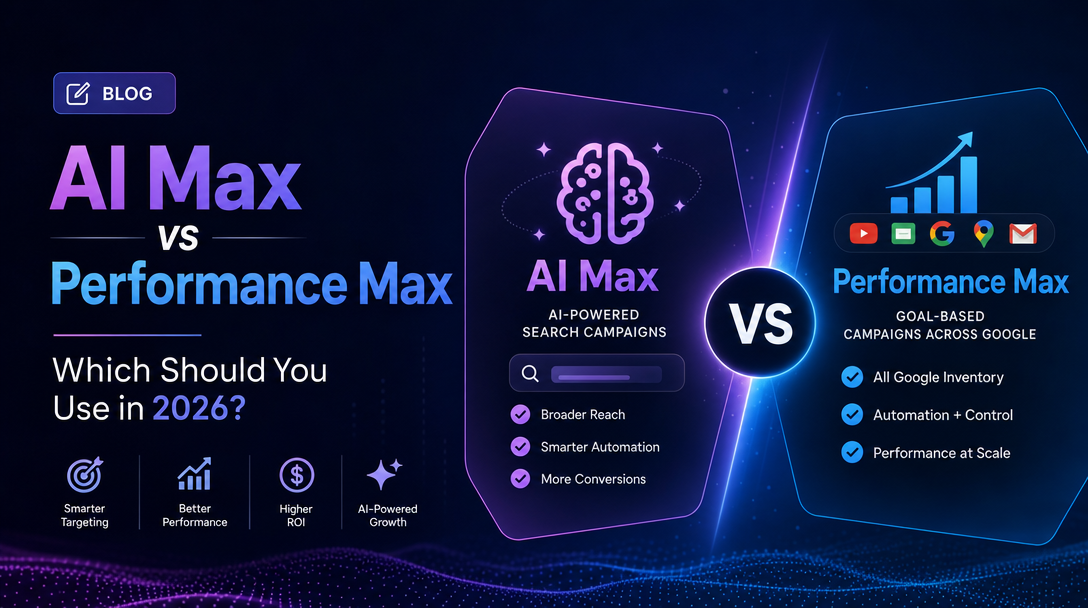
Two things called "Max", both sold on the same promise, and they are not the same kind of object. That is the entire source of the confusion, and it is why most comparisons of the two are subtly wrong.
Performance Max is a campaign type. You create one, and it runs across Search, Shopping, Display, YouTube, Gmail, Discover and Maps from a single budget.
AI Max is a setting on a Search campaign you already have. You switch it on, and your existing campaign — same budget, same ad groups, same keywords — starts behaving differently. (For the full picture of AI Max itself, see the complete AI Max for Search guide; this post is the focused comparison.)
That framing is correct but shallow, and it is where most articles stop. The useful question is not "what does each one add" — both add the same thing, which is Google's matching and generation models. The useful question is what does each one take away, because that is what you cannot get back without turning it off.
On that question, Google's own API documentation contains a detail that the marketing material does not lead with, and that changes how you should test AI Max.
Side by side
| AI Max for Search | Performance Max | |
|---|---|---|
| What it is | A setting on an existing Search campaign | A campaign type |
| Keywords | Still present, but match types stop functioning | None |
| Search term report | Yes, with new URL-parameter visibility | Partial, via search themes and category reporting |
| Negative keywords | Yes, full | Yes — up to 10,000 campaign-level, but they apply only to Search and Shopping inventory |
| Channels | Search only | Search, Shopping, Display, YouTube, Gmail, Discover, Maps |
| Landing page control | Final URL expansion on by default, with URL inclusion/exclusion lists | Asset-group level, with final URL expansion |
| Ad copy control | Text customization generates headlines and descriptions; constrained by text guidelines | Asset groups plus automatically generated assets |
| Reversibility | Toggle off; generated assets remain available for reporting | Not applicable — it is a separate campaign |
The thing almost nobody writes about
Nearly every explainer says some version of "AI Max keeps your keywords, it just finds more queries around them." The first half is true. The second half hides what actually happens.
From Google's Ads API documentation for AI Max for Search campaigns:
All keywords are treated as broad match by default when AI Max is enabled. The
Campaign.keyword_match_typefield becomes deprecated and non-functional. Individual keyword match types only take effect if search term matching is disabled at the ad group level usingAdGroup.AiMaxAdGroupSetting.disable_search_term_matching.
Read that again with an account in mind. If you have a Search campaign built on exact match — a branded campaign, a high-CPC legal or B2B campaign, a campaign where you spent months building phrase-match structure to separate intent tiers — enabling AI Max does not supplement that structure. It switches it off. Your [exact match] keyword and your "phrase match" keyword and your broad keyword all now behave identically.
The keywords are still there. They still show in the UI. They still accrue statistics. But the thing you were using them for — controlling which queries you pay for — is no longer being done by them.
The escape hatch is real but blunt: disable_search_term_matching at the ad group level restores match types for that ad group. So the practical pattern is not "AI Max on or off for the account", it is "AI Max on at campaign level, disabled on the ad groups whose match-type structure you actually depend on."
That is a materially different implementation plan from what "just turn it on and let it find more queries" implies.
Why this matters more than it sounds
Because it inverts the usual risk profile of a Google automation feature. Normally the risk is spend expansion — the system finds more queries, some are junk, you add negatives and move on. Here the risk is structural: an account whose intent tiers were encoded in match types loses that encoding the moment the setting flips, and the loss is invisible in the interface. Nothing warns you. The keyword still says "Exact".
If your account structure carries meaning in its match types, audit that before you enable anything.
What AI Max actually turns on
AI Max is a bundle, not a single behaviour. The components, per Google's own feature list:
- Search term matching — expands beyond your keywords using broad match plus keywordless technology. This is the component that deprecates match types.
- Text customization — generates headlines and descriptions using your existing ad text, your landing page copy, and generative models.
- Final URL expansion — sends the click to whichever page on your site the model judges most relevant, not necessarily the one you set.
- Locations of interest — ad-group-level geographic intent targeting.
- Brand controls — inclusion and exclusion lists at campaign and ad group level.
- URL inclusions and exclusions — the leash on final URL expansion.
- Text guidelines — the leash on text customization.
- Page feed inclusion lists — scoping expansion to a defined set of pages.
Two of those are leashes on the other two, which tells you where the friction is. Google shipped controls for text generation and URL expansion specifically because advertisers needed them. (When you do enable it, follow the AI Max setup guide so the guardrails go on before the expansion.)
The text guidelines are tighter than they look
Text guidelines are how you stop the model writing something you cannot legally or commercially say. The limits are specific:
- Term exclusions: up to 25 exact words or phrases, 30 characters each.
- Messaging restrictions: up to 40 freeform instructions, 300 characters each.
Twenty-five term exclusions is enough for a compliance blocklist in most verticals. It is not enough for a regulated advertiser with a long list of prohibited claims, and it is not enough for a large agency running one campaign across many brands. Check the ceiling against your legal list before you assume this is a solved problem.
What PMax actually takes away — and what it gave back
Performance Max's original trade was total: you gave up channel control, keyword control, placement visibility and most reporting, and got a single optimisation surface in return. Much of that has been walked back.
As of 2026, PMax has:
- Campaign-level negative keywords, up to 10,000. With one important caveat that gets dropped in summaries: they apply only to Search and Shopping inventory. They do nothing for your Display, YouTube, Gmail or Discover delivery.
- Brand exclusions, usable in two directions — excluding your own brand to stop PMax cannibalising a branded Search campaign, and excluding competitor brands to keep it prospecting.
- Channel-level reporting, showing budget allocation across Search, Shopping, Display, YouTube, Discover, Gmail and Maps. This was the single biggest complaint about PMax for two years and it is now largely addressed.
- Search themes with improved query-matching transparency.
- Asset-level insights with creative performance breakdowns.
What it still does not have is keyword-level bidding, ad-group-level query control, or the ability to say "spend this budget on Search and nothing else". If you need those, no amount of PMax controls will give them to you, and that has not changed.
Reading Google's numbers honestly
Google publishes two figures for AI Max:
- 14% more conversions or conversion value at a similar CPA/ROAS, for advertisers activating AI Max in Search campaigns.
- 27% for campaigns "still mostly using exact and phrase keywords".
Plus two named results: L'Oréal reported 2× higher conversion rate at 31% lower cost-per-conversion on net-new queries, and MyConnect reported 16% more leads at 13% lower cost-per-action, with a 30% increase in conversions from net-new queries.
The 27% figure is the one to think about, because the way it is framed is the way it should be doubted. The lift is largest precisely where the baseline was most restrictive. A campaign "still mostly using exact and phrase keywords" is a campaign that was, by construction, matching a narrow slice of queries. Loosening it will increase conversion volume. That is not a finding about AI Max's intelligence — it is arithmetic about match type.
The question the number does not answer is whether the incremental conversions are incremental to the business. Net-new queries that convert may be:
- genuinely new demand you were not reaching (real value), or
- demand that would have reached you anyway through organic, brand, or a different campaign (cannibalised value), or
- demand your existing exact-match campaign was already serving, now re-attributed (double-counted value).
None of Google's published figures separate those three. Neither does the interface. This is not a reason to skip AI Max — the L'Oréal net-new-query framing suggests at least some of it is genuine — but it is a reason to run it as a measured test rather than a switch you flip and declare a win from the in-platform delta.
When to use AI Max for Search
Use a Search campaign with AI Max when:
- Your campaign is mostly exact and phrase, has plateaued on volume, and you have headroom on CPA
- You have a broad site with many relevant landing pages (final URL expansion needs somewhere to expand to)
- You can define your compliance blocklist within the text-guideline limits
- You are prepared to disable search term matching on the ad groups that need their match types
Stay on a Search campaign without AI Max when:
- Your match-type structure encodes intent tiers you actively bid differently
- You are in a vertical where a wrong query is expensive (legal, medical, high-ticket B2B)
- Compliance requires exact control over ad copy beyond 25 term exclusions
- You need clean, attributable search-term data for a keyword-expansion workflow
When to use Performance Max
Use Performance Max when:
- You have a product feed and Shopping is a meaningful channel
- You want cross-channel delivery from one budget and genuinely do not need channel control
- You have enough conversion volume for the model to learn — PMax is unforgiving in thin-data accounts
- You are prospecting, and you have set brand exclusions so it does not eat your branded Search
Run both when: you have a branded Search campaign that must stay exact-match and protected, plus a prospecting motion that benefits from cross-channel reach. This is the common mature setup, and the thing that makes it work is not clever bidding — it is brand exclusions on the PMax side so the two are not bidding against each other for the same query.
The decision guide
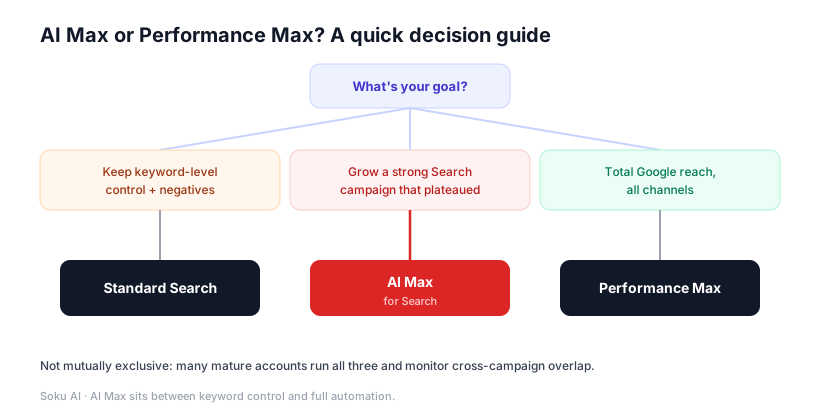
A simple way to choose:
- Need precision and negatives? → Standard Search.
- Strong Search that plateaued? → AI Max for Search.
- Want total Google reach, bidding does the work? → Performance Max.
The cannibalisation problem nobody solves by accident
Search-with-AI-Max and PMax overlap on Search inventory. Google's auction resolves the internal conflict by preferring the campaign with higher Ad Rank, which means your two campaigns are silently competing on a signal you did not choose.
Three things reduce it:
- Brand exclusions on PMax, so branded queries route to the Search campaign that is supposed to own them.
- Campaign-level negatives on PMax for the query classes your Search campaign owns — remembering they only bind on Search and Shopping.
- Not enabling AI Max on the branded Search campaign, because branded terms are exactly where query expansion buys you the least and costs the most.
That third one is worth stating plainly: the campaign most likely to show a good AI Max result in the interface — the branded one, where conversion rates are high — is the campaign where the incremental value is closest to zero.
A test protocol that produces an answer
If you enable AI Max across an account and compare month over month, you will get a number and it will mean nothing. Seasonality, budget changes and query-mix drift will all be inside your delta. A protocol that survives review:
- Audit match-type dependence first. List the ad groups whose match types encode a bidding or routing decision. Those get
disable_search_term_matching. - Pick one campaign, not the account. Preferably a non-brand campaign that has plateaued.
- Freeze everything else — budget, bid strategy, target, assets — for the duration.
- Record the pre-period search term composition. You need to be able to say later which conversions came from queries you were already matching.
- Run at least two full conversion cycles. If your median lag is 7 days, a 14-day test is one cycle and tells you nothing.
- Judge on net-new query conversions, not total conversions. Total will go up; that is not the question.
- Check the landing-page distribution. Final URL expansion is on. If conversions rose but they all landed on a page you would not have chosen, you learned something about your site, not about AI Max.
How Soku fits
Soku connects to Google Ads and reads the account the way this article suggests you should: it pulls the search terms report with match-type composition, so the "which conversions came from queries you were already matching" question is answerable rather than theoretical, and it flags when a campaign's effective match behaviour has diverged from its configured match types — which is precisely the state AI Max puts you in.
For the test protocol above, the parts that are tedious by hand — pinning date ranges so a comparison is not quietly reshaped by a moving window, holding the query-composition baseline, and separating net-new queries from re-attributed ones — are the parts worth automating. The judgment about whether to enable it stays with you.
You can see the account-level version of this in the Google Ads MCP guide, and the broader agent operating model in the Meta Ads MCP guide — the read-heavy, write-gated pattern applies identically to Search automation.
Where to go next
- AI Max for Search: the complete guide — the full picture of the feature this comparison keeps referencing
- Google Ads MCP: the complete guide — connecting an agent to the account these decisions live in
- Best AI media buying tools, ranked — where automation layers sit relative to the platforms
- The DSA → AI Max auto-migration timeline — if you still run Dynamic Search Ads, this decision has a deadline
FAQ
Is AI Max a replacement for Performance Max?
No, and they are not substitutes for each other. AI Max is a setting you enable on an existing Search campaign; Performance Max is a separate campaign type that runs across Search, Shopping, Display, YouTube, Gmail, Discover and Maps. AI Max only affects Search inventory. If your reason for considering PMax is cross-channel reach or a product feed, AI Max does not address it at all. If your reason is "I want Google's models to find more queries on Search", AI Max does that while keeping the Search campaign's reporting and negative keyword controls.
Does AI Max keep my keywords?
Your keywords remain in the campaign, but their match types stop functioning. Google's Ads API documentation states that all keywords are treated as broad match by default when AI Max is enabled, and that Campaign.keyword_match_type becomes deprecated and non-functional. Individual match types only take effect again if search term matching is disabled at the ad group level via AdGroup.AiMaxAdGroupSetting.disable_search_term_matching. So if your account structure depends on exact and phrase match to separate intent, enabling AI Max removes that separation even though the keywords still appear unchanged in the interface.
Can I use negative keywords with Performance Max in 2026?
Yes. Performance Max supports up to 10,000 campaign-level negative keywords, plus account-level negatives. The important limitation, which is frequently omitted, is that they apply only to Search and Shopping inventory — they do not filter Display, YouTube, Gmail or Discover delivery. For those channels you need placement exclusions and brand exclusions instead, which are separate controls.
What lift does Google claim for AI Max, and should I believe it?
Google publishes 14% more conversions or conversion value at a similar CPA/ROAS, rising to 27% for campaigns still mostly using exact and phrase keywords. Treat the 27% figure carefully: the lift is largest where the baseline was most restrictive, so a large part of it is the arithmetic of loosening match type rather than evidence of model quality. Google's named results — L'Oréal at 2× conversion rate and 31% lower cost-per-conversion on net-new queries, MyConnect at 16% more leads and 13% lower CPA — are more informative because they are framed around net-new queries specifically. None of the published figures separate genuinely incremental demand from demand that would have arrived through brand, organic, or another campaign.
Will AI Max and Performance Max compete against each other?
On Search inventory, yes, and Google resolves the conflict by Ad Rank rather than by your intent. The standard mitigations are brand exclusions on the PMax campaign so branded queries route to the Search campaign that should own them, campaign-level negatives on PMax for the query classes your Search campaign owns, and not enabling AI Max on branded Search campaigns in the first place. That last point matters because the branded campaign is where AI Max will look best in the interface and deliver the least incremental value.
Can I turn AI Max off if it does not work?
Yes — it is a campaign setting, so you can disable it. Text customization assets generated while it was on remain available for reporting after you turn it off, so you keep the record of what ran. What you should not assume is that the account returns instantly to its prior state: bid strategies will have been learning against a different query mix, so plan for a re-learning period rather than an immediate revert.
Should I enable AI Max on a branded Search campaign?
Generally no. Branded queries already convert at high rates, so query expansion there tends to add low-intent variants at the margin while risking overlap with your other campaigns. The in-platform numbers will often look good precisely because the baseline conversion rate is high, which makes branded campaigns the easiest place to draw a false conclusion about AI Max's value. Test it on a non-brand campaign that has plateaued on volume instead.
Should I move my DSA campaigns to AI Max or Performance Max?
Google auto-migrates remaining DSAs to AI Max or Performance Max starting February 2027 — but test first. See the DSA migration timeline.
Sources: Google Ads Help — AI Max for Search FAQ, Google Ads API — AI Max for Search, Search Engine Land.