 Soku AI
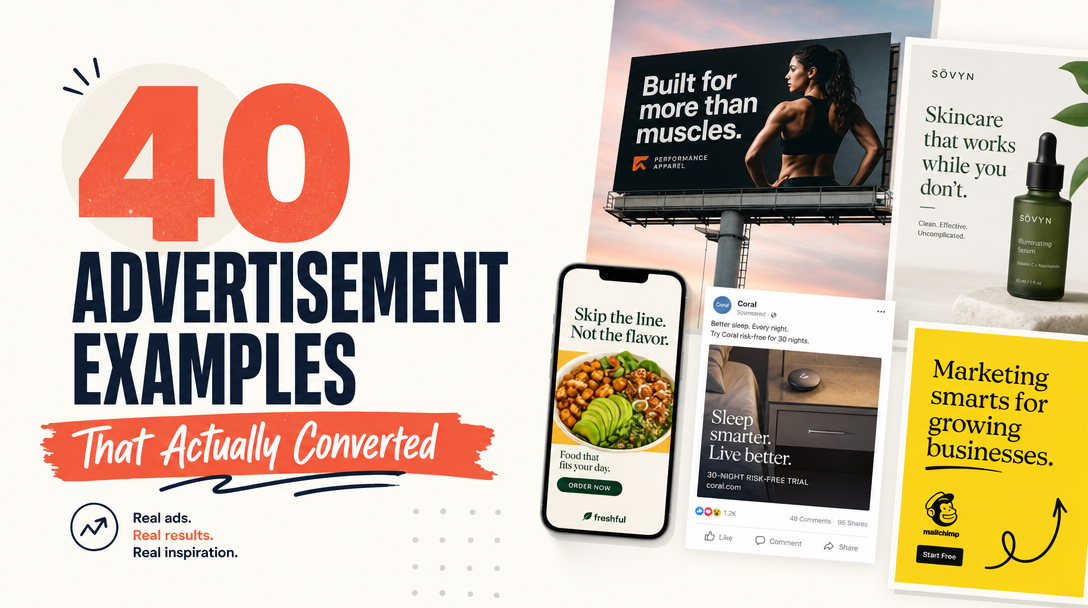
Most "ad examples" posts are a mood board. Forty screenshots of beautiful creative, a sentence of praise under each, and a conversion statistic that came from nowhere. You finish it inspired and no better at making ads.
This list is organised differently. Each example is filed under the persuasion job it performs, because that is the only part that transfers. You cannot use Old Spice's execution. You can absolutely use its mechanism.
How to read this list — and what "converted" means here
A note on evidence, because it changes what this list is worth.
Reliable, checkable performance data for famous advertising is rare. Brands publish results that flatter them, agency case studies are marketing for the agency, and platform case studies are chosen by the platform. Nearly every ad-example article you will find attaches a confident percentage to a famous campaign with no methodology, no control group and no source you can check.
So this list does not do that. Where a campaign is widely documented as a commercial success, it is included on that basis and described as such. Where hard numbers are not public, no number is invented to fill the gap. What every entry does carry is the mechanism — which is the part you were going to use anyway, and the part that is actually verifiable, because you can see it working in the ad itself.
Copy mechanisms. Never copy executions.
1. Reframe The Category
The most valuable thing an ad can do is change what the purchase is. These work when your audience understands your product fine and has filed it in a category where you lose.
1. De Beers — "A Diamond Is Forever." Turned a commodity mineral into the compulsory symbol of commitment, and in doing so invented the expected spend. The mechanism: attach the product to a social ritual so that not buying it becomes a statement.
2. Apple — "Get a Mac." Reframed a spec comparison as a personality comparison. When you cannot win on the axis the customer is using, change the axis.
3. Dove — "Real Beauty." Moved soap out of aspiration and into recognition. Mechanism: reject the category's dominant emotional register when it is exhausted and the audience is tired of it.
4. Red Bull — "Gives You Wings." Sold a functional stimulant as permission for ambition. The product's actual benefit was reframed as an identity.
5. Liquid Death — canned water sold as heavy-metal merchandise. Took the least differentiated product in existence and moved it into a category where differentiation is the whole point. Mechanism: if your product cannot be different, the context can be.
How to use this group: write your category's default promise in one sentence, then write the opposite. If the opposite is true of your product and sounds like a relief, you have a reframe.
2. Attack A Specific Incumbent
Comparison converts because it borrows the incumbent's existing consideration. Risky, effective, and legally constrained — only claim what you can substantiate.
6. Avis — "We're number two. We try harder." Turned a weakness into the reason to choose. The most-copied comparative mechanism in advertising.
7. Pepsi Challenge. A blind taste test as the entire creative. Mechanism: if the product genuinely wins a fair test, make the test the ad.
8. Dollar Shave Club — "Our Blades Are Fing Great."* Attacked incumbent pricing logic in the first ten seconds, then made the alternative feel obvious. The comedy is the delivery, not the mechanism.
9. Samsung's long-running iPhone comparisons. Feature-by-feature attacks aimed at people already in the consideration set. Works because it targets the switch, not the category entrant.
10. Wendy's fresh-versus-frozen positioning. A single, checkable product fact used as the whole comparative wedge.
How to use this group: pick one attribute where you genuinely win, and make sure it is one the customer already cares about. Attacking on an attribute nobody weighs is the standard failure here. Our alternatives pages are this mechanism in written form.
3. Demonstrate The Product Working
The highest-converting mechanism for most direct-response accounts, because proof and persuasion arrive in the same asset.
11. Blendtec — "Will It Blend?" An absurd durability demonstration that is also a complete product spec.
12. Purple mattress — the raw-egg drop test. Turns an invisible engineering claim into something visible in four seconds.
13. Squatty Potty. Made an unmentionable mechanism explainable and shareable through a diagram-in-motion.
14. Any well-made before/after skincare or fitness sequence. The oldest converting format in direct response, and still the most reliable where the change is visible and honest.
15. Software screen recordings that start mid-task. No logo, no intro — the interface doing the specific thing the viewer wants. Consistently outperforms polished brand film on performance placements.
How to use this group: find the single moment where your product visibly does the thing, and open on it. The most common mistake is spending three seconds on branding before the demonstration starts, on a placement where three seconds is the entire ad.
4. Borrow Credibility
You are not the most persuasive voice about your product. Someone else is.
16. Founder-to-camera explaining why they built it. Low production, high trust, and it survives creative fatigue longer than polished work because it reads as a person rather than an ad.
17. UGC-style customer testimonial. Converts because it looks like the surrounding feed. The moment it looks produced, the mechanism inverts.
18. Expert endorsement — the dentist, the mechanic, the trainer. Transfers authority from a profession the audience already trusts.
19. Press-quote stacks. Three publication logos with one line each. Cheap to produce, works on cold traffic where nobody has heard of you.
20. Screenshotted reviews and comment sections as the creative. Third-party voice with zero production cost. Frequently the top performer in a creative test and rarely tested at all.
How to use this group: the credibility must be real. Fabricated testimonials are both a compliance problem and, in practice, obvious to the audience.
5. Remove A Named Risk
For considered purchases, the barrier is usually not desire — it is fear of a specific bad outcome.
21. Warby Parker — home try-on. The entire ad is the removal of the "what if they don't suit me" risk.
22. Casper and the 100-night trial. Made a high-consideration purchase reversible, and made reversibility the message.
23. Zappos free returns both ways. The policy is the ad.
24. "No credit card required" on a free trial. One line that removes the largest single objection in SaaS signup.
25. Money-back guarantees stated as the headline rather than buried in the footer. Moving the guarantee from small print to headline is one of the cheapest tests available.
How to use this group: ask five recent customers what nearly stopped them buying. Their answer, addressed directly in a headline, is usually a better ad than anything in a brainstorm.
6. Create Or Name The Occasion
If there is no moment to buy, manufacture one.
26. Spotify Wrapped. An annual occasion the audience creates the creative for. Mechanism: give people a personalised artefact they want to publish.
27. Guinness and St Patrick's Day. Attaching a brand to an existing calendar moment until the association runs both ways.
28. Hallmark and the manufactured greeting-card occasion. The purest version: invent the day, sell the product for it.
29. Black Friday as a category-wide occasion. Now so established that the mechanism has inverted — participation is the default and abstaining is the statement.
30. "Back to school" in categories with no school connection. Borrowing an existing occasion's urgency for an unrelated product.
How to use this group: occasion beats discount, because a reason to buy now survives after the discount ends and trains nobody to wait for the next sale.
7. Dramatise The Cost Of Inaction
Loss framing, used carefully. Powerful, and the mechanism most likely to be executed badly.
31. Public-health campaigns using consequence imagery. The reference case for loss aversion in advertising.
32. Security and insurance ads that open on the aftermath rather than the protection.
33. "Your competitors are already doing this." Category-standard B2B, effective because the loss is social rather than financial.
34. Cart-abandonment reminders naming what is still in the basket. The specificity is the mechanism — a named item is a real loss in a way that "items in your cart" is not.
35. Genuine scarcity — the last of a run, a closing enrolment. Works exactly as long as it is true. Fake scarcity is the fastest way to destroy an account's credibility with repeat buyers, and it is detectable.
How to use this group: loss framing outperforms gain framing on the same offer often enough to always be worth testing, and it curdles into manipulation quickly. The line is whether the loss is real.
8. Make The Offer The Message
Sometimes the creative's only job is to get out of the way.
36. A single price on a plain background. Converts hard when the price is genuinely disruptive.
37. Amazon's "free two-day shipping" era. Not a creative idea — a logistics achievement stated plainly, repeatedly, for years.
38. "First month free" as the entire headline. No metaphor, no story.
39. Bundle-value maths shown as arithmetic — the components, their separate prices, and the total struck through. The creative is a sum.
40. Search text ads that simply state the offer. The highest-intent placement in advertising rewards specificity and punishes cleverness more than any other.
How to use this group: if your offer is genuinely better, creative sophistication can only get between it and the buyer. Test the plainest possible statement of it — this is the control that a surprising number of accounts have never run.
What To Actually Do With This
Three steps, in this order.
Diagnose the friction first. Your audience is stuck at one of three points: they do not understand the category (use groups 1 and 3), they understand it but prefer someone else (groups 2 and 4), or they want it and hesitate (groups 5, 6 and 7). Most failing creative is solving the wrong one of the three, and no amount of production quality fixes that.
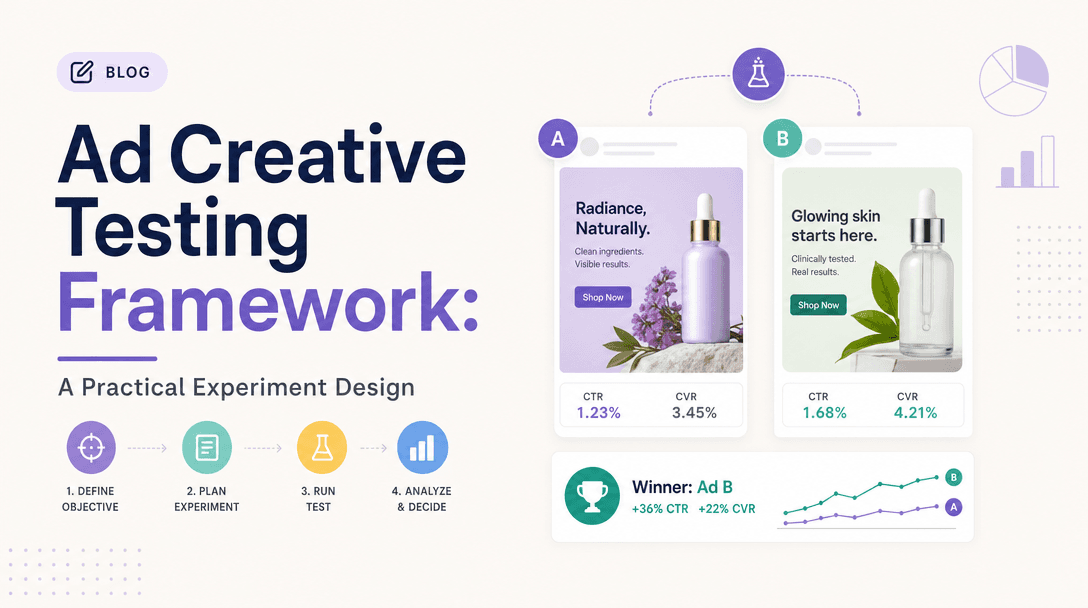
Test mechanisms against each other before you test executions. Four ads using four different mechanisms will teach you more in one cycle than twenty headline variants of the same idea. Once a mechanism wins, then iterate inside it — that is when variant volume starts paying. The framework for running that properly is in our ad creative testing guide, and if the constraint is producing the variants at all, creating 100 ad variants with AI covers the production side.
Write the mechanism down before you brief. One sentence, no brand nouns: "Remove the fear that it will not fit." If your brief cannot be reduced to a sentence like that, the resulting ad will be decoration, and it will test like decoration.
The reason to hold examples loosely is that the execution is the part that expires. Every ad in this list is dated; several are decades old and would fail outright as posted today. The mechanisms underneath them have not changed at all, and that is the only durable thing in a swipe file.