 Soku AI
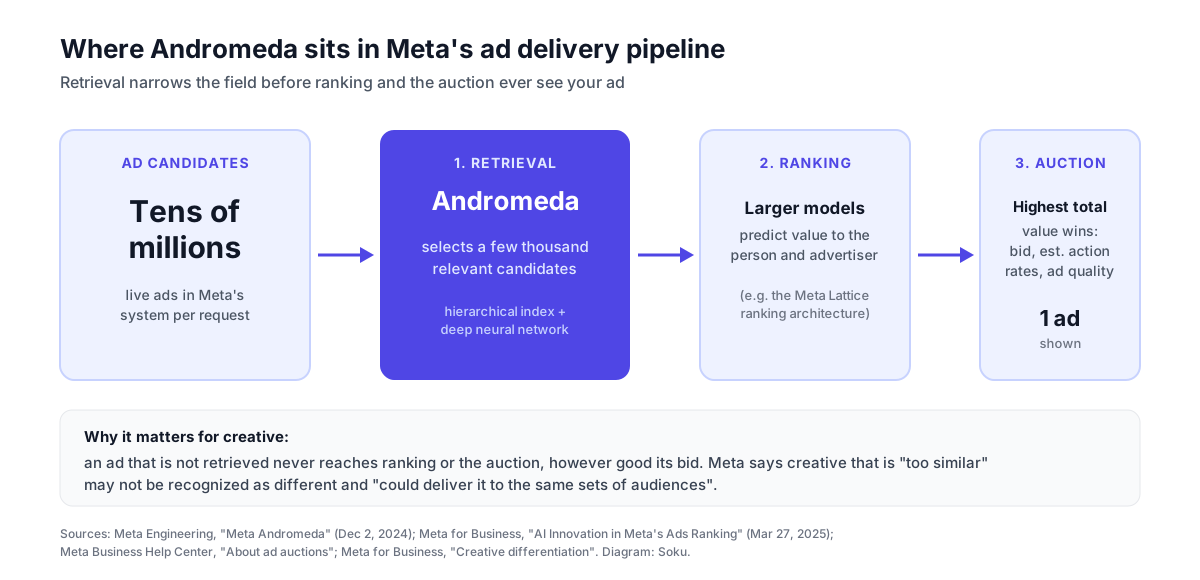
Meta Andromeda is the system that decides which of your ads are even considered for a given person. Meta's ad pipeline has stages. Before ranking models predict who will convert, and before the auction weighs your bid, a retrieval stage picks a few thousand relevant ad candidates from tens of millions. Andromeda is the engine Meta built for that first cut, announced on its engineering blog on December 2, 2024.
That matters for advertisers for one reason. If the first cut prefers ads that are genuinely different from each other, then twenty ads that are really one idea in different colours give the system one option, not twenty. Meta's own advice since Andromeda has moved in exactly that direction: it now says the focus has shifted "from niche targeting to creative diversification" as the main way to find the right audience.
Most of what's written about Andromeda goes much further than Meta has. You'll read that it "uses computer vision to fingerprint every ad", that it assigns "Entity IDs", that it rolled out in October 2025, that you need exactly 8 to 15 ads per ad set. Some of this may be true. Meta hasn't said any of it.
So this guide keeps three things apart, and labels each one:
- Meta says: stated in a Meta engineering post, newsroom post or Business Help Center article, linked at the claim.
- Practitioner claim, not confirmed by Meta: widely repeated by agencies and tool vendors, with no Meta primary source we could find.
- Soku recommends: our editorial judgement, built from the confirmed mechanics.
It ends with two things you can use: a creative-diversity audit worksheet and an account-structure rebuild. Last verified: 2026-10-08. For the full account blueprint, see Meta Ads account structure. For when individual ads wear out, see creative fatigue benchmarks.
What Meta Andromeda actually is (Meta says)
Andromeda is a retrieval system. The engineering post explains the stages directly: "Retrieval is the first step in our multi-stage ads recommendation system. This stage is tasked with selecting ads from tens of millions of ad candidates into a few thousand relevant ad candidates. In the following stage, larger and more sophisticated ranking models predict people and advertiser value to determine the final set of ads to be shown to the person."
Here's what Meta has stated about how it works, all from the December 2024 engineering post unless noted:
- Why it was built. Retrieval "processes three orders of magnitude more ads than subsequent stages", and Meta expected generative AI creative tools to make the number of ads "grow significantly". The old system "relied on a process with isolated model stages and numerous rule-based heuristics" and could apply only "limited personalization".
- What it is. It's a deep neural network co-designed with NVIDIA Grace Hopper Superchip and Meta's MTIA accelerator. Meta says this allowed "a meaningful increase of model capacity (10,000x) for enhanced personalization".
- How it scales. Andromeda "organizes ads into a hierarchical index with multiple layers, reducing the number of inference steps by focusing only on most relevant nodes". The index and the retrieval model are trained together. Meta describes this as built "to support exponential ad creatives growth from Advantage+ creative".
- Results Meta reports. Across Instagram and Facebook, Andromeda delivered "+6% recall improvement to the retrieval system" and "+8% ads quality improvement on selected segments". In March 2025 Meta's business newsroom restated the 8% ads quality figure and called Andromeda "the personal concierge".
- Where it's heading. Meta wrote that the architecture "is expected to transition to support an autoregressive loss function", leading to "a more diverse set of ad candidates", and that "increased ad diversity can improve people's experience with ads and drive better advertiser outcomes."
Two things are missing from Meta's description, and they matter. Meta never says Andromeda measures how similar your creatives are. It also never says Andromeda merges similar ads into one. The engineering post is about model capacity, indexing and hardware. The case for creative diversity comes from Meta's advertiser guidance, published alongside, which is covered next.
Andromeda is also one of several systems. In the same March 2025 newsroom post, Meta lists GEM, a large ads recommendation model, Lattice, its "ad ranking architecture", and sequence learning. When an article blames "the Andromeda update" for every change in your account, it's crediting one stage with the work of the whole pipeline. After retrieval, Meta's auction still picks the ad with the highest "total value", which combines your bid, estimated action rates and ad quality.
Every number Meta has published, in one place
Most Andromeda articles quote one or two of these numbers without saying where they came from. Here is every performance figure we found in Meta's own Andromeda and creative-diversification material. All of them are self-reported, most are averages or "selected segments", and none has been independently audited.
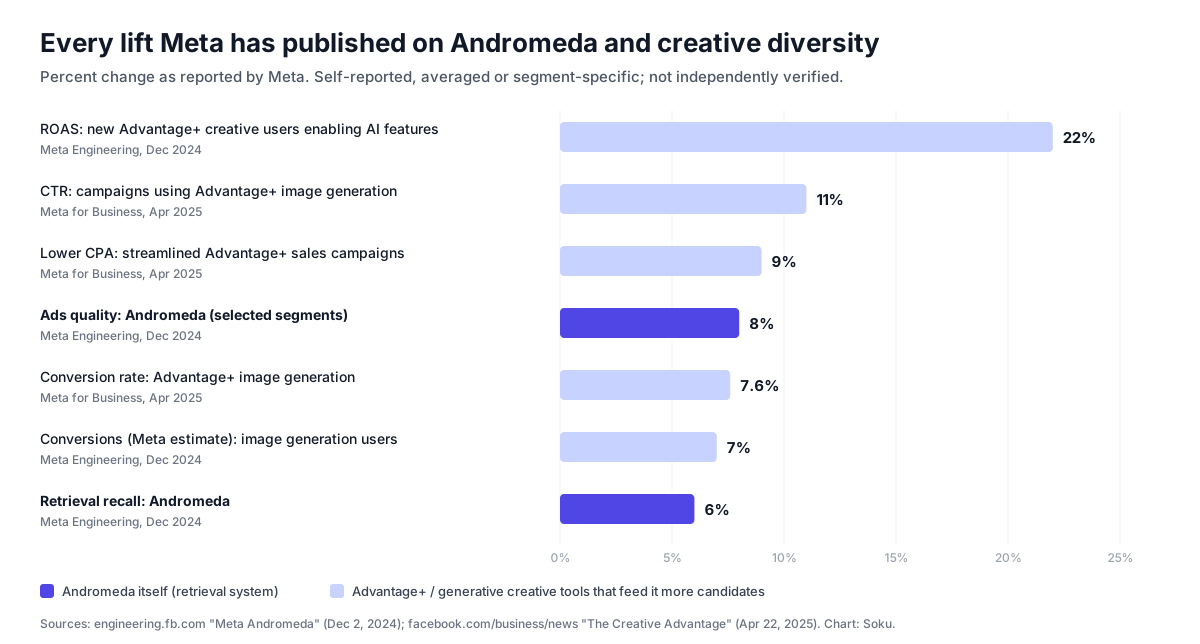
Look at which bars belong to Andromeda. Only the 6% recall and 8% ads quality figures measure the retrieval system. The larger numbers describe the tools that feed retrieval more candidates: Advantage+ creative, image generation, and the streamlined Advantage+ sales campaign setup. That fits Meta's framing. Andromeda is the infrastructure that lets the system cope with far more creative, and creative diversification is what Meta wants you to do with that capacity.
Why near-duplicate variants get grouped
This is the claim behind most Andromeda advice, so here are the three levels of evidence for it.
Meta says. On its creative differentiation guidance page, Meta writes: "When creative is too similar, our system may not recognize it as different and could deliver it to the same sets of audiences. This overlap limits your reach and ultimately leads to Creative limited or Creative fatigue status." The same page adds that "creative needs to be meaningfully different" and that "true creative diversification is a spectrum."
Meta also has a metric for it. The Business Help Center describes a Creative diversity metric that is "calculated by comparing the images and video thumbnails in your ad set to each other to determine similarity," converted to a score and labelled High, Medium or Low. Meta says it's used "to determine if more varied images and videos need to be added to an ad set to help prevent creative fatigue and improve performance". The metric is marked "estimated" and "in development."
Meta also defines the two delivery statuses that the overlap leads to. In Creative fatigue recommendations, Meta considers "all recent exposures of the ad's image or video, including those from other campaigns from your Page". Creative limited appears when cost per result is above your past ads but less than twice as high. Creative fatigue appears at twice or more. Meta's first recommended fix is a new image or video "that is materially different from the original creative."
Practitioner claim, not confirmed by Meta. The "Entity ID" model. Agencies and tool vendors describe Andromeda as giving a shared ID to ads that look alike, so that "50 ads clustered into one Entity ID get one ticket to the auction." Some go further and say it uses computer vision, language models and audio analysis to fingerprint each ad. We found no Meta source that uses the term "Entity ID" or describes this mechanism, and at least one vendor that popularized the term, AdsUploader, says outright that it is "an explanatory device for this clustering behavior rather than an official term Meta publishes." Treat it as a useful mental model, not a documented feature.
Soku recommends. You don't need the Entity ID story to act on this, because Meta's own statements are enough. If Meta counts recent exposures of the same image or video across campaigns, and its diversity metric compares thumbnails, then a recoloured or resized version of an ad probably reaches the same people as the original and wears out on the same schedule. Plan as if near-duplicates share one budget of attention. Whether Meta implements that as an ID, a cluster or a similarity penalty doesn't change what you should do.
What "creative diversity" means concretely
Meta's guidance points to three kinds of difference. Formats ("the system needs different formats to thrive"). Customer motivations ("featuring the same product through various angles like price, performance or ease of use"). And personas: Meta's three-step diversification guide suggests building "personas that outline different customer needs and blockers to purchase", for example deals for younger shoppers and reviews or demonstrations for older ones. It also tells advertisers to "forget the idea of a 'perfect ad'."
Turned into something you can audit, that gives six dimensions. Two ads are meaningfully different when they differ on the dimensions near the top of this table, not only the ones at the bottom.
| Dimension | What changes | Counts as diversity | Does not count |
|---|---|---|---|
| Concept / angle | The reason to buy | Problem-solution vs. founder story vs. social proof vs. price | Same claim reworded |
| Persona | Who the ad is for | New parent vs. gym regular vs. gift buyer | Same person, different shirt |
| Hook | First 2 seconds or first line | Question vs. bold claim vs. demo-in-motion vs. objection | Same opening, new caption font |
| Format | How it's consumed | UGC video vs. static vs. carousel vs. talking head | Same video at 1:1, 4:5, 9:16 |
| Visual world | Setting, talent, style | Kitchen vs. gym vs. office; creator vs. studio | Background colour swap |
| Proof / offer | Why believe, why now | Review vs. stat vs. demo; bundle vs. free shipping | Button text "Shop now" vs. "Buy now" |
Resizes and placement crops are still worth doing, because Meta recommends asset customization by placement. Just treat them as one ad served well everywhere, not as new creative. The same goes for Advantage+ creative enhancements and AI background generation. Meta reports real lifts from them (the chart above), and Meta's creative-differentiation page explicitly offers image generation and expansion as a way to "get even more image variety". They are a cheap layer on top of real concept diversity, not a replacement for it.
The creative-diversity audit worksheet
This is the original part of this guide. It's a worksheet you can run on any ad set in about 20 minutes. It's our method (Soku recommends); the thresholds are editorial judgement, not Meta rules.
Step 1. List every active ad in the ad set and tag it on the six dimensions. Use the values you'd use in a campaign naming convention, so this tagging can live in your ad names afterwards.
Step 2. Group ads that share the same concept, persona and hook. Format and visual world alone don't make a new group. Each group is one "idea".
Step 3. Count ideas, not ads, and compare against spend.
Here is a worked example. The ads are hypothetical, for a skincare brand, to show how the worksheet reads:
| Ad | Concept | Persona | Hook | Format | Visual world | Idea group |
|---|---|---|---|---|---|---|
| A1 | Problem-solution (dull skin) | 30s office worker | "Why does my skin look tired at 3pm?" | UGC video 9:16 | Bathroom, creator | 1 |
| A2 | Problem-solution (dull skin) | 30s office worker | "Why does my skin look tired at 3pm?" | UGC video 4:5 | Bathroom, creator | 1 |
| A3 | Problem-solution (dull skin) | 30s office worker | "Why does my skin look tired at 3pm?" | Same video, green background | Bathroom, creator | 1 |
| A4 | Problem-solution (dull skin) | 30s office worker | Same hook, new caption | Static 1:1 | Bathroom, creator | 1 |
| A5 | Social proof | Skeptical first-time buyer | "4,000 reviews, here are the worst ones" | Carousel | Screenshots | 2 |
| A6 | Price / offer | Deal seeker | "Starter kit under $20" | Static 4:5 | Flat lay | 3 |
Six ads, three ideas, and four of the six are one idea. If idea 1 also takes most of the spend, the ad set looks diversified in Ads Manager but behaves like a one-concept ad set.
Step 4. Score it.
| Check | Healthy | Warning | Action |
|---|---|---|---|
| Distinct ideas per ad set | 4+ | 1–2 | Brief new concepts, not new cuts |
| Share of ads in largest idea group | Under 40% | Over 60% | Pause duplicates, keep the best execution |
| Formats represented | 3+ (video, static, carousel) | 1 | Add a format to an existing winning idea |
| Personas addressed | 3+ | 1 | Write a brief per persona |
| Meta "Creative diversity" column | High or Medium | Low | Add visually different images and video |
| Delivery status | Active | Creative limited / Creative fatigue | New, materially different image or video |
Step 5. Write the next brief from the gaps. If every idea is problem-solution, the next brief is social proof or founder story. If every ad is UGC, the next one is a static offer or a demo. This is the weekly loop Meta describes in its three steps: find the top performers, form a hypothesis about why they work, and brief "a new opportunity or audience you'd like to reach and a creative direction that could resonate."
Account structure: what changes, and what Meta actually recommends
Andromeda didn't change the rules of account structure. It made the old consolidation argument stronger. Here's what Meta has documented.
Meta says, on learning. Ad sets usually exit the learning phase "after about 50 results in the week after the ad set's last significant edit", according to About the learning phase. The same article advises: "Avoid high ad volumes. When you create many ads and ad sets, the delivery system learns less about each ad and ad set." It also says that by combining similar ad sets, "you also combine learnings."
Meta says, on ad volume. About managing ad volume states that "when an advertiser runs too many ads at once, each ad delivers less often" and that "too many ads can result in worse performance." Its best practices are to combine ad sets split by audience, geography, placement or language, using breakdowns for reporting, and to "decrease ads per ad set, but maintain diverse creative assets per ad set". It notes that one ad "can contain multiple (up to 10) creative assets." An earlier version of that page recommended six or fewer creatives per ad set. As Jon Loomer documented, Meta has since removed that line.
Meta says, on Advantage+ sales campaigns. Its three-step diversification guide, from the 2024 holiday season, recommends "maintaining at least 20 diversified ads in Advantage+ shopping campaigns and dedicating 20-30% of your overall ad budget towards testing new ads", plus launching new ads weekly.
Meta says, on targeting. Meta's April 2025 post says the focus "has shifted from niche targeting to creative diversification as the best lever to find the most relevant audiences," and that varied creative can help reach audiences advertisers "might not have realized would be interested in their product."
Those statements look contradictory: fewer ads per ad set, but at least 20 ads. They aren't. Both say the same thing: give the system more distinct ideas without splitting the learning. Twenty diversified ads in one consolidated Advantage+ campaign meet both. So do six ads that each carry several genuinely different assets. Thirty near-identical ads spread across eight interest-based ad sets meet neither.
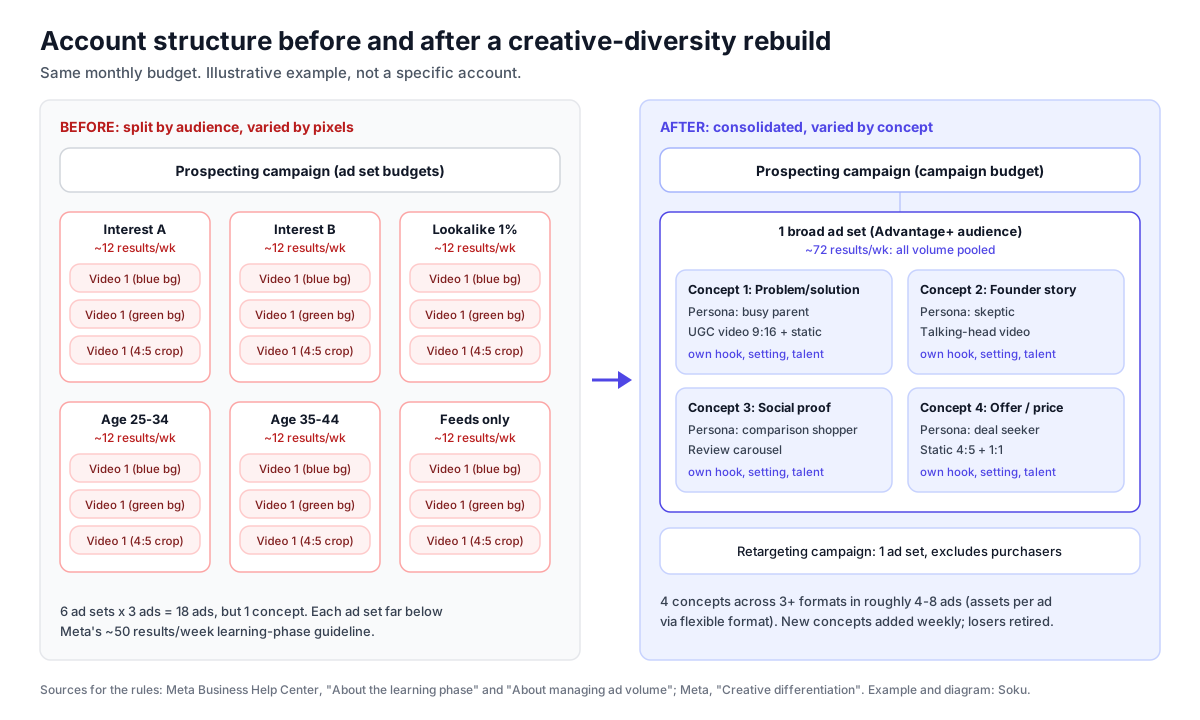
Soku recommends the rebuild in the diagram for most direct-response accounts. It's an illustration, not data from a specific account:
- Consolidate prospecting into one campaign with campaign budget and one or two broad ad sets (Advantage+ audience, or broad targeting with exclusions you actually need). Use the arithmetic from our account structure guide: weekly budget ÷ (target CPA × 50) is the most ad sets you can feed.
- Move the variation from ad sets into the ads. The interests and age bands you used to split by become personas and concepts in the creative. Use breakdowns to see who each concept reaches.
- Size the ad count by ideas. Four to eight ads covering four or more distinct concepts and three or more formats is a sensible start for a moderate budget. Go toward Meta's 20-ad guidance for Advantage+ sales campaigns once you can produce that many genuinely different ideas.
- Keep retargeting separate and small, and exclude purchasers from prospecting.
- Add new concepts weekly and leave the winners running. Meta notes that keeping the original ad active "instead of pausing or turning it off may maximize results."
Practitioner claims, not confirmed by Meta: "Andromeda killed interest targeting." Meta's guidance calls creative the better lever for finding audiences; it doesn't say targeting inputs stopped working. "Use exactly 8–15 (or 10–15, or 50) ads per ad set." We found no Meta source for these specific ranges, only the 20-ads-for-Advantage+ guidance above. "Andromeda-aligned structures get 20–35% higher ROAS." These are vendor case claims with no published method.
How to measure whether diversity is working
The aim isn't more ads. It's more of your budget reaching more people through more ideas. These signals, in order of how directly Meta documents them, tell you whether that's happening:
- Creative diversity column (Meta metric). Add it in Ads Manager under Columns, then Customize columns. A Low label is Meta telling you the images and thumbnails in the ad set look alike. Remember its limits: it compares images and video thumbnails, so two videos with different scripts but similar opening frames can still score Low. It's also marked estimated and in development.
- Delivery status (Meta-defined). Creative limited means cost per result is above your past ads but less than double. Creative fatigue means double or more. Both mean the image or video has reached the same people too often. That's the exact problem diversity solves.
- Spend concentration (Soku recommends). Sort the ad set by amount spent. If one idea group takes more than about 70% of spend for two consecutive weeks while newer concepts get almost nothing, the system isn't treating them as useful alternatives. Either they're too similar to the winner or they're weaker. The worksheet tells you which.
- Reach per concept, via breakdowns (Soku recommends, using Meta's breakdown tools). Break results down by age, gender and placement. Distinct concepts should win with different groups. If every concept wins with the same group in the same placement, you've made one ad several times.
- Frequency and blended cost per result (Soku recommends). At the ad set level, frequency should stay flat or fall as you add concepts, and cost per result should hold steady as spend rises. For what frequency level means fatigue for your audience size, see creative fatigue benchmarks. For definitions, see reach vs impressions vs frequency.
- Concept hit rate (Soku recommends). Track how many new concepts launched each month become a top-three spender. That's the number your creative process controls, and the one to improve. Before declaring a head-to-head winner, check the gap with our A/B test significance calculator.
Where AI fits, and where it doesn't
Meta itself pushes generative tools as a diversification aid, and its numbers for image generation are in the chart above. The trap is using AI to make more of the same. A model asked for "20 variations of this ad" will produce 20 near-duplicates, which is exactly what the creative-differentiation guidance warns against.
Use AI at the concept level instead. Generate one brief per persona and motivation from the worksheet's gaps, then produce each concept in two or three formats. Our 100 ad variants workflow shows how to organize that volume around a concept matrix instead of random sprawl. For hooks specifically, the AI hook generator covers different opening patterns. For a ranked look at generation tools, see best AI tools for Meta ad creatives.
Soku's part is narrower than "Andromeda optimization", and we'd rather say so. Soku connects to your Meta Ads account and reads performance ad by ad. It can generate image and video assets, and, where you've enabled write access and approved the action, build the ads. That makes it a fit for the loop in the worksheet above: seeing which ads carry spend, then producing the next distinct concept you brief. It doesn't see inside Andromeda, and nothing outside Meta can tell you how Meta groups your ads. The Creative diversity column and your own spend distribution are still the evidence.
The short version
- Meta says: Andromeda is the retrieval stage that picks a few thousand candidates from tens of millions. It was built to handle far more creative, Meta reports +6% recall and +8% ads quality from it, and Meta now calls creative diversification, not niche targeting, the main lever.
- Meta says: too-similar creative may not be recognized as different and may reach the same people. Meta's Creative diversity metric compares images and thumbnails. Creative limited and Creative fatigue are defined by cost per result against your past ads.
- Not confirmed by Meta: Entity IDs, fingerprinting by computer vision or audio, specific rollout dates, and magic ads-per-ad-set numbers.
- Soku recommends: count ideas, not ads. Consolidate ad sets and put the variation in concept, persona, hook and format. Measure diversity through the Meta column, delivery status, spend concentration and breakdowns.