 Soku AI
TikTok ads cost about $4 per 1,000 impressions and about $17 per e-commerce purchase in 2026, on the best-documented third-party data. That's Triple Whale's median across 5,900+ e-commerce brands from August 2025 to July 2026. It's an estimate from one analytics vendor's customers, not a price TikTok sets. TikTok doesn't publish rates for auction ads at all.
What TikTok does publish, in its Business Help Center, is the part that decides whether your budget works: a hard minimum per campaign and ad group, a recommended budget per optimization event expressed as a multiple of your cost per result, separate rules for Smart+, GMV Max and Spark Ads, and how each bidding method turns spend into a bill. Most pages ranking for this query cover one of those, loosely. This page puts all of them in one table, from TikTok's own documentation, and then gives you a budget template to run on your own numbers.
Last verified: 2026-10-12. Every TikTok rule below links to the help center article we read that day, with the article's own "last updated" date where it shows one. Third-party benchmarks are labeled as third-party estimates, with their sample, period and caveats. The worked examples are illustrative arithmetic with stated assumptions, not benchmarks. For the cross-platform benchmark reference and the long list of figures we refused to publish, see the pillar: paid media benchmarks by industry. The sister pages cover Facebook ads cost and Google Ads cost.
TikTok's minimum budget by campaign type
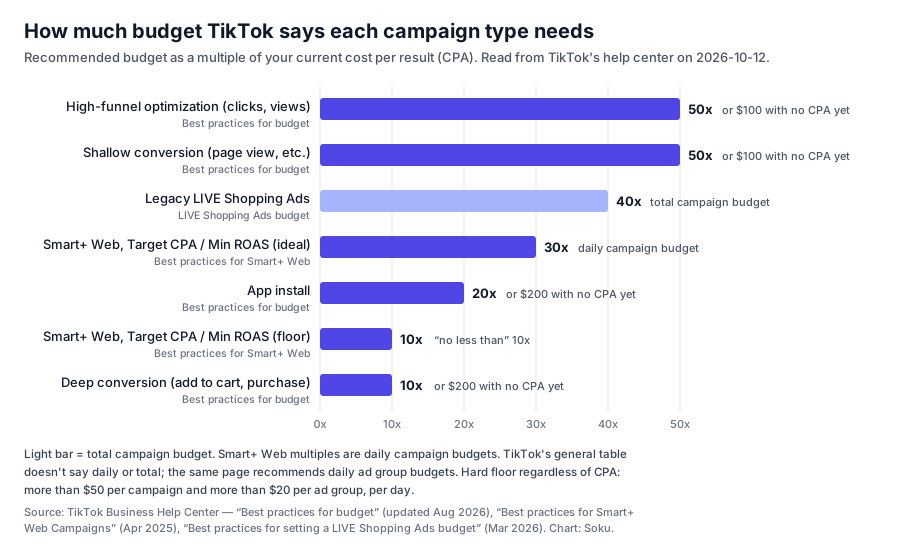
This is the table we couldn't find anywhere else. It separates the hard minimum (what Ads Manager requires before it'll run) from the recommended starting budget (what TikTok says the system needs to learn). It also says plainly where TikTok publishes no number. Read on 2026-10-12.
| Campaign type | Hard minimum TikTok documents | Recommended starting budget | TikTok source |
|---|---|---|---|
| Standard auction campaign (manual) | Campaign daily or lifetime budget must exceed $50. Ad group daily budget must exceed $20. Ad group lifetime budget ≥ $20 × scheduled days | 10× current CPA (deep conversions), 20× (installs), 50× (shallow and high-funnel). With no CPA yet: $200, $200 and $100 | About budgets (Jul 2026), Best practices for budget (Aug 2026) |
| Campaign budget optimization (CBO) | Same $50 campaign minimum | Learning is judged at campaign level: expect stable performance after 50 campaign results for installs and 20 for deeper-funnel objectives, and again after each adjustment | About campaign budget optimization |
| Smart+ (including upgraded Smart+) | No Smart+-specific minimum in the Smart+ articles we read | Smart+ Web: start with at least 10× historical CPA. With Target CPA or Minimum ROAS: daily campaign budget of 30× historical CPA, no less than 10×. At least 6 creatives, 7 days without significant edits | Best practices for Smart+ Web Campaigns (Apr 2025) |
| Product GMV Max (TikTok Shop) | No hard minimum stated in the GMV Max articles we read; setup shows a recommended budget | 2 × historical non-LIVE GMV ÷ ROI target. Keep consumption under 80%. Hold each ROI target for 3 full days | Best practices for Product GMV Max (Jun 2026) |
| LIVE GMV Max (TikTok Shop) | No hard minimum stated. Creative Boost add-on: at least $10 per day per boosted video | Recommended daily budget shown in setup, based on your LIVE performance | Creative Boost setup (Jun 2026), Create a LIVE GMV Max campaign |
| Legacy LIVE Shopping Ads | Standard minimums | 40× historical average CPA as the entire campaign budget (about 40 conversions per shop to exit learning) | LIVE Shopping Ads budget (Mar 2026) |
| Spark Ads | A format, not a campaign type: inherits the minimums of the ad group it runs in | Same as the campaign type it runs in | About Spark Ads |
| Reach & Frequency | No public minimum; budget comes from the reservation | Reserve a fixed CPM up to 225 days ahead | About Reach & Frequency (Jan 2026) |
| TopView | "Minimum spend varies" by market; fixed rate from a TikTok sales rep or dynamic CPMs in Campaign Forecaster | Book at least 60 days ahead for 100% impression campaigns; qualified customers only | About TopView |
Four things in that table are worth slowing down for.
The hard minimum is in USD and it's per level. A campaign with three ad groups on daily budgets needs each ad group above $20 and the campaign above $50. TikTok's budget article adds that the campaign budget shouldn't be lower than the ad group budget, "because this can cause delivery issues." The best-practice multiples are quoted in USD "or equivalent" in other currencies.
The recommended budget is a multiple of your own CPA, not a dollar figure. TikTok's budget best practices page is the clearest statement of that we found:
| What you optimize for | Recommended minimum | If you have no current CPA |
|---|---|---|
| Any other high-funnel event (not conversions) | 50 × current CPA / cost per result | $100 |
| Shallow conversion (page view, etc.) | 50 × current CPA / cost per result | $100 |
| App install | 20 × current CPA | $200 |
| Deep conversion (add to cart, purchase, etc.) | 10 × current CPA | $200 |
TikTok doesn't say on that page whether these are daily or total figures. The same page tells you to use a daily budget rather than a lifetime budget for ad groups, so the practical reading is a daily ad group budget. Treat that as our interpretation.
Smart+ and GMV Max don't have a separately published floor in the articles we read. If someone quotes you a "Smart+ minimum of $X a day" as a TikTok rule, ask for the help center link. The numbers TikTok publishes for these campaign types are formulas, not floors.
Reserved formats are priced by a person, not a page. TopView and Reach & Frequency are bought at a CPM agreed in advance. TikTok's TopView article says the minimum spend varies by market and the rate comes either from a sales representative or from dynamic CPMs in Campaign Forecaster.
What TikTok ads cost: the third-party numbers
TikTok publishes no CPM, CPC or CPA benchmarks. Every figure below is a third-party estimate, and we only kept sources that name a sample and a period. One cleared that bar: Triple Whale's TikTok report, published March 24, 2026 and updated August 20, 2026, covering more than 5,900 brands that use Triple Whale's analytics, August 1, 2025 to July 31, 2026.
| Metric (TikTok, e-commerce) | Aug 2025 – Jul 2026 median | Aug 2024 – Jul 2025 median |
|---|---|---|
| CPM | $4.08 | $5.71 |
| Click-through rate | 0.61% | 0.70% |
| Conversion rate | 1.56% | 2.46% |
| Cost per acquisition | $17.07 | $24.86 |
| Average order value | $50.32 | $46.90 |
| Platform ROAS | 1.51 | 1.43 |
Source: Triple Whale, "TikTok Ads Benchmarks by Industry", read 2026-10-12. Third-party estimate.
By industry, the CPM spread is narrow and the CPA spread is wide:
| Industry (Triple Whale) | Median CPM | Median CPA | Median CTR | Median CVR |
|---|---|---|---|---|
| Sports & Outdoors | $3.46 | $14.67 | 0.54% | 0.99% |
| Health & Wellness | $3.67 | $11.17 | 0.51% | 0.80% |
| Beauty | $3.92 | $10.32 | 0.51% | 1.12% |
| Lifestyle & Boutique | $4.01 | $19.59 | 0.61% | 2.06% |
| Apparel & Accessories | $4.16 | $20.64 | 0.74% | 2.08% |
| Toys, Art & Collectibles | $4.40 | $18.37 | 0.55% | 1.71% |
| Electronics | $4.40 | $28.90 | 0.64% | 1.46% |
| Food & Beverage | $4.54 | $12.44 | 0.45% | 0.99% |
| Pets & Animals | $4.59 | $5.46 | 0.41% | 0.38% |
| Home & Garden | $4.61 | $19.33 | 0.59% | 1.61% |
Period: Aug 2025 – Jul 2026. Sorted by CPM.
How to read this source, and where it breaks
We're publishing these numbers with their faults visible, because a reader who copies them into a plan deserves to know them.
- It's e-commerce only. Brands using a Shopify-centric analytics tool. If you sell software, services or apps, this isn't your comparison set, and there is no comparably documented public TikTok dataset for those.
- The year-over-year CPM change is stated two ways. The table says −24.48%. The text says −28.48%. The arithmetic on the two medians ($5.71 to $4.08) gives about −28.5%, so the text is closer.
- Some industry rows aren't plausible as written. Pets & Animals shows a $0.38 median order value and a 0.02 ROAS, and the text names Health & Wellness twice when listing the lowest CPAs (the first figure, $10.32, belongs to Beauty). Its MER figures (0.09 to 0.35) also read as inverted against its own definition of MER as revenue divided by ad spend. We kept the CPM, CTR, CVR and CPA rows and treat the rest as unreliable.
- The medians don't multiply into each other. $4.08 ÷ (1,000 × 0.61% × 1.56%) gives an implied CPA of $42.87, two and a half times the reported $17.07. Part of that is normal: the median account for one metric isn't the median account for another. A gap that large also suggests the CTR and CVR are measured on different bases (for example, CVR per session rather than per click, or Triple Whale-attributed conversions). Use the CPA row as reported, and don't rebuild it from the other rows.
One comparison is fair, because it's the same vendor, method and period. Triple Whale's Meta medians for August 2025 to July 2026 were a $15.06 CPM and $38.99 CPA. So TikTok impressions cost about 27% of Meta's, and the median TikTok purchase cost about 44% as much. The catch is in the same report: TikTok's median AOV of $50.32 and click-through rate of 0.61% are both lower, so the cheaper purchase is often a smaller one. That's why the pillar argues for computing your break-even ROAS instead of comparing platform averages.
How TikTok charges you: bidding methods and billing events
TikTok's auction "ranks ads based on bid price and the relevance an ad might have to people," per its bidding methods article (updated Aug 2025). What you're actually billed for depends on the bidding method, and TikTok lists four:
| Bidding method | What triggers a charge | Objectives TikTok lists it for |
|---|---|---|
| CPM | Each impression (priced per 1,000) | Reach |
| oCPM (optimized CPM) | Each impression, delivered to people likely to take your action | Shop purchases, product sales, conversions, app install, lead generation, community interaction (follows) |
| CPV | A view of at least 6 seconds, or an interaction in the first 6 seconds, whichever happens first | Video views |
| CPC | Each click | Shop purchases, product sales, traffic, conversions, app install, community interaction (profile visits) |
Two consequences that most cost guides miss:
- oCPM is the default for conversions and app installs. So in a typical performance campaign you aren't buying conversions. You're buying impressions that TikTok aims at likely converters, and your CPA is spend divided by the conversions that result. That makes CPM the root of every other number, exactly as it is on Meta.
- "CPA" is not a billing event on TikTok. Several ranking pages list it as a fifth pricing model. TikTok's own table has four, and cost per action is something you target with a bid strategy, not something you're charged per.
Bid strategies: Target cost per result and Maximum Results
TikTok's bidding strategies article (updated Sep 2026) lists two strategies:
- Target cost per result. Goal-based: the system "optimizes delivery towards a cost per action defined by the advertiser." TikTok says plainly that "the actual CPA can be slightly higher or lower than the target CPA," and that costs "may fluctuate day to day, but the average will be around the bid amount." For Conversions campaigns it's only available when the optimization goal is Conversion.
- Maximum Results. Spend-based: it "aims to deliver the highest volume of conversions within your defined budget" and doesn't optimize toward a target CPA, so "some degree of CPA fluctuations should be expected."
A note on names, because guides disagree. Older guides call these Cost Cap and Lowest Cost (or Maximum Delivery), and some list a Bid Cap. TikTok's current strategy article lists only the two above. The old name survives in places: TikTok's Smart+ Bid Protection terms still say "Cost Cap." For reach and video views, Bid Control (Aug 2026) makes Target cost per result the default and pre-fills a suggested bid, which TikTok says "does not represent the actual amount that you will pay." If a guide tells you to pick "Bid Cap," it's describing a control your account may not show.
Three cost-relevant rules from TikTok's documentation:
- You can switch strategies mid-flight. Hybrid Bidding lets an active ad group move from Maximum Results to Target cost per result. TikTok recommends waiting for at least 5 conversions and 3 days, then setting the target at the ad group's last-3-day average CPA. Per TikTok's CPA stability guide (Aug 2026), Hybrid Bidding doesn't support the Product Sales (Shop) objective.
- To scale Maximum Results, add ad groups rather than budget. The same guide says that instead of raising budget on a Maximum Results ad group, you should create more ad groups, or switch to Target cost per result first and then raise budget.
- Conversion campaigns are expensive before learning ends. The strategy article warns that conversion campaigns "often see performance fluctuate before passing the Learning Phase. This may lead to high CPM."
Photo: Detail .co on Unsplash.
How much do TikTok Spark Ads cost?
Spark Ads promote an existing organic post (yours, or a creator's with authorization) instead of a standalone ad upload. On cost, here's what TikTok's documentation supports and what it doesn't.
No separate format fee. TikTok's Spark Ads article and Spark Ads FAQ describe Spark as an ad format that runs in ordinary ad groups (eight objectives under Auction buying, three under Reach & Frequency) and list no Spark price. A Spark Ad is billed on whatever the ad group bills on (impressions, clicks or views) and needs the same $20 ad group and $50 campaign minimums.
The real cost differences sit outside the bill. First, creator licensing: if the post belongs to a creator, what you pay them for the authorization code is negotiated off-platform, and TikTok notes you can customize the authorization duration "to meet campaign needs and minimize costs." Second, the auction's response to the creative: a post that already earned engagement organically may clear cheaper, and a weak one won't.
Spark CPC isn't directly comparable with non-Spark CPC. In TikTok's metric definitions, a Spark Ad's "paid clicks" are clicks on the CTA button and ad caption. For non-Spark ads, paid clicks also include the nickname, profile picture and swipe-left. Profile clicks on a Spark Ad flow into separate metrics such as paid profile visits. If you compare CPC across the two formats, you're comparing different click definitions.
TikTok's own performance claims are vendor claims. The FAQ says Spark Ads outperform non-Spark ads on view-through and engagement "in a cost-efficient way," and that its Spark Ads Profile Landing Page showed "near-doubled performance in CTR with significantly lower CPC." TikTok gives no sample, period or baseline for either. Treat them as a reason to test Spark Ads, not as a number to budget with.
One operational limit affects cost planning in Smart+: TikTok's Smart+ Web Campaigns article says they "do not support mixing Spark ads and non-Spark ads in one campaign." For setup, authorization codes and when a Spark Ad beats a standard in-feed ad, see our TikTok Spark Ads guide.
Smart+ costs: quotas, budget strategies and Bid Protection
Smart+ is TikTok's automated campaign type for sales, app, lead and traffic objectives. It doesn't change how you're billed. It changes who decides where the budget goes. Three cost-relevant details from TikTok's documentation:
Budget strategy. In the upgraded Smart+ experience (Jul 2026) you choose between a campaign budget (TikTok allocates across ad groups, the Smart+ version of CBO) and ad group budgets you set yourself. With a campaign budget, all ad groups must share the same optimization location, goal and event, and bid adjustments apply to all of them.
Quota by spend. TikTok limits active Smart+ campaigns by the account's highest monthly spend in the past 12 months: under $1,500 a month gets 50 active Smart+ campaigns, $1,500 to under $150,000 gets 200, and $150,000 or more gets 1,000. TikTok's stated reason is that fewer live campaigns each get a better chance of passing learning.
Smart+ Bid Protection. TikTok runs a limited-time incentive that refunds part of a Smart+ campaign's overspend in ad credits. To qualify, a Web Conversions, App Promotion or Lead Generation campaign using Cost Cap, Minimum ROAS or Target ROAS must run at least 3 full consecutive days, get at least 15 conversions in that window, and stay within edit limits. If actual CPA is more than 1.2 times the Cost Cap bid, TikTok credits (actual CPA − bid) × conversions. TikTok's own example: a $10 bid, an $18 actual CPA and 25 conversions earn $200 in credits. Credits stay in the same ad account and can't be withdrawn, and TikTok can withdraw the program at any time, so don't build a plan around it.
GMV Max budgets, briefly
For TikTok Shop sellers, GMV Max has been the default and only supported campaign type for new Shop Ads since July 2025, per TikTok's GMV Max migration notice. It optimizes to an ROI target and counts organic and affiliate orders for promoted products. On budget, the documented numbers are:
- Product GMV Max: recommended budget = 2 × historical non-LIVE GMV ÷ ROI target, keep consumption below 80%, and keep each ROI target for at least three full days (best practices, Jun 2026). Available in Indonesia, Malaysia, the Philippines, Thailand, Vietnam, Singapore and the US.
- LIVE GMV Max: you enter a daily budget, with a recommendation based on your LIVE performance. The optional Creative Boost adds a separate daily budget of at least $10 per video, and that spend is excluded from ROI compensation. TikTok's LIVE GMV Max setup article lists Indonesia, Malaysia, the Philippines, Thailand, Vietnam and Singapore.
We didn't find a hard GMV Max minimum in the articles we read. For ROI targets, how GMV Max counts orders and when it's worth running, see our TikTok GMV Max guide.
Budgets: how TikTok actually spends them
The minimums tell you what Ads Manager will accept. These rules tell you what happens to the money once you're above them.
Daily, lifetime and dynamic daily budgets
Per TikTok's budget article (Jul 2026), a daily budget is "the average amount you're willing to spend" per day, and a lifetime budget is the total for the campaign or ad group's run. A lifetime budget "may not be allocated evenly across each day" but won't exceed the total. You can't switch budget types after launch, and delivery pauses when an ad group hits its budget.
Dynamic Daily Budget is a third option: an average daily budget over a Sunday-to-Saturday week. Per TikTok's example, a $50 budget may spend up to $62.50 on a good day and as little as $37.50 on a slow one, and the week will be capped at $350, seven times the daily figure. That's much tighter than Meta, which may spend up to 75% over a daily budget on a given day.
The learning phase is the real floor
TikTok's learning phase article (Jun 2026) says volatility "typically" starts to decline "after about 25 campaign results or 7 days," and lists three things that hurt: pausing, edits that retrigger learning, and "unreasonable budget setting or creative volumes." The budget multiples in the table above are TikTok's translation of that into money. CBO campaigns are judged at the campaign level: 50 results for installs and 20 for deeper-funnel objectives, and again after each adjustment.
How fast you can change a budget
TikTok's two budget articles don't quite agree, so here are both:
- About budgets (Jul 2026): during learning, raise budget by no more than 40% per adjustment. After learning, no more than 30%. Not more often than every two days.
- Best practices for budget (Aug 2026): after learning, keep budget "within the 50% range" of the previous budget, and wait at least two days between targeting, bid or budget changes.
Follow the stricter one. Smart+ Web has its own rule: if a campaign regularly spends 90% or more of its daily budget, try raising it by up to 30%. After the first seven days, change bids by no more than 15% every two days (Smart+ Web best practices).
One more detail from the best-practices page: if you set up or change a Maximum Results strategy mid-day, "there might be a spending discount based on the actual remaining effective hours of delivery." A campaign launched at 6 p.m. won't spend a full day's budget that day.
The TikTok budget planning template
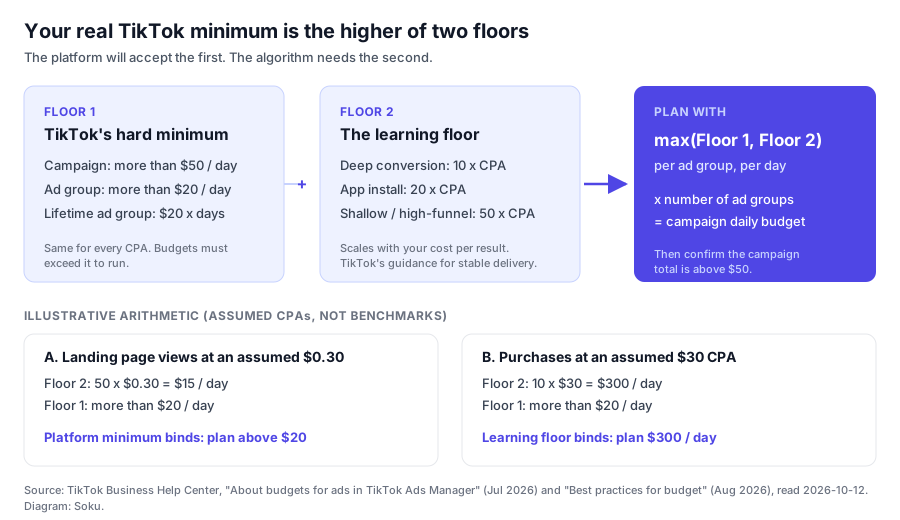
Everything above reduces to one rule: your working budget per ad group is the higher of TikTok's hard minimum and the learning floor for your optimization event. Here's the template. Copy it, replace the inputs, and run the steps in order. You can do steps 7 to 10 in our ad budget calculator.
INPUTS
A. Optimization event and its type         (deep / install / shallow / high-funnel)
B. Expected cost per result (CPA)          (your last 7 days, or a stated assumption)
C. Number of ad groups you plan to run
D. Budget type                             (daily, or lifetime with N scheduled days)
E. Average order value and contribution margin (for the profit check)

STEPS
1. Learning multiple:      10 (deep), 20 (install), 50 (shallow or high-funnel)
2. Learning floor:         multiple × B, per ad group, per day
   (no CPA history: $200 deep or install, $100 shallow or high-funnel)
3. Platform floor:         more than $20 per ad group per day
4. Working ad group budget = max(step 2, step 3)
5. Campaign daily budget   = step 4 × C          → confirm it is more than $50
6. Lifetime alternative:   ad group lifetime ≥ $20 × N days (and step 4 × N to learn)
7. Monthly media           = step 5 × 30.4
8. Expected results/month  = step 7 ÷ B
9. Break-even CPA          = AOV × contribution margin
10. Profit check           = is B below step 9? If not, fix CPA before adding budget
Worked example 1: a purchase campaign that fits (illustrative)
Every number in these examples is an assumption chosen to make the arithmetic easy to follow. None is a benchmark and none comes from a real account.
A store optimizing for purchases expects a $30 CPA, plans two ad groups, has an $80 AOV and a 45% contribution margin.
1. Learning multiple:     10 (purchase = deep conversion)
2. Learning floor:        10 × $30 = $300 per ad group per day
3. Platform floor:        more than $20
4. Working budget:        max($300, $20) = $300 per ad group per day
5. Campaign daily budget: 2 × $300 = $600 per day (more than $50: yes)
7. Monthly media:         $600 × 30.4 = $18,240
8. Expected purchases:    $18,240 ÷ $30 = 608 per month
9. Break-even CPA:        $80 × 45% = $36
10. Profit check:         $30 < $36, so each first order clears margin
Worked example 2: a $3,000 a month budget (illustrative)
The same store has only $3,000 a month, about $98.68 a day ($3,000 ÷ 30.4).
Optimize for purchases at $30 CPA:   floor = 10 × $30 = $300/day   → can't fund one ad group
Optimize for add to cart at $8:      floor = 10 × $8  = $80/day    → one ad group fits
Optimize for landing page views
  at $0.50 per result:               floor = 50 × $0.50 = $25/day  → up to three ad groups fit
No CPA history, purchase:            TikTok's starting figure is $200/day → doesn't fit
At $3,000 a month the budget can't feed a purchase-optimized ad group at a $30 CPA. That doesn't mean TikTok "doesn't work" at this spend. It means the budget should go to one ad group, optimizing for an event that happens often enough to learn from (TikTok counts add to cart as a deep conversion too), until volume allows a move down the funnel. This is the same trap as Meta's "50 results a week," expressed in TikTok's multiples.
Worked example 3: a 14-day promotion on a lifetime budget (illustrative)
One ad group, purchase optimization, an assumed $25 CPA, 14 days.
Platform floor:   ad group lifetime ≥ $20 × 14 = $280; campaign lifetime > $50
Learning floor:   10 × $25 = $250 per day × 14 = $3,500
Working budget:   $3,500 lifetime
The platform would accept $280. The learning floor says $3,500. A $280 promotion will run, but on TikTok's own guidance it won't have enough budget to stabilize before it ends.
Worked example 4: Product GMV Max (illustrative)
TikTok's formula is 2 × historical non-LIVE GMV ÷ ROI target. TikTok doesn't specify the lookback window. Because the budget you enter is daily, we apply it to daily GMV, which is our interpretation. Assume $1,500 a day in non-LIVE GMV and an ROI target of 4.
Recommended daily budget = 2 × $1,500 ÷ 4 = $750
80% consumption line     = $600 a day
If spend regularly passes $600, TikTok's guidance is to raise budget as performance allows
What moves your TikTok cost: a sensitivity table
On oCPM, every TikTok cost per result is the same chain: CPC = CPM ÷ (1,000 × CTR), and CPA = CPC ÷ CVR. Check your own links with the CPM calculator, CTR calculator and CPC calculator.
The table holds one hypothetical ad group fixed (CPM $5.00, CTR 0.80%, CVR 2.0%: CPC $0.625, base CPA $31.25) and changes one thing at a time. It's illustrative math, not a benchmark.
| What changes | Link in the chain | Illustrative new CPA | Change vs base | Why it moves |
|---|---|---|---|---|
| Auction 20% pricier | CPM $5.00 → $6.00 | $37.50 | +20% | CPA moves one-for-one with CPM |
| Fresher creative | CTR 0.80% → 1.00% | $25.00 | −20% | Pure arithmetic. TikTok's auction also weighs relevance, so the real effect may be larger |
| Fatigued creative | CTR 0.80% → 0.60% | $41.67 | +33% | See creative fatigue benchmarks |
| Better landing page | CVR 2.0% → 2.5% | $25.00 | −20% | Pure arithmetic |
| Weaker offer or slower page | CVR 2.0% → 1.5% | $41.67 | +33% | Pure arithmetic |
| Creative and landing page together | CTR 1.00%, CVR 2.5% | $20.00 | −36% | Both rates sit in the denominator, so the gains compound |
| Learning reset by a big edit | All three, temporarily | Higher, unquantified | — | TikTok: conversion campaigns "often see performance fluctuate" and "high CPMs" before learning ends |
The asymmetry is the lesson. A 20% pricier auction costs 20%. A 25% drop in click-through or conversion rate costs 33%. On TikTok the creative is the ad unit, and creative wears out fast, which is why TikTok builds "ad group fatigue detection and auto-refresh" into Smart+. For how teams keep up with that, see our AI creative guide for TikTok ads.
How you pay: billing options
TikTok's billing options article lists three ways to pay, and the choice is mostly one-way:
- Manual payment. You prepay a balance, ads draw it down, and ads stop when it runs out.
- Automatic payment. TikTok charges your payment method when you reach the account's billing threshold or bill date, whichever comes first. Billing can be weekly or monthly, and the bill date depends on your registration time and historical spend.
- Monthly invoicing. For eligible businesses, with invoices due 30 days from the invoice date unless agreed otherwise, against a spending limit TikTok sets.
You can move from manual to automatic or invoicing, and from automatic to invoicing, but never back. Disputes over a billed amount must be raised within 7 days of receiving the bill.
The full cost of TikTok ads is more than media
Media is the part this page has measured, but it's rarely the whole bill.
- Creative. TikTok rewards new creative more visibly than any other platform. Budget for a steady flow of new videos, or for tools that make variations from what you have. Smart+ Web's best practice of at least six creatives per campaign is a useful minimum.
- Creator licensing. Spark Ads built on creator posts carry whatever fee you negotiate for the authorization. It isn't on TikTok's invoice but belongs in your CPA.
- Management. Someone, or something, has to watch learning status, budget pacing and fatigue. An agency retainer can exceed the media spend at small budgets. See what an AI marketing agency costs for the comparison.
To plan the whole thing across channels, with best, base and worst CPA scenarios, use the free paid media budget planning spreadsheet.
What we left out, and why
| What we found | Why we cut it |
|---|---|
| A "$4.80 average TikTok CPM" (with 0.61% CTR and 1.92% conversion rate) from a 2026 benchmark page | No sample size or period. The page says the data is "updated in real time" inside the vendor's product |
| Industry tables with "average CPM $5.20 – $18.00, CPC $0.45 – $2.20" quoted in a ranking cost guide | Attributed to another vendor's blog with no sample, period or method we could find |
| "TopView costs $10 – $20 CPM" and "Brand Takeover starts at $50,000 per day" | Secondary sources. TikTok's own TopView page says minimum spend varies by market and rates come from sales or Campaign Forecaster |
| CPA as a TikTok "pricing model" | Not a billing event in TikTok's bidding methods table |
| Bid Cap and Lowest Cost as current TikTok strategies | TikTok's current strategy article lists Target cost per result and Maximum Results only |
| A "Smart+ minimum of $70 – $100 a day" or similar | Third-party heuristics. Not in the Smart+ articles we read |
| Triple Whale's TikTok ROAS, AOV and MER by industry | Implausible rows (a $0.38 AOV, 0.02 ROAS) and MER values that read as inverted; platform ROAS isn't comparable across accounts anyway |
| A cross-platform CPM table (TikTok vs Meta vs YouTube vs LinkedIn) | No source at all. The pillar covers why we won't publish it |
| Any Soku account data | We don't publish customer data. Every number here is from TikTok's documentation, a named third party, or labeled illustrative math |
How Soku fits
The table at the top tells you what TikTok needs. Your account tells you whether you're giving it that: each ad group's CPA, its budget as a multiple of that CPA, whether it's still in learning, and which link in the CPM-to-CPA chain moved this week. That's easy to check once and tedious to check every week.
Soku is an AI agent for paid media that connects to your TikTok Ads account alongside Meta, Google and ChatGPT Ads. Ask it which ad groups are budgeted below their learning floor, or why cost per result rose, and it works from your own CPM, click-through and conversion data rather than a published median. When it proposes a change, such as consolidating ad groups, moving a budget within TikTok's adjustment limits, or switching an ad group's bid strategy, nothing changes until you approve it. When the fix is fresher creative, Soku Creatives can generate new image and video variations to test.
Related reading
- Paid media benchmarks by industry: the pillar, with sourced cross-platform benchmarks and what we discarded
- How much do Facebook ads cost and how much does Google Ads cost: the same method applied to Meta and Google
- TikTok Spark Ads: setup, authorization codes and when Spark beats a standard in-feed ad
- TikTok GMV Max: ROI targets and budgets for TikTok Shop
- AI creative guide for TikTok ads: keeping creative fresh enough to hold CPA down
- Ad budget calculator: turn a CPA and a goal into a budget