 Soku AI
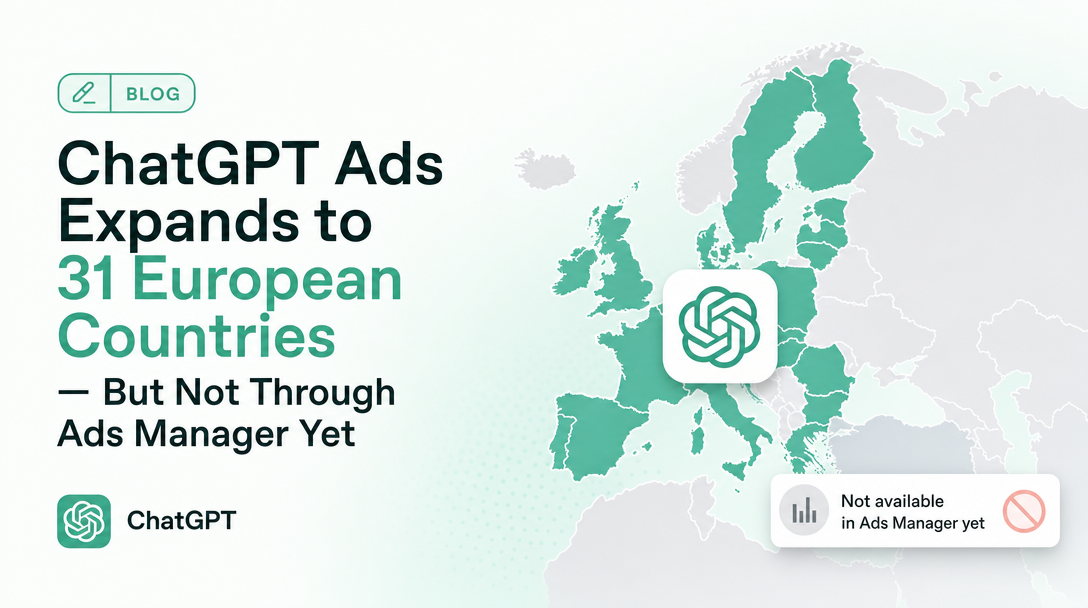
ChatGPT Ads has run in nine countries since its February pilot. As of this week the official availability table lists forty — the same nine marked Available, and thirty-one new European markets marked Coming Soon.
That word is doing a lot of work, and almost every summary of this news has skipped it. "Coming Soon" is not a placeholder here. It is a precise description of an access model that OpenAI has stated explicitly and that changes what a European advertiser should actually do this month.
Last verified: 2026-08-24. Everything in the "what OpenAI says" sections is quoted or closely paraphrased from official OpenAI sources captured on that date, with URLs. Everything marked "Soku's reading" is our analysis, not OpenAI's position.
What changed, in OpenAI's words
Three official sources moved within the last week, and they agree with each other.
1. The announcement (18 August 2026)
OpenAI published ChatGPT Ads expands across Europe, dated 18 August 2026. Its opening line: "Six months after we began testing ads in the U.S., we're bringing ChatGPT Ads to 31 European markets."
The paragraph that matters most to anyone planning a launch is the third one:
"Advertisers will initially be able to access ChatGPT Ads through the OpenAI Ads Solutions team, agency partners, and technology partners. Self-service access through Ads Manager will follow later this summer."
The post also restates the audience boundary: "ads will be shown only to users on the Free and Go plans. Plus, Pro, and Enterprise subscriptions will remain ad-free."
And it puts a number on the platform's scale for the first time in a while: "Tens of thousands of marketers have now advertised on ChatGPT."
2. The advertiser product-update email (20 August 2026)
OpenAI's ChatGPT Ads product-update email, sent 20 August 2026, listed the expansion among six items:
"ChatGPT Ads are coming to Europe next week: Starting next week, ChatGPT Ads will expand to 31 European countries, giving advertisers with business in these markets a new opportunity to expand their reach."
The same email confirmed that Brazil and Mexico are now live, and covered four items we have already documented in detail: the Maximize results bid strategy, platform targeting, view-through conversions and a new measurement-partner integration.
3. The availability table (updated 23 August 2026)
The help-centre article Ads Manager Availability was updated within the last day of our check and now carries a forty-row table. Every one of the thirty-one European entries reads Coming Soon; the nine existing markets read Available.
This is the corroboration that matters. The email is a lead source, not a fact source — but here the help centre has caught up with it, so the expansion can be stated as documented fact rather than as an announcement.
The full country list, as published
Available now (9): Australia, Brazil, Canada, Japan, Korea, Mexico, New Zealand, United Kingdom, United States.
Coming Soon (31): Austria, Belgium, Bulgaria, Croatia, Cyprus, Czech Republic, Denmark, Estonia, Finland, France, Germany, Greece, Hungary, Iceland, Ireland, Italy, Latvia, Liechtenstein, Lithuania, Luxembourg, Malta, Netherlands, Norway, Poland, Portugal, Romania, Slovakia, Slovenia, Spain, Sweden, Switzerland.
Two details worth noting about that list, because they tell you something about how OpenAI is sequencing this.
It is the EEA plus Switzerland, not "Europe" loosely. All 27 EU member states are present. Add the three EEA-EFTA states — Iceland, Liechtenstein, Norway — and that is 30. Switzerland, which is neither EU nor EEA, is the thirty-first. The United Kingdom is not in this cohort because it has been Available since earlier in the rollout.
Soku's reading: a rollout drawn on exactly the EEA boundary is a regulatory-perimeter rollout, not a market-size rollout. Malta, Cyprus and Liechtenstein are not there because their ad markets justify the engineering; they are there because launching into the EEA is a single compliance decision rather than thirty-one. For an advertiser, the practical implication is that you should not read the list as a signal about which of these markets OpenAI expects to matter commercially. Germany and Malta arrived on the same day for the same reason, and that reason was not demand.
What "Coming Soon" actually means operationally
This is the part that changes what you do this week, and it comes straight from the announcement rather than from us.
Access at launch runs through three channels:
- The OpenAI Ads Solutions team — OpenAI's own sales function.
- Agency partners.
- Technology partners.
Self-service through Ads Manager "will follow later this summer."
So for a European advertiser, the immediate state of the world is:
- ChatGPT Ads will be buyable in your market imminently.
- It will not be self-serve in your market at launch.
- The route in is a conversation — with OpenAI, with your agency, or with a technology partner already integrated with the platform.
Soku's reading. Three consequences follow, and none of them are obvious from the headline.
First, the advantage window is a relationship window, not a bidding window. In a normal platform launch, early advantage comes from cheap inventory before competition arrives. Here, the gate before the auction is access itself. Whoever has a partner path in gets to run in a thin auction; whoever waits for the self-serve button competes with everyone who waited. That is an unusual shape and it rewards a phone call more than a budget.
Second, "later this summer" is a narrow window in the northern hemisphere. The announcement is dated 18 August. Summer, on any conventional reading, ends in September. Do not read that as a promise — OpenAI has not committed to a date — but do read it as a signal that the self-serve gap is intended to be weeks rather than quarters. Building a 2027 plan around partner-only access is probably over-fitting to a temporary state.
Third, the API question is open and worth asking your partner directly. The Advertiser API issues keys "in the Settings tab of Ads Manager", and each key is scoped to one ad account. If Ads Manager self-service is not yet available in a market, the documented path to an API key in that market is not obvious from the public docs. OpenAI's API Partner Setup documentation describes how approved partners configure client accounts, which is the likely answer — but it is worth confirming rather than assuming, because it determines whether your reporting can be automated from day one or has to be exported by hand for the first few weeks.
Why this is OpenAI's largest expansion, by a distance
The announcement frames it plainly: "In February, we began testing ads in ChatGPT with a pilot in the United States. Over the past six months, we have expanded to eight additional markets. The addition of 31 European markets marks our largest expansion to date."
Some arithmetic that OpenAI does not do for you: this takes the platform from 9 countries to 40, a 4.4× increase in market count, in one step, six months after first pilot. Meta, Google and TikTok all took years to reach that footprint. The comparison is not entirely fair — ChatGPT already has the users in those markets, so this is a commercial and compliance unlock rather than a distribution build — but it does explain the shape of the access model. You do not open thirty-one self-serve markets simultaneously; you open thirty-one partner-mediated markets and then turn on self-serve behind them.
What else shipped in the same week
Two further official changes landed in the same window and neither has been widely covered.
The ad-groups guidance was substantially rewritten
The help article Create Ad Groups for ChatGPT Ads was updated within a day of our check, and the rewrite goes further than a copy polish. Its subtitle changed from "Best practices for creating ad groups for ChatGPT" to "Best practices for organizing ad groups and describing when your ads may be useful."
The substantive changes:
- The description of context hints moved from hints that "help determine when your ads may be relevant to people using ChatGPT" to hints that "help our systems understand when your ads may be relevant to conversations or user journeys in ChatGPT." The phrase "user journeys" is new.
- The guidance on specificity gained a worked example that was not there before: "instead of using a broad context hint like 'running shoes,' use a more descriptive phrase such as 'cushioned everyday running shoes for beginners training for their first 5K.'"
- A new framing question was added: "What else should we know about this product, who it helps, and when it's useful?"
- Two new caveats appeared at the end. First: "Being specific does not mean people need to use the exact words in your context hint." Second, and more pointed: "Context hints are not exact-match controls, audience targeting rules, or instructions to show your ad only for specific conversations. They do not guarantee that your ad will appear for particular words, topics, audiences, or situations."
Soku's reading. That last paragraph reads like a correction of a widespread misuse. The earlier version said context hints were "broad thematic signals, not exact keyword matching" — a single line. The new version dedicates a full paragraph to enumerating four things context hints are not. When documentation grows a disclaimer that specific, it is usually because advertisers were treating the field as a keyword list and complaining about the results. If you have been writing context hints as comma-separated terms, the new worked example is telling you to write sentences instead.
The ad-group scoping advice also loosened. The old text said to create separate ad groups if you need hints for "meaningfully different products, audiences, or use cases." The new text says to keep an ad group "focused on a common product category, theme, or customer need," that "context hints can cover related situations and natural variations within that theme," and to split only when the hints "would require different ad messaging or landing pages." That is a meaningfully more permissive structure — fewer, broader ad groups — and it changes account architecture advice for anyone building one now.
The advertising principles were published in the consumer FAQ
The consumer-facing Ads in ChatGPT article gained a section stating four principles: mission alignment, answer independence ("Ads do not influence answers. Ads are separate and clearly labeled"), conversation privacy ("We keep conversations private from advertisers, and we never sell user data"), and choice and control. It also added an advertiser-facing pointer to openai.com/advertisers.
Soku's reading: publishing the principles in the user-facing FAQ, in the same week as an EEA-wide launch, is not a coincidence. It is the sort of thing you do when thirty-one new regulators and a much larger privacy-attentive user base are about to look at the product.
What a European advertiser should actually do now
Concrete, in order.
- Find out which of the three access routes you already have. If you work with an agency, ask whether they are an OpenAI agency partner. If you use a technology partner for creative or measurement, ask whether they are integrated. If neither, register at openai.com/advertisers — the availability article names that form as the route for markets not yet self-serve.
- Do not build the account structure you would have built last month. The ad-groups guidance changed this week toward fewer, broader ad groups with descriptive sentence-form context hints. Building to the old advice and restructuring later costs more than reading the new page first.
- Decide your measurement approach before launch, not after. The OpenAI Pixel and the Conversions API are both live, and the announcement lists third-party measurement integrations as part of the platform build-out. In a market where self-serve is not yet open, you may not have Ads Manager access to configure these yourself on day one — which makes it a question for your partner conversation rather than a task for launch week.
- Set expectations about the audience. Ads serve only to Free and Go users. In markets with high Plus and Pro penetration, your addressable ChatGPT audience is smaller than the total ChatGPT audience by a margin you cannot look up. Model conservatively.
- Do not plan around the country list as a demand signal. As above: it is an EEA perimeter, not a market-size ranking.
What we are not claiming
In the interest of not adding to the noise around this launch:
- We do not know the launch date. "Next week" from a 20 August email points at the week of 24 August, but no official source names a date.
- We do not know the self-serve date. "Later this summer" is the only guidance published.
- We do not know whether pricing, minimum budgets or bid mechanics differ in the new markets. The minimum budgets by country documentation has not been updated for the new markets as of this check.
- We have not seen a ChatGPT ad serve in a European market, and neither has anyone else writing about this.
Sources
All verified 2026-08-24:
- ChatGPT Ads expands across Europe — OpenAI, 18 August 2026
- Ads Manager Availability — help centre, forty-country table
- Create Ad Groups for ChatGPT Ads — help centre, rewritten context-hints guidance
- Ads in ChatGPT — help centre, advertising principles
- Our approach to advertising and expanding access — OpenAI ads principles
- Advertiser API overview and API Partner Setup — developer docs
- OpenAI ChatGPT Ads advertiser product-update email, 20 August 2026 — attributed to the email, not to documentation, except where the help centre corroborates it
If you are new to the platform, start with our complete ChatGPT Ads guide, or see how it compares to the incumbents in ChatGPT Ads vs Google Ads vs Meta Ads.