Soku AI

OpenAI is paying new advertisers to try ChatGPT Ads this holiday season. Its holiday landing page, ads.openai.com/holiday, opens with one line: "New to ChatGPT ads? Get $500 ad credit on us when you spend $500. Offer ends December 31."
That reads like a simple match. It is not quite one. OpenAI has published separate Ad Credit Terms (dated July 29, 2026) and a set of billing answers about promotional credit, and together they decide what the $500 is worth: which spend counts, when the credit starts working, when it disappears, how tax is handled and what can void it.
This guide puts those rules in one place, works out the dates for this year's calendar, and ends with a plan for using the credit on a real test rather than letting it lapse.
Last verified: 2026-11-03. Soku's documentation monitor captured 65 OpenAI ads pages (37 help-centre articles, 25 developer-docs pages and 3 openai.com pages) at 00:02 UTC on 2026-11-03 (run-20261103T000245Z) with no capture errors. The holiday landing page and the Ad Credit Terms were read separately on the same day. Items that appear only in OpenAI's advertiser email are labelled as such. Everything marked Soku analysis is our reading, not OpenAI's.
The short version
- The offer is for advertisers new to ChatGPT Ads: $500 of credit after $500 of spend, with the offer ending December 31, 2026.
- The qualifying $500 is yours to pay. Credit only covers fees incurred after it is issued. It does not refund the spend that earned it.
- Unless your offer says otherwise, the credit expires 90 days after issuance, and whatever is left is forfeited.
- It applies only to the account named in the offer, cannot be combined with other credits or discounts, and has no cash value.
- Tax is calculated on your fees after the credit, except where the law requires otherwise.
- You see it under Billing → Activity → Promotions. An empty line there does not, on its own, mean anything has gone wrong.
- Seeing the offer is not the same as earning it. OpenAI treats seeing, enrolling, qualifying and receiving credit as four separate steps.
What OpenAI has actually published
Three official sources and one email cover this offer. They do different jobs, and it helps to know which one you are reading.
| Source | What it establishes |
|---|---|
| ads.openai.com/holiday (read 2026-11-03) | The offer itself: "$500 ad credit on us when you spend $500", for advertisers "New to ChatGPT ads", ending December 31 |
| Ad Credit Terms (published July 29, 2026) | The general rules for every OpenAI ad credit: eligibility, application, taxes, 90-day expiry, no stacking, no cash value, revocation |
| Billing & Payment help article | How credit is earned and where it appears in Ads Manager |
| OpenAI advertiser email, November 2, 2026 | A reminder for the November 4 holiday webinar that also mentions the credit. An announcement, not documentation |
The email, titled "Two days away: Your 2026 ChatGPT Ads Holiday Playbook", says: "Sign up for an Ads Manager account before December 31 to get ad credit when you spend on your first campaign." The landing page says the offer "ends December 31". Neither says whether the $500 of spend must also happen by December 31. We come back to that below.
The Ad Credit Terms also define the word "Offer" as "the email, promotional offer, or other communication from OpenAI making an Ad Credit available". So the landing page and any email you receive are both part of the rules for your credit, alongside the general terms.
Four steps, not one
OpenAI's billing FAQ answers the question "Does seeing a promotional offer mean I have earned credit?" with a flat no: "Seeing an offer, enrolling, meeting its requirements, and receiving credit are separate steps." It adds: "Creating an account or choosing a campaign budget does not establish that credit has been earned."
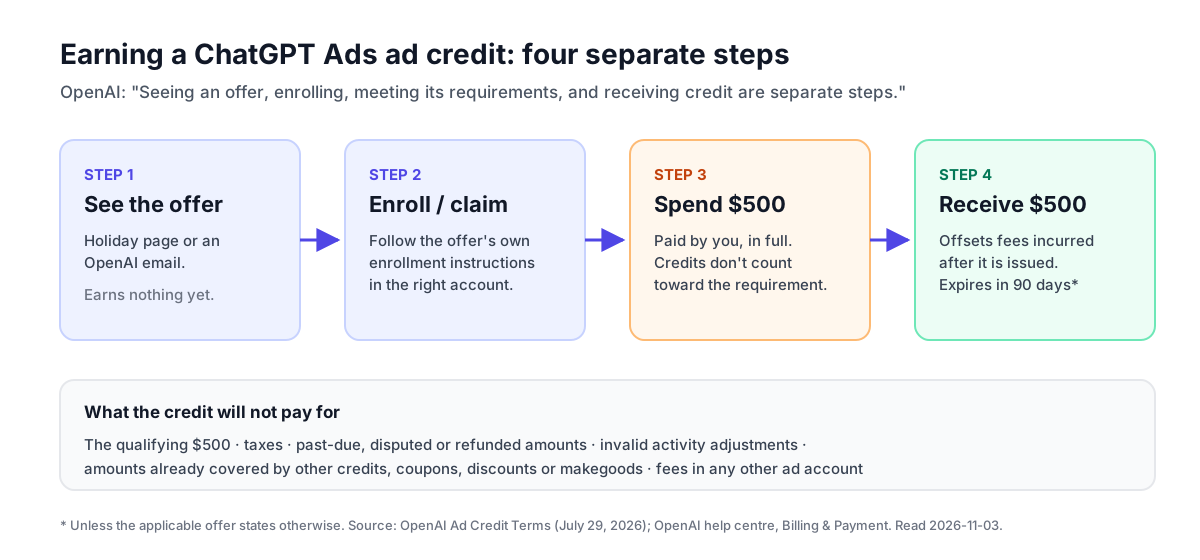
- See the offer. The holiday page, an email or another OpenAI communication.
- Enroll. The holiday page's button reads "Start now to claim". Follow the offer's own enrollment instructions; the billing FAQ tells advertisers to follow "your offer's eligibility rules, enrollment instructions, qualifying-spend requirement, and dates."
- Meet the requirement. Here, $500 of spend.
- Receive the credit. It is then applied to eligible fees.
Soku analysis: the practical lesson is to read the offer you were shown before you launch, not after. If it tells you to claim through a specific link or in a specific account, a campaign launched without doing that may still spend $500 without producing a credit.
What counts toward the $500, and what the credit pays for
The Ad Credit Terms are precise about money moving in both directions.
On the way in, Ad Credits "do not count toward any spending requirements". The $500 must be ordinary paid spend.
On the way out, credit applies only to "Eligible Fees", defined as fees for advertising services "incurred after an Ad Credit is issued and before it expires, for the account and Advertising Services specified in the applicable Offer". The definition then excludes:
- taxes;
- past-due, disputed or refunded amounts;
- "invalid activity adjustments";
- "amounts paid or offset using other credits, coupons, discounts, makegoods, or incentives".
The billing FAQ says the same thing from the advertiser's side: credit "applies to eligible charges after it is issued; it does not refund the spending used to qualify."
So the offer is worth $500 of future advertising, on top of $500 you spend first. In total, $1,000 of delivery for $500 of your own money, if you keep advertising long enough to use the credit.
How the charges actually land on your card
New self-serve accounts are billed on a payment threshold, not upfront. OpenAI's billing article uses a $25 threshold as its example: "your card will be charged once your account accrues $25 in unpaid spend." Its example progression moves through $25, $50 and $100 invoices before reaching a $200 threshold, after "two separate successful invoice payments that each meet or exceed the qualifying threshold before tax". Any balance left at the end of the month is charged then.
Soku analysis: on a new account, the qualifying $500 will reach your card as a series of small charges, not one. OpenAI's terms say it "may automatically apply Ad Credits to Eligible Fees", so after the credit is issued you should expect later invoices to be offset rather than to receive a separate payment. The terms do not describe how a partially used credit appears invoice by invoice, so do not reconcile on the assumption that it will be a single line.
Tax: calculated after the credit
Section 3 of the Ad Credit Terms says applicable "VAT, GST, sales tax, and similar indirect taxes will be calculated on the Fees net of any Ad Credit applied to those Fees, except where applicable law requires otherwise." You "remain responsible for any Taxes not covered by, or not eligible for payment with, an Ad Credit", and OpenAI "may charge those Taxes" to your payment method.
Soku analysis: in most cases that means the credited $500 carries little or no tax, while the qualifying $500 is taxed normally. Where your jurisdiction requires tax on the gross amount, expect a small charge even on a fully credited invoice. OpenAI's own billing article notes that it "cannot provide tax advice", so ask your accountant if the amount matters.
The dates: qualifying, issuance and the 90-day clock
Two clocks matter: when you finish the qualifying spend, and when the credit expires.
How long $500 takes to spend
OpenAI's Daily budgets article says "The standard minimum for the US in USD is $25." A daily budget is an average across a Sunday-to-Saturday week. A single day can spend up to twice the budget, and a week no more than seven times it.
| Daily budget | Days of full delivery to reach $500 | Latest US launch to finish by Dec 31 at full delivery |
|---|---|---|
| $25 (US minimum) | about 20 | about December 11 |
| $50 | about 10 | about December 21 |
| $100 | about 5 | about December 26 |
These are Soku analysis figures, assuming the campaign delivers its full budget every day. Real campaigns often deliver below budget early on, and new ads must first pass OpenAI's review, so treat the right-hand column as the last possible date, not a target. Our minimum budgets by country guide lists the floors outside the US.
Two reporting delays affect how you track progress. OpenAI's billing article says spend insights "may be delayed 7–8 hours", and "A zero or delayed spend total does not mean that no charges are accruing." Our reporting delay guide covers how long the numbers take to settle.
Does the spend have to happen by December 31?
The sources do not say. The landing page says the offer "ends December 31". The email ties December 31 to signing up: "Sign up for an Ads Manager account before December 31 to get ad credit when you spend on your first campaign."
The billing FAQ adds one relevant rule: "Verification delays do not, by themselves, establish a new qualification deadline." If your business verification or account review is still pending at the end of December, that does not extend the window.
Soku analysis: plan as if both the claim and the $500 of spend need to be complete by December 31, which is the stricter reading, unless the offer you claim states otherwise. Getting the account approved early matters more than launching early. Our business verification guide covers what OpenAI checks.
When the credit expires
Section 4 of the Ad Credit Terms: "Unless the applicable Offer states otherwise, Ad Credits expire 90 days after issuance, and any unused balance is forfeited."
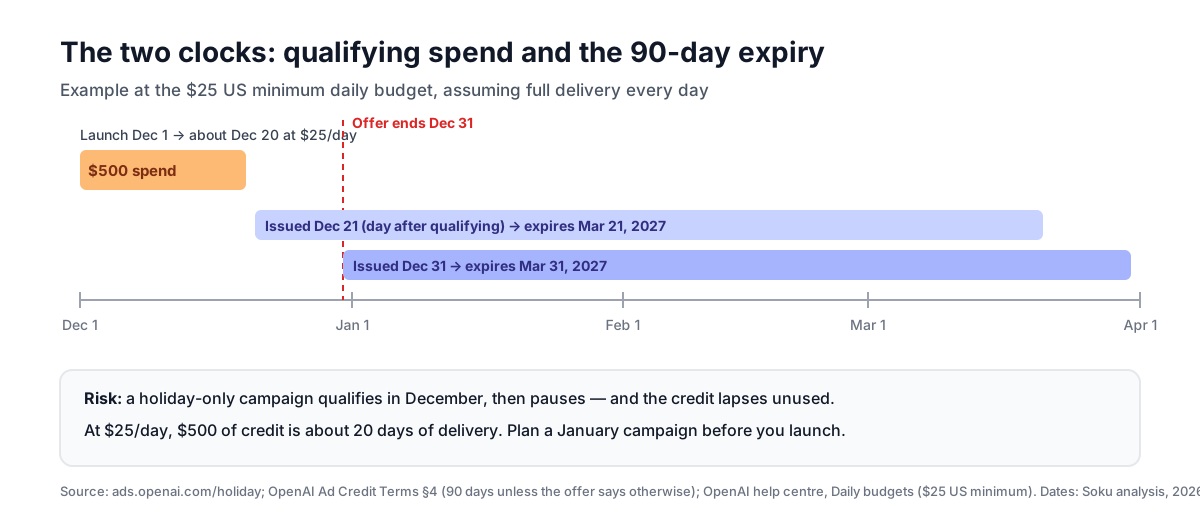
| Credit issued | Expires (90 days later) |
|---|---|
| December 1, 2026 | March 1, 2027 |
| December 15, 2026 | March 15, 2027 |
| December 21, 2026 | March 21, 2027 |
| December 31, 2026 | March 31, 2027 |
Soku analysis: the expiry is generous if you keep a campaign running. At the $25 US minimum, $500 of credit is about 20 days of delivery. The real risk is a holiday-only campaign: you spend $500 to qualify in December, the sale ends, you pause everything, and the credit expires unused in March. If you take the offer, plan a January campaign before you launch the December one.
The fine print that changes decisions
One account only
Eligible Fees are fees "for the account and Advertising Services specified in the applicable Offer", and the terms say Ad Credits are "nontransferable". OpenAI's Ads Manager account setup article lets eligible self-serve organisations create additional ad accounts.
Soku analysis: agencies and multi-brand teams should decide which account claims the offer before anyone launches, and run both the qualifying spend and the follow-up campaigns there. Spend in a sibling account does not help. If a partner runs campaigns for you, ask which account they sit in before you count on the credit. Our guide to running several ChatGPT Ads accounts covers how accounts are separated.
No stacking
The terms say Ad Credits "may not be combined with other credits, coupons, discounts, rebates, incentives, or makegoods". Section 7 adds that a credit does not entitle you to "price matching, retroactive true-ups, or credits or incentives offered to other customers."
Soku analysis: if a sales contact has offered you a different incentive, compare the two before claiming either. You will not get both, and a better offer appearing later does not upgrade yours.
Good standing, policy and revocation
To receive or use a credit, the account "must be in good standing, as determined by OpenAI in its sole discretion". Section 6 lets OpenAI "suspend, revoke, or void Ad Credits" for a violation of the Ad Credit Terms, the Advertising Terms, OpenAI's policies or the law, and for "nonpayment, fraud, misuse, unauthorized sale or transfer, issuance or application errors". You "remain responsible for Fees previously offset by any suspended, revoked, or voided Ad Credit."
Soku analysis: a policy problem can therefore cost more than the rejected ad. Credit already used can be clawed back as a bill. Before you launch, check your ads and landing pages against OpenAI's Ads Policies, and read our guide to ad review rejections. A failed card payment is also a risk: OpenAI's billing article says ads "may stop delivering until the billing issue is resolved", and nonpayment is a listed reason to revoke a credit.
No cash value, and OpenAI can change the offer
Ad Credits "are nonrefundable, nontransferable, have no cash value, cannot be redeemed for cash". OpenAI "may modify, suspend, or terminate an Offer or correct issuance or application errors", and "will not replace, reinstate, or pay for unused, expired, suspended, revoked, or voided Ad Credits."
Where to see the credit
The billing FAQ: "Select the correct ad account and open Billing → Activity. Review the relevant dates and look for Promotions entries."
It also warns against reading too much into an empty view: "A missing entry or zero remaining balance alone does not explain whether credit has not yet been issued, has been used, has expired, or is otherwise unavailable. Contact Support if your account's activity does not match the offer you received."
Soku analysis: keep a record of the date you claimed the offer, the account ID, and the date your spend passed $500. If the credit has not appeared after a reasonable wait, that is the information support will ask for. OpenAI's billing article lists [email protected] for billing questions.
Is it worth taking?
For a team that has not tried ChatGPT Ads, yes, provided you treat the $1,000 as a planned test and not a free trial you might abandon.
OpenAI's holiday page makes the case for the season with its own numbers. It says retail and ecommerce conversations account for "more than 1.7 billion prompts on ChatGPT each week", that US product-search activity on ChatGPT "rose 52% during the 2025 holiday season", and that during Cyber Five 2025 product-search activity rose 94% on Black Friday against matched weekdays. These are OpenAI's internal figures, footnoted as such on the page. We have no independent way to check them.
The same page lists two customer results: Newegg at "3× ROAS across campaigns and 7× during its two-week Fantastech Sale", and Loop Earplugs at "5.1× ROAS and a 3.7% post-click conversion rate across five campaigns". Both are OpenAI's case studies of advertisers it selected. They are not benchmarks for your account.
A test plan that uses the whole credit
Soku analysis, for a US advertiser starting in early December:
- Now: set up measurement first. OpenAI's holiday page tells advertisers to "complete your account, conversion measurement, and product catalog setup before holiday demand builds." Without the Pixel or Conversions API in place, $1,000 of delivery tells you about clicks and nothing about sales. Our conversion-optimized campaigns guide covers the prerequisites.
- Early December: launch the qualifying campaign at a budget that reaches $500 by about December 20, leaving room for slow delivery. $35 to $50 a day works for most teams.
- Watch spend, not the calendar. Spend lags 7 to 8 hours. Check the running total each morning.
- Before pausing anything: plan January. Keep at least one campaign running, or ready to launch, so the credit is used inside its 90 days.
- Judge the test on the full $1,000. Compare cost per result across both halves. The second half is cheaper to you, but the platform's performance is the same, and that is what you are deciding whether to buy more of.
If you are planning Black Friday and Cyber Monday campaigns at the same time, our Black Friday budget and pacing checklist covers the budget-week reset and pause lag that affect those dates.
What OpenAI does not say
- Whether the $500 of spend must be completed by December 31, or only the sign-up.
- How long after qualifying the credit is issued.
- Whether "new to ChatGPT ads" is judged per business, per organisation or per ad account.
- Whether the offer is available outside the US. The holiday page shows US-dollar amounts and US statistics but does not state a country restriction.
- How a partly used credit appears on individual invoices.
If your offer email or claim page answers any of these, it takes precedence over this guide.
Where Soku fits
Soku creates and edits standard ChatGPT Ads campaigns, ad groups and ads through a partner integration. Every change waits for your approval, campaigns start paused, and a managed launch only switches a campaign on once at least one ad has passed OpenAI's review. Soku's ChatGPT Ads Conversions campaigns use the conversion event setting ID that OpenAI expects, and since November 2 the Results column counts every conversion attributed to those campaigns. Soku reports ChatGPT Ads spend and results next to Meta, Google and TikTok, which is how you judge a $1,000 test against what the same money buys elsewhere.
Ad credits are applied by OpenAI to the account named in the offer, so check them in Ads Manager under Billing → Activity.
For the rest of the mechanics, see our guides to daily budget pacing, account spending limits, product feed campaigns and everything you need to know about ChatGPT Ads.
Sources
All read or captured on 2026-11-03 unless stated.
- OpenAI: ChatGPT Ads holiday page
- OpenAI: Ad Credit Terms (published July 29, 2026)
- OpenAI: Advertising Terms
- OpenAI: Ads Policies
- OpenAI help centre: Billing & Payment
- OpenAI help centre: Daily budgets
- OpenAI help centre: Ads Manager Account Setup
- OpenAI advertiser email of November 2, 2026: "Two days away: Your 2026 ChatGPT Ads Holiday Playbook". Not published online; quoted as an announcement, not as documentation.